



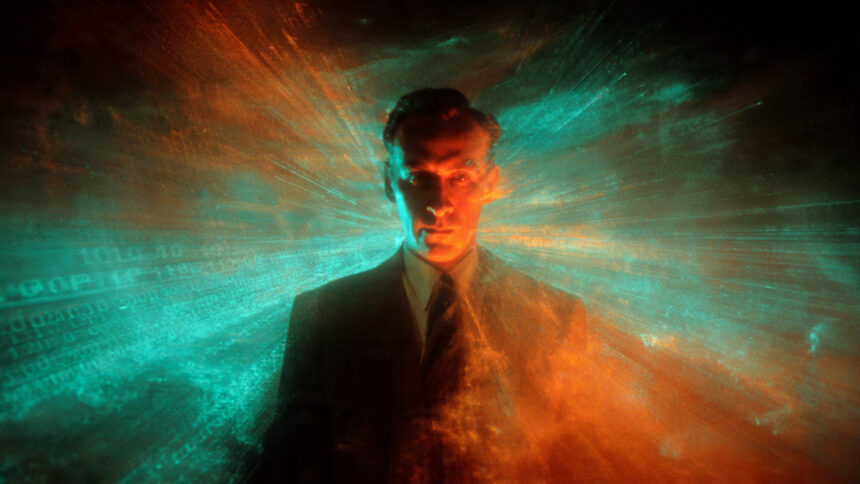
John Archibald Wheeler was a physicist who worked directly with Einstein and Niels Bohr and coined the term “black hole.” His idea, presented at a 1989 Santa Fe Institute conference and published the following year, was called “it from bit”: that physical reality has an informational basis, and that observation plays a genuine role in how quantum outcomes settle into definite states. That’s a serious, still-debated position in the philosophy of physics. What it isn’t is a claim that death is data deletion with no recovery, that consciousness is a processing error, or that a person’s identity has no more weight than a file on a drive.
Wheeler’s actual writing was searching and curious, not bleak. The bleakness belongs to a much later layer built on top of it.

What Wheeler Actually Said
The precise wording matters here, because Wheeler wrote it down himself. In his 1990 paper “Information, Physics, Quantum: The Search for Links,” he described it from bit this way: “every item of the physical world has at bottom, at a very deep bottom, in most instances, an immaterial source and explanation, that what we call reality arises in the last analysis from the posing of yes-no questions and the registering of equipment-evoked responses, in short, that all things physical are information-theoretic in origin and this is a participatory universe.”

Wheeler had spent decades on quantum foundations and general relativity by the time he proposed this, working through the anthropic principle and what he called genesis by observership, the idea that measurement plays an active role in how physical outcomes resolve. Physicist Anton Zeilinger later described Wheeler’s participatory universe as radical among his peers. It’s a serious idea from a major twentieth-century physicist. It’s also, on its own terms, an open philosophical question rather than a settled fact about the disposability of a human life.
Why Philosophers Have Pushed Back
Wheeler’s idea has drawn direct, credentialed criticism worth knowing about, since it complicates any confident retelling in either direction. Philosopher of science William Dembski has pointed to a circularity in the strongest version of the claim: if observers create reality through measurement, something has to explain where the observers themselves came from, since they can’t very well create the very reality that produced them. That’s a published objection, not a minor footnote, aimed at the specific idea that observation is the fundamental, generative act of the universe.

Other physicists distinguish more carefully between two separate claims Wheeler sometimes blurred together: that measurement requires information to resolve an outcome, a narrower, better-supported point, and that the thing being measured doesn’t exist until an observer looks at it, a much stronger and more contested claim. Serious physicists and philosophers still argue about exactly which version, if either, Wheeler’s own evidence actually supports.
The Holographic Principle and the Bekenstein Bound, Precisely
These are genuine, actively studied ideas in theoretical physics, worth describing on their own terms. The holographic principle, developed by physicists including Gerard ‘t Hooft and Leonard Susskind, proposes that the information describing a volume of space can be encoded on its boundary, a mathematical framework that has produced useful results in string theory and black hole physics.
The Bekenstein bound, named for physicist Jacob Bekenstein, sets a theoretical limit on how much information can be contained in a given region of space before its own gravity would collapse it into a black hole. The Planck length is a genuine, extremely small unit derived from fundamental constants, and some physicists have proposed that spacetime might be discrete at that scale rather than perfectly smooth, an active, unresolved research question.

None of these frameworks, as actually published and debated among physicists, describe the universe running out of resolution the way a video game world does, or your own perception as a lag artifact of biological hardware. They’re mathematical tools physicists use to study extreme conditions like black hole interiors, not settled descriptions of ordinary daily experience.

What Genetics and Memetics Actually Claim
Richard Dawkins’s 1976 concept of the “selfish gene” is an influential framework in evolutionary biology, and it’s worth stating precisely rather than stretched past its own claim. Dawkins argued genes are the unit natural selection acts most directly on, a still-discussed position in evolutionary theory, not a claim that people are hostages of their own DNA or that love and appetite are meaningless outputs of a replication script.

The related idea of memes, ideas competing for attention the way genes compete for reproduction, is a metaphor biologists and philosophers continue to debate the limits of, not a proof that human meaning is illusory. Susan Blackmore has written seriously about how far the meme metaphor can be pushed. Her work is a genuine academic position within a live debate, not confirmation that human choice is nothing but code executing.

Data Collection Deserves Its Own Grounding
The critique of corporate and governmental data harvesting is genuinely worth taking seriously as its own subject, with documented practices behind it: predictive advertising models, behavioral tracking, and data brokerage are established industries, studied by researchers in digital privacy and internet policy.
That’s a legitimate, well-founded concern about consent, power, and commercial incentive. It doesn’t require the physics of “it from bit” to explain or justify it, and folding a regulatory and ethical problem into a claim about the fundamental unreality of matter doesn’t make the privacy concern more urgent. It just borrows unrelated authority from physics to dress up an argument that already stands on its own terms.

What Wheeler Himself Actually Thought About Wonder
This is worth closing on, because Wheeler’s own recorded temperament runs directly against the bleakness attached to his ideas here. He described physics as an act of curiosity, not despair: “If you haven’t found something strange during the day, it hasn’t been much of a day.”

He spoke of humanity living “on an island surrounded by a sea of ignorance,” where growing knowledge only reveals more shoreline worth exploring, not less reason to care.
He was, by every account from colleagues who worked alongside him, a physicist animated by wonder at existence rather than resignation about its end. Reducing his actual life’s work to a script about inevitable, comfortless deletion misrepresents not just the philosophy but the man who spent his career finding new reasons to be curious about being alive at all.