


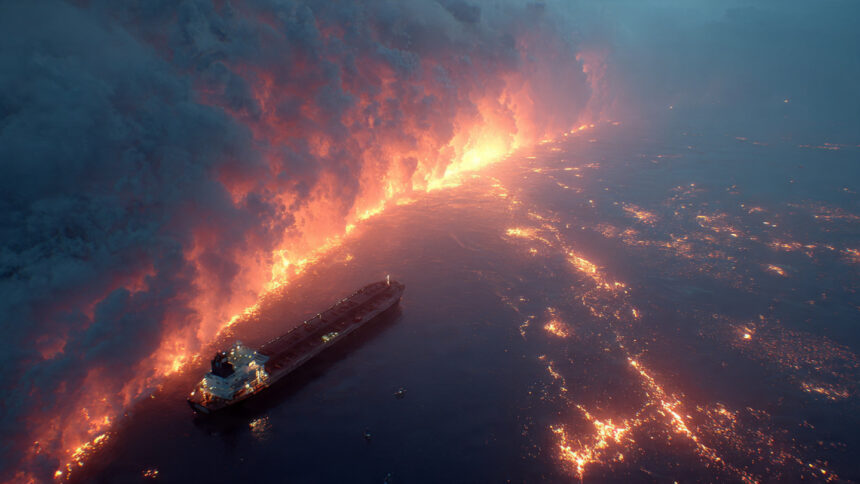
Before the Strait of Hormuz became the artery of the modern oil economy, it was already a place where empires fought, merchants became rich, kingdoms moved themselves onto islands, and religious traditions imagined wars at the edge of history. Today, roughly one-fifth of global petroleum-liquids consumption normally passes through this narrow waterway. In 2026, war and blockade have turned it into a live geopolitical pressure point again. But the strangest part of Hormuz is not that modern governments care about it. It is that for centuries, people have repeatedly loaded this same piece of geography with meanings far larger than its size.
The name itself is disputed. Its history is tangled between Persia, Arabia, Portugal and the Indian Ocean trading world. Jewish, Christian and Islamic traditions developed their own elaborate ideas about Persia, northern invaders, final wars and the end of the age. And modern interpreters have repeatedly looked at those old texts, looked at whichever empire or enemy frightened them most, and announced that the ancient pattern has finally arrived. That pattern is real. The prophecy is real as literature and religious history. What is not established is the leap from either one to the claim that the Strait of Hormuz itself was somehow destined to become the stage on which the end of the world would unfold.

Why Twenty-One Miles of Water Became an Imperial Prize
The strategic importance of Hormuz is not a product of the twentieth century. It is geography doing what geography does. The strait connects the Persian Gulf with the Gulf of Oman and the Arabian Sea, and at its narrowest it is only about 21 miles wide. Modern tankers pass through carefully defined shipping lanes, but the underlying fact is much older: for anyone moving between the Gulf and the wider Indian Ocean, there is no comparable maritime shortcut around this particular bottleneck. The modern oil economy made that fact extraordinarily expensive, but it did not create it.
There was already a major port called Hormuz on the Iranian mainland near present-day Minab before the famous island kingdom emerged. By the late thirteenth and early fourteenth centuries, political instability and attacks helped drive the rulers of Hormuz to move their court and much of their population offshore, eventually establishing the island port that became one of the great commercial centers of the medieval Indian Ocean. The move was not cosmetic. It placed the kingdom directly into the maritime network linking Persia, Arabia, India and East Africa, while giving its rulers leverage over ships and merchants passing through the Gulf. Encyclopaedia Iranica records Marco Polo visiting Hormuz twice, in 1272 and 1293, and describes the commercial importance of the port.
Hormuz became wealthy precisely because it sat where routes converged. Spices, pearls, silk, horses, metals and other commodities moved through its commercial sphere, and its rulers learned that controlling trade did not necessarily require producing the goods themselves. It required controlling the place where everyone else had to pass. The island kingdom was therefore a medieval version of the same strategic equation that still governs the strait today: a small geographic bottleneck can acquire disproportionate political power because everyone else has to calculate around it.
Portugal understood that equation almost immediately. Afonso de Albuquerque attacked Hormuz in September 1507, defeated its defenders and began constructing a fortress. The first occupation did not produce complete control, and Albuquerque returned in 1515 to establish Portuguese rule more firmly. The Portuguese did not simply erase the Hormuzi monarchy; the local rulers remained in place as nominal authorities under Portuguese dominance. Encyclopaedia Iranica describes Portuguese control as lasting for more than a century, while noting that the Hormuzi princes continued nominally in power and that the island remained commercially prosperous.
Portugal, Persia and the Ottoman Empire Fought Over the Same Chokepoint
The Portuguese conquest did not end the contest. It internationalized it. The Ottoman Empire had its own ambitions in the Indian Ocean and Persian Gulf, and in 1552 the Ottoman admiral and cartographer Piri Reis led a campaign against Portuguese positions. His forces reached Hormuz and bombarded the fortress, but they could not take it. The Ottoman expedition eventually withdrew after supplies became a problem, while the Portuguese reinforced the island. The campaign is a useful reminder that Hormuz was never merely a European colonial possession sitting passively at the edge of Asia. Ottoman, Persian and local interests were all entangled in the struggle over the waterway.
The decisive change came in the early seventeenth century. Safavid Persia wanted the Portuguese removed, and the English East India Company had its own reasons for weakening Portuguese dominance in the Gulf. In 1622, Persian forces working with English naval assistance captured Qeshm and Hormuz after a fierce campaign. The Portuguese fortress was destroyed, and much of its stone was subsequently reused at Bandar Abbas. The old imperial arrangement had collapsed, but the underlying strategic value of the location had not changed. A new power had simply taken control of the same geographical advantage.
That is the first great lesson of Hormuz. Empires change. Flags change. Religions change. Technologies change. The geography does not negotiate.
Then There Is the Name: Hormuz, Hormoz, Or Something Much Older?
This is where the historical record becomes much less comfortable. The name “Hormuz” has attracted an enormous amount of speculation because one prominent proposed connection leads directly into ancient Iranian religion. The Middle Persian forms Ohrmazd and Hormizd are forms associated with Ahura Mazda, the supreme deity of Zoroastrianism. Encyclopaedia Iranica documents the linguistic forms from Old Iranian and Avestan through Middle Persian and later Persian usage.
That does not, however, prove that the geographical name Hormuz was simply named after Ahura Mazda. Similar-looking names across languages are not enough to establish a complete etymological chain. Another proposed explanation connects the name to local terminology associated with a waterway and date palms. Other accounts effectively take the historical name of the kingdom as the starting point rather than assuming a direct theological origin. The important point is not to manufacture certainty where the scholarship does not provide it. There is a genuine linguistic question here, and “Hormuz comes from Ahura Mazda” is much stronger than the evidence allows if stated as an established fact.
And yet the possibility is fascinating for a different reason. Even when the etymology remains unresolved, the region really was embedded in the Iranian religious world. The history of the Persian Gulf is not a clean sequence in which ancient Zoroastrian Persia disappears and a completely unrelated medieval Hormuz suddenly appears. Languages, religions, dynasties and trading cultures overlapped for centuries. That makes the religious associations worth investigating without turning an uncertain etymology into a secret code.

The Ancient Texts Really Do Talk About a Final War
Now we reach the part of the story where it becomes very easy to go wrong.
Gog and Magog are not modern inventions. They appear in Ezekiel 38-39, where Gog is presented as a hostile figure associated with the land of Magog and a coalition that comes against Israel before divine judgment destroys the invading force. The imagery is unmistakably apocalyptic. It describes armies, invasion, catastrophe and a final confrontation. Later Christian tradition carried the names into Revelation, where Gog and Magog again appear in an eschatological conflict. Jewish, Christian and Islamic traditions subsequently developed the figures in different directions.
But the ancient text does not say, “Gog is Iran in the twenty-first century.” It does not identify the Strait of Hormuz. It does not give modern political borders. Those connections come later, through interpretation.
Josephus provides an early example of how this process worked. Writing in the first century, he associated Magog with the Scythians. Later interpreters made other identifications. Across late antiquity and the Middle Ages, Goths, Huns, Turks and other peoples could be fitted into the expanding imaginative geography of Gog and Magog. Scholars studying the tradition have documented how readily the identities shifted as different societies encountered new enemies.
That does not make the prophecies meaningless. It makes them historically interesting. The texts functioned partly as containers into which successive generations poured their own geopolitical fears. The names remained ancient while the enemies changed.
Persia Appears in Apocalyptic Tradition, But That Is Not the Same as a Prediction of Hormuz
Persia does occupy an important place in Jewish and later Christian religious imagination, and medieval Jewish literature contains substantial eschatological discussion involving Persia and other nations. Later mystical traditions, including material associated with the Zohar, developed elaborate visions of future conflict involving figures and peoples described through the symbolic categories of Ishmael and Edom. These traditions are real. They deserve to be studied as religious literature and as evidence for how Jewish communities imagined history and its possible end.
But there is a critical distinction between a text containing an image that resembles later history and a text demonstrably predicting that later history. The first is historical evidence. The second is an interpretive claim.
That distinction becomes especially important whenever modern political events are mapped backward onto ancient prophecy. Once Iran, Israel, America, Russia or another contemporary power enters the discussion, the temptation is to search ancient texts for names that can be made to fit. Sometimes the parallels are striking. Sometimes they are extraordinarily creative. But resemblance is not the same thing as prediction, and the fact that generations of interpreters have repeatedly made these identifications is itself part of the historical pattern.
Every Generation Finds Its Own Gog
This may be the most revealing part of the entire story. The identities change with extraordinary regularity.
Scythians were candidates. So were Goths. Huns became candidates. Turks became candidates. Mongols entered the imaginative geography of the end times. During the Crusading period, Muslim powers were frequently interpreted through apocalyptic frameworks. Later centuries produced their own candidates. The names changed because the world changed, while the underlying narrative remained available for reuse. Modern scholarship has repeatedly documented this process rather than treating it as an isolated feature of contemporary conspiracy culture.
The twentieth and twenty-first centuries have simply accelerated the mechanism. Wars, revolutions, the creation of Israel, the Iranian Revolution, the Gulf War, the Iraq War, the rise of ISIS and the recurring confrontations between Iran, Israel and the United States have all generated new attempts to identify contemporary events with ancient eschatological patterns. The fact that the same interpretive machinery activates during crisis does not prove that the interpretation is false. Nor does it prove that the interpretation is true. It tells us something more basic: humans reach for inherited narratives when reality becomes frighteningly difficult to understand.
Apocalyptic traditions are particularly powerful because they transform chaos into sequence. The enemy appears. The nations gather. The conflict escalates. Judgment arrives. History becomes a story with an ending. For people living through war, that can be psychologically and religiously compelling even when the historical evidence cannot establish that the ancient narrative was describing their particular century.
And Then 2026 Made Hormuz Impossible to Ignore
The modern significance of Hormuz is not symbolic. It is brutally physical. In 2024, an average of about 20 million barrels per day of petroleum liquids passed through the strait, roughly one-fifth of global petroleum-liquids consumption and more than one-quarter of seaborne oil trade. About one-fifth of global LNG trade also passed through it, much of that associated with Qatar. There are alternative pipelines, but their capacity can replace only part of the volumes normally moved by sea.
That makes the strait strategically important without invoking prophecy at all.
And in 2026, the old chokepoint logic became painfully visible again. The U.S.-Iran conflict has disrupted shipping for months, and the maritime traffic passing through Hormuz has fallen dramatically. Reuters reported in early September that only four commodity vessels crossed the strait on one day, compared with a ten-day average of about fifteen, while the broader conflict and U.S. blockade have severely reduced Iranian oil exports. Other reporting has documented repeated attacks, threats and military action around the waterway.
This is where the temptation to declare prophecy fulfilled becomes strongest. A real strategic chokepoint is under extraordinary pressure. Iran is involved. Israel and the United States are involved. Oil markets are reacting. Ships are being attacked. The strait itself has become part of the battlefield. Ancient traditions contain imagery about Persia, Israel, invading powers and a final conflict. The pieces appear to line up.
But that is precisely the moment when historical discipline matters most.
The Etymology Converges. The Prophecy Doesn’t Follow.
There is no need to exaggerate Hormuz to make it extraordinary.
It really is one of the world’s great maritime chokepoints. Its strategic importance predates the oil industry by centuries. A medieval kingdom became wealthy by exploiting the same geography that modern petroleum exporters depend upon. Portuguese, Persian and Ottoman forces fought over it. European merchants built their fortunes around it. The name itself carries a genuine unresolved linguistic history reaching into the Iranian past. Jewish, Christian and Islamic traditions developed elaborate stories about Persia, invading nations and the end of history. And in 2026, the waterway once again became a central piece of a major geopolitical confrontation.
All of those statements can be true at once.
What cannot be established from those facts alone is that the ancient texts were specifically predicting the present conflict, that Hormuz was secretly encoded into those texts, or that today’s war is therefore proof that an apocalyptic sequence has begun. History cannot verify a theological fulfillment claim in the same way it can verify a Portuguese fortress, a shipping route, an Ottoman campaign or a tanker crossing.
And perhaps that is the more unsettling story.
Hormuz does not need prophecy to become important. Geography already made it important. Human beings then layered empire onto geography, religion onto empire, mythology onto religion, and modern geopolitics onto all of it. The same twenty-one miles of water have been repeatedly transformed into whatever the surrounding age most urgently needed them to represent: a commercial prize, an imperial gateway, a Persian possession, a Portuguese fortress, an oil artery, a military target, or, in the eyes of some believers, a possible threshold to the end of history.
The water itself has never changed its mind.
We have.