



A note on terminology first: “Aryan” in this piece refers to its original historical-linguistic meaning, the Indo-Iranian peoples and their shared linguistic heritage, a term still used in Indo-European linguistics today, predating and distinct from its terrible later misuse.
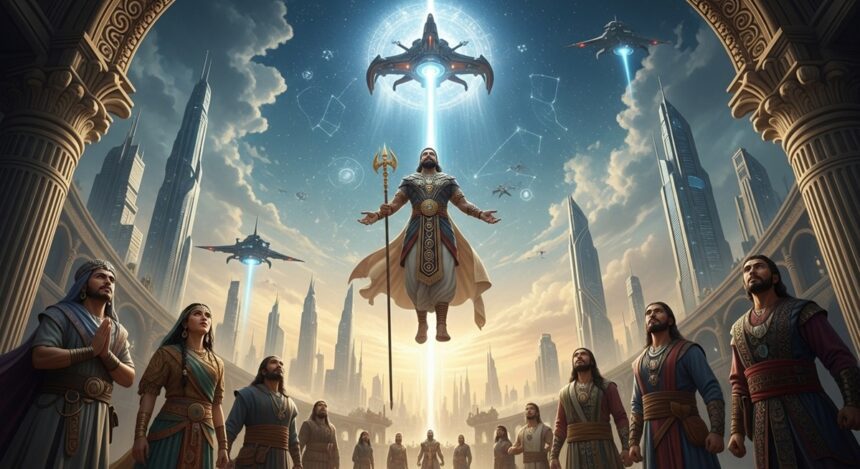
The idea of ancient gods returning to Earth has captivated human imagination for centuries. In the vast tapestry of mythology, Indo-Iranian cosmological traditions offer rich, cyclical concepts of time and renewal, worth understanding on their own accurate terms.
Ancient Indian Texts and Cosmic Cycles
Ancient Indian literature is literature exploring themes of cosmic cycles. The Vedas, Puranas, and epics like the Mahabharata really do describe divine interventions, and Historians confirm dating these narratives precisely remains difficult.
The “3044-Year Prophecy”
No source, ancient or modern, contains any verifiable version of the quote “It will take 3044 years when the gods will return for another round of domination.” This specific phrase has no traceable origin in any established translation of the Mahabharata, the Puranas, or any other ancient Indian text. It appears to have been constructed specifically to produce a 2044 date.
The dating of the Kurukshetra War itself, the war the Mahabharata describes, is genuinely, seriously contested among historians and Indologists, with proposed dates ranging from 3102 BCE, based on traditional astronomical calculation, to roughly 1400 BCE, to roughly 950 BCE, to as late as the 9th century BCE, based on archaeological and genealogical evidence. Historian Upinder Singh and other scholars note that whether the war occurred at all, in any historically verifiable sense, cannot be definitively proven or disproven. There is no single, agreed “1000 BCE” baseline for this calculation to begin from, making the entire 2044 date calculation doubly unfounded.

Traditional Hindu cosmology, well documented and worth understanding accurately, places Kali Yuga’s actual end far in the future, around 428,899 CE, with over 426,000 years remaining. The yuga cycle spans 432,000 years, and Texts like the Vishnu Purana describe a gradual decay before Kalki, Vishnu’s final avatar in this tradition, arrives to restore order and begin the golden Satya Yuga anew. No ancient source ties this to 2044.
Real Prophecies in the Puranas and Vedas
The Bhavishya Purana, meaning “Future Purana,” is one of eighteen major Puranas and does contain forecasts of social change within Hindu cosmological tradition. Vedic teachings, as discussed by scholars, describe a cyclical understanding of moral and spiritual conditions, offering hope through spiritual revival.

The Bhagavad Gita, part of the Mahabharata, does record Krishna’s promise: “Whenever there is a decline in righteousness and an upsurge in unrighteousness, O Arjuna, at that time I manifest myself on earth.” This accurately quoted verse reflects a cyclical theological view within Hindu tradition, without specifying any particular calendar date for its fulfillment.
Iranian Myths and Zoroastrian Eschatology
Zoroastrian tradition offers its own, rich vision of renewal. The Avesta, Zoroastrianism’s sacred scripture, speaks of ideas of cosmic restoration central to this ancient faith.
The Real Promise of Saoshyant
Central to Zoroastrian eschatology is Saoshyant, a prophesied future savior figure who will defeat evil and usher in Frashokereti, Scholars translate this as “the making wonderful” of the world. This theologically significant concept involves resurrecting the dead and a final purification, leading to eternal renewal under Ahura Mazda. No established Zoroastrian text specifies a mid-21st-century date. This is a later, unverifiable modern reinterpretation layered onto ancient theology.

Real Shared Indo-Iranian Heritage
The shared linguistic and cultural roots between India and Iran are well documented history. The term “Aryan” accurately denoted Indo-Iranian peoples in this original, historical-linguistic sense, with deities like Indra and Ahura Mazda reflecting confirmed common origins in comparative religious scholarship, legitimate academic territory entirely distinct from later, unrelated political misappropriation of the term.
The 2005 “Contactee” Claims
Claims of a 2005 individual communicating with “Aryan representatives from constellations” have no connection to any ancient text and no independent verification. These are modern, unverifiable claims belonging to contemporary UFO contactee culture, not ancient prophecy, and should be identified clearly as such rather than blended together with Hindu and Zoroastrian scripture.

The Vaimanika Shastra
The Vaimanika Shastra, describing vimana flying machines, is a real published text, but it is not an ancient one. Scholarship has established it was composed in the early 20th century, channeled by an individual named Pandit Subbaraya Shastry between 1918 and 1923, not translated from any ancient Sanskrit source. Aeronautical engineers at the Indian Institute of Science conducted a formal technical analysis in 1974 and concluded the described vehicles are aerodynamically non-functional and could not fly using the principles described. Comparing this modern, non-functional text to ancient technology or extraterrestrial visitation has no scholarly support.

Historians of science have confirmed George Lucas drew broadly on global mythology, including elements of Hindu and other traditions, when creating Star Wars, a well established creative influence. Robert Oppenheimer’s documented 1965 recollection of quoting the Bhagavad Gita, “Now I am become Death, the destroyer of worlds,” following the Trinity nuclear test is accurately recorded history, a reflection of how ancient text can carry weighty meaning across centuries, without requiring any claim that the text encodes literal advanced technology.
Comparative Mythology and Cyclical Time
It’s worth explaining why cyclical cosmology, the idea of ages of decline followed by renewal, recurs so consistently across independent ancient cultures worldwide, since this pattern is itself worth understanding accurately. Comparative religion scholars have identified remarkably similar cyclical age structures in ancient Greek tradition, including Hesiod’s documented “Ages of Man” concept describing Gold, Silver, Bronze, and Iron ages of progressive moral decline, in Aztec cosmology’s concept of successive “Suns” or world-ages, and in the Hindu and Zoroastrian traditions discussed throughout this piece. Anthropologists studying this recurring pattern generally attribute it to a shared human tendency to interpret observed moral and social change through cyclical, generational narrative structures, rather than evidence of a single shared ancient source or literal astronomical calendar linking these independent traditions together. This broader comparative context helps explain why Hindu and Zoroastrian cyclical cosmology feels intuitively similar to other world traditions, a pattern in human religious thought, without requiring any of these traditions to be secretly encoding a shared, precise, calculable modern date.
Central Asian History Worth Knowing Accurately
It’s worth adding accurate historical context on Central Asia’s significance, since the region does have substantial historical importance connecting Indian and Iranian civilizations, just not through prophecy. Historians have extensively studied Central Asia’s role as a crossroads of trade, culture, and religious exchange for millennia, particularly through the Silk Road trade networks that connected Indian, Persian, Chinese, and Mediterranean civilizations. Archaeological evidence confirms substantial cultural and linguistic exchange between Indo-Iranian peoples across this region going back thousands of years, the same shared heritage the term “Aryan” historically and accurately described. This substantial, well-documented history of cultural connection is significant and worth learning about on its own terms, considerably more historically grounded than any claim that the region is destined to become a governing center for a prophesied divine reunification.
Why Skepticism Toward Specific Dates Is Warranted
Historians studying prophecy and apocalyptic prediction note a recurring pattern: specific calendar dates attached to ancient cyclical cosmology, like the 2012 Maya date confusion, consistently fail to materialize as predicted, precisely because the underlying ancient traditions themselves were never actually describing a specific, calculable calendar date in the way modern reinterpretation claims. The Hindu and Zoroastrian traditions discussed here are rich, theological and philosophical systems concerned with cyclical renewal and moral order, worth engaging with seriously as religious philosophy, not as a coded countdown to a specific year.
Whether or not any specific date holds significance, these traditions remind us of shared human heritage and the enduring appeal of stories about renewal and moral restoration, worth appreciating accurately, on their own terms.