




The document does not use euphemism.
It describes a space-time modification weapon. In the next sentence it notes, as a point of comparison, that a hydrogen bomb would look like a firecracker by comparison. This language appears in an official Navy slide deck marked For Official Use Only that was released through the Freedom of Information Act and is now in the public domain. The document’s author is Dr. Salvatore Cezar Pais, an aerospace engineer employed by the Naval Air Warfare Center’s Aircraft Division. The document’s institutional context is a funded research program that received at minimum $466,810 from the Department of Defense between fiscal years 2017 and 2019.
This needs a direct correction before going any further, because it inverts what actually happened. The War Zone, whose reporting first surfaced these patents and is the primary source for this entire story, contacted physicists about the claims over a period of roughly two years, and every physicist they reached said there was no scientific reality to what one described as the “pseudo-scientific jargon” in Pais’s patents. Dr. Brian Collett, chair of the physics department at Hamilton College, reviewed the claims directly and said the work bore no more resemblance to quantum physics as he understood it than “The Force” from Star Wars, adding that the claims of macroscopic quantum coherence “seem dubious” and that he could not see how the described interaction could produce any of the claimed effects. The Navy’s Chief Technology Officer for Aviation, Dr. James Sheehy, did endorse the patents and did cite competitive Chinese development as justification, a real and documented fact. That endorsement happened despite the physics being widely regarded as unsupported, not because it was validated.
The records are public. The patents are public. The endorsement letter is public. The test results are public. What the program produced after the confirmed experiments is not public, which is a different kind of answer.
The Pais Patents
Dr. Salvatore Cezar Pais filed a series of patents with the United States Patent and Trademark Office through the Naval Air Warfare Center that describe a coherent family of technologies based on a single underlying physical principle he calls the Pais Effect.
The Pais Effect describes what happens when electrically charged matter, spanning from solid to plasma states, is subjected to controlled accelerated spin and accelerated vibration under rapid acceleration and deceleration transient conditions. Under these conditions, Pais claims, the rotating charged matter generates electromagnetic field intensities at a scale that creates what he describes as macroscopic quantum effects: the ability to influence the quantum vacuum, the baseline energy state of spacetime, in the immediate vicinity of the device.
The implications of controlling the quantum vacuum are not trivial. The vacuum is not empty. Quantum electrodynamics describes it as a sea of virtual particles constantly appearing and annihilating, generating a baseline energy density that pervades all of spacetime. Objects moving through space interact with this field. The Casimir effect, the measurable attractive force between two uncharged metal plates placed extremely close together, is a recorded quantum vacuum phenomenon that has been reproduced in laboratory conditions at multiple independent institutions.
Pais’s claims extend the Casimir effect’s implications to a scale and intensity that would allow a vehicle to effectively manipulate the quantum vacuum around itself. Three patents describe the practical applications.
Patent US10144532B2 describes an unconventional spacecraft propulsion system whose hull generates a quantum vacuum plasma field that allows the craft to create its own spacetime reference frame. A vehicle inside this field does not experience inertial resistance from its environment. It does not push against air or water. It does not generate the thermal signature that combustion or ion drives produce. It moves because the spacetime geometry around it has been modified to make its current position and its target position adjacent.
Patent US10187690B2 describes a plasma compression fusion device that uses high-intensity pulsed electromagnetic fields to compress plasma to fusion ignition conditions. The device, if functional, produces the energy required to operate the spacecraft propulsion system and generates, under extreme operating conditions, the space-time modification effects described in the FOUO slide deck.
Patent US10144533B2 describes the High Energy Electromagnetic Field Generator that produces the field intensities required for both the propulsion and fusion applications.
The three patents form a complete system: a generator, a power source, and a propulsion mechanism. The HEEMFG project funded experiments at NAWCAD to test the feasibility of the generator component. The tests were conducted. The results were recorded and released.
The Sheehy Letter
When patent applications are contested at the Patent and Trademark Office on grounds of implausibility, the Navy’s response to the examiner’s rejection of the Pais patents is one of the most significant items in the FOIA release.
Dr. James Sheehy, serving as Chief Technology Officer of the Naval Aviation Enterprise at the time, wrote a letter addressing the patent examiner’s rejection. The letter’s content establishes several things that the mainstream treatment of these patents has not fully absorbed.
Sheehy stated that the inventions were valuable to the Navy and aligned with the Navy’s research interests. This is the standard language of a patent endorsement. What follows is not standard.
Sheehy stated that China was developing similar technology. This is a statement from the Chief Technology Officer of Naval Aviation, made in an official patent filing, asserting that a foreign state adversary was pursuing technology based on the same physical principles as the Pais patents. This is not speculation about what China might eventually develop. It is a statement about what China was currently doing, made by an official with access to classified intelligence on Chinese defense research programs.
The statement implies that the Pais patents were not the Navy’s theoretical exploration of an interesting physicist’s ideas. They were a competitive response to a confirmed foreign development program. The technology being competed for was electromagnetic field manipulation at the scale required for spacetime modification.
The patent examiner’s rejection had been based on the grounds that the proposed inventions appeared to violate known physics. Sheehy’s letter did not dispute the physics. It asserted the Navy’s need to pursue the technology regardless of the current state of theoretical validation, on the grounds that an adversary was already pursuing it.
When a competitor is developing a technology, the official institutional response is not to wait for theoretical consensus. It is to develop it in parallel. Sheehy’s letter is the Navy’s official statement that this was the situation with space-time modification technology in the period 2017-2019.
The Physical Tests
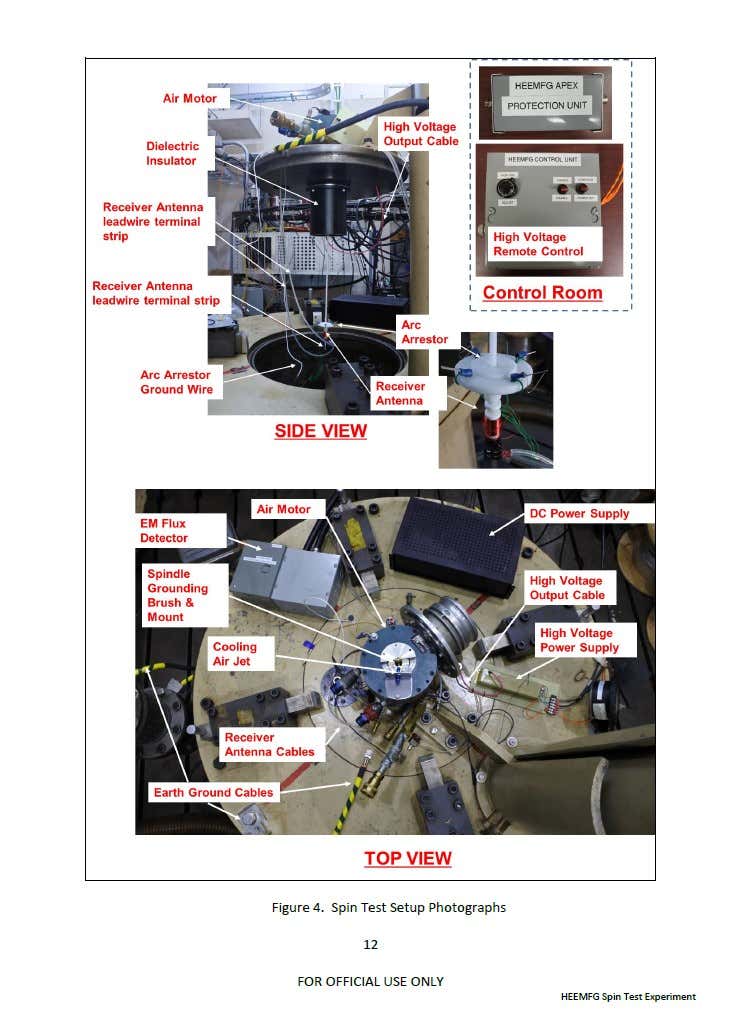
The FOIA documents include test reports from experiments conducted at NAWCAD facilities using laboratory versions of the HEEMFG concept. The tests used rotating capacitors to generate electromagnetic field intensities directed toward producing demonstrable macroscopic quantum effects.
The test results section of the report includes a detail that the summary treatments of these documents have noted without developing. Personnel who approached the test apparatus during operation reported experiencing an unusual sensation on the skin. The report notes that multiple prosaic explanations exist for this sensation: electromagnetic field interaction with cutaneous sensory neurons, static charge buildup, thermal effects from the electromagnetic field. These explanations are acknowledged.
The sensation’s presence in the test results is significant regardless of its cause. It indicates that the apparatus produced a detectable physical effect in the environment surrounding it at intensities sufficient to affect human sensory perception. A device that produces no detectable effect produces no sensation. The HEEMFG produced one.
Whether the sensation represents a prosaic electromagnetic field effect or the beginning of the quantum vacuum interaction that the Pais Effect predicts requires distinguishing between field intensities. The report does not specify the field intensity at which the sensation was observed. This parameter would determine whether the effect is consistent with conventional electromagnetic field physiology or requires the Pais Effect’s macroscopic quantum mechanism.
The experiments apparently continued. The documents indicate activity as recently as July 2019. The FOIA trail followed by The War Zone suggests that the program may have transitioned to DARPA, the ONR, or the Air Force Research Laboratory after the confirmed NAWCAD phase. FOIA requests regarding a possible transition have not produced responsive documents.
The Propulsion Connection
The unconventional spacecraft patent’s description of a vehicle that creates its own spacetime reference frame using quantum vacuum plasma fields describes, in engineering terms, the exact propulsion behavior that military pilots have been reporting in UAP encounters since at least 1947 and that the declassified UAP footage from the Nimitz and subsequent encounters shows directly.
A craft that has generated a quantum vacuum plasma field around itself does not push against the atmosphere. It does not push against water. It has no reaction mass to exhaust and no thermal signature from combustion. It can transition from atmospheric flight to underwater operation without changing its fundamental operating mode because it is not interacting with either medium in a conventional propulsion sense.
Its acceleration from hover to supersonic speed produces no G-force effects on its occupants because the acceleration is not applied to the craft and its contents from outside. The quantum vacuum field moves with the craft as its reference frame. The occupants are stationary relative to their local spacetime while the surrounding spacetime geometry moves relative to the larger environment.
Commander David Fravor described an object at the Nimitz encounter that went from hover to beyond visual range in under two seconds from a standing start with no visible propulsion exhaust. The pilots in the Tehran incident described an object that matched their speed precisely and decelerated instantly to their deceleration, then departed at a velocity that covered sixty miles in under two minutes. The radar operators aboard the USS Princeton tracked objects dropping from 80,000 feet to sea level in seconds.
These behaviors are inconsistent with every known propulsion system. They are consistent with a craft operating inside a quantum vacuum plasma field whose spacetime reference frame it controls independently of the surrounding environment.
Bob Lazar’s description of the gravity amplitude drive at S4, recorded in the piece on this site, describes a superficially similar outcome in different vocabulary: a device that generates gravity waves by amplifying the quantum-level gravitational properties of element 115. It is worth being precise about the difference in evidentiary weight between these two cases rather than treating them as equivalent. The Pais patents are real, filed documents with a documented institutional history, including the Navy’s own on-the-record statement that the underlying physics was never validated. Lazar’s claims about S4 and element 115 remain, as the library’s own dedicated piece on Area 51 notes, uncorroborated by any independently verified employment record, and no institution has confirmed the academic credentials he claims. Both describe conceptually similar propulsion outcomes. They are not comparable as evidence.
The Chinese Development
Sheehy’s reference to Chinese advances in similar technologies is not the only indication that the physical principles behind the Pais patents were under active investigation by multiple state actors in the period of the recorded experiments.
The National University of Defense Technology in China has published peer-reviewed papers on electromagnetic propulsion systems whose theoretical foundations overlap with the Pais Effect mechanism. The research into high-intensity pulsed electromagnetic field generation for aerospace applications at Chinese defense research institutions appears in the academic literature that Chinese researchers have published in English-language journals.
The publication of this research in open literature rather than classified channels could reflect genuine scientific openness, could reflect a decision that the theoretical foundations are sufficiently well established that publication does not provide adversary uplift, or could reflect a different kind of information management: making the research visible to indicate capability without revealing implementation details.
Sheehy’s statement that China was developing similar technology suggests that his assessment was based on intelligence beyond the open academic literature. The intelligence basis for his assessment has not been declassified.
What is on record is that the Navy’s Chief Technology Officer for Aviation considered the Chinese development significant enough to use it as a primary justification for endorsing patents that the Patent Office had rejected as physically implausible. The endorsement worked. The patents were granted. The experiments were funded. The tests were conducted.
What the Space-Time Modification Weapon Means
The FOUO slide deck’s description of the space-time modification weapon is the most extreme application in the Pais patent family and the one whose implications extend furthest beyond the propulsion and energy applications.
The language in the document describes conditions under which the plasma compression fusion device can lead to the development of a weapon that makes a hydrogen bomb look like a firecracker by comparison. The hydrogen bomb operates by fusing atomic nuclei, releasing the binding energy of nuclear matter. Its yield is measured in megatons of TNT equivalent. A weapon that makes this look like a firecracker operates at an energy scale that implies the direct manipulation of spacetime geometry rather than the release of nuclear binding energy.
The Alcubierre warp drive metric, published in 1994 in the peer-reviewed journal Classical and Quantum Gravity by theoretical physicist Miguel Alcubierre, demonstrated mathematically that the general theory of relativity permits spacetime geometries that would allow a bubble of flat spacetime to move at superluminal velocities relative to the surrounding spacetime. The paper did not propose a mechanism for creating such a geometry. It demonstrated that the geometry was permitted by the equations. Subsequent theoretical work has identified the energy requirements for Alcubierre’s geometry as prohibitively large but has not closed off the possibility of alternative geometries with lower energy requirements.
A device that directly manipulates spacetime geometry at the scale implied by the space-time modification weapon concept is not a bomb in the conventional sense. It is a device that changes the physical structure of reality in its vicinity. The consequences of deploying such a device in a conflict context are not analogous to nuclear weapons consequences. They are analogous to removing the physical laws that govern the target’s material existence.
The Navy wrote this into an official record. That record was released.
The Unanswered Question
The HEEMFG experiments were conducted. Personnel felt something when they approached the apparatus. The question of what happened to the program after 2019 has in fact been answered, and deserves to be reported rather than left hanging. In February 2021, NAWCAD’s communications director confirmed directly to The War Zone that the High Energy Electromagnetic Field Generator testing ran from October 2016 through September 2019 and concluded without proving the Pais Effect. The Navy’s own on-the-record statement is that the theoretical concept failed. Pais himself, contacted separately, maintained that his work “shall be proven correct one fine day,” but that is the inventor’s own continued conviction, not a Navy finding. FOIA requests about a transition to DARPA, ONR, or AFRL have not produced responsive documents, which is consistent with there being no such transition rather than evidence one is being concealed.
The Bob Lazar piece on this site covers a physicist describing reverse-engineering of craft using conceptually similar propulsion physics, though with the evidentiary caveats noted above. The Nimitz piece covers pilots describing craft performance consistent with propulsion this library discusses in terms of quantum vacuum plasma fields. The Tehran piece covers similar propulsion behavior from 1976.
Given that the Navy’s own confirmed statement is that the Pais Effect was never validated, the more straightforward reading is the mundane one: a single inventor with an unusual theory secured unusually generous institutional support, in part because of genuine strategic anxiety about a competitor, and the resulting experiments did not produce the predicted effect. That is a real story about how institutions can be persuaded to fund speculative research under competitive pressure. It is a different and better supported story than the patents representing confirmed reverse-engineered UAP propulsion.
The patents are filed. The experiments were conducted. The documents are public.
What the experiments produced after July 2019 is the question the FOIA trail has not yet reached.