



Seventy-four thousand years ago, a supervolcano in Sumatra unleashed one of the largest eruptions the Earth has experienced during the existence of our species. For years, scientists and science writers built a terrifying possibility around it: Toba triggered a prolonged volcanic winter, devastated ecosystems across continents, and reduced Homo sapiens to a tiny remnant population. The number most often repeated was fewer than 10,000 effective individuals. It became one of paleoanthropology’s great apocalypse stories, humanity passing through the eye of a needle while almost everything else disappeared. But the closer researchers have looked at the layers of ash, lake sediments, stone tools, climate records and population genetics, the less that story survives intact. Toba was genuinely catastrophic. The evidence that it nearly erased humanity is another matter entirely.
The distinction matters because this is not a case of scientists discovering that an eruption never happened, or that the volcano was somehow exaggerated. The mountain was real. The ash is real. The geological scar is real. What has changed is the proposed chain connecting that eruption to a human near-extinction: first a massive eruption, then a planet-wide volcanic winter, then ecological collapse, then famine, then a population bottleneck. Each link looked plausible when the hypothesis was assembled in the 1990s. Decades of archaeological, genetic and paleoclimate research have now tested those links independently, and the predicted catastrophe keeps failing to appear.
What Actually Happened at Toba
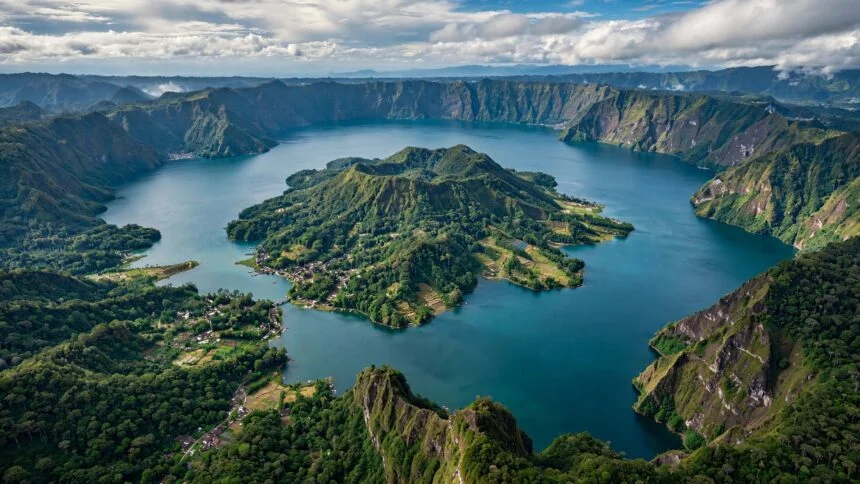
This part needs no embellishment, because the geology is already extraordinary. Around 74,000 years ago, the Toba caldera in northern Sumatra produced the Youngest Toba Tuff eruption, an enormous explosive event generally classified as a VEI-8 super-eruption and regarded as the largest explosive eruption of the Quaternary. Estimates of the erupted material run into the thousands of cubic kilometres, and the event left behind the vast Toba caldera that now contains Lake Toba. Its ash was carried thousands of kilometres from Sumatra and forms a distinctive geological marker across parts of the Indian Ocean basin and South Asia. Scientists can identify the eruption in archaeological and sedimentary records by the microscopic volcanic glass it left behind. In other words, there is nothing hypothetical about the mountain’s violence. The question is not whether Toba was capable of changing the environment. The question is what that change actually did to the humans who were alive when it happened.
Where the Human-Apocalypse Story Came From
The connection between Toba and a human near-extinction was not invented by journalists after the fact. It came from a serious scientific argument. In 1998, anthropologist Stanley Ambrose published a paper in the Journal of Human Evolution proposing that the Toba eruption could explain a late-Pleistocene population bottleneck. His model combined two observations that, at the time, appeared to fit together remarkably well: genetic evidence suggesting that ancestral human populations had passed through periods of extremely small effective population size, and geological and climatic evidence suggesting that Toba had injected enormous quantities of volcanic material into the atmosphere. If sulfur aerosols had produced several years of severe cooling, Ambrose argued, plant productivity could have collapsed, food supplies could have failed, and human populations could have crashed with them. The paper proposed that volcanic winter might have reduced modern human populations to fewer than 10,000 effective individuals and linked the event to subsequent population expansion and differentiation. It was a hypothesis, but it was a serious one, and because the geological event and the genetic signal appeared to occupy roughly the same broad slice of time, the story proved extraordinarily persuasive.
That distinction is important because the later history of the Toba theory is often told backwards. It’s easy to imagine that somebody simply looked at a gigantic volcano and invented a sensational explanation for human origins. That’s not what happened. The original argument was an attempt to make different scientific datasets speak to one another. The problem was that those datasets were operating at radically different resolutions. A genetic estimate of effective population size is not a head count of living humans. A climate model is not a thermometer buried beneath a 74,000-year-old archaeological layer. And the coincidence between two broad dates does not automatically mean that one caused the other. The Toba hypothesis was worth testing precisely because it made predictions that archaeology, genetics and paleoclimate science could eventually try to falsify.
Then the Evidence Started Going the Other Way
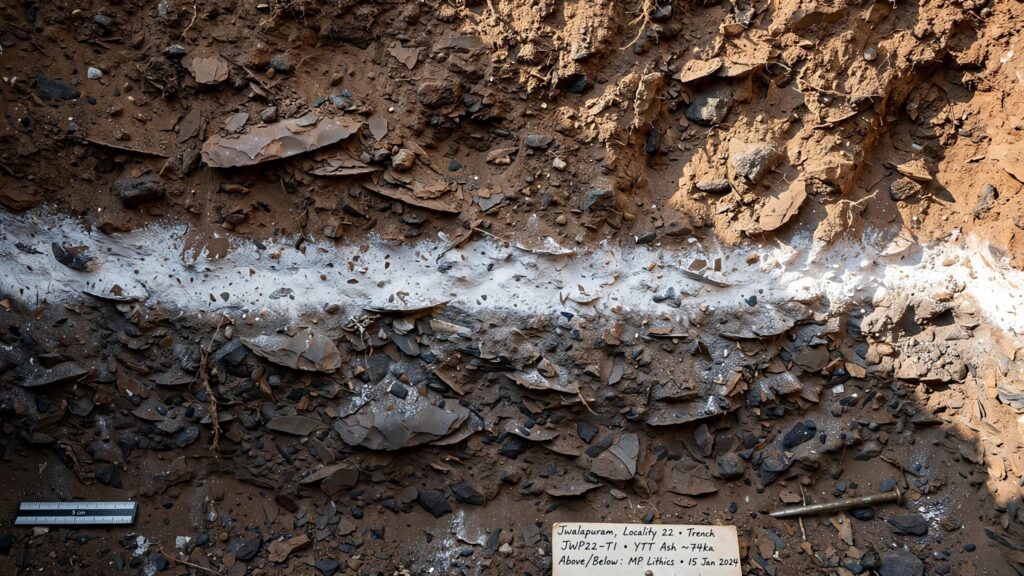
The archaeological record was among the first major problems for the catastrophe model. At Jwalapuram in southern India, Michael Petraglia and colleagues found Middle Palaeolithic technology both beneath and above the Toba ash, with no obvious technological break corresponding to the eruption. Later work at Dhaba in central India likewise documented long-term human occupation spanning the period of the eruption. The significance isn’t that every human in India somehow walked through the ashfall untouched. It’s that the archaeological record doesn’t show the kind of population replacement or cultural collapse that a continent-wide demographic disaster should make easier to detect. The people living in these landscapes before Toba did not simply vanish from the sequence, leaving a sterile archaeological horizon behind them. Human activity continued.
The same problem appeared in Africa, where the bottleneck should have been especially consequential if Toba really reduced the ancestral population of modern humans to a tiny remnant. Sediments from Lake Malawi produced a high-resolution environmental record spanning the eruption, and researchers found no dramatic volcanic-winter signature. There were ecological changes, including evidence for reduced precipitation and vegetation stress, but the record did not show the prolonged collapse predicted by the most extreme Toba scenario. The 2018 analysis concluded that the data provided no support for a six-year volcanic winter in eastern Africa or for a Toba-caused genetic bottleneck. More recent work has continued in the same direction. A 2026 high-resolution study of Lake Chala in eastern Africa, published in Science Advances, used sub-annual sediment layers precisely dated against Greenland ice cores to estimate that Toba-induced radiative cooling in the region could not have exceeded roughly 1°C, with the authors’ best estimate closer to 0.5°C. That doesn’t mean the eruption had zero environmental consequences. It means the extreme global-freezing scenario has become increasingly difficult to reconcile with actual regional records.
Then came perhaps the most awkward evidence of all for a simple global volcanic winter: the 2025 Jwalapuram study led by Gopesh Jha and colleagues. Instead of finding a prolonged freeze in the years immediately after the eruption, the researchers reconstructed a sequence involving an initial period of muted cooling followed by several years of regional warming and then environmental recovery. Their conclusion was not that Toba somehow warmed the entire planet, and that distinction matters. Their data are regional. What they demonstrated is that the local response in a landscape occupied by humans was considerably more complicated than the textbook image of a darkened, frozen world. The atmosphere doesn’t owe human narratives a simple response curve. A super-eruption can produce different climatic effects in different places, and the evidence from India doesn’t behave like the straightforward volcanic winter that the original bottleneck model required.
There’s an even more fundamental problem with the genetic side of the story. The old argument treated an apparent reduction in human genetic diversity as though it were a literal census showing that only a few thousand people survived a particular disaster. It was neither. Effective population size is a statistical reconstruction of how genetic variation behaves across generations, not a count of every man, woman and child alive at a given moment. As genome-wide studies became more sophisticated, the supposed bottleneck increasingly failed to line up cleanly with 74,000 years ago. Some analyses have pointed toward population structure and climate-driven demographic changes much earlier, around 150,000 to 130,000 years ago, while other work places important founder effects associated with later dispersals. The neat genetic cliff corresponding to the Toba eruption has never emerged with the clarity the popular story implies.
The Evidence From Africa Is Even Harder to Ignore
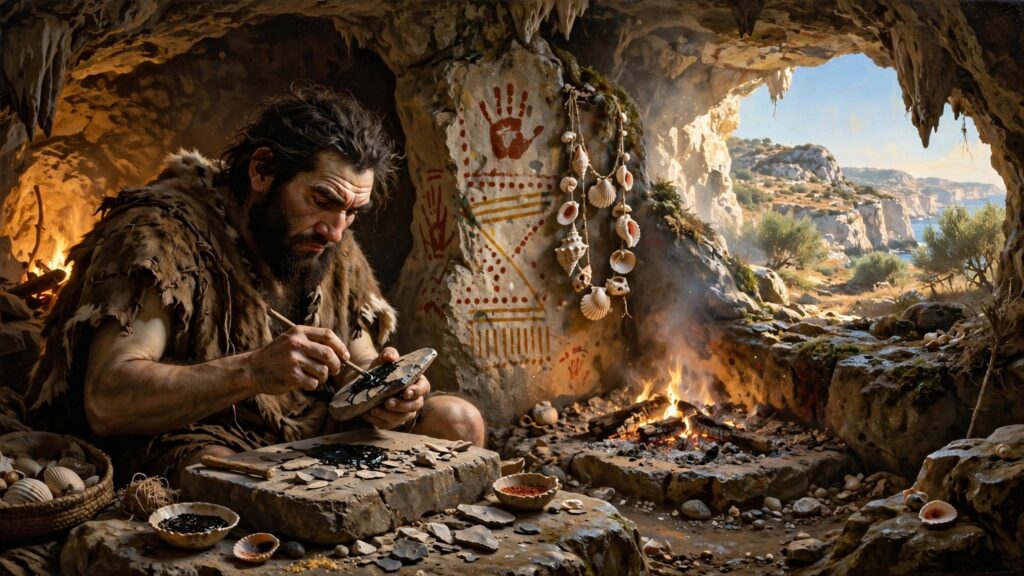
One of the most important developments has come from archaeological sites far from Sumatra, because if Toba really caused a species-level demographic crisis, evidence shouldn’t depend entirely on what happened in one unusually fortunate refuge. At Pinnacle Point and Vleesbaai on the South African coast, researchers identified microscopic volcanic glass chemically matching the Toba eruption in archaeological deposits dated to roughly 74,000 years ago. The crucial point is what surrounds that ash. Human occupation continues through the relevant layers, with stone tools, hearths, animal remains and other evidence of activity before and after the eruption. The record doesn’t look like a civilization suddenly extinguished and then repopulated by newcomers. It looks like people who experienced a major environmental event and continued living in the landscape.
And the evidence doesn’t stop at southern Africa. In 2024, research at Shinfa-Metema 1 in the Horn of Africa, led by Curtis Marean and colleagues and published in Nature, provided another remarkably direct test of the old story. The site preserves evidence of modern humans living through the Toba eruption itself, including stone-tool traditions and environmental adaptations associated with a period of aridity. Rather than revealing an abandoned landscape after a human catastrophe, the site records behavioural flexibility. The researchers proposed that seasonal waterways could have provided what they called “blue highways” through an otherwise increasingly dry landscape, allowing human groups to adapt rather than simply disappear. This extended a line of evidence that had already emerged from South Africa: humans were not passive passengers waiting for climate to decide whether they lived or died. They were remarkably adaptable animals capable of changing what they ate, where they moved and how they exploited landscapes.
This doesn’t prove that nobody died because of Toba. It would be absurd to claim that. A super-eruption capable of depositing ash across enormous distances would have produced local destruction, respiratory hazards, ecological disruption and serious stress for communities caught in the wrong place at the wrong time. Archaeology is also notoriously bad at measuring short-lived mortality. A population could suffer losses without leaving behind a clean archaeological signature, particularly when the people involved were mobile hunter-gatherers and when the relevant deposits are tens of thousands of years old. The evidence therefore doesn’t justify replacing one extreme claim with its opposite. What it does justify is something much more precise: there is no compelling evidence that Toba reduced humanity to a few thousand survivors or produced the species-wide demographic collapse once attributed to it.
Neanderthals Make the Catastrophe Story Even Harder to Sustain
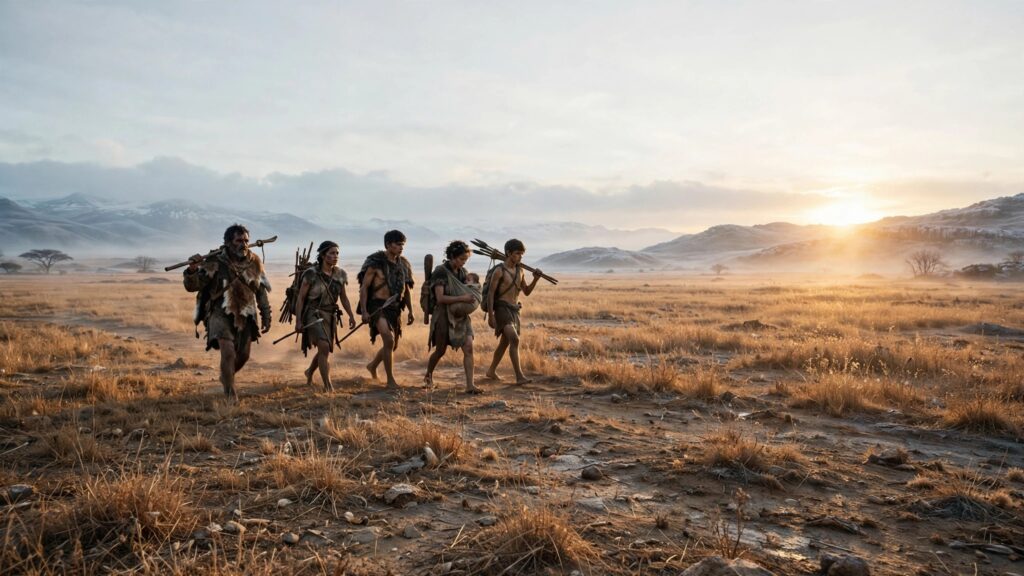
The same evidence forces a broader correction to the picture of Late Pleistocene humans and their relatives. Neanderthals were once portrayed as cognitively limited creatures who disappeared because they were simply inferior to Homo sapiens. The archaeological record no longer supports that caricature. Neanderthals produced sophisticated stone technologies, used adhesives, exploited pigments, cared for injured group members and left evidence of behaviour that has been interpreted as symbolic on several occasions. Perforated marine shells associated with Neanderthals in Iberia have been interpreted as ornaments, while the production of birch-bark tar required controlled heating and a multi-stage technological process. Some claims for Neanderthal cave art remain contested, particularly the dating of certain Spanish paintings, and they should remain contested. But the larger point survives those disputes: the cognitive and behavioural distance between Neanderthals and modern humans was never as simple as the old caricature suggested.
That matters for Toba because a genuine, severe, global volcanic winter shouldn’t have affected only one branch of the human family while leaving every other population looking suspiciously normal. Paleoanthropologist John Hawks has pointed out that Neanderthal populations in Europe don’t show an obvious demographic collapse corresponding to the eruption, while archaeological evidence from India, South Africa and elsewhere likewise fails to reveal the predicted global discontinuity. None of this means the eruption had no effect on Neanderthals or other hominins. It means the most dramatic version of the catastrophe hypothesis requires a level of synchronized ecological and demographic destruction that the surviving record doesn’t clearly show.
What the Population Numbers Actually Tell Us
There’s still a genuinely strange fact hiding underneath the failed Toba catastrophe story: humanity really did have a small effective population for much of its deep history, and our species really does possess unusually low genetic diversity compared with several other great apes. The mistake was assuming that these facts demanded one spectacular explanation. They don’t. Human populations were geographically fragmented, repeatedly expanded and contracted, became isolated and reunited, and lived through enormous climatic oscillations long before the Toba eruption. A statistical signal of small effective population size can emerge from population structure and reproductive patterns without requiring the entire species to have been reduced to a few thousand living bodies by a single disaster.
The emerging picture is therefore much less cinematic but considerably more interesting. Rather than a single volcano compressing humanity into a tiny genetic bottleneck and then releasing us into a new world, human populations appear to have remained relatively small and structured over very long periods, with climate, migration, local extinctions, founder effects and later expansions repeatedly reshaping the species. Some demographic contractions may have been severe. Some regions may have experienced genuine disasters. But there’s no need to force all of those processes into one moment in 74,000-year-old Sumatra. The human story was probably messier than that, and the mess is exactly what the evidence is beginning to reveal.
So Why Did Humans Expand?
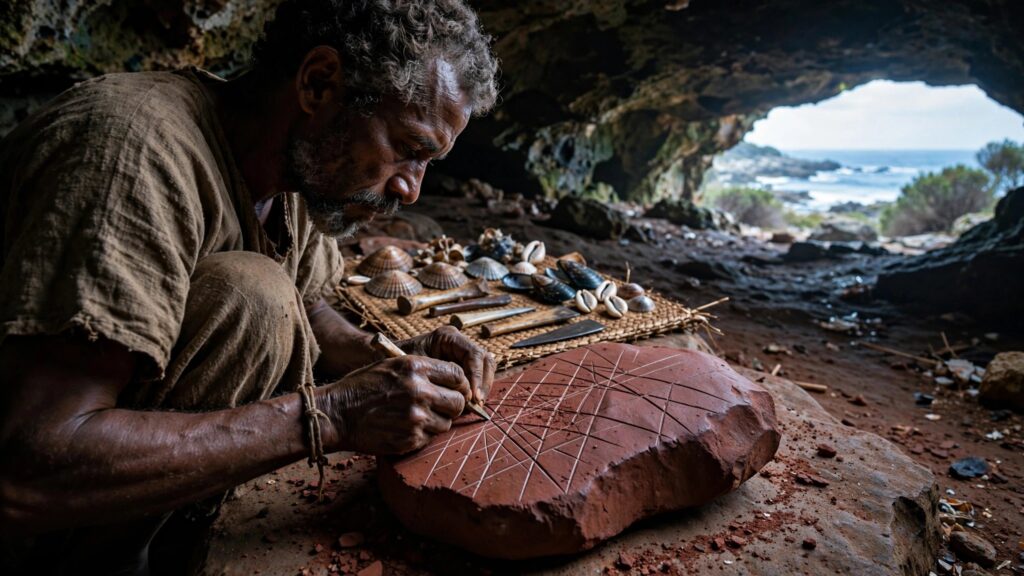
If Toba didn’t nearly wipe us out, another question immediately follows: why did Homo sapiens eventually become so extraordinarily widespread? The answer doesn’t appear to require an apocalypse. Archaeological evidence from sites such as Blombos Cave and Pinnacle Point shows increasingly sophisticated technological and social behaviour in southern Africa during the broader period surrounding the Toba eruption, including heat treatment of stone, advanced projectile technology, pigment use, personal ornaments and increasingly complex exploitation of coastal resources. These innovations didn’t appear because a volcano conveniently reset humanity. They developed within populations that were already experimenting, adapting and transmitting knowledge across generations.
The coastal record is especially revealing because it turns the old survival story on its head. Marine environments could provide unusually rich and predictable resources during periods when inland conditions became difficult, and social networks could allow people to move information, materials and techniques across considerable distances. Inland groups could exploit seasonal rivers and changing ecological niches. Different populations could survive the same climatic disturbance in radically different ways because geography, technology and social organization changed the risks they faced. That’s not the behaviour of a species waiting for a volcano to decide its fate. It’s the behaviour of a species whose greatest evolutionary advantage may have been its ability to improvise.
Toba Erupted. Human Continuity Is the Actual Finding.
The most satisfying part of the Toba story is therefore not that scientists “got it wrong.” Science is supposed to do exactly what happened here. A serious hypothesis was proposed from the evidence available at the time. Other researchers tested it. New archaeological sites appeared. Better genetic datasets became available. Lake sediments preserved increasingly fine-grained climate records. Microscopic volcanic glass allowed researchers to identify the eruption inside archaeological layers thousands of kilometres from Sumatra. And as those independent lines of evidence accumulated, the original explanation became harder and harder to defend. The hypothesis didn’t collapse because somebody found a better story. It weakened because the world itself refused to behave as the story predicted.
That’s the part popular history usually leaves out. The Toba eruption really was enormous. It really did alter environments. People really did live through it. Some undoubtedly suffered terribly, and some populations may have been affected far more severely than others. But the evidence now points away from the image of a frozen planet containing only a few thousand desperate survivors. Archaeological continuity appears where extinction should have left a gap. Human adaptation appears where collapse should have appeared. African climate records show limited rather than civilization-ending effects. And genetic research has failed to produce the clean 74,000-year bottleneck the popular narrative requires.
So the volcano did not erase humanity.
Something more interesting happened. Humanity endured one of the most violent eruptions of the Quaternary not as a single fragile population huddled beneath a global volcanic winter, but as scattered communities living in very different environments, responding to danger in very different ways. Some probably moved. Some changed what they ate. Some exploited coastlines. Some followed seasonal water. Some suffered. Some prospered. And together, across tens of thousands of years, those fragmented populations continued the long experiment that eventually produced us.
Toba was never a story about how close humanity came to disappearing. The evidence increasingly suggests it’s a story about how difficult humanity is to erase.