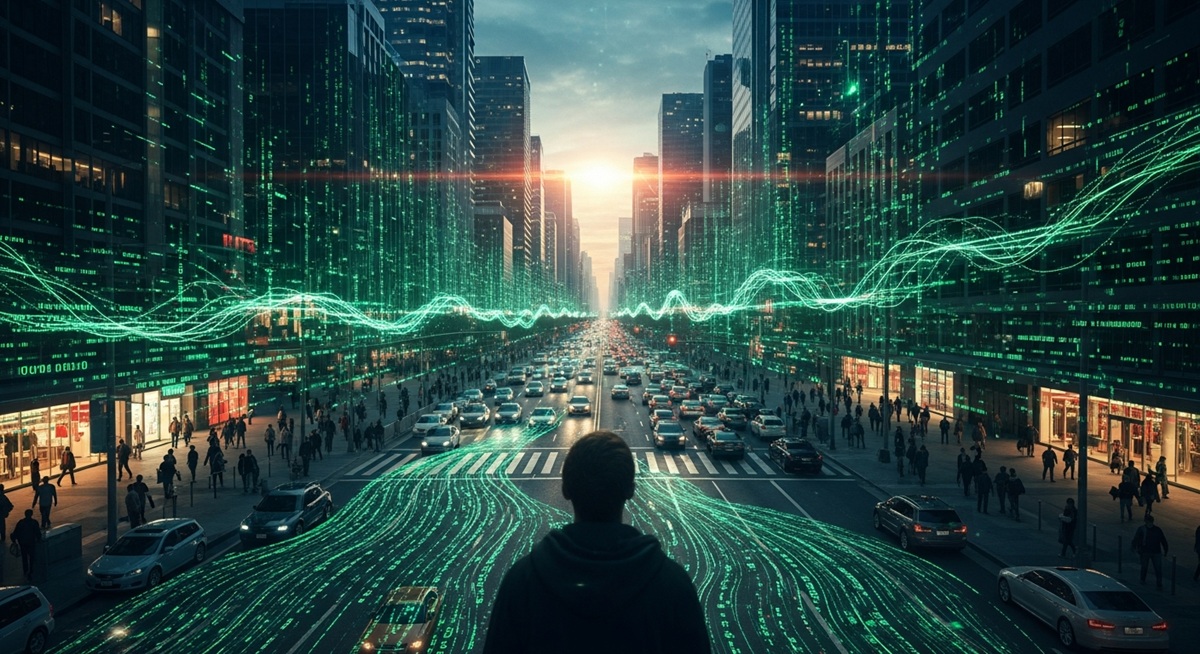
What if the world we experience is not the fundamental level of reality at all? The simulation hypothesis sounds like a premise borrowed from The Matrix, but its most influential modern formulation is not science fiction. In 2003, Oxford philosopher Nick Bostrom published a formal argument claiming that at least one of three extraordinary possibilities must be true: advanced civilizations almost always destroy themselves before reaching the technological maturity needed to run vast simulations. Civilizations that do reach that stage almost never choose to run them, or simulated observers eventually become so numerous that we should expect to be among them.
More than two decades later, astronomer David Kipping applied Bayesian reasoning to the problem and found odds hovering below 50 percent for the simulation hypothesis under his assumptions. And then there is the quote that has helped give the argument a theological aura: David Pearce called it “perhaps the first interesting argument for the existence of a Creator in 2000 years.” The quotation is real. The context changes what it means.
The Simulation Hypothesis Did Not Begin With The Matrix

The Matrix made simulated reality culturally unforgettable in 1999, but the philosophical argument usually associated with the simulation hypothesis came a few years later. Nick Bostrom’s paper, Are You Living in a Computer Simulation?, was published in The Philosophical Quarterly in 2003 after earlier versions had circulated. Its conclusion is often compressed into the much simpler claim that “we probably live in a simulation.” That is not actually what Bostrom’s argument establishes. His paper presents a trilemma: at least one of three propositions must be true. Either humanity is very unlikely to survive long enough to become “posthuman”, or posthuman civilizations are extremely unlikely to run large numbers of ancestor-simulations, or we are almost certainly living in a computer simulation. Bostrom’s argument does not identify which of those possibilities is true. That distinction is the entire point.
The machinery underneath the argument is more interesting than the popular version suggests. Bostrom begins with an assumption from philosophy of mind: that consciousness might be substrate-independent, meaning that a sufficiently detailed computational process could in principle generate conscious experience even if it ran on non-biological hardware rather than inside a biological brain. He then considers a future civilization with enormous computational resources, the same category of speculative future power examined in questions about whether advanced civilizations should interfere in human affairs. If such a civilization could create conscious ancestor-simulations and chose to run them in very large numbers, simulated human-type observers could eventually vastly outnumber biological observers in the original civilization. If we have no special reason to think we are members of the biological minority rather than the simulated majority, the statistical argument points toward the latter. The crucial word is if.
That makes the simulation argument fundamentally different from the popular image of someone discovering a strange pixel in the sky or finding a “glitch” in the laws of physics. Bostrom was not claiming to have detected a computational artifact. He was asking what follows from a particular chain of assumptions about consciousness, technological civilization, and the future abundance of simulated observers. The argument is therefore philosophical before it is physical. It becomes an argument about our reality only if its premises about minds and civilizations turn out to be applicable.
The distinction matters because the simulation hypothesis is often presented as though it were a scientific theory waiting for a decisive experiment. It is not presently in that position. A scientific theory normally makes predictions that can be confronted with observations in a way that could distinguish it from competing explanations. Bostrom’s original argument instead constructs a conditional probability problem: if certain technological and philosophical possibilities are real, then a particular conclusion follows. That does not make the argument meaningless. It makes the question much harder, and much more interesting, to settle.
Then Came the Famous “50/50” Calculation

In 2020, Columbia University astronomer David Kipping tried to put a Bayesian framework around Bostrom’s argument. His paper, A Bayesian Approach to the Simulation Argument, begins from a problem that the popular version of Bostrom’s argument tends to glide past: we do not actually know that ancestor-simulations are technically possible. That uncertainty cannot simply be ignored. Kipping therefore incorporated uncertainty about whether such simulations can exist at all, rather than treating their feasibility as a settled fact.
The resulting calculation is often reported as a 50/50 result, sometimes with the more precise shorthand of roughly 49.8 percent for being simulated and 50.2 percent for being in “base reality.” That makes for an irresistible headline: scientists have calculated that there is a coin-flip chance we are living in a simulation. But the headline is considerably stronger than the calculation. Kipping’s published conclusion is that, under his Bayesian model, the probability of being simulated is below 50 percent and approaches 50 percent in the limit of an arbitrarily large number of simulations. Those numbers are therefore outputs of a model with specified assumptions, not measurements extracted from the universe by an instrument.
There is an even more interesting twist. If humanity itself eventually creates enormous numbers of convincing ancestor-simulations containing conscious observers, the situation changes dramatically. That would provide evidence that one of the central technological premises of the simulation argument is actually possible. In Kipping’s framework, producing such simulations would push the probability strongly toward the simulation hypothesis. The paradox is almost beautiful: the strongest evidence we could ever produce for living in a simulation might be humanity’s own success at building simulated worlds.
The Famous Quote Needs Context
Now we reach the quotation that gives the simulation argument an almost theological glow. David Pearce, the British transhumanist philosopher, described Bostrom’s Simulation Argument as “perhaps the first interesting argument for the existence of a Creator in 2000 years.” The quotation is genuine. It appears on Bostrom’s own simulation-argument website. But the same page adds two words in parentheses immediately afterward: “exaggerated compliment.”
That parenthesis deserves more attention than it usually receives. Pearce was not delivering a neutral scientific assessment from outside the debate. He and Bostrom were intellectual collaborators in the transhumanist movement and co-founded the World Transhumanist Association. The line is therefore best understood as enthusiastic praise from a close philosophical colleague, not as an independent verdict that Bostrom had demonstrated the existence of God, a Creator, or even a simulation. Bostrom himself clearly regarded the wording as generous enough to require qualification. The quote is historically interesting precisely because it reveals how naturally the simulation argument invites theological interpretation, but it is not evidence for that interpretation.
And there is another subtle distinction. A simulator, if simulators exist, would not automatically be God in the traditional religious sense. A sufficiently advanced civilization could create a simulated universe while remaining finite, contingent, ignorant of its own ultimate origins, and embedded within a deeper physical reality. Bostrom himself explores this possibility: the beings running our simulation might resemble gods relative to us while still being inhabitants of a higher-level reality themselves. His argument therefore does not logically produce a traditional omnipotent Creator. It produces, at most, a strange hierarchy of possible realities in which “creator” and “created” become relative terms.
The Computational Problem Is Real, and Bostrom Already Knew It
One of the most persistent objections is also one of the easiest to misunderstand. Surely, critics argue, simulating an entire universe at quantum resolution would require an absurd amount of computation. If the simulator has to calculate every particle, every quantum fluctuation, every distant galaxy, and every microscopic event simultaneously, the machine would seemingly need to reproduce something comparable to the universe itself.
Interestingly, Bostrom’s original paper does not require that kind of brute-force rendering. He explicitly argues that a simulator would not necessarily need to represent every microscopic detail of the cosmos continuously. If the purpose were to create an environment indistinguishable from physical reality for its inhabitants, the simulation could in principle devote enormous resources to conscious observers and to the portions of the environment they actually interact with, while representing distant or unobserved regions more economically. He even discusses the possibility of generating microscopic detail when it becomes relevant to an observation.
That does not make the computational objection disappear. It changes the question. Instead of asking whether a simulator could reproduce every atom of the visible universe with perfect fidelity, we have to ask what resources are actually required to generate a world that is observationally indistinguishable from one. Those are very different computational problems. And they remain deeply speculative. A 2025 astrophysical preprint by Fabrizio Vazza argued that simulating our universe under physics like ours would require fantastically large energy and computational resources, concluding that such a scenario is effectively incompatible with known physical constraints. The work is a serious challenge to simple versions of the hypothesis, but it is not a final disproof of every conceivable simulation scenario, particularly because the simulator’s physics, computational architecture, and relationship to our universe are themselves unknown.
This is where the simulation debate repeatedly runs into the same wall: whenever an objection becomes specific, the hypothesis can often retreat into assumptions about a simulator whose capabilities and physical laws are unknown. That makes the hypothesis difficult to falsify. But the reverse is also true: the more freedom we give an imagined simulator, the less predictive the hypothesis becomes. A claim that can accommodate almost any observation risks becoming a metaphysical possibility rather than an empirical explanation.
A Very Old Question Wearing Very Modern Clothes
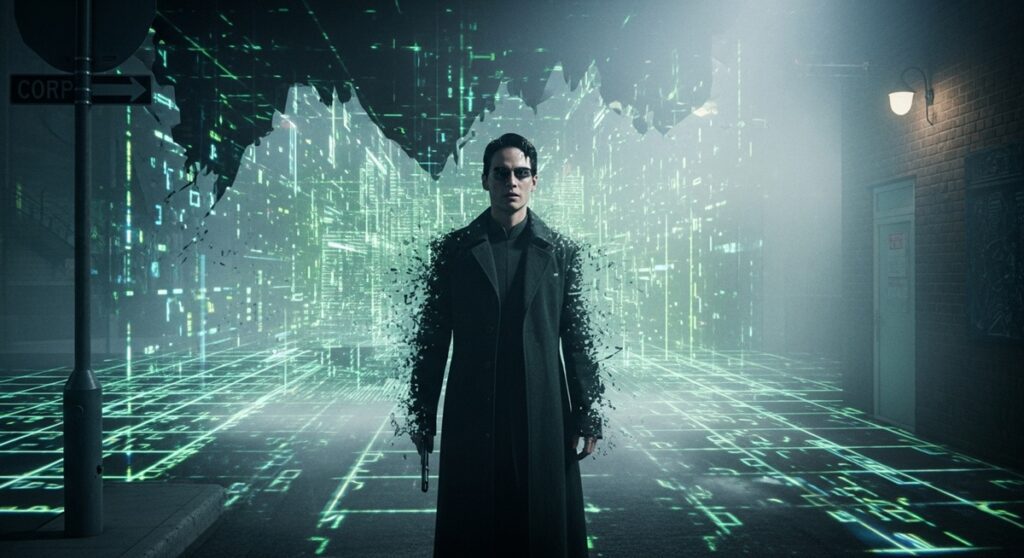
The strangest part of the simulation hypothesis may be that its central intuition is much older than computers. Long before anyone imagined processors, virtual environments, or artificial intelligence, philosophers and religious traditions were already asking whether ordinary experience represents the deepest level of reality. The resemblance should not be exaggerated. Maya in Hindu traditions, Buddhist teachings about illusion and emptiness, and Sufi reflections on the relation between the visible world and ultimate reality are not simply ancient versions of Bostrom’s argument, a distinction explored further in whether we are truly human, or living inside the dream of reality. They arise from different metaphysical systems and pursue different goals. Yet they share a recognizable structural intuition: what appears immediately real may not be the whole of what is real.
That distinction becomes especially important with the language of maya. In many Hindu philosophical contexts, maya is not simply “the universe is fake,” as modern internet summaries often imply. The concept is entangled with questions of appearance, ignorance, consciousness, and ultimate reality. Buddhism likewise cannot be reduced to the proposition that “we are inside a computer.” Its analysis of experience concerns impermanence, dependent arising, and the mistaken tendency to treat phenomena as possessing the kind of independent permanence we imagine them to have. The philosophical overlap with simulation thinking is therefore real, but it exists at the level of a question about appearances and ultimate reality, not at the level of a prediction about digital machinery.
There are striking technological metaphors in more recent spiritual writing as well. Paramahansa Yogananda used the motion picture as a metaphor for creation, describing human beings as actors within a cosmic drama and the visible world as something like a projected image. That analogy is fascinating precisely because it shows how metaphors of mediated reality evolve with technology. A nineteenth-century thinker might reach for a theatre. A twentieth-century mystic could reach for cinema. A twenty-first-century culture reaches for software, rendering engines, virtual reality, and artificial intelligence. The underlying philosophical question remains older than all of them: is the world as it appears the world as it ultimately is?
The Bhagavad Gita offers another revealing example, although again not a prediction of simulation technology, part of a broader tradition of altered-perception practices examined in Robert Monroe’s out-of-body experiences and the Toltec path to unfathomable freedom. In its famous comparison, the embodied self changes bodies as a person changes worn-out garments. The metaphor separates the enduring subject from the temporary form it inhabits. That is profoundly different from Bostrom’s argument, yet the resemblance in structure is hard to miss: the visible layer is not necessarily the deepest layer. The Gita is making a spiritual claim about the self and rebirth, Bostrom is making a probabilistic argument about observers and simulated worlds. Similar imagery does not make them the same theory.
And Then AI Started Building Worlds
There is, however, one modern development that makes the old comparison feel less metaphorical than it once did. On August 5, 2025, Google DeepMind announced Genie 3, a world model capable of generating dynamic environments from text prompts that users can navigate in real time. DeepMind describes it as producing interactive worlds at 24 frames per second, with consistency maintained for several minutes at 720p resolution. It is not remotely a simulation of a universe, and it does not demonstrate that reality itself is computational. But it is a remarkable technological reminder that “a machine generates a world from a description” has moved from speculative fiction into an actual research laboratory.
That distinction matters. Genie 3 does not create conscious universes. It does not establish substrate-independent consciousness. It does not prove that physical reality is information. It does not demonstrate that the laws of nature are computer code. What it demonstrates is something simultaneously more modest and more extraordinary: machines are becoming increasingly capable of constructing coherent, interactive environments that were not explicitly programmed scene by scene by a human designer. The distance between “computer-generated world” and “simulated reality” remains enormous, but the first category is becoming technologically ordinary in a way that would have seemed fantastical only a generation ago.
The Part That Still Cannot Be Settled
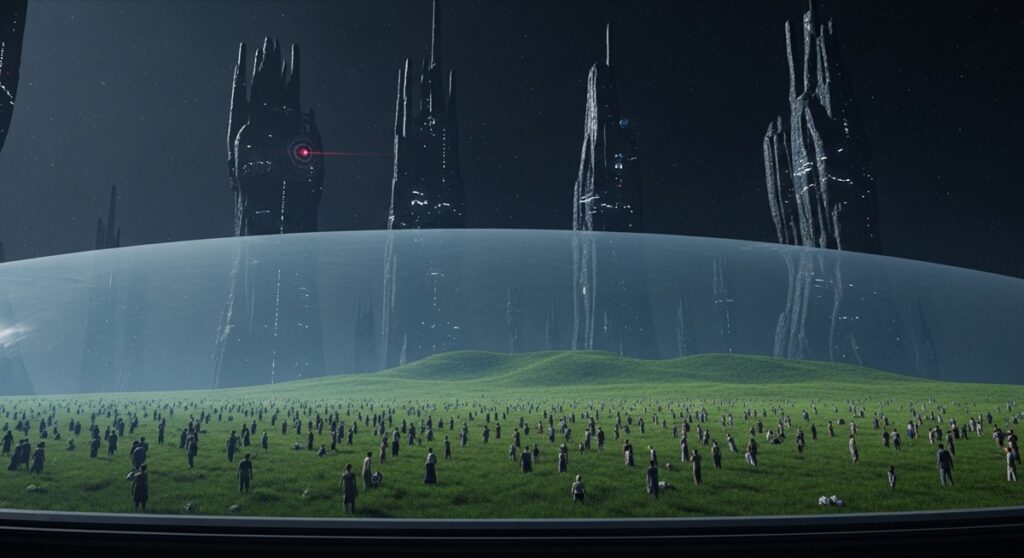
The simulation hypothesis survives because none of its major assumptions has been decisively settled. We do not know whether consciousness can be reproduced computationally. We do not know whether civilizations routinely survive long enough to become posthuman. We do not know whether advanced civilizations would want to create enormous populations of conscious ancestor-simulations. We do not know how much computation such a project would actually require. And we do not know whether there is some principled way to distinguish a simulated universe from a non-simulated one using observations available from inside the universe.
That last uncertainty is the most uncomfortable. If every possible observation can be explained either by ordinary physics or by a sufficiently powerful simulator choosing to reproduce ordinary physics, then the simulation hypothesis gains explanatory flexibility at the cost of predictive power. A mysterious result can be called a glitch, a non-mysterious result can be called evidence of a perfectly implemented simulation, the absence of evidence can be explained by the simulator hiding its tracks. At some point, the hypothesis becomes insulated from the very observations that would be needed to establish it.
None of this means the question is foolish. Quite the opposite. The simulation argument forces several enormous questions into the same room: what consciousness is, what makes an observer an observer, how probability should work when we reason about our own existence, whether minds can be instantiated in different physical substrates, what technological civilizations might eventually become, and whether “reality” has to mean the deepest physical layer rather than simply the world in which we actually live.
And perhaps that is where the famous Creator quote finally belongs. Pearce was not handing science a proof of God. Kipping was not measuring the probability of heaven. Bostrom was not reporting a glitch in the universe. The three arguments, taken together, do something subtler: they show how quickly a question about future computers becomes a question about consciousness, then a question about probability, then a question about metaphysics, and finally a question that religions have been asking for thousands of years, whether the reality we experience is the deepest reality there is.
The actual CIA Gateway Process document belongs in a similar evidentiary category: real, declassified, and inconclusive. A document can be authentic without proving the extraordinary interpretation later attached to it. The same principle applies here. Bostrom’s argument is real. Kipping’s calculation is real. Pearce’s quotation is real. None of them, by itself or together, establishes that our universe is a simulation.
And that may be the strangest conclusion of all. The simulation hypothesis does not become more interesting when we pretend it has been proved. It becomes more interesting when we see exactly how much remains unknown. We may live in a simulation. We may not. We may eventually build simulations ourselves and discover that the question was pointed in the wrong direction all along. Or we may discover that consciousness cannot be copied, that civilizations rarely survive long enough to try, or that the computational demands make simulated universes physically impossible.
For now, the universe has given us no loading screen, no hidden developer console, and no definitive line of code. What it has given us is something more difficult: a reality that is intelligible enough to invite explanation, mysterious enough to resist final explanation, and strange enough that an argument written by a philosopher in 2003 can still make us wonder whether the world in front of our eyes is the world underneath everything, or merely the one we happen to inhabit.