





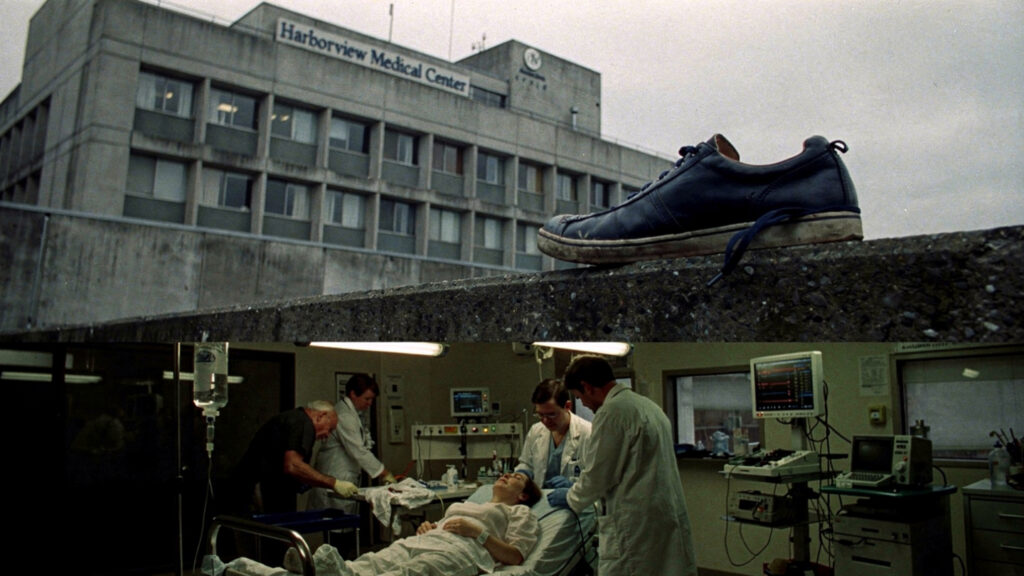
The case that established the evidentiary standard for the near-death experience research field involves a woman, identified in the published literature as Maria, who was resuscitated following a cardiac arrest at Harborview Medical Center in Seattle in the 1970s. During the resuscitation she had no measurable brain activity. After she was revived she told her social worker, Kimberly Clark Sharp, that she had left her body and floated upward through the hospital building until she found herself outside on a ledge of the building’s north side where she had observed a tennis shoe.
She described the shoe in detail: it was a man’s shoe, dark blue, worn at the little toe area, with the lace tucked under the heel. She said it was on a ledge on a side of the building. She could not have seen it from her hospital room. She could not have seen it from any location accessible to a patient in her condition. She had been in cardiac arrest.
Clark Sharp went outside after the conversation, found the ledge, and found the shoe. It matched Maria’s description in every detail that was verifiable, including the worn area and the tucked lace.
The shoe is not in a controlled experimental setting. The case is anecdotal, a single witness describing a single event to a single researcher, and the chain of verification, Clark Sharp finding the shoe after Maria described it, appears in Clark Sharp’s account rather than in an independent observer’s contemporaneous record. These are real evidentiary limitations. They do not change the nature of the claim: a patient in verified cardiac arrest described a physical object in a location with physical characteristics that were subsequently confirmed.
This is the structural template for what the near-death experience research tradition calls veridical perception during cardiac arrest. The Maria case is the most famous. It is not the most rigorously documented. The most rigorously documented cases come from a different research tradition that developed thirty years later.
Pim van Lommel and the Lancet Study
In 2001, the medical journal The Lancet published a paper by Dutch cardiologist Pim van Lommel and colleagues whose methodological design addressed the evidentiary problems that the Maria case and similar anecdotal reports presented.
Van Lommel’s study was prospective rather than retrospective. Rather than collecting accounts from people who sought out NDE researchers after having anomalous experiences, he enrolled every patient who was successfully resuscitated following cardiac arrest at ten Dutch hospitals over a four-year period. The enrollment was complete: every successfully resuscitated patient who was conscious enough to be interviewed within a few days of resuscitation was included. The methodology prevented the selection bias that retrospective collection of self-reported NDE accounts inevitably produces.
Over the four-year period, 344 consecutive cardiac arrest survivors were enrolled and interviewed. Of these, 62, approximately 18 percent, reported some form of NDE, and 41 of the 62, approximately 12 percent of the total sample, reported a core NDE with multiple characteristic elements. The elements that van Lommel coded for, using a validated NDE scale developed by Kenneth Ring, included awareness of being dead, positive emotions, out-of-body experience, moving through a tunnel, communicating with light, observation of colors, observation of a celestial landscape, meeting deceased persons, life review, and the presence of a border or boundary.
The prospective design allowed van Lommel to compare the 18 percent who reported NDE against the 82 percent who did not, asking the question that the NDE research field had not previously been able to answer systematically: what distinguishes the patients who have NDEs from those who do not?
The findings were unexpected and have driven the subsequent theoretical debate. None of the medical variables that would be expected to predict NDE occurrence if the experience is a product of cerebral anoxia, the duration of cardiac arrest, the degree of oxygen deprivation, the medications used in resuscitation, showed a significant relationship to NDE occurrence. The patients who had the most prolonged cardiac arrests and the deepest physiological insult were not more likely to report NDE than those who had shorter arrests.
The one variable that did predict NDE occurrence was the most provocative finding in the study: patients who had experienced a previous NDE were more likely to experience another one. This finding is inconsistent with every physiological model of NDE as a product of a brain state during oxygen deprivation, because physiological states produced by anoxia do not reliably recur based on prior experience of the same state.
Van Lommel’s conclusion in the published paper was careful and specific: the data is inconsistent with the hypothesis that NDE is produced by cerebral anoxia or by any of the other physiological mechanisms that have been proposed as explanations. The paper explicitly stated that the occurrence of NDE during a period of flatline EEG, verified absence of measurable cortical activity, challenges the conventional model of consciousness as a product of brain activity.
The Lancet is one of the oldest and most prestigious medical journals in the world. Van Lommel’s paper passed peer review at that journal. Its findings have not been formally refuted in the peer-reviewed literature. The theoretical challenge it presents to the conventional neuroscientific account of consciousness has not been resolved.
The AWARE Study
Sam Parnia is a British-American critical care physician whose research career has been specifically organized around the question that the van Lommel study raised: if patients are having experiences during verified periods of no measurable brain activity, is there any way to design a study that could provide objective evidence of the out-of-body perception component of those experiences?
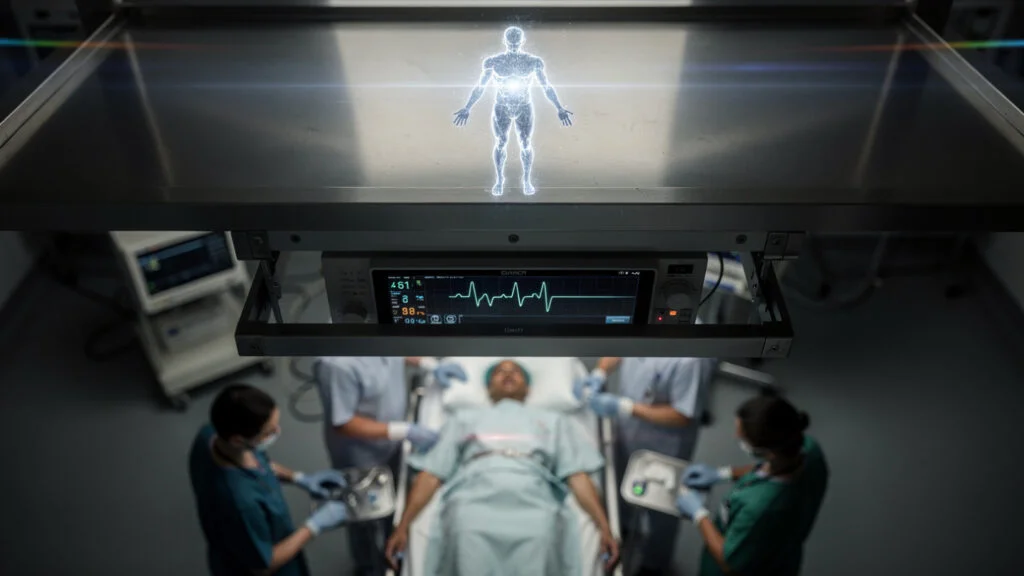
Parnia’s methodological innovation was the placement of visual targets in cardiac arrest resuscitation areas at positions that would only be visible from above, from the ceiling, specifically from the vantage point that NDE patients typically describe occupying during out-of-body experiences. The targets were images placed on elevated shelves, their content known to the study staff but not to the patients, positioned so that a person lying on the resuscitation table or standing anywhere in the room at floor level could not see them. A person hovering near the ceiling during a cardiac arrest resuscitation, if such a thing were occurring, would be positioned to see them.
The AWARE study, Awareness during REsuscitation, ran at fifteen hospitals in the United Kingdom, United States, and Austria between 2008 and 2012. Results were published in the journal Resuscitation in 2014. The study enrolled 2,060 cardiac arrest events. Of the 330 survivors who were conscious enough to be interviewed, 140 reported some form of awareness during cardiac arrest, and 39 percent of those reported feelings consistent with NDE phenomenology.
The finding that the AWARE study’s design was built to produce, a cardiac arrest survivor accurately describing the content of a visual target placed at ceiling height in the resuscitation area, occurred in one case out of the 2,060 enrolled events. One patient accurately described the content and location of a visual display unit visible only from the ceiling during the resuscitation. This patient’s cardiac arrest was verified by EEG monitoring as occurring during a period of no measurable brain activity.
One confirmed case out of 2,060 events is a limited result by the standards of the study’s original design ambitions. Parnia’s published interpretation was appropriately cautious: the single confirmed case is insufficient to draw broad conclusions but is the first objectively verified instance of accurate visual perception during a verified period of no measurable brain activity in a controlled research setting.
The methodological limitations of the AWARE study are real and acknowledged by Parnia in the published paper. Many of the resuscitation areas did not have visual targets installed because of logistical difficulties. Many cardiac arrest patients did not survive or were not in a condition to be interviewed. The study was not designed to capture every potential veridical perception event, only those that could be verified against the visual target design.
Parnia has subsequently launched a second phase of the study with improved methodology and a larger target installation rate. The results of AWARE II have not been fully published as of the knowledge cutoff for this library’s research.
Kenneth Ring and the Systematic Research
Kenneth Ring is a psychologist at the University of Connecticut who has spent four decades systematically studying near-death experiences and whose contributions to the field’s methodological development span his published work including Life at Death in 1980, Heading Toward Omega in 1984, and Mindsight in 1999.
Ring’s contribution to the evidentiary base is his systematic study of near-death experiences in a population whose case represents the strongest possible challenge to the sensory explanation for NDE visual content: blind individuals.
In Mindsight, Ring and collaborator Sharon Cooper recorded interviews with 31 blind individuals who had experienced near-death experiences or out-of-body experiences. Of these, 80 percent reported visual perception during their NDE or OBE. This is the finding whose implications the conventional neuroscientific explanation for NDE has the most difficulty accommodating.
The standard explanations for NDE visual content, cerebral anoxia producing random firing in visual cortex, the brain’s dying generation of visual imagery from stored memory, temporal lobe activation producing visual hallucination, all require a functional visual system as their mechanism. Individuals blind from birth have no visual memories to generate imagery from. Their visual cortex does not process visual information in the ordinary way. The standard mechanisms cannot produce accurate visual perception in congenitally blind individuals.
Ring’s documented cases include individuals blind from birth who described visual elements of their NDE with accuracy. One case, documented in detail in Mindsight, involves a woman blind from birth who described seeing the color of a nurse’s fingernail polish during an NDE associated with a medical emergency, a detail subsequently confirmed by the nurse involved.
A congenitally blind person who has never experienced color vision describing the color of fingernail polish seen during a period of cardiac-arrest-adjacent consciousness is a case that the conventional neuroscientific explanation for NDE visual content does not accommodate without invoking mechanisms whose operation in the congenitally blind has not been established.
The Neuroscience of the Flatline
The conventional neuroscientific framework for consciousness treats conscious experience as a product of patterns of electrochemical activity in the cerebral cortex. This framework is supported by an enormous body of evidence: cortical regions produce conscious experiences when stimulated, damage to cortical regions eliminates conscious capacities, and the relationship between brain state and conscious state is correlated across every experimental paradigm that has been applied to the question.
The challenge that NDE research presents to this framework is not a challenge to the correlation between brain activity and ordinary conscious experience. It is a challenge to the inference that consciousness requires ongoing cortical activity, drawn from the cases where conscious experience appears to be occurring during verified periods of flatline EEG.
Cardiac arrest produces cessation of the heart’s pumping action. Without cerebral blood flow, the brain’s oxygen supply is depleted within seconds. EEG activity, the electrical signal of cortical neural activity, ceases within fifteen to thirty seconds of cardiac arrest. This cessation is measurable, verifiable, and consistent: a cardiac arrest patient who has flatline EEG has no measurable cortical activity of the kind that the conventional model associates with conscious experience.
The NDE cases that Van Lommel’s study, the AWARE study, and the Ring studies record are cases where patients report conscious experience during this period. The experiential content they report, the out-of-body perspective, the observation of events in the resuscitation room, the encounter with deceased relatives, the life review, is not the random fragmentary experience that the dying brain hypothesis would predict. It is organized, coherent, and in the verified veridical cases, accurate.
The mainstream neuroscience response to the NDE challenge has been consistent: proposing mechanisms that could produce the reported experiences without requiring consciousness outside the brain. The mechanisms proposed include residual cortical activity below EEG detection threshold, reanimation during the recovery phase before the patient’s memory consolidation was complete, temporal lobe seizure activity during oxygen deprivation, and DMT release from the pineal gland during cardiac stress.
Each of these mechanisms is real and plausible for some aspects of NDE phenomenology. None of them accounts for the veridical perception cases without invoking additional assumptions. The residual activity hypothesis requires accepting that the EEG is failing to detect activity sufficient to produce organized conscious experience. The reanimation hypothesis requires that the experiences occur during the recovery phase and that the patient’s perception of time during the experience is radically distorted. The temporal lobe hypothesis requires accepting that temporal lobe seizure activity produces consistently organized, thematically coherent experiences across different patients rather than the variable and fragmentary experiences that temporal lobe stimulation typically produces.
The DMT hypothesis, proposed specifically by Rick Strassman and connected to the pineal gland material that the consciousness piece in this library covers, is the most physically alternative mechanism. Strassman’s published research on DMT’s effects establishes that the compound produces experiences with significant phenomenological overlap with NDE reports. Whether the pineal gland releases sufficient quantities of DMT during cardiac arrest to produce NDE-consistent experiences is not established by direct measurement. The hypothesis is plausible and testable but has not been directly tested in the cardiac arrest context.
The Cross-Cultural Consistency
The most robust element of the NDE evidence base, independent of the methodological debates about studies, is the cross-cultural consistency of the core NDE phenomenological structure.
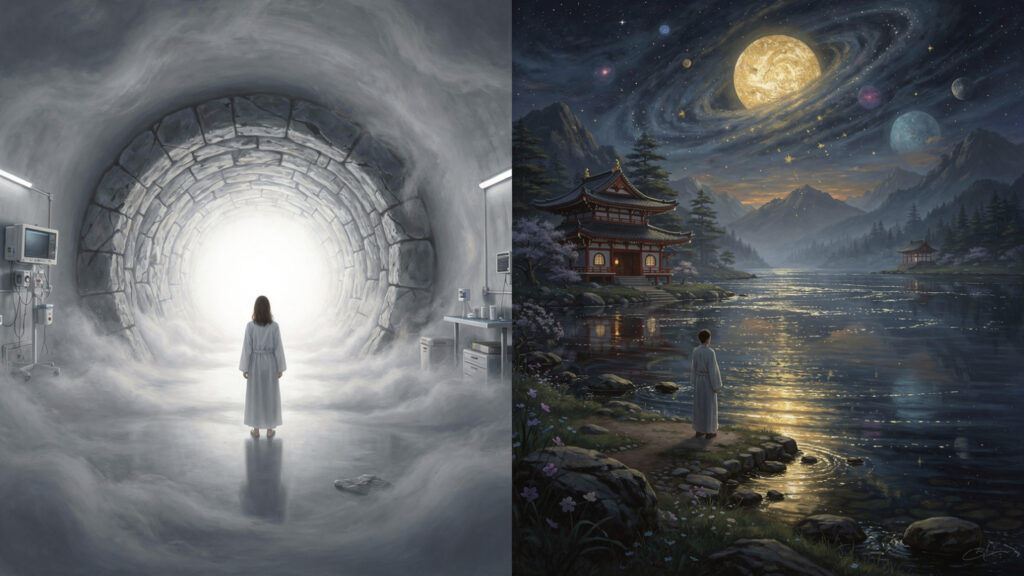
NDEs have been recorded systematically in Western clinical settings and in multiple non-Western cultural contexts. The core elements, separation from the body, movement through a transitional space, encounter with a boundary, meeting with deceased individuals, positive emotional tone, life review, and reluctance or inability to cross the final boundary, appear across cultures with a consistency that cultural transmission cannot explain.
Japanese NDE researcher Yoshia Miyamoto has recorded NDEs in Japan whose core structure is consistent with van Lommel’s Dutch cases and Parnia’s British-American cases despite significant differences in the cultural imagery within which the experience is expressed. The boundary is a gate or a river in Japanese accounts rather than the tunnel common in Western accounts. The figures encountered are described in terms consistent with Japanese Buddhist cosmology rather than Western Christian cosmology. But the underlying structure, the sequence of experiential events, is consistent.
Native American NDE accounts recorded by researchers working with traditional communities show the same core structure in cultural vocabularies that have no recorded contact with the Western clinical NDE literature.
The cross-cultural consistency of NDE core phenomenology is the finding that the cultural construction hypothesis for NDE, the argument that NDE content is produced by culturally expectations and beliefs, cannot fully accommodate. A cultural construction would produce culturally variable content at the structural level as well as the symbolic level. What is found is culturally variable symbolic content within a cross-culturally consistent structural framework.
The structural consistency across cultures suggests that the NDE’s core phenomenological structure reflects something that is not determined by cultural expectation. What it reflects, a real experience of a genuine transition between states of existence, a universal human psychological response to the physiology of dying, or something else that the current framework has not characterized, is the question that the cross-cultural evidence raises without resolving.
The After-Effects
The after-effects of NDE that Ring, van Lommel, and other researchers have systematically recorded provide an additional evidentiary dimension that the physiological explanation must account for.
NDE experiencers show consistent changes in personality, values, and worldview that distinguish them from matched control groups of cardiac arrest survivors who did not report NDE. The changes appear in the systematic research using validated psychological assessment instruments and are not attributable to the cardiac arrest experience alone, because the non-NDE cardiac arrest survivors in the same studies do not show the same profile of changes.
The changes recorded across multiple studies include: reduced fear of death, measured on validated death anxiety scales. Increased concern for others, measured on empathy and altruism scales. Reduced materialism, recorded in self-report and behavioral measures. Increased interest in spiritual questions and practices. Enhanced sense of purpose and mission. Reported development of previously absent or enhanced psychic or intuitive capacities.
The enhanced psychic capacity finding is the most controversial element of the after-effect research but is recorded systematically enough to require acknowledgment. Ring’s research found that a significant proportion of NDE experiencers reported enhanced intuitive or extrasensory experiences following their NDE, at rates significantly higher than matched control populations. Whether these reported capacities reflect genuine changes in perceptual processing, enhanced attention to information sources that were previously filtered out by ordinary consciousness, or something else, is not established by the self-report data.
The death anxiety reduction is the most consistently recorded and most robustly measured after-effect. Van Lommel’s follow-up studies at four and eight years post-NDE show persistent reduction in death anxiety in NDE experiencers compared to non-NDE cardiac arrest survivors. This reduction is measured rather than self-reported, using standardized validated instruments whose results are not subject to the social desirability bias that could inflate self-reported spiritual growth narratives.
A cardiac arrest survivor whose measured death anxiety is significantly lower than a matched survivor who did not report NDE, at four and eight years following the event, is showing a persistent measurable change in a psychological variable that the physiological experience of cardiac arrest alone does not produce. Whatever the NDE experience is, it produces something that the cardiac arrest experience without NDE does not produce.
The Theoretical Frameworks
The theoretical frameworks proposed to account for the NDE evidence without requiring consciousness outside the brain, and those proposed to account for it by accepting that possibility, are both recorded in the published scientific and philosophical literature.
The most sophisticated purely materialist framework is the one developed by neuroscientist Susan Blackmore in her dying brain hypothesis, whose mechanism is that the visual cortex’s chaotic response to anoxia produces the tunnel and light phenomenology through the same mechanism that produces phosphenes when the eye is pressed. Blackmore’s framework is internally consistent for the tunnel and light elements but does not accommodate the veridical perception cases, the congenitally blind cases, or the cross-cultural structural consistency.
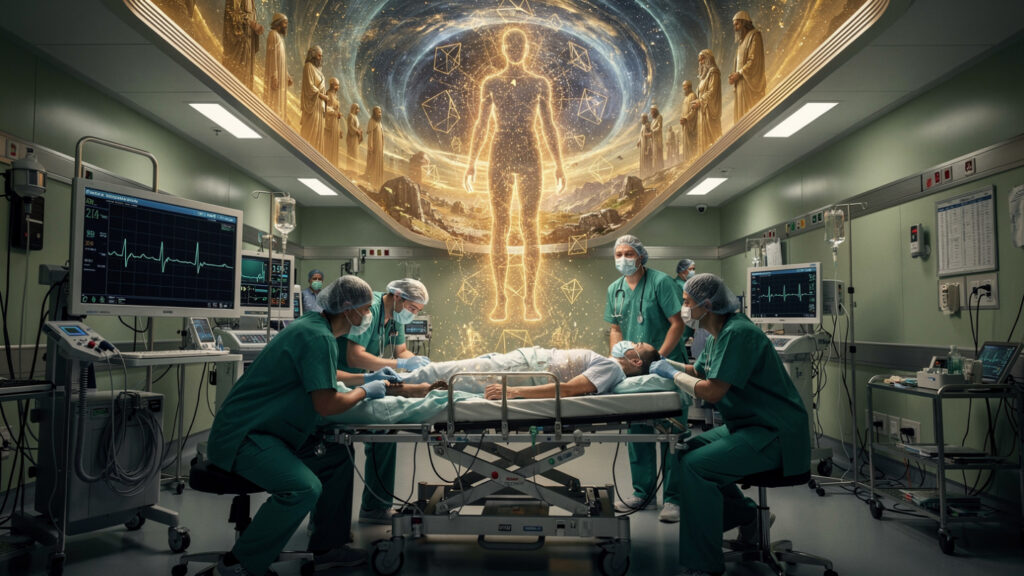
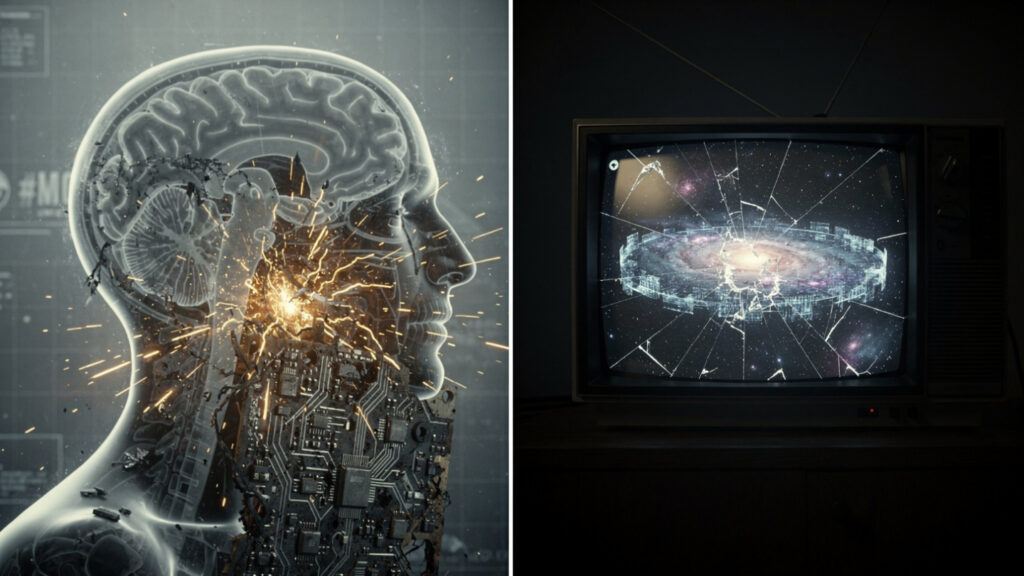
The most rigorous non-materialist framework in the peer-reviewed scientific literature is van Lommel’s continuity of consciousness hypothesis, published in his book Consciousness Beyond Life and in subsequent peer-reviewed papers. Van Lommel’s proposal, drawing on quantum physics models of consciousness including those developed by Roger Penrose and Stuart Hameroff, is that consciousness is not produced by the brain but is transmitted through the brain in the way that a television set transmits a television signal. The brain’s flatline state does not eliminate consciousness in this model, it eliminates the brain’s capacity to transmit and receive the consciousness that continues to exist independently of the brain’s activity.
This framework is consistent with the NDE evidence and is published in peer-reviewed form by a credentialed cardiologist in mainstream medical venues. Whether it is correct depends on whether quantum coherence in the biological structures Penrose and Hameroff identify, specifically the microtubules in neural cells, actually plays the role in consciousness that the framework requires. This is a testable claim whose testing is ongoing in the quantum biology literature.
What the Evidence Establishes
The near-death experience evidence base, as assembled from the peer-reviewed research, establishes several findings whose implications the conventional neuroscientific framework for consciousness has not fully accommodated.
Conscious experience with organized, coherent, and in cases accurately veridical content occurs during verified periods of no measurable cortical activity in a significant proportion of cardiac arrest survivors. This finding appears in Van Lommel’s Lancet study, the AWARE study, and multiple smaller prospective studies using consistent methodology.
Congenitally blind individuals describe accurate visual perceptions during these experiences at rates comparable to sighted experiencers. This finding appears in Ring’s Mindsight research with the case documentation that makes the claim falsifiable.
The core phenomenological structure of NDE is consistent across cultures with no recorded contact, suggesting that the experience reflects something not determined by cultural expectation. This finding appears in the cross-cultural research literature.
The after-effects of NDE, specifically the reduction in death anxiety measured at years post-event, distinguish NDE experiencers from non-NDE cardiac arrest survivors in ways that the cardiac arrest experience alone does not produce.
These four findings together constitute an evidence base that the conventional neuroscientific framework for consciousness must either accommodate through proposed mechanisms that do not yet have direct empirical support, or acknowledge as evidence that the framework is incomplete in a specific and significant way.
Van Lommel published in The Lancet. Parnia published in Resuscitation. Ring published in peer-reviewed psychology literature. The evidence is in the record.
The neuroscience has not explained how.
Physicist John Wheeler’s own observer-participancy framework offers one theoretical angle on why observation and reality might be this entangled.