




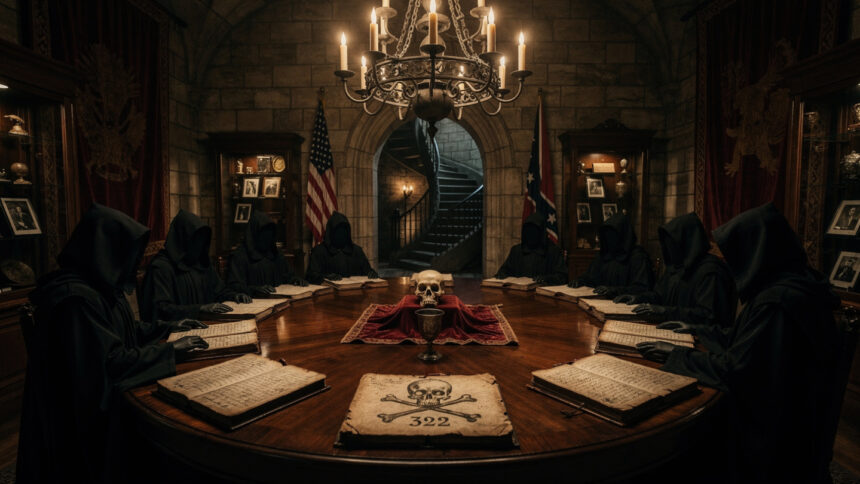
In 1873 a group of Yale students broke into the Skull and Bones tomb on the New Haven campus and walked out with the membership records.
They published them.
The document, known as the Iconoclast, was printed and distributed across Yale that same year. It listed every member of the society since its founding in 1832 and made an argument whose premise was not conspiracy theory but arithmetic: a small, closed group of men were rotating through the most powerful positions in Yale’s administration, faculty appointments, and undergraduate life, doing so in ways that excluded everyone who had not been tapped in their junior year for membership in a single senior society whose deliberations were secret and whose obligations to each other appeared to extend well beyond graduation.
The Iconoclast’s authors were not claiming occult ritual or world domination. They were observing a pattern of institutional preferment and asking whether a university was well served by it.
The pattern they observed in 1873 extended, across the following century and a half, considerably beyond Yale’s administration.
The German Origin and What Russell Brought Back
William Huntington Russell spent the academic year 1831-32 at the University of Berlin. What he encountered there has been described by researchers including Antony Sutton as a chapter of a German university society operating within a broader philosophical tradition whose roots connected to the Hegelian idealist tradition then transforming European intellectual life.
Whether the society Russell encountered was formally Hegelian, or simply a German student fraternity whose organizational model impressed him, what he brought back to New Haven was a framework whose essential features he transplanted intact: a closed membership selected by existing members, a graduated initiation process designed to create bonds of mutual obligation, deliberations whose content was never disclosed to outsiders, and a network whose value to its members was precisely its exclusivity.
Russell co-founded Skull and Bones at Yale in 1832 with Alphonso Taft, whose son William Howard Taft became the only person in American history to serve as both President of the United States and Chief Justice of the Supreme Court. The son of one of the society’s two founders reaching the apex of both the executive and judicial branches of the American government within two generations of the society’s founding is the first data point in a pattern whose subsequent development makes the founding context worth understanding precisely.
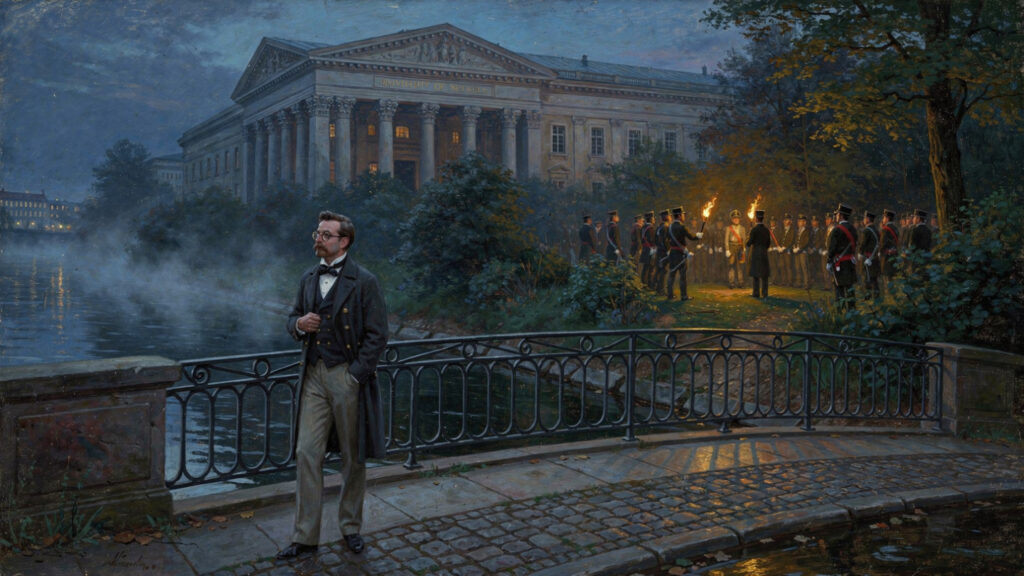
The society Russell and Taft created was not unique in its basic structure. American college fraternities proliferated throughout the nineteenth century and most have produced distinguished alumni without generating the institutional concentration that Skull and Bones has. The difference is not the secret ritual or the closed membership. The difference is selection. Skull and Bones does not tap the most popular undergraduates or the most socially prominent. Its recorded selection pattern, analyzed across its membership record, targets individuals identified as most likely to achieve significant institutional power after graduation. The society is not creating the network’s members. It is identifying them early and binding them together before the power is achieved.
The Initiation and the Psychology of the Bond
The Tomb on the Yale campus, a windowless brownstone structure built in 1856 that sits on High Street across from the university’s main campus, has been described by journalists who examined its exterior and by former members who described its interior in Alexandra Robbins’s 2002 book Secrets of the Tomb, the most thoroughly reported account of the society’s practices drawing on named sources willing to speak on record.
The initiation process as described in Robbins’s accounts centers on a biographical exercise whose psychological mechanics are worth examining as carefully as its content. New members lie in a coffin and deliver an extended account of their sexual history to the assembled membership. The exercise is not, by the accounts of former members, experienced as degrading or coercive. It is experienced as liberating in the way that confession is liberating: the disclosure of something private and potentially shameful, witnessed by a closed group who will never repeat it, creates a specific quality of bond that ordinary shared experience does not.
The psychological literature on vulnerability and trust is relevant here. Brené Brown’s published research on vulnerability establishes that the willingness to disclose genuine vulnerability is the foundation of authentic connection rather than a product of it. The Bones initiation engineers this dynamic deliberately: it creates a situation in which fifteen individuals simultaneously disclose the kind of information that, outside the Tomb, would make them vulnerable to social judgment, and in doing so creates a trust whose character differs from friendship because it is founded on mutual vulnerability rather than mutual affection.
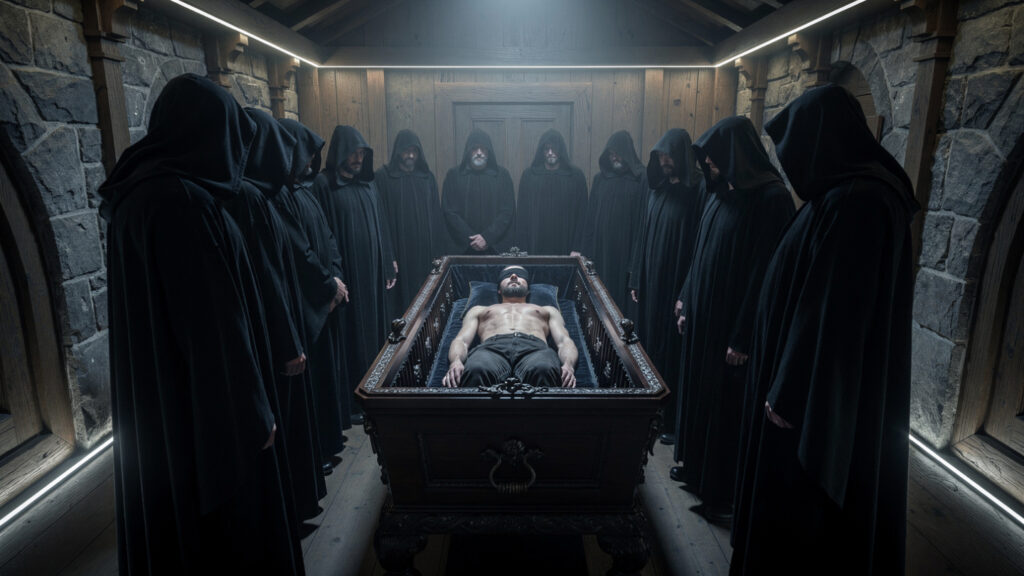
The former members who have described the process consistently use one word: effective. Not strange, not disturbing, not coercive. Effective. The bond it creates is the bond that produces, decades later, a CIA director who picks up the phone and calls a fellow patriarch rather than going through official channels, a Secretary of State who trusts a fellow Bones member’s assessment of a foreign government over his own staff’s analysis, a newspaper publisher who gives a fellow patriarch’s perspective more weight than it would otherwise receive.
The secret is not what is said in the Tomb. The secret is that the Tomb exists, that fifteen people know what was said there, and that those fifteen people will carry that knowledge for the rest of their lives without disclosing it to anyone outside the circle.
That is the product the initiation manufactures. Everything else follows from it.
The Recorded Members and What They Built
The membership record assembled by Antony Sutton in America’s Secret Establishment and supplemented by Robbins’s research and by the Yale archive’s own partially accessible records reveals a concentration of individuals at the top of American institutional life whose consistency across generations and across institutional domains requires explanation.
Henry Stimson was tapped in 1888. Over the following five decades he served as Secretary of War under William Howard Taft, Secretary of State under Herbert Hoover, and Secretary of War again under Franklin Roosevelt and Harry Truman, making him the most institutionally durable senior civilian in American government across the first half of the twentieth century. His role in the Manhattan Project decision included his recorded recommendation against bombing Kyoto, which he had visited and whose cultural significance he understood. The recommendation was accepted. Kyoto was removed from the target list. The decision was made by a Bones patriarch whose network of fellow members extended through every administration he served across forty years of public life.
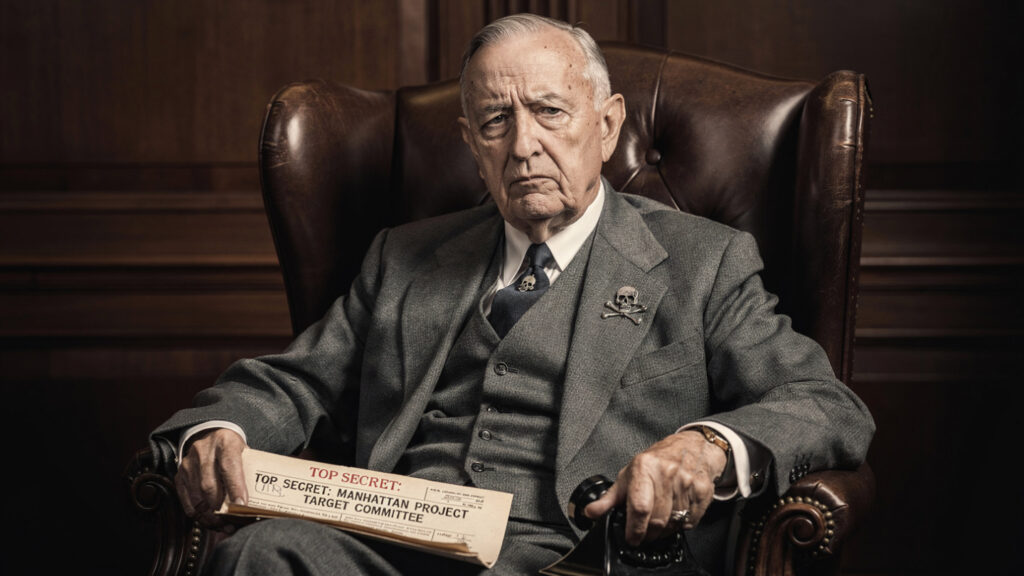
Averell Harriman was tapped in 1913. His career traces a line from Wall Street through the wartime alliance to the Cold War that makes him one of the most consequential American figures of the twentieth century whose name is least known to the general public. His business activities in the 1930s included directorship of the Union Banking Corporation, whose financial relationships with German industrial interests connected to the Nazi government led to Treasury Department asset seizure under the Trading with the Enemy Act in October 1942. The seizure appears in the Congressional record. Harriman’s subsequent service as Ambassador to the Soviet Union and Ambassador to Great Britain, his presence at the Yalta Conference alongside Roosevelt, Churchill, and Stalin, and his direct communications with Soviet leadership across the war and its aftermath place him at the center of every major Allied decision of the period.
After the war he served as Secretary of Commerce under Truman, then as Governor of New York, then as a senior foreign policy advisor through the Kennedy and Johnson administrations. His longevity in positions of influence, spanning from Woodrow Wilson’s presidency through Lyndon Johnson’s, is a function of the network that sustained him through changes in administration, party, and foreign policy direction that would have ended the careers of individuals without comparable institutional support.
McGeorge Bundy was tapped in 1940. He joined the Kennedy administration as National Security Advisor in 1961 and remained in the position under Johnson through 1966, occupying the office during the Cuban Missile Crisis, the Gulf of Tonkin resolution, and the escalation of American military involvement in Vietnam that would define the decade. His brother William Bundy, also a Bones member, served simultaneously as Assistant Secretary of State for East Asian Affairs, placing two members of the same secret society in the two most influential positions shaping American policy toward the defining military conflict of the era.
Whether their shared Bones membership influenced their policy coordination is not established in the available record. That two brothers from the same secret society occupied adjacent positions of extraordinary influence during the same period is a matter of record. The conventional explanation is meritocracy: both were genuinely capable men who would have risen to comparable positions regardless of their Bones connection. The alternative explanation is network: the trust bond of the Tomb facilitated a coordination whose character differed from ordinary interagency communication because it operated through a channel whose existence was not disclosed in official records.
Both explanations are consistent with the available evidence. Neither is provable from the membership record alone.
The Bush-Kerry Election and What It Revealed
The 2004 American presidential election produced an episode whose statistical improbability deserves more analytical attention than it has received in the mainstream political literature.
George Herbert Walker Bush was tapped in 1947. He subsequently served as Congressman, Ambassador to the United Nations, Chairman of the Republican National Committee, Chief of the United States Liaison Office in China, Director of Central Intelligence, Vice President, and President. His son George Walker Bush was tapped in 1968. He served as Governor of Texas before winning the presidency in 2000.
John Forbes Kerry was tapped in 1966. He served as a Navy officer in Vietnam, returned to lead Vietnam Veterans Against the War, served as Lieutenant Governor of Massachusetts, and was elected to the United States Senate in 1984, where he chaired the Senate Foreign Relations Committee.
In November 2004, George Walker Bush and John Forbes Kerry faced each other in the American presidential election. Both men were members of Skull and Bones. Both men had been initiated in the Tomb. Both men had delivered their biographical confessions to the assembled membership. Both men knew things about each other, and about the network they shared, that neither would discuss publicly.
When Tim Russert asked Bush about his Bones membership on Meet the Press in February 2004, Bush said it was too secret to discuss. When Russert asked Kerry the same question on the same program, Kerry said the same thing. The most powerful office in the world was being contested by two men who declined to discuss a shared institutional affiliation on national television, and the political press accepted this without sustained examination.
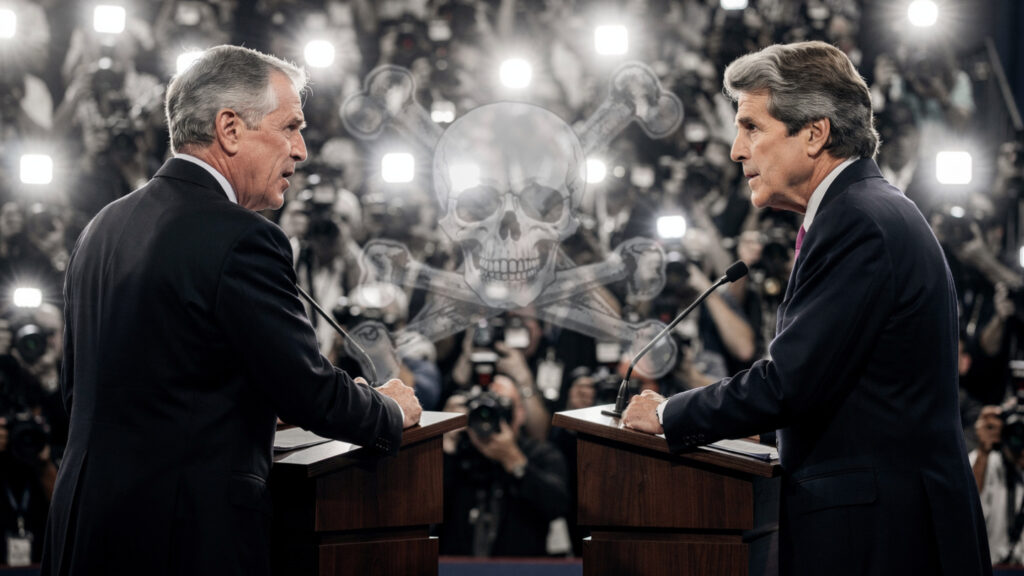
The statistical context: approximately 11,000 men graduated from Yale between 1966 and 1968, the years surrounding Kerry’s tapping. Skull and Bones taps 15 per year. The probability of any given Yale graduate being a Bones member is approximately 0.1%. The probability of two Yale graduates from the same general era both being Bones members and both becoming major party presidential candidates in the same election is an exercise in astronomical improbability if the selection is random.
The selection is not random. That is the point.
The CIA and the Intelligence Architecture
The relationship between Skull and Bones and the American intelligence establishment is the most extensively recorded element of the society’s institutional footprint and the one whose character is most precisely assessable against the public record.
The Office of Strategic Services, established in 1942 as America’s wartime intelligence agency and the direct predecessor to the CIA, drew heavily from the Yale network in building its early officer corps. The OSS’s director William Donovan was not a Bones member, but the cultural preference he established for Ivy League graduates with existing networks of institutional trust created a pipeline whose subsequent decades produced a disproportionate concentration of Yale men, including Bones members, in senior intelligence positions.
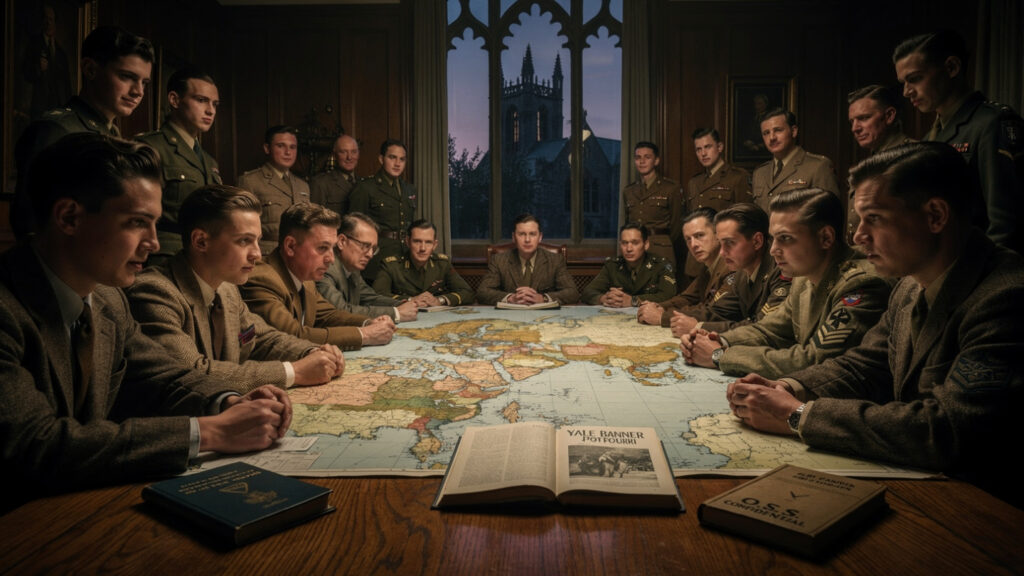
William F. Buckley Jr. was tapped in 1950. After graduation he served as a CIA officer in Mexico City under E. Howard Hunt, himself a future Watergate conspirator, before leaving to found National Review in 1955 and build the intellectual framework of postwar American conservatism. His CIA service is acknowledged in his own published accounts without apology: he regarded it as patriotic service whose methods were justified by the Cold War stakes.
The recorded roster of CIA directors with Bones or Yale connections runs through the agency’s history with a consistency that the conventional meritocratic explanation handles less cleanly than its proponents suggest. Porter Goss was tapped in 1960. He served as a CIA operations officer in the 1960s before entering Congress and eventually serving as CIA Director from 2004 to 2006.
Tim Weiner’s Pulitzer Prize-winning history of the CIA, Legacy of Ashes, drawn from declassified records and named sources, describes the founding generation’s cultural character without framing it as a Bones conspiracy. What it shows is a preference for individuals whose existing network of institutional trust, whose known quantities within a closed social system, made them the preferred candidates for work requiring discretion, loyalty, and access to information channels that could not be formalized in official records.
Skull and Bones is not the CIA’s talent pipeline. It is one of several elite networks whose members produced exactly what the early CIA wanted: men who already knew how to keep secrets, who had practiced institutional loyalty in a closed group, and who had demonstrated the willingness to maintain a parallel reality alongside their official one.
The Financial Architecture
The relationship between Skull and Bones and American finance is a pattern of personnel concentration rather than institutional founding.
Prescott Bush, tapped in 1917, built his career at Brown Brothers Harriman alongside Averell Harriman. The firm’s financial relationships with German industrial interests in the 1930s led to the Treasury Department seizing Union Banking Corporation assets in 1942. The seizure is in the Congressional record. The interpretation of what it means, straightforward financial crime versus complex wartime business entanglement, remains contested among historians whose assessments of the documentation diverge significantly.
What the financial pattern shows across the century is not control of American finance by a secret society but something narrower and more verifiable: the systematic placement of network members in senior positions at institutions where trust, discretion, and access to closed information channels are more valuable than technical expertise. Investment banking, private equity, and the senior advisory roles at major financial institutions reward exactly the qualities the Bones network produces: the capacity to maintain confidentiality, the access to a parallel information channel among trusted peers, and the institutional credibility that comes from membership in a network whose other members are known quantities.
The Women’s Admission Crisis
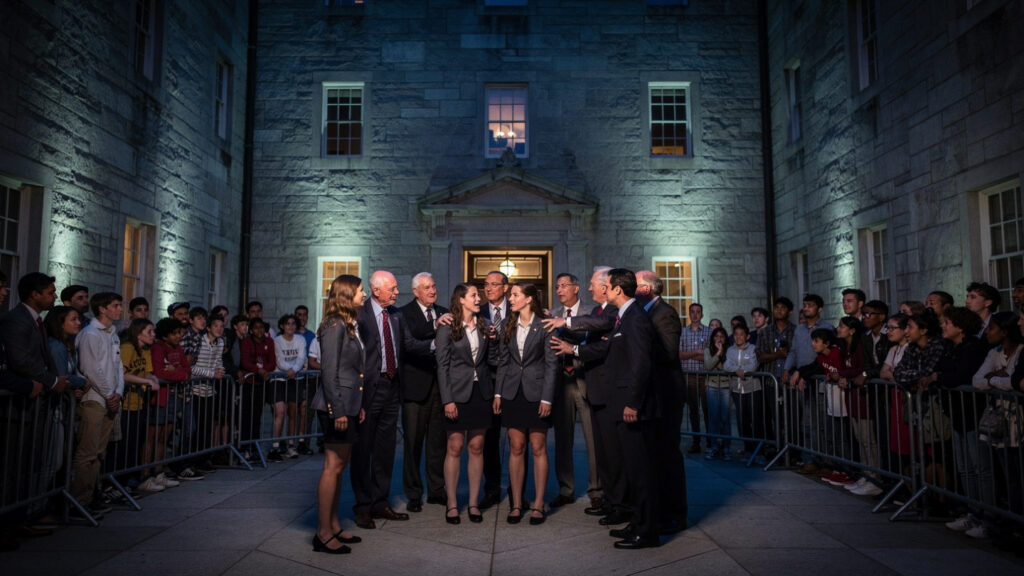
In 1991, Skull and Bones voted to admit women for the first time in its 159-year history.
The alumni patriarchs sued to prevent it.
The episode, recorded in Robbins’s reporting and in the Yale Daily News archive, reveals more about the society’s self-understanding than any initiation ritual. The older generation of Bones members went to court to prevent the institution they had built from changing its fundamental character. They lost. The society admitted its first female members in 1991.
The legal challenge and its failure illuminate two things simultaneously. First, that the network’s older members understood the society’s all-male character as essential to its function rather than as an incidental historical artifact. The specific vulnerability of male biographical disclosure to an all-male audience, and the specific trust bond it creates, was what they were protecting. Second, that the society’s institutional structures were strong enough to override its own members’ resistance: the younger Bones members who voted for admission prevailed over the older patriarchs who controlled the alumni organization.
Whether the admission of women changed the society’s essential character, or whether the initiation process adapted its mechanisms while preserving its psychological function, is a question the available record does not fully answer because the post-1991 society’s internal workings are no better recorded than the pre-1991 version.
What the episode establishes is that Skull and Bones is an institution capable of internal conflict, capable of being changed by its members against the resistance of its alumni, and capable of institutional adaptation whose specific character reflects the same pragmatic calculation that has governed the network’s development across its entire history: preserve what produces the bond, adapt everything else.
The Sutton Analysis and Its Limits
Antony Sutton’s America’s Secret Establishment is the most systematic attempt to draw institutional conclusions from the Bones membership record, and its claims deserve honest assessment rather than either adoption or dismissal.
Sutton argued that Skull and Bones membership represents a deliberate strategy of placing members on both sides of every major ideological divide in American public life, funding both socialist and capitalist movements, ensuring the network’s members occupy positions of influence regardless of which faction prevails. His account of Bones members in seemingly contradictory institutional positions, funding both Bolshevik revolution and American anti-communism, supporting both progressive and conservative causes across the twentieth century, is genuinely suggestive.
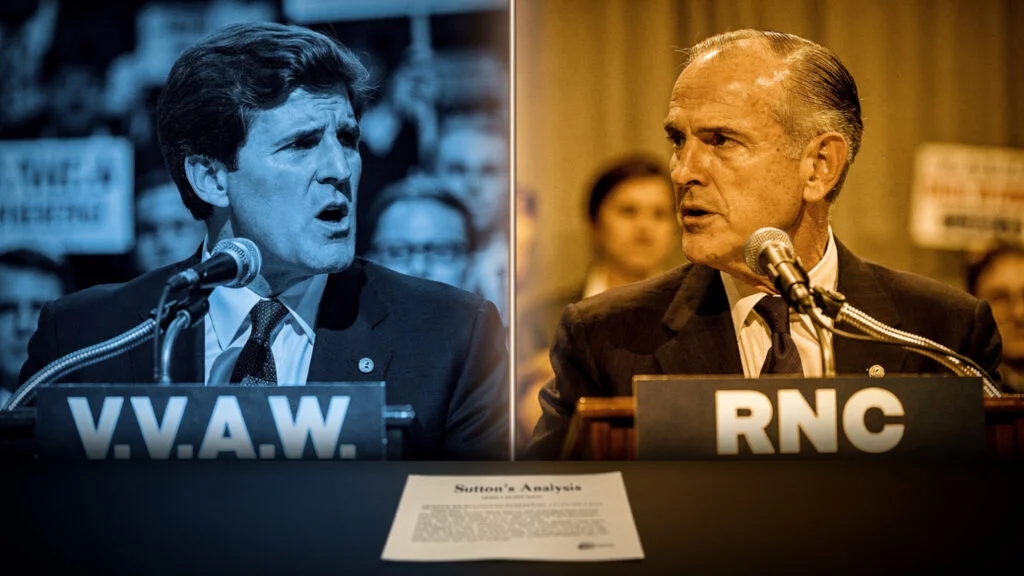
The membership record’s bipartisan character is real. Bones members appear in Democratic and Republican administrations, in liberal and conservative media, in left-leaning foundations and right-leaning think tanks. Kerry and Bush are the most visible instance of a pattern that runs through the society’s history.
But Sutton’s framework requires a coordination whose evidence he does not produce beyond the membership record itself. A network that places members across ideological lines because it selects for institutional effectiveness regardless of ideological affiliation, and whose members subsequently rise to influential positions through their own capabilities and the support of their network, produces exactly the same pattern as a network deliberately placing members on both sides of every divide. The two explanations are observationally equivalent from the outside.
What the record establishes is the pattern. What it does not establish is the intent behind it. Sutton’s analysis is most useful not as proof of deliberate coordination but as a framework for understanding what a sufficiently successful trust network looks like from the outside when its members have been operating across multiple institutional domains for 190 years.
It looks like this.
What the Record Actually Shows
Honest assessment of the Skull and Bones historical record produces conclusions that are more modest than the mythology and more significant than the dismissal.
What is established: a private senior society at Yale whose membership since 1832 has included an unusual concentration of individuals who subsequently occupied senior positions in American intelligence, financial, media, and political institutions. The concentration exceeds what random distribution from a single university’s graduating class would predict by a margin that cannot be accounted for by meritocracy alone, because the society is not selecting for merit in the abstract but for a specific kind of institutional effectiveness that the trust bond of the initiation process then amplifies through network effects.
The mechanism is not conspiracy. It is the deliberate engineering of trust at the moment in life, the senior year of an elite university, when the individuals who will occupy the next generation’s institutional positions are identifiable but not yet placed. By binding them together before they have power, the network creates obligations of mutual support that operate across every subsequent institutional context its members enter. The CIA director and the newspaper publisher and the Secretary of State and the investment banker are not coordinating through secret meetings or coded communications. They are doing what people do who trust each other: picking up the phone, extending professional courtesy, opening doors, and providing access to information channels that are not available to people outside the circle.
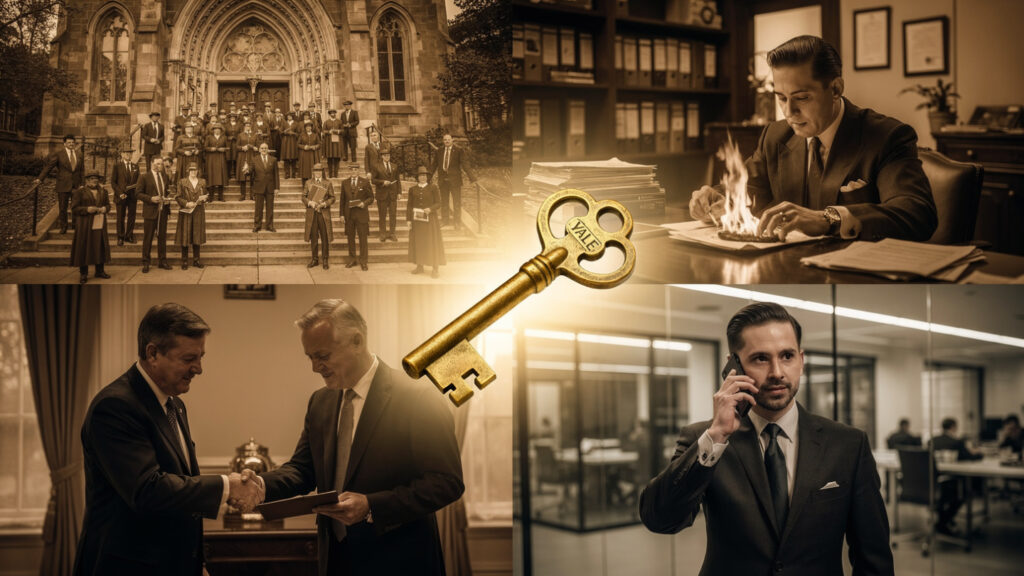
This is not remarkable as a human behavior. It is what every network does. What is remarkable about Skull and Bones is the deliberateness of its construction, the consistency of its application across 190 years, and the institutional altitude its members have reached with a consistency that the conventional meritocratic narrative of American institutional life does not fully account for.
The Iconoclast’s authors were not wrong in 1873. They identified a real pattern operating at the scale of a single university. What they could not have known was how far that pattern would extend across the following century.
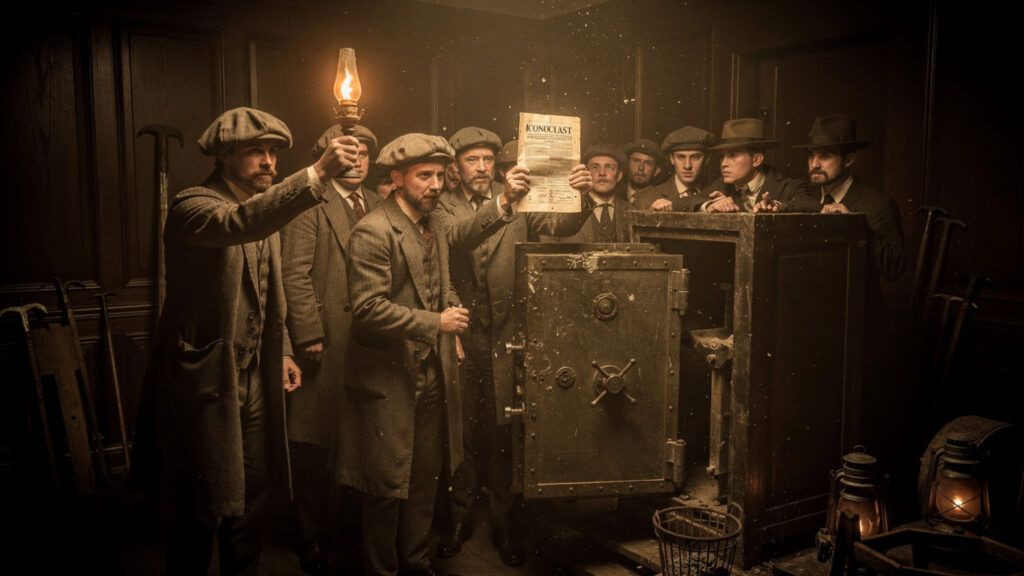
The stolen list recorded who was in the room. The subsequent careers show what those people built. The connection between the two is not theory. It is the record.
Whether the record constitutes evidence of coordination or simply of a network functioning as networks do, the question 190 years of history has generated, depends entirely on what you believe about the relationship between trust, obligation, and institutional power in a society that formally insists those things are separate.
Inside the Tomb, fifteen people every year make an argument that they are not.
The Tomb is still standing. The tapping still happens every spring. The deliberations still stay inside.
And the alumni still answer each other’s calls.