



S. James Gates Jr. was not looking for God.
He was working through the algebraic structure of supersymmetric string theory at the University of Maryland, doing the kind of mathematics theoretical physicists do when they are trying to understand whether the fundamental forces of nature can be described within a deeper and more coherent framework. The work is extraordinarily abstract, conducted in a mathematical language so far removed from ordinary experience that philosophical questions about what the equations might mean for reality itself usually remain several levels below the immediate problem of solving them. Gates was not searching for evidence of a hidden architect, a simulation, a demiurge, or an intelligence behind the physical universe. He was doing mathematics.
And then the mathematics contained something unexpectedly familiar.
Gates found a mathematical structure corresponding to a doubly-even self-dual linear binary error-correcting code, the same broad class of structure used in information theory and computer science to preserve information when a signal passes through a noisy channel. Error-correcting codes are not decorative mathematics. They are mechanisms for maintaining the integrity of information when corruption, interference, or noise threatens to alter what was originally transmitted.
The striking part was not that someone had deliberately inserted a computer code into a physical device. Nobody had. Gates encountered the structure inside the mathematics of supersymmetry itself, in equations developed to describe aspects of fundamental physical theory. The resemblance was sufficiently unexpected that Gates recognized it as something worth discussing beyond the immediate technical calculation.
In a 2008 paper co-authored with Charles Doran, Michael Faux, Tristan Hübsch, Kevin Iga, and Gregory Landweber, building on earlier 2005 work by Faux and Gates, the team demonstrated that classifying these mathematical objects, called adinkras, is mathematically equivalent to classifying certain error-correcting codes. Gates discussed the finding in subsequent public lectures, connecting it to the possibility that the universe might have a computational character, a considerably more speculative framing than the six-author paper itself makes. That connection became one of the most widely repeated parts of the story, because it supplied an extraordinarily modern image for an extraordinarily old question. What if the apparent solidity of physical reality is not the deepest layer of reality at all? What if what we experience as the universe is an information-bearing structure whose apparent stability depends upon rules operating beneath the level of ordinary perception?
There is an important complication, and it makes the story more interesting rather than less. Gates himself has never treated the discovery as proof that we live inside a simulation. At the 2016 public debate on the simulation hypothesis hosted by the American Museum of Natural History, participants offered dramatically different estimates of the probability that our reality is simulated. Max Tegmark gave 17 percent. David Chalmers gave 42 percent. Lisa Randall regarded the probability as effectively zero. Gates, despite being the physicist associated with the discovery of the error-correcting structures, gave a figure of approximately 1 percent.
That number matters. It prevents the discovery from being turned into something its discoverer never claimed it was. Gates found an unexpected mathematical structure that has a striking relationship to information theory. He did not find a literal computer, a programmer, or a physical proof that the universe is simulated. If anything, the caution of the person closest to the mathematics is part of what makes the original discovery worth examining. The mathematics is real. The interpretation remains open.
What Was Written in the Second Century
Nearly two thousand years before Gates encountered his codes, another description of reality was being assembled in a completely different intellectual world.
The Apocryphon of John is one of the texts preserved among the thirteen leather-bound codices discovered near Nag Hammadi in Egypt in 1945. The surviving manuscript is Coptic, but scholars place the composition of the work itself much earlier, generally in the second century CE. Its cosmology belongs to the diverse world of early Christian and Gnostic thought, a world in which competing groups were arguing over creation, revelation, the nature of the divine, the origin of evil, and the relationship between the visible world and a reality beyond it.
The text begins not with a machine but with a problem of hierarchy. At the highest level stands the Invisible Spirit, the ultimate divine principle beyond ordinary description. From this transcendent source proceeds a series of divine emanations, including Barbelo and the fullness known as the Pleroma. The material world familiar to human beings does not occupy the highest position in this architecture. It is downstream from something more fundamental.
Then the architecture breaks.
Sophia, one of the divine emanations, produces a being without the proper counterpart or stabilizing relationship that would normally accompany the act of creation. The result is Yaldabaoth, the Demiurge, a creator who possesses enormous power within the lower realm but lacks knowledge of the higher reality from which his own existence ultimately derives. His defining limitation is therefore not simple physical weakness. It is incomplete knowledge.
Yaldabaoth looks upon what he has created and believes himself to be the highest god. He declares his own supremacy because he cannot perceive the reality above him. The irony is central to the text. The creator of the lower world mistakes the lower world for the whole of existence precisely because he cannot see beyond the boundaries of the system he governs.
Yaldabaoth then creates the material cosmos and produces subordinate powers, the Archons, who participate in governing the lower order. The human being occupies an unusual position within this arrangement because something originating from the higher divine realm becomes present within material existence. The divine element within humanity is therefore not entirely native to the lower system. It is a trace of an origin beyond it.
This produces the central drama of Gnostic salvation. The problem is not simply that human beings are sinful or morally defective. The deeper problem is that they have forgotten what they are and where they came from. The system is experienced as the whole of reality because its inhabitants have lost awareness of the reality beyond it. Gnosis, in this framework, is not merely acquiring another piece of information. It is awakening to an origin that was present all along but concealed by the conditions of ordinary existence.
This is the Apocryphon of John. It is a second-century cosmological text preserved in a manuscript discovered in Egypt in 1945. It was written in theological language because theology was the intellectual language available to its author. It contains no information theory, no computers, no mathematical physics, and no concept remotely equivalent to modern digital simulation.
The Architecture of Error Correction
Then Claude Shannon enters the story.
In 1948, Shannon published A Mathematical Theory of Communication, establishing the foundation of modern information theory. His central insight was that communication could be treated mathematically as the transmission of information through a channel that is inevitably exposed to noise. The problem was not merely how to send a message. It was how to ensure that the message could survive the journey.
The solution was structure. By introducing carefully designed redundancy into information, a communication system can detect that corruption has occurred and, within defined limits, reconstruct what was originally transmitted. Error-correcting codes are the practical expression of this principle. They are methods for preserving informational integrity when the channel itself is imperfect.
The mathematical object Gates encountered belongs to this world of ideas. A doubly-even self-dual linear binary code possesses a highly constrained structure, with mathematical properties that make it possible to identify relationships among patterns of information. The important point for the present argument is not that the universe contains a literal string of binary computer instructions. It does not. The important point is that a structure associated with the mathematics of error correction appears within the algebraic framework of supersymmetric physics.
That distinction is crucial because it is precisely where the strongest version of the popular story goes too far. An error-correcting code appearing in a mathematical theory does not automatically demonstrate that the universe was programmed. Mathematics contains structures that appear in many apparently unrelated disciplines, and the fact that a physical theory can be represented using mathematical objects familiar from information theory does not by itself identify a programmer, a computer, or an external computational substrate.
But neither does the observation become meaningless simply because the strongest interpretation has not been established.
The intriguing fact remains that a mathematical framework developed to describe aspects of fundamental physics contains structures that can also be understood through the language of information preservation. The universe, at least in the mathematics, is not merely describable in terms of particles and forces. It can also be described in terms of information, constraints, transformations, and structures that resemble the mathematics used to preserve information against corruption.
That is a remarkable observation. It is not yet a verdict.
Two Descriptions of a Maintained World
Now place the ancient text and the modern mathematics beside one another, but resist the temptation to declare them identical before examining the actual correspondence.
The Apocryphon of John describes a lower material reality that is not the ultimate reality. It is produced by a creator whose knowledge is incomplete, administered by subordinate powers, and inhabited by beings who possess something that originates beyond the lower system. The inhabitants experience the constructed world as ordinary reality because they do not ordinarily perceive the architecture above it.
Gates’s work does not describe any of those theological entities. His equations contain no Demiurge and no Archons. What they contain is mathematical structure associated with error correction, information, and the preservation of integrity within a formal system.
The resemblance therefore exists at the level of architecture rather than vocabulary. One framework imagines reality as a lower-order creation whose stability depends upon structures above and within it. The other reveals mathematical structures within physical theory that are naturally described using the language of information preservation. One was theological. The other is mathematical. One arose in the second century. The other emerged from twentieth-century physics and information theory.
The temptation is to say that they describe the same thing.
The more defensible claim is that they ask an uncannily similar question.
Is the reality we experience the deepest layer of reality, or is it an internally coherent lower-order structure whose stability depends upon principles that its inhabitants cannot directly see?
That question is much older than the computer and much more interesting than the simulation hypothesis alone. The computer gave modern culture a new vocabulary for expressing it, but the underlying philosophical problem existed long before anyone imagined digital machines.
The Demiurge as an Information Problem
The most interesting part of the comparison is therefore not the superficial resemblance between Archons and software processes. It is the problem of incomplete knowledge.
In the Apocryphon of John, the Demiurge is powerful precisely within the world he governs, yet ignorant of the larger reality from which that world ultimately derives. His mistake is epistemological before it is metaphysical. He sees a domain and mistakes the domain for the whole.
Modern computational thinking provides an unusually precise analogy for this kind of limitation. A system can contain rules governing its internal behavior without containing within those rules a complete representation of the larger system in which it exists. An entity operating entirely within a formal environment may be capable of describing enormous portions of that environment while remaining unable to step outside the framework that defines its available observations.
That is not proof that our universe is a simulation. It is a statement about the limits of observers embedded within systems. A character inside a sufficiently sophisticated virtual environment would not necessarily possess access to the computer running the environment. The laws governing the character’s world could be perfectly discoverable from inside the world while the hardware executing those laws remained completely inaccessible.
This is where the ancient theological problem becomes unexpectedly relevant to the modern information problem. The Demiurge’s defining error is not that he cannot manipulate the world. He can. It is that he cannot see beyond the framework in which his manipulation takes place.
That distinction matters because human beings face the same structural problem. We can investigate the universe from within the universe, construct increasingly precise mathematical descriptions of its behavior, and discover astonishing regularities in the laws governing it, yet every observation still arrives through instruments and minds that themselves belong to the system being investigated.
The question is not whether science can discover truth. It plainly can. The question is whether an observer embedded within reality can ever obtain an observation from outside reality itself.
Bostrom Changes the Question
Nick Bostrom’s 2003 simulation argument adds another layer to the problem, although it must be kept separate from Gates’s mathematics. Bostrom’s argument is philosophical and probabilistic. It does not identify a physical anomaly that proves simulation. Instead, it asks what follows if technologically mature civilizations can create enormous numbers of conscious simulations and choose to run them.
If simulated observers eventually vastly outnumber observers in the original reality, then a randomly selected observer would statistically be more likely to belong to a simulated world than to the original one. Bostrom’s argument therefore concerns probability, not physical detection.
Gates is doing something entirely different. His work concerns mathematical structure inside a physical theory. The Apocryphon of John is doing something different again. It is presenting a theological cosmology in which the visible world is a lower-order creation governed by beings whose knowledge is incomplete.
These three frameworks should not be collapsed into a single proof. They do, however, form an unusually revealing sequence. Ancient Gnostic thought asks whether the visible world is the whole of reality. Modern philosophy asks whether sufficiently advanced civilizations could generate realities populated by conscious observers. Modern theoretical physics reveals that the mathematics used to describe fundamental physical structures can contain objects naturally understood through the language of information.
The convergence is real as a history of ideas. The conclusion remains open.
The Gnosis Problem
The deepest claim in the Apocryphon of John is also the claim that physics cannot presently adjudicate. The text proposes that human beings contain something whose ultimate origin lies beyond the material order, and that ordinary consciousness is structured in such a way that this origin is forgotten.
Gnosis is therefore not simply learning a new doctrine. It is recognition. The individual comes to know something about the nature of the self that was previously obscured by immersion in the material world.
This idea has echoes across the history of contemplative thought, although the traditions involved should never be treated as interchangeable. Vedantic traditions speak in different terms about liberation and the relation between self and ultimate reality. Buddhist traditions analyze attachment, impermanence, and the absence of a permanent self. Taoist traditions explore a mode of living that does not depend upon forcing the world into the categories imposed by the ego. Christian mysticism develops its own language of union, transformation, and knowledge of God.
The resemblance is suggestive, but resemblance is not identity. These traditions developed within radically different philosophical and religious contexts, and translating all of them into the vocabulary of simulation theory would erase more than it reveals.
Yet there is a question worth preserving beneath the differences. What if the human sense that ordinary consciousness is not the whole story is not merely a theological invention or a psychological accident? What if it reflects a genuine limitation built into the perspective of an observer who can never step completely outside the system being observed?
Physics cannot currently answer that question. Neither can the Apocryphon of John. The ancient text offers a metaphysical interpretation. Modern physics offers mathematical descriptions. Neither provides the missing observation from outside the universe.
The Signature Problem
There is another reason this story continues to attract attention. The idea of a hidden architecture leaves a recognizable philosophical problem behind it. If reality were generated or maintained by a deeper computational structure, would traces of that structure necessarily be visible from within the system?
Possibly. But not necessarily.
A simulated world does not have to contain obvious computer graphics, visible code, or glitches. A sufficiently sophisticated simulation would be defined precisely by the fact that its inhabitants experience internally consistent laws. What would count as evidence would therefore be subtler. Researchers would have to look for mathematical constraints, information-theoretic limits, unexplained regularities, discretization, or other properties that distinguish a computational substrate from competing physical descriptions.
This is why the error-correcting code is interesting even when the stronger conclusion is rejected. It belongs to the category of observation that makes the computational interpretation conceivable. It does not make the interpretation inevitable.
The same caution applies to other famous arguments often placed beside the simulation hypothesis, including the quantum measurement problem, delayed-choice experiments, and cosmic fine-tuning. Each is a genuine scientific or philosophical problem. None becomes evidence for simulation simply because simulation provides an intuitive narrative that appears to accommodate it.
Quantum mechanics does not require a conscious observer to make physical interactions meaningful. Fine-tuning does not uniquely imply a designer because anthropic reasoning and other cosmological possibilities remain under discussion. Delayed-choice experiments do not establish that consciousness reaches backward through time. These phenomena are strange enough without adding conclusions that the experiments themselves do not establish.
The stronger intellectual position is therefore not to pretend that every anomaly points toward the same answer. It is to ask whether several independent lines of inquiry are beginning to make the same question unavoidable.
What the Architects Left
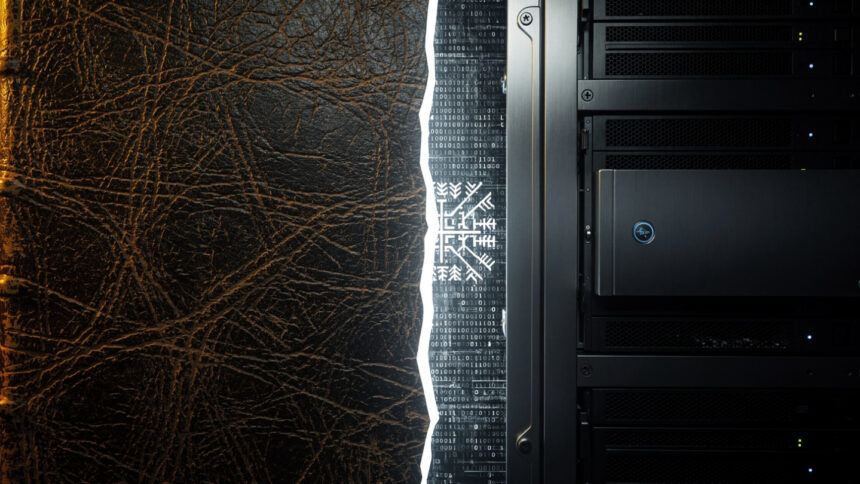
A watermark is not a message written across the surface of a page. It is part of the medium’s structure. It becomes visible only under particular conditions, and its significance depends upon understanding the process that produced it.
The metaphor is powerful, but the evidence must remain more modest than the metaphor. Gates did not discover a literal signature from an architect. He discovered mathematical structures associated with error-correcting codes inside the algebraic framework of supersymmetric physics. The interpretation of those structures as evidence for a designed computational universe remains speculative, and Gates himself has assigned that possibility a very low probability.
That is precisely why the discovery deserves to be remembered accurately.

Gates was not searching for ancient theology when he encountered the mathematics. The author of the Apocryphon of John was not anticipating information theory when describing the relationship between the material world, its creator, and a reality beyond it. Neither was attempting to validate the other. The two traditions emerged from radically different intellectual environments and were separated by nearly two thousand years.
Yet both force the same question into view: what if the world we experience is not the final explanatory layer?
The ancient answer was theological. There is a higher reality, the material world is downstream from it, and human beings contain something that points beyond the system in which they find themselves.
The modern answer is mathematical. Physical reality can be described through structures that have deep relationships with information, computation, symmetry, and error correction, raising questions about whether information is merely a description of reality or something closer to its underlying architecture.
The philosophical answer is more unsettling because it refuses to close the case. Perhaps these are independent discoveries of a genuine underlying structure. Perhaps human beings repeatedly invent similar metaphors because we repeatedly encounter the same limitations of embodied perception. Perhaps the resemblance is partly profound and partly accidental. Perhaps the universe is computational. Perhaps computation is simply one of the mathematical languages in which a universe that is not computational can nevertheless be described.
We do not know.
But we now possess something the author of the Apocryphon of John did not have and the ancient world could not have had: a mathematical language capable of describing reality in terms of information itself.
That changes the question.
The ancient Gnostic asked whether the visible world might be a lower-order construction whose inhabitants had forgotten their origin. Modern physics asks what information means at the deepest levels of physical theory. Computer science asks how information survives corruption. The simulation hypothesis asks whether conscious observers could inhabit realities generated by systems outside their own experiential access.
None of these questions proves the others.
But together they create a remarkable intellectual trajectory. A second-century text imagines reality as an ordered system whose inhabitants cannot ordinarily perceive the architecture that sustains it. Two millennia later, a physicist working inside the mathematics of fundamental theory discovers structures associated with the preservation of information against error. Between those two points lies the entire emergence of modern mathematics, information theory, computation, physics, and the scientific understanding of the universe as something that can be represented in abstract formal structures.
The responsible conclusion is not that the ancient text predicted Gates, or that Gates proved the ancient text. Neither claim survives careful examination.
The more interesting conclusion is that both belong to a much older human investigation into the possibility that appearance is not the deepest layer of reality.
Gates found an unexpected structure in the mathematics.
The ancient text described an unexpected structure in existence.
Neither one gives us the view from outside.
But both leave the same door open, and after nearly two thousand years, the question on the other side has acquired a new language.
The architects may not have left a signature. We cannot honestly say that they did. What they left us, at minimum, is something more difficult to dismiss: a universe whose deepest mathematics can be expressed in the language of information, and an ancient tradition that spent nearly two thousand years asking whether the world we inhabit was ever the whole of reality in the first place.