




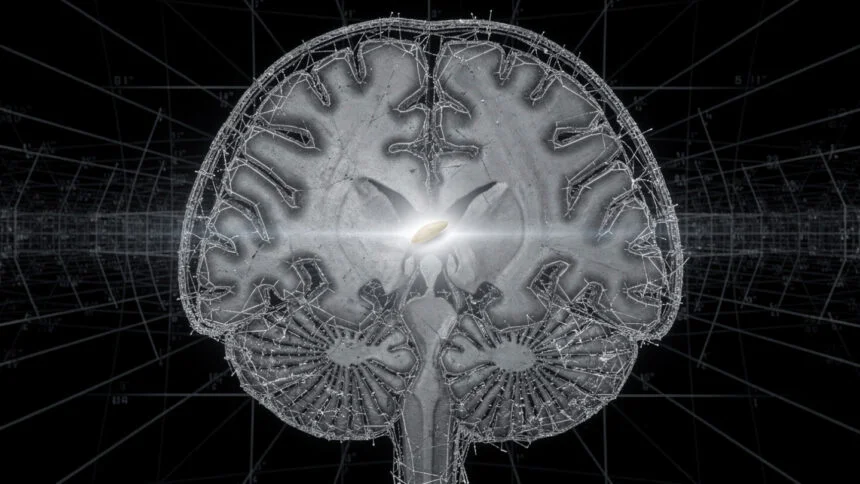
The most powerful consciousness-altering compound known to chemistry is being manufactured inside your skull right now.
Not as a side effect of medication. Not as the residue of recreational drug use. Not as something introduced into the human organism from outside. The compound is N,N-dimethyltryptamine. DMT. And the extraordinary fact is not merely that this molecule can radically alter human consciousness when administered experimentally. It is that the human organism possesses the biochemical machinery required to synthesize it itself. DMT has been identified in mammalian tissue, the enzymes required for its synthesis have been detected in relevant tissues, and the pathway by which tryptamine can be methylated into DMT has been established in the pharmacological literature. The human brain, in other words, contains part of the chemistry required to manufacture one of the most radical consciousness-altering compounds known to science.
The effects associated with DMT are not subtle. At sufficient doses, ordinary perceptual boundaries can disappear almost completely. The stable sense of inhabiting a physical body can dissolve. Time can cease to behave as it does in ordinary waking consciousness. Subjects frequently describe entering environments that appear more coherent, more vivid, and more objectively real than ordinary waking reality, sometimes accompanied by encounters with apparently autonomous beings whose agency seems independent of the subject’s intention. The phenomenology is remarkable not simply because it is strange, but because certain structural features recur across otherwise unrelated reports: the sense of entering somewhere rather than merely hallucinating something, the perception of autonomous intelligence, the conviction that the experience contained information rather than imagery, and the persistent impression afterward that ordinary consciousness had been the narrower state.
DMT is classified as a Schedule I controlled substance in the United States. That classification places it among substances legally defined as having no currently accepted medical use and a high potential for abuse. Whatever one thinks of that legal framework, it creates an extraordinary scientific paradox when placed beside endogenous DMT production. The molecule is treated as an externally administered substance requiring the highest level of regulatory restriction while the human organism itself possesses biochemical machinery capable of producing it. The legal status of the molecule tells us what the state permits researchers to do with it. It does not tell us why the brain makes it.
That distinction matters. The question this article is asking is not whether people should take DMT. It is not whether every DMT experience should be interpreted literally. It is not even whether the entities encountered during psychedelic states are objectively independent beings. The question is more fundamental: why does the human biological system contain a mechanism capable of radically disrupting the ordinary architecture of consciousness at all? And when that question is placed beside split-brain research, default-mode-network research, near-death reports, and the larger pattern this series has proposed across its first five installments, the brain begins to look less like a machine that simply generates consciousness and more like an interface that regulates access to it, if that proposed pattern holds.
Rick Strassman, a clinical psychiatrist at the University of New Mexico, spent five years conducting the first government-approved human research on DMT’s effects on consciousness after the substance had been placed under the modern controlled-substance regime. His work, later summarized in DMT: The Spirit Molecule, did not prove that DMT opens a doorway to another dimension. It could not. Clinical pharmacology does not possess an instrument capable of making that conclusion. What Strassman’s research did establish was something more difficult to dismiss: when the molecule is administered under controlled conditions, human consciousness can enter a remarkably consistent class of states characterized by radical alterations in perception, identity, time, agency, and the apparent presence of autonomous intelligences.
The findings are therefore not fundamentally about recreational drug use. They are about the architecture of consciousness itself. They concern what happens when the ordinary biological mechanisms that maintain the familiar human world-model are disrupted, and what appears when those mechanisms stop doing what they normally do.
What the Pineal Gland Does
The pineal gland’s established function is the production of melatonin, the hormone central to the regulation of circadian rhythm and the sleep-wake cycle. Light information reaches the brain through the retina and is relayed through the suprachiasmatic nucleus, allowing the pineal system to synchronize internal biological timing with the external day-night cycle. That function is well established. It is ordinary physiology. It is measurable, reproducible, and not controversial.
The more provocative question concerns what else the pineal gland and surrounding biological systems are capable of producing. DMT has been detected in mammalian tissues, and research has identified the enzymes involved in its biosynthetic pathway, including indolethylamine-N-methyltransferase and aromatic-L-amino-acid decarboxylase. Tryptamine, a precursor in the pathway, has also been identified in relevant tissues. These findings establish that the biochemical machinery for endogenous DMT synthesis exists. They do not, by themselves, establish precisely when the human pineal gland releases enough DMT to produce the extraordinary phenomenology associated with externally administered doses. That distinction is important, because the strongest version of the pineal-DMT hypothesis remains a hypothesis rather than an experimentally demonstrated account of birth, death, dreaming, or mystical experience.
Strassman’s hypothesis was that the pineal gland could play a particularly important role during extraordinary physiological transitions, including birth and death, and potentially during dreaming and certain altered states of consciousness. The attraction of the hypothesis is obvious. Birth and death are not ordinary biological moments. They are threshold conditions in which the organism undergoes a profound transition from one state of existence to another, and the brain’s regulatory architecture is itself undergoing unusual conditions. But the scientific question remains open: whether endogenous DMT reaches concentrations capable of generating the full phenomenology produced by intravenous or inhaled administration has not been definitively established.
And yet the correspondence remains striking. The moments traditionally associated with the greatest transformations of consciousness are precisely the moments at which biological boundaries become unstable: birth, death, deep sleep, extreme physiological stress, and states of profound contemplative absorption. Across cultures, these thresholds have repeatedly been described as moments when ordinary consciousness becomes permeable and another order of experience becomes accessible. The scientific literature cannot simply convert that correspondence into proof of a hidden mechanism. But neither does scientific caution require pretending the correspondence does not exist.
Birth and death are the boundaries of biological existence. The pineal system belongs to the biological machinery of consciousness. DMT belongs to that machinery’s known biochemical repertoire. Whether the relationship is accidental neurochemistry or part of a deeper architecture remains unanswered.
René Descartes Was Not Wrong About Everything
René Descartes, whose philosophical legacy helped establish the modern distinction between mind and body, identified the pineal gland as the point at which mind and body might somehow be brought into relation. In Les Passions de l’âme, published in 1649, he treated the pineal gland as the seat through which the soul interacted with the physical brain. Modern neuroscience rejected the specific mechanism almost completely. The pineal gland is not a mystical control room, and there is no evidence that it houses a separable soul in the Cartesian sense.

But the conventional dismissal of the entire Cartesian intuition as a historical curiosity is too easy. Descartes was wrong about the pineal gland’s function, but his reason for focusing on it was not irrational. He noticed something anatomically unusual: the gland is singular. The major cerebral hemispheres and many of the structures associated with perception, memory, emotion, and regulation are bilateral. The pineal gland is not. It occupies a central position deep within the brain and participates in a system that synchronizes internal biological states with environmental cycles. Descartes interpreted that singularity through the philosophical vocabulary available to him. He was looking for a physical point at which a unified experience could somehow relate to a divided physical organ.
His proposed mechanism was wrong. The structural question was not absurd.
What Descartes could not possibly have known was that the biological system surrounding this singular central structure is associated with the chemistry of DMT, a compound capable of producing some of the most profound alterations of conscious experience ever experimentally recorded. That does not vindicate Cartesian dualism. It does something more interesting: it reopens the question of whether the brain should be understood only as the generator of consciousness or also as the regulator, filter, and interface through which consciousness is organized.
The distinction becomes critical when the pineal question is placed beside what happened when twentieth-century neurosurgeons physically divided the brain itself. Because the next discovery was not that consciousness disappears when the brain is divided. It was that something much stranger happens.
Roger Sperry’s Nobel Prize and the Two Minds
In 1981, Roger Sperry of the California Institute of Technology received the Nobel Prize in Physiology or Medicine for his work on the functional specialization of the cerebral hemispheres. Much of the research underlying that recognition involved patients who had undergone corpus callosotomy, a surgical procedure in which the corpus callosum was severed to reduce the severity of otherwise treatment-resistant epilepsy. The corpus callosum contains hundreds of millions of nerve fibers linking the left and right cerebral hemispheres. It is one of the principal communication highways between the two halves of the human brain.
When that highway is severed, something extraordinary becomes visible. The hemispheres continue to function. They continue to receive information. They continue to control different parts of the body. They can even display different responses to the same situation. The operation does not simply destroy consciousness. Instead, it disrupts the integration through which the two hemispheres ordinarily participate in one coherent behavioral and perceptual system.
The classic split-brain experiments demonstrated the consequences with startling clarity. Information presented to the left visual field is primarily processed by the right hemisphere, while information presented to the right visual field is primarily processed by the left hemisphere. In patients with a severed corpus callosum, an object presented exclusively to the left visual field may be correctly identified by the left hand while the patient is unable to verbally name it, because the right hemisphere received the relevant visual information but the language-dominant left hemisphere did not. Reverse the visual field and the pattern reverses. The same biological organism can therefore contain two partially isolated information-processing systems with different access to perception, language, memory, and action.

More disturbing for simplistic theories of consciousness are the behavioral conflicts. The language-dominant hemisphere can generate explanations for actions initiated by information unavailable to it, effectively constructing a narrative after the fact. The other hemisphere can initiate behavior the speaking hemisphere cannot explain. In some experiments, one hand has appeared to interfere with actions initiated by the other. What emerges is not literally two complete human beings occupying one skull, and the popular phrase “two minds in one body” can oversimplify a complicated neuropsychological phenomenon. But the underlying fact is profound: the unity we ordinarily experience as a single self depends upon communication between distributed neural systems.
Before the corpus callosum is severed, these systems participate in a remarkably integrated process. After it is severed, some of that integration breaks down and partially independent streams of processing become visible. The finding does not prove that consciousness exists independently of the brain. It does not establish a non-material soul. What it does establish is that the ordinary unity of consciousness cannot simply be equated with any single anatomical component of the brain. The “self” is not sitting inside the left hemisphere waiting to be discovered. It emerges from the coordinated activity of a distributed system.
That distinction is exactly where the computed-system framework becomes relevant. A process running on complex hardware is not necessarily identical with any individual component of that hardware. Change the architecture and the process changes. Divide the architecture and the process may divide. Damage the communication layer and functions that previously appeared unified can become independent. The split-brain literature therefore provides an unusually powerful demonstration of a distinction that is often blurred in popular accounts of neuroscience: the neural substrate and the conscious process it supports are related, but they are not conceptually identical.
The hardware matters enormously. But hardware is not the same thing as the process running through it.
The computed-system framework proposed in the Architects piece is the model in which this distinction becomes structurally coherent. A process can depend completely upon its hardware without being identical to a single hardware component. It can be integrated through communication channels. It can become functionally divided when those channels are cut. And it can present a unified interface to itself even though the machinery beneath that interface is distributed across multiple interacting systems.
The Default Mode Network and What It Is Suppressing
The next piece of the puzzle is not an ancient text or an anomalous experience. It is a network inside the brain that neuroscientists discovered by noticing what the brain does when a person is supposedly doing nothing. The default mode network is a collection of interconnected regions whose activity becomes prominent during rest, autobiographical reflection, mind-wandering, self-referential thought, and the construction of internal narratives. It includes structures such as the medial prefrontal cortex and posterior cingulate cortex, together with other regions involved in memory, imagination, and internally directed cognition.
The name is revealing. The network is “default” because it is associated with the brain’s ordinary mode of operation when attention is not being directed toward a specific external task. It is not simply a laziness circuit. It participates in the construction of the autobiographical self: the continuous internal model that tells you who you are, where you have been, what you remember, what you expect, and what you believe is happening to you now. It is the machinery through which the brain maintains the familiar narrative continuity of being this particular person in this particular world.
Then researchers began suppressing it.
In 2012, Robin Carhart-Harris and colleagues at Imperial College London published research examining the effects of psilocybin on brain activity using neuroimaging methods including fMRI and MEG. Rather than producing a simple increase in global brain activity, psilocybin was associated with decreases in activity and connectivity within key regions of the default mode network. Importantly, the degree of disruption was related to the subjective intensity of the experience. The relationship was not that more ordinary self-processing produced a more expansive psychedelic state. It was the reverse.
The network responsible for maintaining the ordinary self-model became less dominant as the experience became more radical.
Subsequent psychedelic research extended the investigation of this relationship across compounds and experimental conditions, including work involving LSD, DMT, and other altered states. The emerging picture is more nuanced than the old slogan that psychedelics simply “turn off the default mode network,” because psychedelic states involve changes in connectivity and information flow throughout the brain rather than a single switch being flipped. But the central observation remains important: profound changes in the ordinary self-model are associated with profound changes in the network that normally helps maintain it.
And here the question becomes unavoidable. If the default mode network participates in constructing the ordinary narrative self, and if psychedelic states can temporarily disrupt that network while producing experiences subjects describe as larger, deeper, or more fundamental than ordinary consciousness, what exactly has been suppressed? The conventional answer is cautious: the brain’s ordinary predictive and self-referential machinery has been altered, producing an unusual state of consciousness. That explanation is entirely compatible with the available evidence. But it leaves open the question of whether the ordinary state is necessarily the most accurate state.
We routinely use the word “altered” as though it means “less real.” It does not. Waking consciousness is also an altered state produced by a particular configuration of neural activity. Dreaming is altered. Anesthesia is altered. Meditation can be altered. Deep sleep is altered. The fact that a state differs from the baseline does not tell us whether it contains more information, less information, distorted information, or information of an entirely different kind.
The phenomenology matters because the same structural themes keep appearing. Subjects report boundaries dissolving. The autobiographical self becomes less dominant. Time behaves differently. Perception becomes unusually vivid. The sense of separation between observer and environment can collapse. Some subjects report encountering autonomous intelligences. Others describe entering an apparently structured environment that seems to exist independently of their expectations. Many report a conviction that the experience revealed something rather than merely producing something.
None of that proves that the experience is objectively external. A brain can generate extraordinarily convincing experiences. But neither does the brain-generated explanation automatically establish that the content is false. The scientific question is not whether the experience feels real. It is what kind of information is present in the experience, how reliably it can be reproduced, whether independent subjects converge upon similar structures, and whether anything reported can be independently verified.
Within the computed-system framework this series has proposed, one further interpretation becomes available. The default mode network can be understood as part of the biological interface that constructs the ordinary self-model through which a conscious observer experiences the system. If that interface is temporarily destabilized, consciousness may no longer be constrained by the same assumptions about self, time, space, and perceptual boundaries that normally define waking experience. The crucial point is not that suppression automatically equals revelation. It is that the suppression creates a condition in which the ordinary interface no longer has exclusive control over what consciousness can experience.
If the system is a maintained computed environment, that is exactly the kind of behavior the architecture would predict: alter the interface and the observer may gain access to information or structures that the ordinary interface normally hides.
Strassman’s Clinical Findings
Between 1990 and 1995, Rick Strassman administered intravenous DMT to sixty volunteers at the University of New Mexico in a controlled clinical research program. The study represented a major regulatory milestone because it was among the first government-approved human studies of a classic psychedelic after decades of severe restriction. The research was not a collection of recreational anecdotes. Subjects were administered measured doses in a medical environment, monitored during the experience, and interviewed afterward.
The resulting phenomenology was extraordinary for a different reason than its intensity. It displayed structure.
Many participants reported encounters with apparently autonomous beings or intelligences. The experiences differed in their specific imagery, but recurring categories appeared: insect-like entities, reptilian figures, luminous beings, mechanical or technological intelligences, and other presences that subjects experienced as independent agents rather than passive visual hallucinations. Participants frequently described the entities as interacting with them, communicating, observing them, guiding them, examining them, or conveying a sense that the encounter was taking place in a domain that existed independently of the participant’s ordinary imagination.
The strongest interpretation of these reports would be that the participants encountered genuinely autonomous intelligences. The strongest skeptical interpretation would be that a powerful psychoactive compound altered perception and activated internally generated models that were experienced as external. Neither interpretation can be established simply from phenomenology. A subjective conviction of externality is not proof of externality. But the opposite error is equally important: the fact that a brain can generate an experience does not prove that everything experienced within that state was generated from nothing.
The scientific value lies in the pattern. When unrelated people enter radically altered states under controlled conditions, researchers can ask whether the resulting experiences are purely idiosyncratic or whether they contain recurring structures that exceed what would be expected from each participant’s individual biography. The existence of recurring phenomenological categories does not establish an external realm, but it does make the simple claim that these experiences are meaningless random noise increasingly inadequate.
This is where the series’ earlier material becomes relevant. The STARGATE program documented attempts to obtain information through anomalous perception. The near-death literature contains reports of consciousness apparently persisting under conditions in which ordinary sensory processing was severely compromised. Ancient traditions repeatedly describe intermediaries, administrators, guides, and intelligences occupying realities adjacent to the human world. None of these categories should be treated as interchangeable proof. They are not. But when independent lines of evidence repeatedly produce the same structural question, the question itself becomes difficult to avoid.
What if the common feature is not the substance, culture, or century? What if the common feature is the interface?
The computed-system framework provides one possible answer. If DMT temporarily changes the filtering architecture through which consciousness ordinarily encounters reality, then the entities reported during DMT states would not necessarily be hallucinations in the trivial sense of random imagery. They could instead represent internally generated models, culturally shaped archetypes, or, if the stronger hypothesis proves correct, elements of a deeper information environment that ordinary waking consciousness normally cannot access. The available evidence does not tell us which explanation is true. It does tell us that the phenomenology is structured enough to justify asking the question.
The Apocryphon of John described Archons as administrative entities associated with the management of human perception and access to higher levels of reality. The STARGATE program investigated whether human consciousness could obtain information beyond conventional sensory channels. DMT research demonstrated that the human brain can enter a state in which the ordinary self-model and perceptual framework are radically destabilized while subjects report structured encounters with apparently autonomous intelligences.
These are not the same experiment. They do not prove the same conclusion. But they converge on the same architectural question: what lies beyond the ordinary interface, and what happens when the interface becomes permeable?
The pineal hypothesis makes that question even more unsettling because the mechanism is not purely external. The molecule capable of producing the state belongs to the body’s own biochemical repertoire. Whether endogenous DMT is released at birth or death in concentrations sufficient to reproduce the full psychedelic phenomenology remains unresolved. But the existence of the machinery means the brain contains, within itself, the chemical capacity to radically alter the interface through which consciousness experiences reality.
The Three Findings and Their Single Implication
Place the three findings beside one another without forcing them into a conclusion prematurely.
First: the human biological system contains the machinery associated with endogenous DMT synthesis, a compound capable of producing some of the most radical alterations of consciousness known to pharmacology. The exact physiological role of endogenous DMT remains unresolved, and the strongest claims about its release during birth, death, or other threshold states remain hypotheses. But the molecule is real, the pathway is real, and the effects produced when the molecule is administered are real.
Second: split-brain research demonstrated that the unity of ordinary consciousness depends upon the integration of distributed neural systems. When the corpus callosum is severed, previously unified functions can become partially independent, revealing distinct streams of processing, competing intentions, and different access to information. The result does not prove consciousness exists outside the brain. It demonstrates something more precise: the conscious unity we experience is an emergent property of an integrated architecture rather than a simple object located in one anatomical region.
Third: psychedelic neuroimaging research has repeatedly linked profound alterations of consciousness with changes in the networks involved in maintaining the ordinary self-model, particularly the default mode network. The more radically the ordinary self-referential architecture is disrupted, the more radically the subjective structure of consciousness can change. The network that helps maintain the familiar “I” is therefore not simply observing consciousness from the outside. It is participating in the construction of the form consciousness ordinarily takes.
Three research programs. Three different questions. One increasingly difficult distinction: the distinction between consciousness itself and the biological architecture through which ordinary human consciousness is organized.
The strongest version of the argument is not that these findings have already proved consciousness exists independently of the brain. They have not. The stronger and more defensible observation is that the brain behaves like an extraordinarily sophisticated regulator of conscious experience. It integrates information. It constructs a self-model. It filters perception. It establishes continuity. It suppresses or amplifies particular forms of information. It can be divided into partially independent processing streams. And its own chemistry can radically destabilize the interface it normally maintains.
That is remarkably similar to what an interface does.
Within the computed-system framework, the brain can therefore be interpreted as biological hardware supporting a conscious process, while the default mode network represents part of the ordinary interface through which that process navigates the system. The pineal-DMT question becomes the question of whether the biological architecture contains an intrinsic mechanism capable of loosening that interface. The split-brain question becomes the question of how the conscious process behaves when the integration architecture is physically divided. The psychedelic neuroimaging question becomes the question of what remains when the machinery maintaining the ordinary self-model is temporarily disrupted.
The Institutional Response Pattern
The institutional response to these findings is more complicated than simple suppression. In fact, the most effective form of intellectual containment rarely requires hiding a result. It requires allowing the result to remain visible while controlling the vocabulary through which the result is interpreted. That pattern has appeared repeatedly throughout the history traced by this series: anomalous findings are acknowledged, documented, and sometimes even celebrated, while the larger conceptual implications are separated from them so that each result remains confined within the assumptions of its own discipline.
DMT research provides a clear example of the first mechanism. The Schedule I classification created extraordinary regulatory barriers around research involving the substance. Strassman’s clinical work required years of institutional negotiation. The classification did not prevent the human body from possessing the chemistry associated with DMT. It did, however, make systematic investigation of that chemistry far more difficult. A compound could therefore be simultaneously treated as scientifically interesting, legally dangerous, and physiologically present within the human organism.
Split-brain research demonstrates a different mechanism. Sperry’s work was not suppressed. It was rewarded with a Nobel Prize. The findings became foundational to neuroscience. Yet the philosophical implication is frequently kept separate from the empirical result. The research is taught primarily as evidence for hemispheric specialization, lateralization, and distributed cognition. Those are legitimate interpretations. But the deeper question remains: what exactly is the unified “self” that appears to fragment when the integration mechanism is severed? If consciousness were simply identical to one fixed neural object, the split-brain phenomenon would be much harder to describe. Instead, the unity behaves like a property of the communication architecture.
The psychedelic research presents the third mechanism. The altered state is acknowledged, measured, imaged, and increasingly studied. But the word “altered” quietly establishes ordinary waking consciousness as the privileged baseline. The baseline becomes reality, the deviation becomes alteration. Yet from the evidence alone, that hierarchy does not automatically follow. A dream is an altered state. So is anesthesia. So is deep sleep. So is ordinary waking consciousness relative to the total range of possible neural states. Calling a state altered tells us that it differs from the baseline. It does not tell us whether the baseline is more truthful.
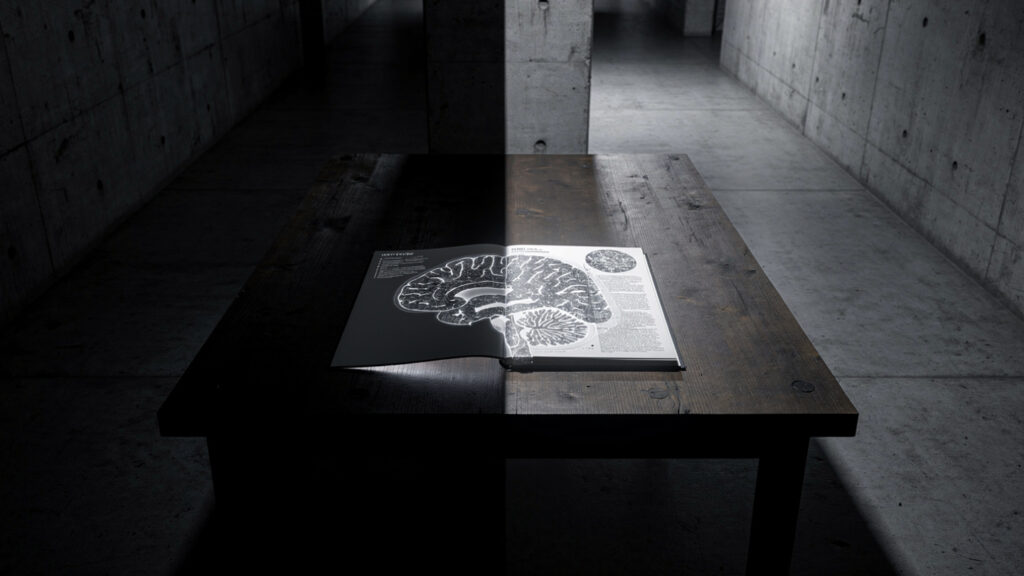
This is not necessarily a conspiracy. It is how disciplines protect explanatory continuity. Neuroscience studies brains. Pharmacology studies molecules. Psychology studies subjective experience. Physics studies physical systems. History studies texts. Each discipline develops methods that work within its own boundaries. The problem appears when the findings are placed beside one another and begin to describe the same architecture from different directions.
Then the boundaries become the problem.
The DMT literature does not prove an external realm. Split-brain research does not prove a disembodied consciousness. Default-mode-network suppression does not prove that psychedelics reveal objective reality. But taken together, they make the simplistic equation brain = consciousness less satisfying than it appears at first glance. The brain is demonstrably involved in constructing the form of ordinary consciousness. The question is whether it also generates consciousness in the strongest possible sense, or whether it regulates an underlying process whose relationship to the physical substrate is more complicated.
What the Hardware Implies
Consider what the biological architecture actually contains. A central endocrine structure participates in the regulation of biological time and possesses biochemical machinery associated with DMT synthesis. A massive communication pathway integrates the two cerebral hemispheres so thoroughly that severing it can expose partially independent streams of processing. A distributed network helps maintain the autobiographical self and the ordinary narrative through which experience is organized. Psychedelic compounds can destabilize that network while producing radically altered forms of consciousness. The same brain that constructs the ordinary interface therefore contains mechanisms capable of disrupting the interface.
That is not proof of design. Evolutionary biology provides many ways for complex systems to acquire functions that were not consciously engineered. The mere presence of a mechanism does not establish an architect. But it does establish architecture. And once architecture exists, the correct scientific question is what the architecture is doing.
The Architects piece found the maintenance signature in the physics equations. The Maintenance piece found active intervention across three independent research programs. The UAP piece found the phenomenon becoming visible at the threshold of nuclear weapons development. This article moves the investigation inward. The architecture is no longer in the equations or in distant observations. It is inside the biological substrate through which every human observer experiences the world.
The pineal gland is part of the chemistry. The corpus callosum is part of the integration. The default mode network is part of the interface. The brain is not merely the object through which consciousness is studied. It is the instrument doing the studying.
The series has been moving from the cosmic to the intimate. The firmware is in the physics. The maintenance is in the research programs. The inspection appears at the nuclear threshold. Now the hardware is in the brain.
And that changes the question.
The question is no longer simply whether the system is maintained. The preceding articles have built a case for that hypothesis, whether the case is strong enough to carry outside the framework of the series is a separate question this article does not resolve. The question now becomes what the maintenance is maintaining. What exactly is the biological interface protecting consciousness from? What information does the ordinary self-model prevent from reaching awareness? And when that model is temporarily loosened, through chemistry, trauma, meditation, physiological crisis, or other threshold conditions, does consciousness encounter a deeper layer of reality, or does the brain simply produce a more elaborate internal simulation?
Those possibilities are not equivalent. And they cannot be separated by philosophy alone.
They require evidence.
That is why the convergence with the other bypass phenomena matters. Strassman’s volunteers described encounters with apparently autonomous entities in environments that felt more real than ordinary waking experience. Van Lommel’s cardiac arrest patients described accurate observations associated with experiences occurring under conditions of severe physiological compromise. Wheeler’s delayed-choice experiment exposed the strange relationship between measurement and the behavior of quantum systems. The STARGATE program produced reports of information obtained under conditions designed to test anomalous perception.
These findings do not all prove the same thing. They should not be forced into a single conclusion merely because they are interesting. But they do create a recurring experimental question: can the ordinary human interface be bypassed, and if it can, does anything beyond the ordinary interface remain consistent enough to be investigated?
Four possible bypasses. Four different bodies of evidence. One unresolved destination.
The brain makes DMT, and the scientific question is not why a psychedelic drug can produce hallucinations. That question is easy. The deeper question is why the biological system contains the machinery for producing one of the most radical known disruptions of the ordinary self-model at all. Roger Sperry found that the integrated human mind can become partially divided when the architecture integrating the hemispheres is severed. Neuroimaging research found that the network involved in maintaining the ordinary self changes profoundly during psychedelic states. And across the phenomenology of those states, subjects repeatedly report that when the ordinary interface becomes less dominant, experience does not simply become emptier.
It becomes larger.
The hardware is real. The chemistry is real. The split-brain effect is real. The neuroimaging findings are real. The experiences are real as experiences. The unresolved question is what they mean.
The strongest conclusion the evidence currently supports is not that neuroscience has proved a simulated universe, a hidden dimension, or an external intelligence. It has not. The stronger conclusion is that the ordinary human experience of reality depends upon an active biological interface, and that interface can be altered, divided, disrupted, and temporarily bypassed. The brain does not merely passively receive the world. It constructs the form in which the world becomes available to consciousness.
If the computed-system framework is correct, that is precisely what a biological terminal would do. It would maintain a stable user interface, compress overwhelming information into a navigable representation, preserve the identity of the observer, restrict access to system-level information, and contain mechanisms through which the interface could be disrupted under exceptional conditions.
The pineal system would belong to the chemistry of the release mechanism. The corpus callosum would belong to the integration architecture. The default mode network would belong to the ordinary interface.
And all three can be disrupted.
That does not establish what, if anything, lies beyond the interface. What it shows, in ordinary neuroscientific terms with no need for a larger framework, is that brain function operates as a regulator and filter, not a passive recorder. Whether that regulator is the interface this series has proposed remains the open question.
What is at the other side is the question this series has been building toward from the beginning.
The Architects piece proposed the architecture. The Maintenance piece argued for active intervention. The Map piece assembled the pre-catastrophe transmission claims. The Catastrophe piece argued for a temporal convergence. The UAP piece argued the pattern at the nuclear threshold fits an inspection model. This piece asks whether the same model extends inward, into the biological interface itself.
The progression is deliberate. First the system. Then the maintenance. Then the map. Then the catastrophe. Then the inspection. Now the hardware.
And once the hardware is understood, the final question becomes unavoidable: if consciousness can move beyond the ordinary interface, what exactly does it encounter when it does?
The next piece turns to the oldest layer of the record to see whether it changes the question.
John C. Lilly’s isolation tank work belongs on the same map, a credentialed researcher’s serious investigation into altered consciousness that ended somewhere far stranger than his own original neuroscience.