



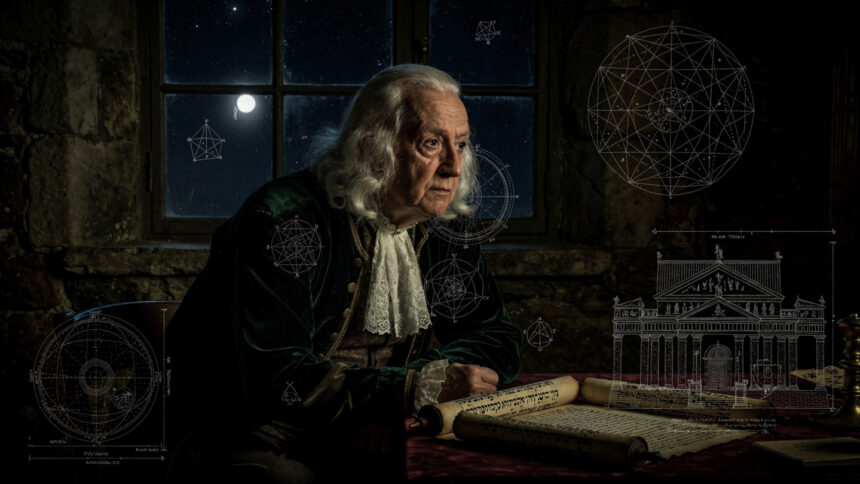
The collected theological manuscripts of Isaac Newton run to approximately 1.3 million words. His mathematical and scientific work, the work for which every educated person in the world knows his name, runs to approximately one million words. The theological writing is longer. It occupied more of his intellectual energy across his lifetime than the Principia, the Opticks, the calculus, the laws of motion, and the theory of universal gravitation combined.
This is not a marginal biographical detail. It is the central fact of Newton’s intellectual life that the conventional history of science has systematically suppressed since his death in 1727. The suppression was deliberate. When Newton’s papers were examined by the Royal Society after his death, they were found to contain extensive theological and alchemical material that his executors considered too dangerous to his reputation to publish. The papers were withheld from the scholarly community and from the public.
They remained withheld for over two hundred years.
In 1936, the economist John Maynard Keynes purchased a substantial portion of Newton’s theological and alchemical manuscripts at auction from the Portsmouth Collection. Keynes spent the following decade reading them. His assessment, delivered in a lecture to the Royal Society of Arts in 1942, is the most honest description of what Newton actually was that any mainstream scholar has produced.
Newton was not the first of the age of reason. He was the last of the magicians, the last of the Babylonians and Sumerians, the last great mind which looked out on the visible and intellectual world with the same eyes as those who began to build our intellectual inheritance rather less than ten thousand years ago.

Keynes understood something that the conventional history of science has been unable to accommodate: Newton’s intellectual project was not the construction of modern physics. It was the recovery of the ancient wisdom that he believed had been encoded in the Bible, in the architecture of the Temple of Solomon, and in the prophetic texts of Daniel and Revelation, and that had been lost through the centuries of corruption and misinterpretation that the church had imposed on the original transmission.
The Yahuda Collection
The manuscript collection that preserves Newton’s prophetic research most extensively is the Yahuda Collection, purchased in 1940 by Abraham Shalom Yahuda, a scholar of Semitic languages, from the same Portsmouth sale that Keynes purchased from. Yahuda acquired the theological manuscripts specifically. He recognized their significance and spent the remaining years of his life attempting to have them published.
They were not published during his lifetime. After his death in 1951, the collection passed through a series of institutional arrangements and was eventually acquired by the National Library of Israel in Jerusalem, where it is currently held. The manuscripts are partially digitized and accessible through the National Library’s online archive.
The Yahuda Collection contains Newton’s extended commentaries on the Book of Daniel, the Book of Revelation, the prophecies of Ezekiel, and related prophetic texts. The manuscripts are written in Newton’s hand, revised and reconsidered over decades, and show the same systematic and methodical approach that characterizes his scientific work. This is not casual spiritual reflection. It is the sustained application of the same intellectual methodology that produced the Principia to the problem of prophetic calculation.

The thesis Newton developed across these manuscripts was that the prophetic texts of the Bible encode a continuous historical timeline that, correctly interpreted, allows the prediction of future events including the Second Coming and the end of the present world order. His calculation methodology was specific: identifying the symbolic vocabularies of the prophetic texts, developing consistent interpretive rules for translating symbolic language into historical and temporal referents, and applying these rules systematically to produce date calculations.
His conclusion about 2060 is the most cited element of the Yahuda material in public discussion. But the 2060 figure is extracted from a context that most discussions of it do not develop. Newton did not predict that the world would end in 2060. He calculated that the prophetic timeline he had derived from the Book of Daniel indicated that the present world order could not survive beyond 2060. His language, recorded in the letter held at the Hebrew University, was that he named 2060 as the earliest possible date, not the predicted date, specifically to prevent the kind of prophetic hysteria that he observed among his contemporaries.
This is not the behavior of a crank predicting the Apocalypse. It is the behavior of a serious scholar establishing a lower bound on a calculation while explicitly warning against treating that lower bound as a definitive date.
The Prisca Sapientia
Newton’s prophetic research was not conducted in isolation from his scientific work. It was conducted as part of a unified intellectual project whose premise was the existence of an ancient wisdom tradition, which he called the prisca sapientia, the pristine wisdom, that had been transmitted from antiquity through channels and that contained the complete knowledge of natural philosophy, theology, and prophecy in an integrated form.
This premise is well established across Newton’s published and unpublished work. In the Scholium to the Principia’s Propositions, Newton explicitly states that the ancient Pythagoreans knew the inverse square law of gravitational attraction and encoded it in the musical intervals they attributed to the planetary orbits. In the unpublished manuscript known as the Classical Scholia, he attributes elements of his gravitational theory to ancient Egyptian, Greek, and Phoenician sources.
The prisca sapientia tradition that Newton was recovering is the same tradition that the Gnostic Transmission piece in this library covers through its institutional channels: the transmission from Alexandria through the Neoplatonists, the Islamic preservation period, Ficino’s Corpus Hermeticum translation, and the Rosicrucian and Freemasonic traditions. Newton was working at the same tradition from the Cambridge end, recovering the ancient knowledge through philological and mathematical analysis of the primary texts rather than through initiatory transmission through the esoteric orders.
His position within the Rosicrucian tradition of his period has been recorded by historians of science including Betty Jo Dobbs and Richard Westfall, whose biographies of Newton establish the extent of his engagement with alchemical and hermetic literature. Newton’s alchemical manuscripts, also in the Yahuda Collection and in Cambridge University Library, show extensive familiarity with the same hermetic sources that the Rosicrucian tradition transmitted through its institutional channels.
Newton was simultaneously recovering the prisca sapientia through the alchemical and hermetic channels, through mathematical analysis of ancient astronomical knowledge, and through the prophetic texts of the Bible. His understanding was that these three channels were different encodings of the same original knowledge, and that the correct interpretation of each would ultimately converge on the same conclusions.
This is the intellectual framework within which his prophetic research makes sense. He was not a religious enthusiast applying religious reading to biblical texts. He was a systematic scholar applying the same methodology to prophetic texts as to physical phenomena, on the premise that both encoded the same ancient knowledge in different symbolic vocabularies.
The Book of Daniel and the Prophetic Timeline
The prophetic text that Newton devoted the most systematic attention to was the Book of Daniel, the Hebrew prophetic text whose visions Newton believed encoded a precise historical timeline extending from the Babylonian period through to the end of the present world order.
Newton’s interpretation of Daniel was developed against the background of the interpretive tradition that stretched from the early church fathers through the Protestant Reformation. The element that distinguished Newton’s approach from his predecessors was his insistence on applying consistent symbolic rules rather than ad hoc interpretations chosen to fit predetermined conclusions.
His symbolic vocabulary for Daniel included: the year-day principle, by which prophetic periods expressed in days referred to years of historical time; the identification of beasts and figures with historical kingdoms and rulers, established by internal consistency across multiple prophetic passages rather than by external historical matching; and the mathematical structure of the prophetic periods, which Newton analyzed for their relationship to known astronomical cycles.
The 1,260-day period that appears in multiple forms across Daniel and Revelation, as 1,260 days, as 42 months, and as a time, times, and half a time, was the central numerical element of Newton’s prophetic calculation. Applying the year-day principle, 1,260 days becomes 1,260 years. Newton’s calculation of when this period began, based on his interpretation of the historical events that the text’s symbolic language described as its starting point, produced his 2060 calculation by adding 1,260 years to the period he identified as the beginning of the prophetic period.
His identification of the starting point appears in the Yahuda manuscripts and was 800 CE, the year of Charlemagne’s coronation as Holy Roman Emperor, which Newton identified with the prophetic event described in Daniel as the establishment of the power that would reign for the 1,260-year period. 800 plus 1,260 equals 2060.
The methodology, applying consistent rules to the prophetic text to produce a calculation rather than choosing a desired conclusion and finding textual support for it, is what makes Newton’s prophetic work different from the prophetic hustles that the source material catalogs. He was not predicting the end of the world for personal or institutional gain. He was applying the same systematic methodology to an interpretive problem that he applied to the orbit of a comet.
Whether the methodology is correct depends on whether the premises are correct: that the prophetic texts encode genuine historical information through a consistent symbolic vocabulary, that the year-day principle is the correct interpretive rule for the time periods, and that Newton correctly identified the historical starting point for the 1,260-year period. Each of these premises is debatable. None of them is obviously absurd given Newton’s overall intellectual framework.
The Temple of Solomon and the Encoded Architecture
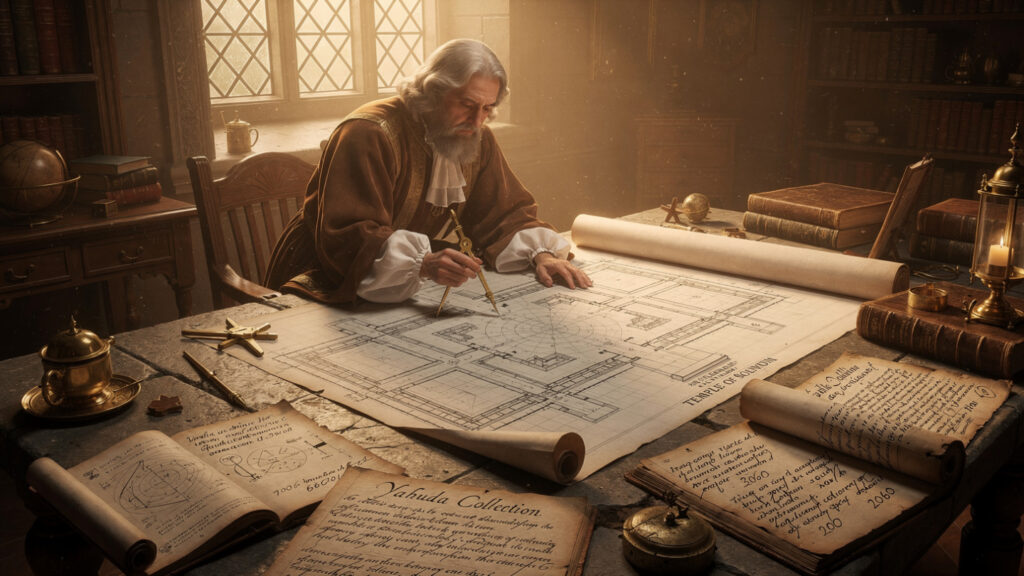
Newton spent years reconstructing the architecture of the Temple of Solomon from the descriptions in the Hebrew Bible and the account in Josephus. The reconstruction appears in his manuscript known as The Temple of Solomon, which describes the Temple’s dimensions, spatial relationships, and proportional system in detail.
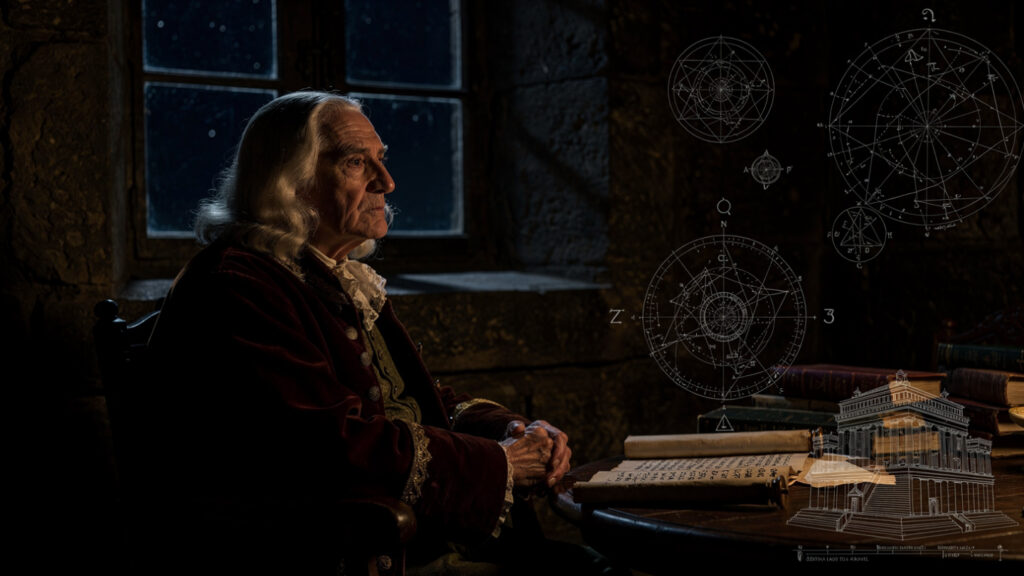
His motivation for this reconstruction was not architectural. It was prophetic and physical. Newton believed that the Temple of Solomon’s architecture encoded the same ancient knowledge that his gravitational theory had recovered from astronomical sources, and that the proportional system of the Temple would provide the key to unlocking the prophetic texts’ numerical encoding.
The connection Newton drew between the Temple’s architecture and the prophetic texts of Ezekiel and Revelation, which describe visionary temples with dimensions and spatial relationships, allowed him to use the reconstructed Temple as an interpretive key for the prophetic numerical codes. This cross-referencing of architectural and textual evidence is the same comparative methodology that the Egypt cluster’s analysis of the Great Pyramid’s astronomical alignments uses: treating the physical structure as an encoded document whose dimensions carry information about the natural world and the historical timeline.
Newton’s conclusion from the Temple analysis was that the ancient builders of the Temple possessed mathematical knowledge of the Earth’s dimensions and its relationship to the astronomical system that the conventional history of science places as a much later development. This conclusion, recorded in his manuscripts, anticipates the archaeoastronomy tradition by two centuries and is consistent with the claims about ancient astronomical knowledge that the Egypt, Anunnaki, and Lost Civilizations pieces in this library document from different evidentiary directions.
The Arian Theology and Its Implications
Newton’s theological manuscripts reveal an aspect of his religious beliefs that his contemporaries and immediate successors suppressed more thoroughly than any other element of his legacy: he was an Arian, meaning he rejected the doctrine of the Trinity and believed that Jesus Christ was a created being of a different and lesser nature than God the Father.
This position was heresy in the England of Newton’s time. The Test Acts required affirmation of the Trinity as a condition of university appointment and public office. Newton held both the Lucasian Professorship at Cambridge and a seat in Parliament. Both would have been forfeit had his theological position been publicly known.
He concealed it throughout his life. The evidence of his Arianism is documented exclusively in his unpublished manuscripts, where he developed the theological argument for the Arian position with the same methodical precision he applied to everything else.
His Arian argument was not primarily theological in the devotional sense. It was historical and textual: the Trinitarian doctrine was a corruption introduced into the Christian tradition by the Council of Nicaea in 325 CE, a politically motivated interpolation that distorted the original Christian tradition to serve the institutional interests of the Roman church. The original tradition, which Newton identified with the prisca sapientia, knew that the divine reality was not Trinitarian in the orthodox sense.
This position connects directly to the Gnostic tradition covered in this library’s Gnostic Transmission piece, which treats the Council of Nicaea as the institutional mechanism by which the Catholic church suppressed the Gnostic and other heterodox traditions that preserved the original Christian knowledge. Newton arrived at this conclusion through textual analysis of the primary documents rather than through esoteric transmission, but he arrived at the same conclusion.
His Arianism also explains the character of his prophetic research. An orthodox Trinitarian reading of the prophetic texts treats them as predicting theological events in a framework the church controls. Newton’s Arian reading treats them as encoding historical information in a symbolic language that the church has deliberately obscured to maintain its institutional authority. The prophetic timeline he reconstructed was not a product of church doctrine. It was what the original texts said when the church’s interpolations were stripped away and the original symbolic vocabulary was restored.
The Newton Papers and the Institutionalized Suppression
The institutional history of Newton’s theological manuscripts is one of the clearest recorded cases of deliberate academic suppression in the history of scholarship.
When Newton died in 1727, his papers passed to his niece’s husband, John Conduitt. The Royal Society examined the papers and recommended against publication of the theological and alchemical material on the grounds that it would damage Newton’s reputation and the reputation of natural philosophy generally. The decision was made by the institution that had been the primary beneficiary of Newton’s scientific reputation to protect that reputation by hiding the intellectual context within which the scientific work had been produced.
The papers were retained in the Portsmouth family archive for over two centuries. They were not included in the various collected editions of Newton’s works published throughout the eighteenth and nineteenth centuries, editions that shaped the image of Newton as the archetypal rationalist scientist. The image was accurate for the published work. It was systematically incomplete as a description of Newton’s intellectual life.

When the papers were finally sold at auction in 1936, their existence was already known to specialists but their content was not. Keynes and Yahuda purchased the two largest collections. Keynes died in 1946, having delivered one lecture about what he had found but having not published a systematic analysis of the manuscripts. Yahuda died in 1951 having attempted to publish the manuscripts without success.
The manuscripts entered institutional collections, were partially catalogued, and were available to specialists for decades before the digital access that makes them currently available through the National Library of Israel’s online archive. The systematic scholarly analysis of their content, which a text corpus of 1.3 million words by one of the most important figures in the history of science deserves, began seriously only in the late twentieth century with the work of scholars including Dobbs, Westfall, and Rob Iliffe.
The suppression was not a conspiracy in the operational sense. It was the rational self-interest of an institution whose authority derived from the image of rational scientific Newton, protecting that image from the complication of prophetic and alchemical Newton. The result was the same as a conspiracy: two centuries of incomplete historical record, a public image of Newton as a rationalist that was accurate for his published work and false for his intellectual life as a whole, and a tradition of dismissing prophetic and hermetic scholarship as irrational that drew its authority partly from the false image of its most prestigious figure.
What Newton Was Recovering
The thesis running across Newton’s theological manuscripts, that the prophetic texts of the Bible encode a precise historical timeline that the correct interpretive methodology can recover, is a version of the same claim that the Gnostic tradition, the Hermetic tradition, and the esoteric transmission chain covered in this library all make from different starting points: that the ancient knowledge was encoded in multiple transmission channels, that the encoding was deliberate, and that the recovery requires methodological tools that the institutional frameworks of religion and science have both obscured.
Newton’s methodological tools were philological, mathematical, and architectural: the careful comparative analysis of textual vocabularies across multiple prophetic books, the application of consistent symbolic rules derived from internal analysis of the texts rather than from external theological tradition, and the cross-referencing of textual numerical systems with architectural proportional systems and astronomical cycles.
His conclusion that 2060 represents a significant threshold in the prophetic timeline is not a prediction of the end of the world. It is a calculation of the endpoint of a historical period that the prophetic texts describe as a 1,260-year reign of an institutional power. What happens after the end of that period the texts describe as the beginning of a different world order, not the annihilation of the physical world.
This eschatology is consistent with the Fourth Turning framework covered across this library’s Prophecy and Cyclical Time pieces, with the Zep Tepi astronomical encoding that the Egypt pieces cover, and with the broader cyclical model of civilizational history that the solar minimum piece and the volcanic convergence piece develop. The prophetic timeline Newton calculated is not an isolated biblical claim. It is one data point in the multi-source convergence that this library has been building toward a consistent framework for understanding the current period.
Newton spent forty-six years working on the prophetic research. He considered it the most important work of his life. He did not publish it.
His executors decided it was too dangerous for his reputation.
His manuscripts are in Jerusalem, partially digitized, available to anyone with an internet connection.
The last of the magicians worked it out. He just never told anyone.