



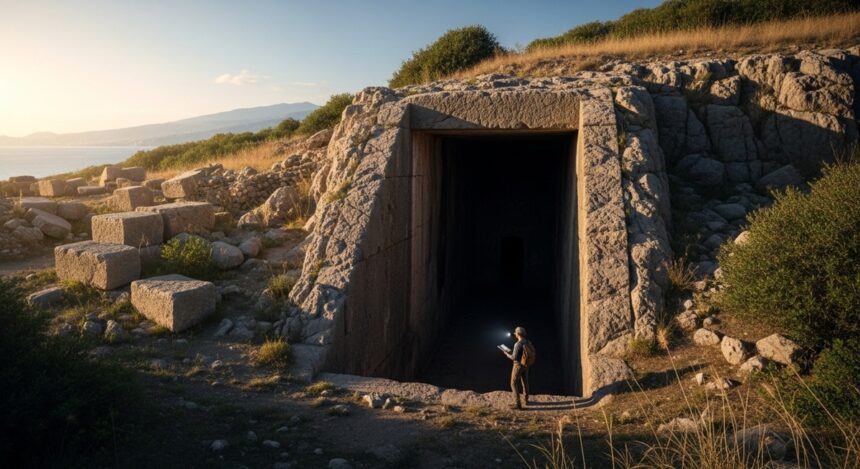
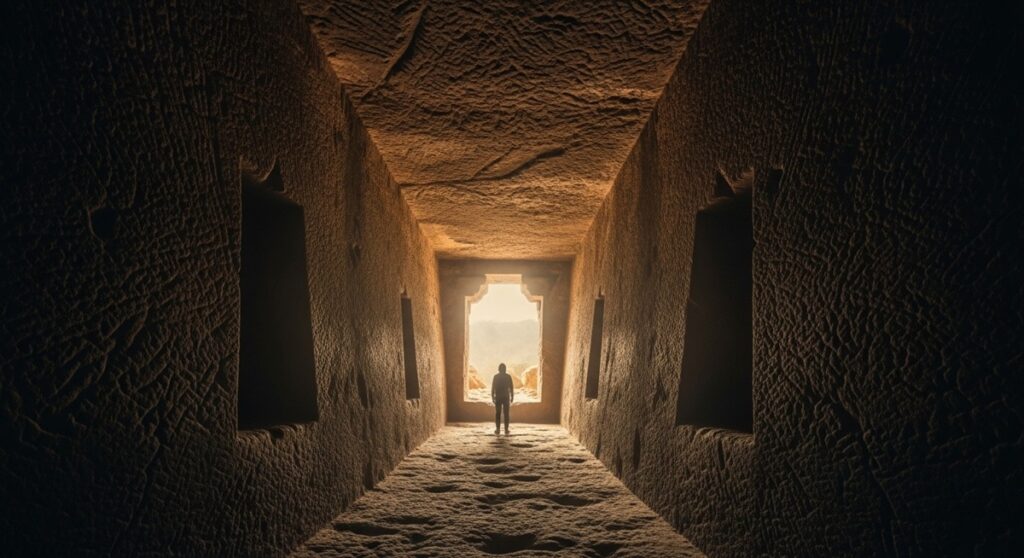
Deep beneath the ancient acropolis of Cumae, west of Naples, is a tunnel so precisely cut into volcanic tuff that its geometry has become part of a much larger mystery. The passage is more than 131 metres long. Its walls create a distinctive trapezoidal profile. Ancient literature places the Cumaean Sibyl in this landscape, and Amedeo Maiuri identified the tunnel as her legendary cave when he excavated it in 1932. But there is an important problem with the story: the archaeology does not establish that this was actually the Sibyl’s cave, and the modern archaeological park now interprets the monument primarily as a military gallery. The trapezoid is real. The ancient engineering is real. The global blueprint is not.
That distinction matters because Cumae does not need a vanished civilization to become extraordinary. The site already contains Greek colonization, Roman military engineering, volcanic geology, ancient oracle traditions, later Christian reuse, and a tunnel whose acoustics really can carry a human voice along its extraordinary length. What has happened over time is something more familiar: a genuine ancient structure acquired a legendary identity, the identity became attached to a striking architectural feature, and the feature was then compared with superficially similar shapes elsewhere in the world until resemblance began to look like evidence of common origin, the same pattern examined at length in the forbidden archives of the lost earth, Hyperborea, inner earth, and the Atlantean cataclysm. The more closely the archaeology is examined, the less necessary that leap becomes, and the more interesting the actual history gets.
The Cave Was Discovered in 1932. The Sibyl Wasn’t
The first fact to get straight is the chronology. Amedeo Maiuri excavated the gallery in 1932 and proposed that it was the Antro della Sibilla described through the literary tradition surrounding Cumae and, above all, Virgil’s Aeneid. The identification was compelling because the gallery has features that can be made to resemble Virgil’s description: a long, dark passage, numerous openings, and an interior complex that can be interpreted as a place where an oracle might have operated. But an interpretation based on literary resemblance is not the same thing as an archaeological identification. The current Parco Archeologico di Cuma is considerably more cautious: its official description interprets the monument as a military gallery cut into the tuff to protect the southern-western edge of the acropolis, probably constructed in the Samnite period between the late fourth and early third centuries BC. The name “Antro della Sibilla” survives because Maiuri’s identification became culturally dominant, not because an inscription was found saying that the Sibyl worked there.
That uncertainty is not a weakness in the story. It is the story. Archaeology often works by accumulating probabilities rather than recovering labels left behind by the builders themselves. The gallery’s architecture provides evidence for what it could have done, its position provides evidence for why it may have been built, later modifications reveal how subsequent populations reused it. None of those things automatically prove that the priestess described by Virgil stood at the end of this particular corridor. Indeed, other underground structures in the Cumae and Baiae area have also been proposed in connection with the ancient literary tradition. The sensible conclusion is therefore narrower and stronger: this is a real ancient gallery whose later identification with the Sibyl became extraordinarily influential, but the archaeological identity of the original oracle site remains a question rather than a solved inscriptional fact.
The Trapezoid Is Real. But It Doesn’t Encode a Global Civilization
The architecture itself is impressive. The gallery runs roughly 131.5 metres through volcanic tuff, with a distinctive cross-section and lateral openings that bring light into the passage. Earlier descriptions often emphasized the trapezoidal profile as though it were a mysterious signature, but the archaeological record gives us a much more concrete observation: the gallery was originally trapezoidal, and later alterations changed the floor level and therefore the apparent proportions of the surviving section. The official archaeological description specifically notes that the gallery began with a trapezoidal form and was subsequently modified during the Roman period. That is exactly the kind of physical evidence archaeologists want, construction phases recorded in the fabric of the monument, rather than a geometric resemblance interpreted backwards into a lost historical connection.
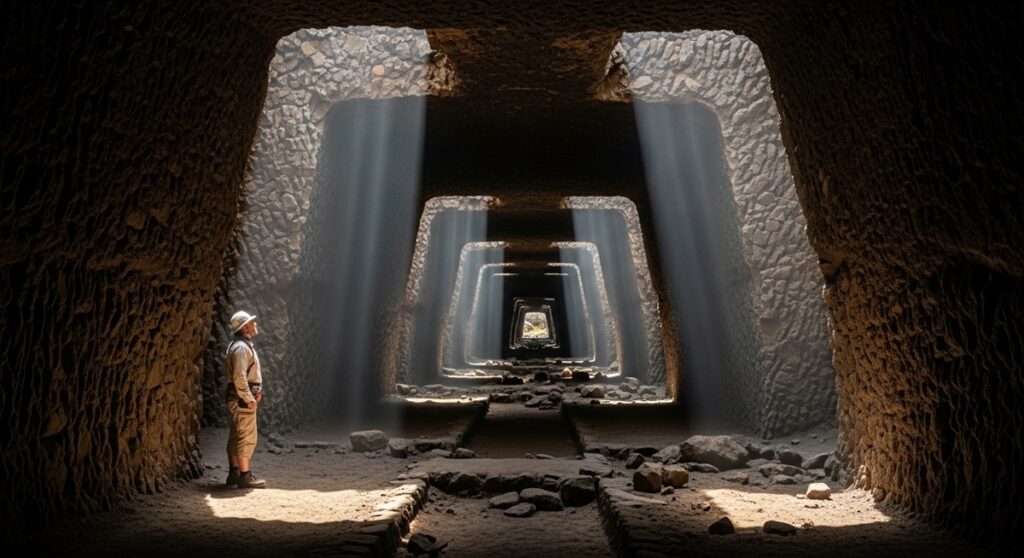
There is a broader engineering principle here, but it needs to be stated carefully. Builders working in earth, rock, masonry, and other materials do not have an infinite number of mechanically sensible ways to make a structure stand. Sloped walls, tapered openings, corbelled roofs, arches, buttresses, retaining walls, and other recurring forms appear repeatedly because gravity and material strength are universal constraints. That does not mean every trapezoid in antiquity had the same function, and it certainly does not prove that every culture independently “discovered the same blueprint.” It means that geometric similarity by itself is weak evidence for historical contact. Before a shared civilization is proposed, archaeologists need the things that actually demonstrate contact: distinctive artifacts, shared construction sequences, inscriptions, technological transfers, datable material, trade networks, or a chain of transmission. A shape alone cannot carry that burden.
This is especially important when comparing Cumae with structures thousands of kilometres away. A trapezoidal doorway at Machu Picchu, a sloping wall in Egypt, an earthen monument in prehistoric Europe, or a shaped chamber in Malta may look related in a photograph while being radically different in material, chronology, function, and construction technique. Similarity is the beginning of an archaeological question, not the answer to it. The moment geometry is treated as a “code,” the reasoning has quietly changed from asking what the builders needed to asking what modern observers want the buildings to mean.
The Tunnel’s Military Interpretation Changes the Story
If the official archaeological interpretation is correct, the trapezoidal geometry becomes even less mysterious. Cumae was not an isolated sanctuary floating outside history. It was a strategic settlement on a volcanic coastal landscape, and its acropolis required defensive infrastructure. The current archaeological interpretation places the gallery within that military context, with its position helping protect the rocky edge of the acropolis. Later Romans altered parts of the complex, including lowering the floor and converting some lateral spaces into cisterns. In the early Christian period, portions of the complex were reused for worship and burial. In other words, the monument itself records changing human priorities: defense, water management, religion, and burial layered onto the same piece of ancient infrastructure.
That sequence is far more revealing than a theory of one mysterious civilization building everything according to a secret geometric language. Ancient structures were rarely frozen at the moment of their original construction. They were repaired, enlarged, repurposed, excavated, filled, drained, converted, and renamed. A modern visitor sees the final surviving geometry, archaeology tries to reconstruct the succession of decisions that produced it. At Cumae, the succession is especially important because the modern name of the monument comes from a nineteenth- and twentieth-century identification layered onto an older structure whose original function may have been quite different.
The Acoustics Really Are Strange, and They’re Measurable
One part of the mystery does have an empirical component: the tunnel’s acoustics. Researchers Gino Iannace and Umberto Berardi performed acoustic measurements and numerical simulations of the Cumaean Sibyl cave, testing how a voice produced near the terminal chamber propagated along the long corridor. Their results found that speech from the interior could remain intelligible along the passage. That does not demonstrate that the tunnel was deliberately designed as an acoustic device, and it certainly does not prove that supernatural forces were involved. It does, however, establish something genuinely fascinating: the physical architecture is capable of producing a communicative acoustic effect that makes the ancient literary image of a voice issuing from a hidden chamber at least acoustically plausible.
That distinction is crucial. Acoustic compatibility is not historical proof. A structure can produce an effect without having been deliberately designed for that effect, and a later religious use can exploit a property that the original builders never intended. But this is precisely what makes the question worth investigating. Instead of claiming that the cave possesses mystical acoustics, researchers can measure the reverberation, model the propagation of sound, and ask what a visitor standing in the tunnel would actually have heard. The mystery becomes testable rather than diminished.
The Sibyl Belongs to a Much Larger Ancient Tradition
The Cumaean Sibyl herself belongs to a much older and broader Mediterranean tradition of prophetic women known collectively as sibyls. Roman authors preserved lists of multiple sibyls associated with different locations, and the Cumaean figure became especially important because Roman literature placed her in the landscape through which Aeneas approached the underworld. Virgil’s Aeneid transformed the local tradition into one of the most influential literary journeys in Western civilization: Aeneas arrives at Cumae, encounters the Sibyl, descends toward the realm of the dead, and receives knowledge about the future of Rome. Later generations then encountered the physical landscape through the literary landscape, making the identification of caves and tunnels with Virgil’s narrative almost inevitable.
This is how mythology and archaeology can become entangled without anyone fabricating anything. A real place acquires a literary association. The literature makes the place famous. Archaeologists later search for the physical setting described by the literature. Once a candidate is found, its features are interpreted through the ancient text. The interpretation then becomes the name by which the monument is known. Visitors eventually encounter the name as though it were an established ancient fact. Cumae is a particularly elegant example of that feedback loop between text, landscape, excavation, and memory.
Lake Avernus Made the Landscape Even Stranger
Just beyond the architecture lies another reason this region generated underworld stories so effectively: geology. Lake Avernus occupies a volcanic crater in the Campi Flegrei, and its ancient reputation as a gateway to the underworld was reinforced by the unusual environmental conditions of the area. The Greek name Aornos was traditionally associated with the idea of a place without birds, while ancient writers described the region as hostile and uncanny. Modern research confirms that Averno is a volcanic lake capable of accumulating geogenic carbon dioxide, providing a real geological background for the area’s long association with unusual gases and dangerous conditions. The geology does not prove every ancient legend, but it helps explain why the landscape was so readily interpreted as a boundary between the living world and the dead.
That is a recurring pattern in ancient religion. Places where the physical environment behaved strangely, such as fumaroles, hot springs, caves, chasms, poisonous gases, earthquakes, unusual echoes, and underground water, were natural candidates for sacred interpretation. Human beings did not need to invent the strangeness. They encountered it first and explained it afterward. Cumae sits inside one of the most geologically active landscapes in Europe, so the association between underground spaces, prophecy, death, and divine presence is hardly difficult to understand.
What the Trapezoid Can and Cannot Tell Us
A geometric pattern becomes historically meaningful only when it is accompanied by a chain of evidence. If two distant structures share a distinctive construction technique, the next questions are chronological and archaeological: Which came first? Did the later builders have access to the earlier one? Are the dimensions and construction sequences genuinely comparable? Are there intermediate examples? Do inscriptions, tools, materials, or settlement patterns provide a transmission route? Without those links, the argument remains visual analogy. A trapezoid can be impressive. It cannot, by itself, transport a civilization across an ocean.
The same discipline applies to claims about astronomical alignments. A tunnel pointing in a particular direction is not automatically an astronomical instrument. Ancient builders certainly understood the sky, and many monuments have demonstrable relationships with celestial cycles. But an alignment becomes evidence only after its orientation, horizon, chronology, construction tolerances, and statistical significance have been established. In the case of this gallery, claims about a special solar alignment should therefore remain claims unless a published archaeoastronomical analysis demonstrates them. Leaving an interesting possibility unresolved is better scholarship than turning an untested alignment into a fact.
A More Complicated, More Honest Mystery
The Cumaean gallery does not need to be a surviving fragment of a forgotten global civilization. It does not need to encode an ancient engineering language shared by cultures that left no demonstrated chain of contact. It does not even need to be the literal cave in which the historical Sibyl practiced her oracle. What we actually have is more complicated: a Greek-era settlement, a remarkable rock-cut gallery, later military and hydraulic modifications, Christian reuse, a powerful literary tradition, a volcanic landscape saturated with underworld associations, and a modern archaeological identification that remains debated. That is not a weaker story. It is a much stronger one because every layer can be investigated separately.
The trapezoid is not the message. It is evidence of builders working within a physical world that constrained what they could build and rewarded solutions that survived. The cave is not a proof of lost civilization. It is a record of people cutting, defending, adapting, reusing, and eventually mythologizing a space beneath an ancient acropolis. And the most revealing detail may be the one the sensational version overlooks: even the monument’s famous identity as the Sibyl’s cave is not beyond question.
That is where the real mystery begins. Not with the assumption that someone has hidden the answer, but with the recognition that the evidence itself is still telling us a more complicated story than the legend.