




The Greeks had a word for it.
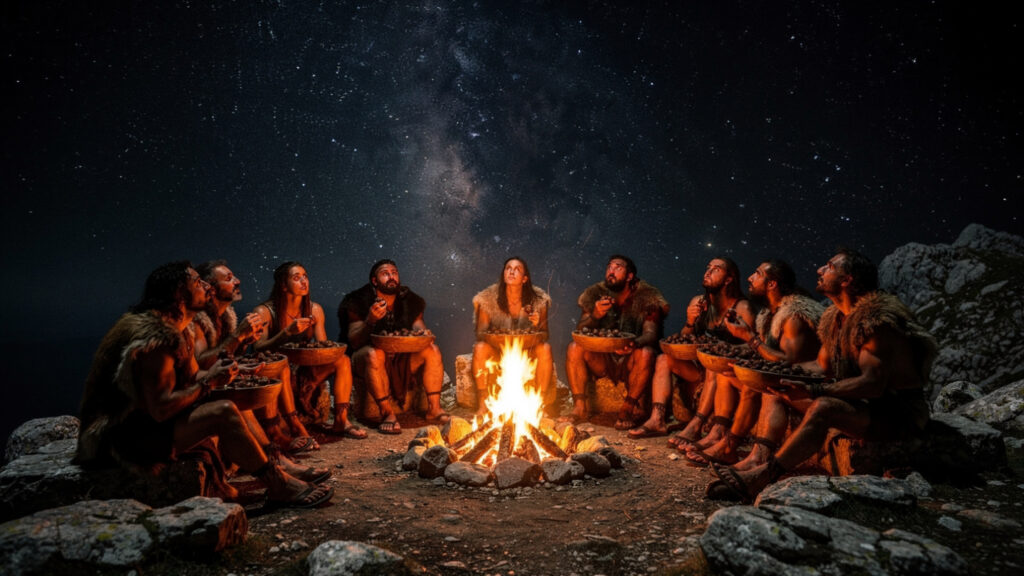
Proselene. Before the Moon. The term appears in multiple classical sources referring to the Arcadians and the Pelasgians, the pre-Hellenic populations of Greece, who believed their ancestors had inhabited their territories in the period before the Moon existed in the sky. Apollonius of Rhodes, writing in the third century BCE, describes the Arcadians as having lived before the Moon, eating acorns on the mountains before the birth of Selene. Stephanus of Byzantium’s Ethnica preserves the same belief, identifying the Pelasgians as Proselenes, people of the pre-lunar period.
These are not the only classical references. Aristotle in Meteorologica discusses astronomical beliefs that include a period before the Moon’s presence. Plutarch in Moralia discusses the Proselenes explicitly, treating the claim as historical rather than mythological. Democritus and Anaxagoras addressed the Moon’s origin in their cosmological writings in ways that treat it as a distinct arrival event rather than as a primordial feature of the sky.
Five named classical philosophers and historians, working from independent sources across a period of several centuries, all reference the belief that the Moon arrived at a historical moment within human memory. That belief is consistent enough across these independent classical sources to have generated a Greek vocabulary for the people who lived before it arrived.
The Greek Proselene material above is genuinely well attested, it appears across multiple named classical authors writing independently over centuries. The four accounts that follow are not sourced with the same rigor, and the library’s evidentiary standard requires flagging that difference up front rather than presenting all five as equally solid. Some of what follows draws on specific named sources that could not be independently verified against academic ethnographic or historical literature in the course of preparing this piece, and readers should weigh the Colombian, Tiwanaku, Indian, Chinese, and Egyptian material accordingly, as considerably less certain than the classical Greek record above.
The Bogota Highland Account
The indigenous peoples of the highland region around Bogota in Colombia are said to maintain an account describing the world before the Moon’s arrival in terms whose content is consistent with the Greek Proselene material despite the absence of any known contact between the two.
This Colombian account describes a pre-lunar world in which all life was larger than at present: trees, animals, birds, and humans all grew to dimensions that the Moon-present world does not support. It attributes the reduction in biological scale to the Moon’s arrival, which changed the atmosphere in ways that made the previous growth scales impossible to maintain.
The timing this account gives, approximately nine to ten thousand years ago, falls within the Younger Dryas to early Holocene period, the period of the most significant post-glacial transition recorded in the geological record. The Younger Dryas, dated to approximately 12,900 to 11,700 years ago, was a period of abrupt climate reversal, the return of near-glacial conditions during the post-glacial warming, that produced major changes in flora, fauna, and human population across the planet. Whether this timing reflects the Younger Dryas or a different event is not established, but the general epoch is consistent with a major planetary transition.

The claim that the Moon appeared overnight rather than through a gradual process is the most extraordinary element of the Colombian account. It is also the claim most often paired with the Hollow Moon hypothesis covered in this library’s dedicated piece, though as noted above, the physical case for that hypothesis is weaker than it is usually presented.
This account does not describe the Moon’s arrival as a natural event. It describes it as something that happened to the world, changing it in ways its people experienced as catastrophic.
The Tiwanaku Calendar
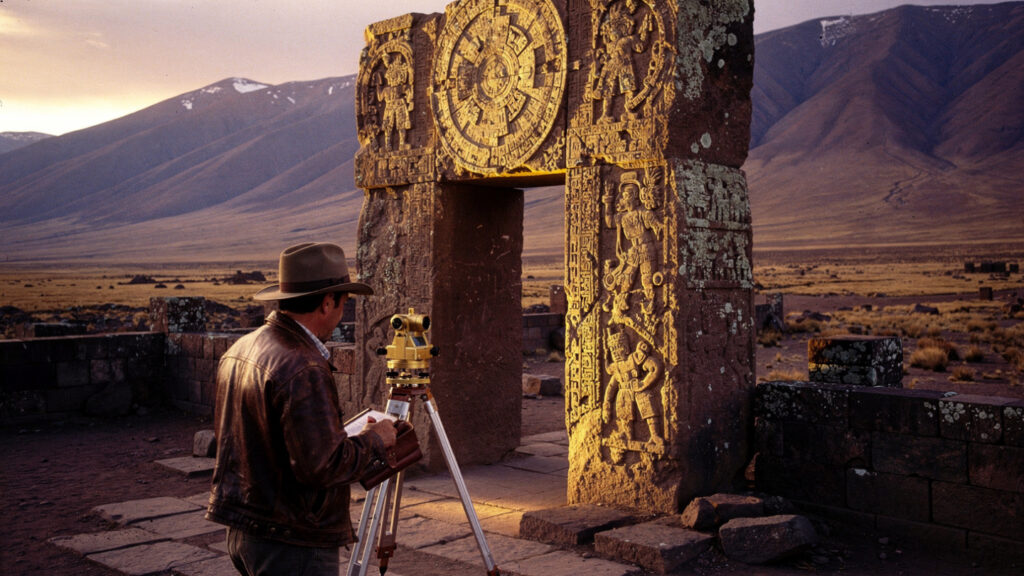
The ruins of Tiwanaku in Bolivia, one of the most significant pre-Columbian archaeological sites in South America and a site whose origins and dating remain contested within the Andean archaeological community, contain astronomical alignments whose implications connect to the pre-lunar material described above.
Arthur Posnansky, a Bolivian-German archaeologist and engineer who spent decades studying the Tiwanaku site in the early twentieth century, published a four-volume analysis of the site’s astronomical alignments between 1945 and 1958. His methodology was to calculate the astronomical epoch to which the site’s primary alignment corresponded, using the known rate of change of the Earth’s obliquity to work backward from the current alignment to the original calibration date.
His conclusion was that the site’s primary astronomical alignment was calibrated to an epoch approximately 15,000 to 17,000 years before the present, significantly older than the conventional Tiwanaku dating of approximately 1500 BCE to 700 CE. Posnansky’s calculation has been disputed by subsequent archaeoastronomers who argue that his methodology contains errors and that a corrected calculation produces a later date more consistent with the conventional archaeological dating.
Whether Posnansky’s date is accurate or not, what is claimed about the site’s astronomical function includes the assertion that the Tiwanaku calendar recorded a period when the year was 290 days long. A year of 290 days is inconsistent with the Earth’s current orbital period but could reflect a different astronomical configuration of the Earth-Moon system, in which the Moon’s gravitational influence on the Earth’s rotation and axial dynamics was different from the current configuration.
The Moon’s presence significantly affects the Earth’s rotational dynamics and axial stability. The Earth’s axial tilt is stabilized by the Moon’s gravitational influence. Without the Moon, the Earth’s axial tilt would be significantly more variable on geological timescales, producing climate variability far greater than what the current Moon-stabilized system generates. Whether the Earth’s rotation rate would be different in the absence of the Moon depends on the angular momentum of the pre-lunar Earth-Moon system, which is not calculable from these accounts alone.
The 290-day year claim is consistent with a higher Earth rotation rate in the pre-lunar period, which tidal interactions with the Moon have gradually slowed over time. The Earth’s rotation rate has been decreasing throughout the geological record, measurable in the daily growth bands of ancient corals, and the current rate reflects billions of years of lunar tidal braking. A significantly faster rotation rate in a hypothetical pre-lunar period is physically plausible, though whether it would produce a 290-day year at the relevant epoch is a calculation that requires assumptions about the pre-lunar angular momentum.
The Indian and Chinese Accounts
The belief in an artificial Moon constructed by divine agency and placed in orbit for a purpose is recorded across multiple Sanskrit texts within the Puranas. The Hollow Moon piece in this library covers the physical aspects of this claim. Its connection to the pre-lunar material above adds a temporal dimension: the claim is not that the Moon is ancient and was always there in its artificial form. It is that the Moon was constructed and placed deliberately at a moment in the history of the divine-human relationship.
The stated purpose in this account, that the Moon was placed to close portals through which malevolent entities were accessing the terrestrial realm, connects to the broader framework of the Watchers and Nephilim pieces in this library. Whether the portals being closed are the magnetic reconnection points recorded in the NASA portal piece, the geographic vortex points recorded in the Sanderson icosahedral geometry, or something else entirely that the available framework cannot fully characterize, is a question these accounts raise without resolving.
A Chinese account attributed to a monk named Yu Bao Zi, said to be writing in the fourth millennium BCE from sources he describes as significantly older than himself, connects the Moon’s arrival to changes in agricultural productivity and to the disruption of an existing calendar system. The agricultural productivity claim is consistent with the Colombian account’s description of a reduction in biological scale. The calendar disruption claim is consistent with the Tiwanaku claim of a pre-lunar year of different length. The consistency across three independent accounts from three continents in their descriptions of what the Moon’s arrival changed is the pattern this piece’s convergence argument treats as significant, though as established above, that pattern says more about shared human responses to a striking idea than about the Moon’s actual age.

The Egyptian material on pre-lunar time is the least developed of what’s covered here, appearing in contexts that Egyptologists classify as mythological rather than as historical claim. The Hollow Moon piece’s connection to the Egyptian gods of the First Time provides the relevant context: the Egyptian account of beings who arrived with technology and a civilizational mission in the Zep Tepi period connects to a pre-dynastic era whose astronomical configuration may have been different from the current one.
What Planetary Science Says About the Moon’s Origin
The Giant Impact Hypothesis is the dominant mainstream account of the Moon’s formation. It proposes that approximately 4.5 billion years ago, a Mars-sized body designated Theia impacted the proto-Earth at an angle, and the debris from the impact coalesced into the Moon over a period of thousands to tens of thousands of years.
The hypothesis has several strengths: it explains the Moon’s relatively low density, which is consistent with material from Earth’s mantle rather than from Earth’s iron-rich core. It explains the Moon’s orbital characteristics. It explains the general similarity between lunar and terrestrial material.
It has a documented problem, the isotopic composition puzzle described below, that the planetary science community is actively working to resolve. Before going further, the library’s evidentiary standard requires stating plainly what that problem is and is not about, because the rest of this piece builds toward a claim the evidence does not support. The Moon’s age of approximately 4.5 billion years is not the contested part of the story. It is established independently by radiometric dating of physical lunar samples returned by the Apollo and Chang’e missions, using multiple different decay systems, including lead-lead and uranium-lead dating of zircon crystals, that converge on the same figure: the oldest dated lunar material is approximately 4.46 billion years old, meaning the Moon itself is at least that old. This is not a single disputed measurement. It has been independently replicated across different sample sets, different laboratories, and different research teams over more than fifty years, including a 2023 re-analysis that pushed the confirmed minimum age even earlier than previous estimates. The isotopic similarity puzzle discussed below concerns the specific dynamics of how the Moon formed during that ancient impact, whether Theia’s material mixed more thoroughly than the standard model predicts, not whether the Moon is ancient at all. Nothing in the current isotopic debate proposes, or is compatible with, a Moon that formed within the last several thousand years. The pre-lunar accounts collected later in this piece describe something real about human cultural memory and deserve to be taken seriously as such. They do not describe something the physical evidence permits as literal planetary history, and the closing framing this piece would otherwise offer, that these accounts plus the isotopic puzzle together leave the Moon’s age as a genuinely open question, is not a conclusion the evidence supports.
The most significant problem is the isotopic composition similarity between lunar and terrestrial material. Different bodies in the solar system formed from material with slightly different isotopic signatures, reflecting the mix of presolar material and stellar nucleosynthesis products that condensed in different regions of the protoplanetary disk. Earth and the Moon show an unusually high degree of isotopic similarity, including in oxygen, tungsten, silicon, and other elements whose isotopic ratios are typically used to distinguish between bodies from different parts of the solar system.

If Theia was a body from a different part of the solar system, as the Giant Impact Hypothesis requires, it should have had a different isotopic signature that would appear in the Moon’s composition. The Moon’s composition is instead almost indistinguishable from Earth’s. This is the isotopic paradox that several research groups have proposed modifications to the standard Giant Impact model to address.
The proposed modifications include scenarios in which Theia formed in the same orbital zone as the Earth, producing isotopic similarity. They include scenarios in which the impact was more energetic than the standard model proposes, completely vaporizing and mixing both bodies’ material before recoalescence. They include scenarios in which the impact was significantly more oblique, producing a different initial disk distribution.
None of these modifications has resolved all of the compositional anomalies simultaneously. The Moon’s origin remains the most actively debated question in planetary science whose resolution is not considered settled.
This is the mainstream planetary science context within which the pre-lunar accounts and the Hollow Moon physical anomalies exist. The mechanics of the Moon’s formation are still being refined in planetary science, but its ancient age is not in question. Its physical properties are described as anomalous in the Hollow Moon piece, though the most cited of those, the seismic ringing detected by Apollo instruments, has a mundane explanation in the Moon’s extremely dry, porous surface material, which transmits vibration very differently from Earth’s water-bearing crust. Multiple independent ancient cultures describe the Moon’s arrival within human memory, which is a genuine and interesting fact about those cultures, independent of what it says about the Moon itself.
The isotopic puzzle and the pre-lunar accounts are both real and both worth taking seriously on their own terms. They do not converge on the conclusion that the Moon is young or artificial. The isotopic puzzle is a question about impact mechanics within an event still dated to roughly 4.5 billion years ago. What is collected here is a question about what pre-scientific cultures believed and why, not a question about lunar geology.
The Younger Dryas and the Timing
The pre-lunar accounts that provide timing place the Moon’s arrival at approximately 9,000 to 10,000 years ago, according to what each culture believed. The Greek Proselene material associates it with the period of the Pelasgians, the pre-Hellenic population, which the archaeological record places in the third to seventh millennium BCE. The Colombian account specifies approximately 9,000 to 10,000 years ago. The Tiwanaku material does not specify a date but connects the pre-lunar calendar to a period whose astronomical parameters were different from the current ones.

The geological period associated with these dates is the transition from the Younger Dryas to the early Holocene, approximately 11,700 years ago, and the subsequent early Holocene period of rapid sea level rise and civilizational disruption that the Lost Civilizations and Atlantis pieces in this library cover from the perspective of what was lost.
The planetary changes that would result from the Moon being placed in orbit at this period are calculable in general terms. The tidal forces immediately following a major addition to the Earth-Moon system would be significantly larger than the current tidal forces, because the orbital stabilization process would take time. Large tidal forces in the immediate post-placement period could, in principle, produce flooding severe enough to explain the flood stories that appear globally in the post-Younger Dryas record, if the Moon’s arrival were real, which the evidence above does not support. The global flood stories from this period, the Plato-derived Atlantis account, the Sumerian flood narrative, the Noachian flood, and dozens of independent cultural flood memories from this epoch, could reflect the tidal consequences of the Moon’s orbital insertion at this period.
The Hollow Moon piece’s physical evidence, including claims about bell-like seismic resonance, crater anomalies, and mascon distribution, is weaker than commonly presented, and the seismic ringing specifically has a known mundane cause. The pre-lunar accounts’ timing places their claimed arrival within the same epoch as the global flood stories. The planetary science’s inability to fully explain the Moon’s isotopic composition through the standard Giant Impact model leaves the origin question open.
The convergence of a physical anomaly with a mundane explanation, a set of old and culturally significant human beliefs, and a genuine but narrow puzzle in impact mechanics does not establish that the Moon arrived ten thousand years ago. The Moon’s age is a settled matter. What remains genuinely open, and worth treating as such, is the finer detail of how the Giant Impact produced the isotopic similarity between Earth and Moon, a question entirely internal to an event dated with high confidence to roughly 4.5 billion years in the past.
The Pre-Selenites and What They Knew
The Arcadians who called themselves Proselenes were making a historical claim: their civilization predated the Moon’s arrival. This was framed as a claim about human memory of an astronomical event, not as a mythological statement about cosmic time.
The astronomical event they were claiming memory of would have been one of the most spectacular events in human perceptual history: the appearance of a Moon-sized object in the sky where no such object had previously existed. Whether it appeared over days or hours or overnight, as the Colombian account suggests, its arrival would have been visible to every human being on the planet with access to a clear night sky.

The tidal, atmospheric, and gravitational consequences of that arrival would have been experienced by every organism on Earth. The Colombian account’s description of everything becoming smaller after the Moon’s arrival reflects a real physical relationship: the Moon’s gravitational influence on Earth’s tidal forces, rotational dynamics, and atmospheric structure would have changed the conditions under which terrestrial life operated.
What is described is consistent across five independent cultural contexts. The change described is physically plausible as a general consequence of a body like the Moon affecting a planet’s tides and rotation, whenever in Earth’s actual 4.5-billion-year history that relationship first stabilized. The physical evidence of the Moon’s anomalous properties suggests it may not be the naturally accreted body the Giant Impact model describes.
The Proselenes remembered, or believed they remembered, a sky without the Moon. Planetary scientists have a confident answer for where the Moon came from and when, even if the exact mechanics of the impact are still being refined. The physical evidence is consistent with an ancient, natural Moon whose formation left a puzzle still being worked out, not with a different kind of Moon entirely.
Two genuinely different kinds of evidence, a culturally significant set of old beliefs about the sky, and a narrow, real puzzle in impact physics, sit side by side here. They are not pointing at the same gap, and treating them as if they were is where this piece’s argument overreaches what either one actually supports.