



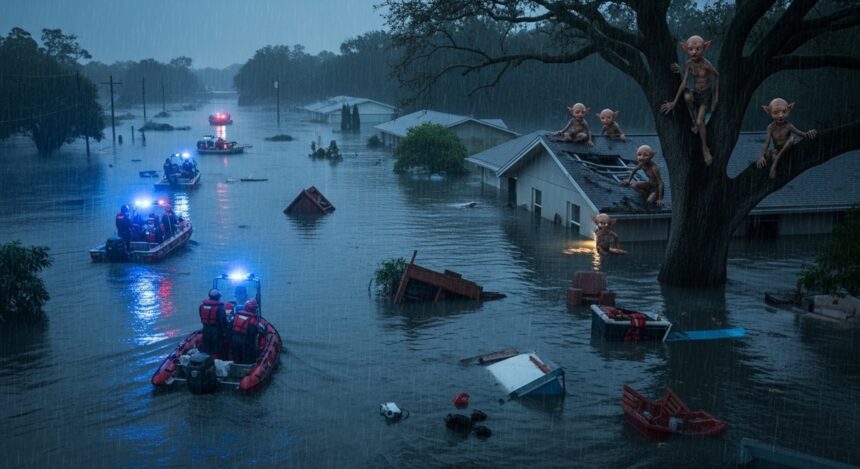
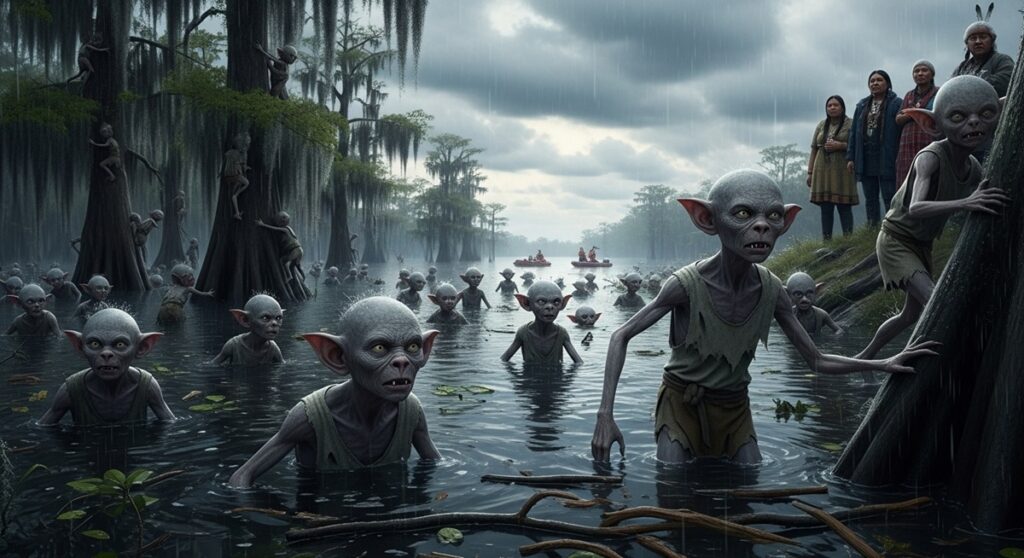
Florida really was hit by extraordinary flooding in 2016. More than 22 inches of rain fell in one part of the state during Hurricane Hermine. What the historical record does not show is the other story attached to that disaster: hundreds of communities supposedly encountering small humanoid beings called “Khari,” with truck drivers, boat crews, and helicopter pilots reporting the creatures emerging from the flooded ground.
That distinction matters because the Seminole and Miccosukee traditions do contain genuinely strange beings. They include witch-owls, long-eared monsters, dangerous spirits, and stories whose details vary between communities and generations, part of a much broader pattern of subterranean and hidden-dweller folklore documented in traditions like Death Valley and the underground city of Shin-au-av. Those traditions have their own histories and their own cultural contexts. The “Khari” story, by contrast, has no traceable source that I could locate in the published folklore record, tribal cultural material, or contemporary reporting I examined. It appears to be a modern story wearing the clothing of an older tradition—and the real folklore is considerably more interesting than the invention.
The Flood Was Real. The Creature Story Wasn’t Documented
The first thing worth correcting is the easiest thing to get wrong: the 2016 flood itself. Hurricane Hermine struck Florida in September 2016 and produced severe rainfall and flooding across the state. Florida’s later disaster-recovery documentation records a storm-total maximum of 22.36 inches near Tarpon Springs, with more than 10 inches reported at numerous other locations and significant flooding along rivers and low-lying areas. Contemporary National Weather Service material likewise warned of major rainfall and flash-flood potential. So a story that begins with “Florida was overwhelmed by extraordinary rain in 2016” is not inventing the disaster. The problem begins when that genuine meteorological event is used as the setting for an alleged mass encounter for which the documentary trail disappears.

That missing trail is important. A genuine event involving hundreds of communities, emergency crews, multiple aircraft, boat operators, truck drivers, and dozens of witnesses would normally leave fragments behind: dispatch records, newspaper reports, emergency-management documents, photographs, recordings, named witnesses, incident numbers, or at minimum contemporary discussion that could be traced back to the event. Instead, the “Khari” narrative arrives as a finished story, complete with distinctive physical descriptions and dramatic encounters, but without the evidentiary infrastructure that a real large-scale incident should generate. The absence of a source does not mathematically prove that nobody ever told such a story, but it does mean the account cannot responsibly be presented as a documented 2016 event.
There Is No Traceable Seminole Tradition of a “Khari”
The central claim therefore needs to be framed carefully. I could not locate a credible ethnographic, tribal, archival, or contemporary source establishing a Seminole or Miccosukee being called “Khari” with the characteristics assigned to it in this story: a roughly meter-tall humanoid, an unusual head, pointed ears, subterranean origins, a sacred-object narrative, a shrinking transformation, or a population suddenly forced to the surface by floodwater. Nor could I trace the supposed 2016 encounters to a named folklorist, storyteller, emergency responder, newspaper investigation, or identifiable witness. That is a much stronger and more defensible conclusion than saying that no Seminole person has ever used the word “Khari.” What can be said is that the specific creature tradition being circulated is not supported by a traceable source.
That distinction is especially important when dealing with living Native nations. The Seminole Tribe of Florida and the Miccosukee Tribe of Indians of Florida are not extinct cultures whose traditions exist only in old folklore books. Their languages, ceremonies, community institutions, and cultural practices continue into the present. The National Park Service, for example, documents the continuing importance of the Green Corn ceremony among Seminole and Miccosukee communities while noting that some traditional practices are not open to outsiders. Treating a newly circulating monster story as “ancient Seminole mythology” without a source is therefore not harmless embellishment. It turns a living culture into a backdrop for a modern cryptid narrative.
The Stikini Is Real Folklore
And this is where the story becomes much more interesting, because Seminole tradition already contains material that sounds like something invented for a modern horror film. The Stikini, also spelled Stigini or Ishtikini in English-language sources, is described in the published folklore record as a dangerous witch-like being capable of transforming into an owl-like monster. Accounts describe a human appearance by day and a terrifying nocturnal form associated with attacks on people. Some versions say the transformed being expels its internal organs before taking its owl form, hiding them so that the creature can later return to human shape. Other accounts emphasize the danger associated with even speaking its name. These are not claims about an undiscovered biological species. They belong to a body of Seminole folklore with a documented transmission history, and contemporary writing by a member of the Seminole Nation of Oklahoma shows that the story remains meaningful as cultural memory rather than merely as a cryptid entry on an internet list.
The differences between versions are worth preserving rather than smoothing away. Some communities treat the Stikini as a deeply frightening supernatural being, while other accounts describe the figure more like a cautionary or frightening story. That variation is normal for oral tradition. Folklore is not a database in which every community receives an identical canonical creature description. Stories change as they are transmitted, and the people who preserve them determine what can be told, to whom, and in what context. The existence of variation therefore strengthens rather than weakens the point: genuine folklore has a transmission history.
Long Ears Has an Actual Name and a Paper Trail
Another figure that appears in published accounts is Hvcko Capko, also rendered Hatcko-tcapko and translated in English-language sources as “Long Ears.” The descriptions are unsettlingly specific: a hairy or wolf-like creature with unusually long pointed ears, sometimes given a horse-like tail and a powerful unpleasant odor, associated in the folklore with disease. The surviving accounts vary in their details, which again is what we should expect from oral tradition rather than from a standardized fictional character sheet. Published folklore collections identify it as a Seminole figure, and the story has also circulated in accounts associated with Seminole communities in Oklahoma.
That does not make Hvcko Capko a zoological discovery. It makes it something more historically interesting for the purposes of this article: a documented piece of folklore whose existence can be traced independently of modern internet cryptid culture. There is a crucial difference between saying “people told stories about a creature called Long Ears” and saying “Long Ears was a real undiscovered animal.” The first is an ethnographic claim. The second is a biological claim requiring physical evidence. Confusing the two is one of the easiest ways for folklore to be transformed into pseudohistory.
The Skunk Ape Connection Is More Complicated
The same caution is needed with Esti Capcaki, a name frequently presented online as a Seminole or Miccosukee precursor to Florida’s modern Skunk Ape. Popular accounts describe the figure as a hairy or tall being and connect the tradition directly to the contemporary cryptid. But the evidentiary chain here is weaker than the one surrounding the Stikini and Long Ears material. Modern articles repeat the attribution, while the underlying connection to specific Seminole or Miccosukee traditional sources is much harder to establish independently. That does not prove the figure was invented recently. It means the claim should be labeled as reported folklore attribution rather than settled ethnographic fact.
That distinction is precisely what a serious investigation should preserve. “The Seminole have a documented monster tradition” is supportable. “Every creature attributed to Seminole folklore on cryptid websites is an authenticated traditional being” is not. The first respects the record. The second allows the internet to manufacture certainty simply by repeating itself.
The Alleged Witnesses Are Where the Story Should Have Become Checkable
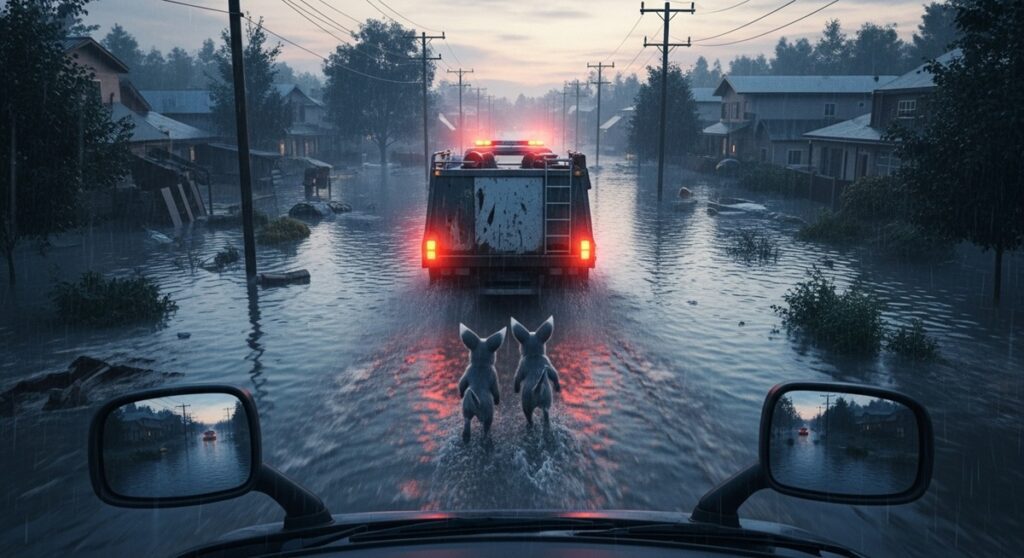
The supposed 2016 encounters are especially revealing because they are presented with exactly the kind of detail that invites verification: a truck driver allegedly chased by two creatures, a boat operator supposedly rescuing young beings while prioritizing a human family, helicopter crews allegedly reporting “gray children,” and multiple communities supposedly affected simultaneously. Those details sound like eyewitness testimony, but testimony becomes evidence only when it can be connected to a person, a date, a place, a recording, an original publication, or another independent record. Here, the names and documentary links are missing.
That is not a minor editorial defect. It changes the category of the story. A named witness whose 2016 account can be checked against weather records, rescue logs, contemporaneous reporting, and other witnesses is an investigative lead. An unnamed witness appearing only inside a later retelling is folklore or internet narrative. The latter can still be fascinating. It simply cannot be promoted into historical fact by giving it more confident prose.
Why “Little People” Keep Appearing in Human Storytelling
There is, however, a much larger question hiding underneath the failed “Khari” story. Across the world, human cultures have produced stories about diminutive beings, hidden neighbors, underground inhabitants, forest people, household spirits, and dangerous creatures occupying the boundary between the familiar world and the wilderness. The recurrence is real. But recurrence does not establish a common biological species, an ancient worldwide civilization, or forgotten contact between unrelated peoples. Humans everywhere encounter darkness, caves, burrows, strange animal sounds, unexplained tracks, isolation, death, weather, and the persistent feeling that something may be watching from beyond the edge of visibility. Those experiences provide remarkably fertile material for folklore without requiring the same creature to exist everywhere.
The important point is that different traditions should not be collapsed into one giant “little people” mythology simply because their creatures share a few visual characteristics. A Seminole story belongs to its own historical and cultural setting. A European fairy tale belongs to another. A modern cryptid report belongs to another. Similarity can be interesting without being evidence of identity. The moment all of these traditions are treated as fragments of a single hidden species, the actual cultures that produced them begin disappearing beneath the theory imposed on top of them.
Where Folklore Ends and Evidence Begins
The temptation with a story like this is to choose between two extremes: believe the creature existed, or dismiss the entire tradition as nonsense. Neither response is necessary. The 2016 flood was real. Seminole and Miccosukee cultural traditions are real. The Stikini is a genuine part of the published folklore record. Hvcko Capko has a traceable place in accounts of Seminole tradition. The modern Skunk Ape has a substantial folklore and popular-culture history. What remains unsubstantiated is the leap from those documented traditions to a creature called “Khari” supposedly appearing across Florida during a specific flood disaster.
And that distinction is more than a fact-checking technicality. It is the difference between preserving a culture and rewriting one. The Everglades does not need an invented species to become mysterious. The Seminole and Miccosukee traditions do not need a fabricated eyewitness event to become extraordinary. Their actual stories survived because people carried them forward—not because an internet narrative made them sound more like a classified zoological discovery.
The “Khari” story has no documentary foundation I could verify. The folklore surrounding the Seminole and Miccosukee does. One is an unsupported modern narrative. The other is a living cultural record. The responsible choice is not to make the real folklore smaller by attaching the invented creature to it. It is to let the real stories remain strange enough on their own.