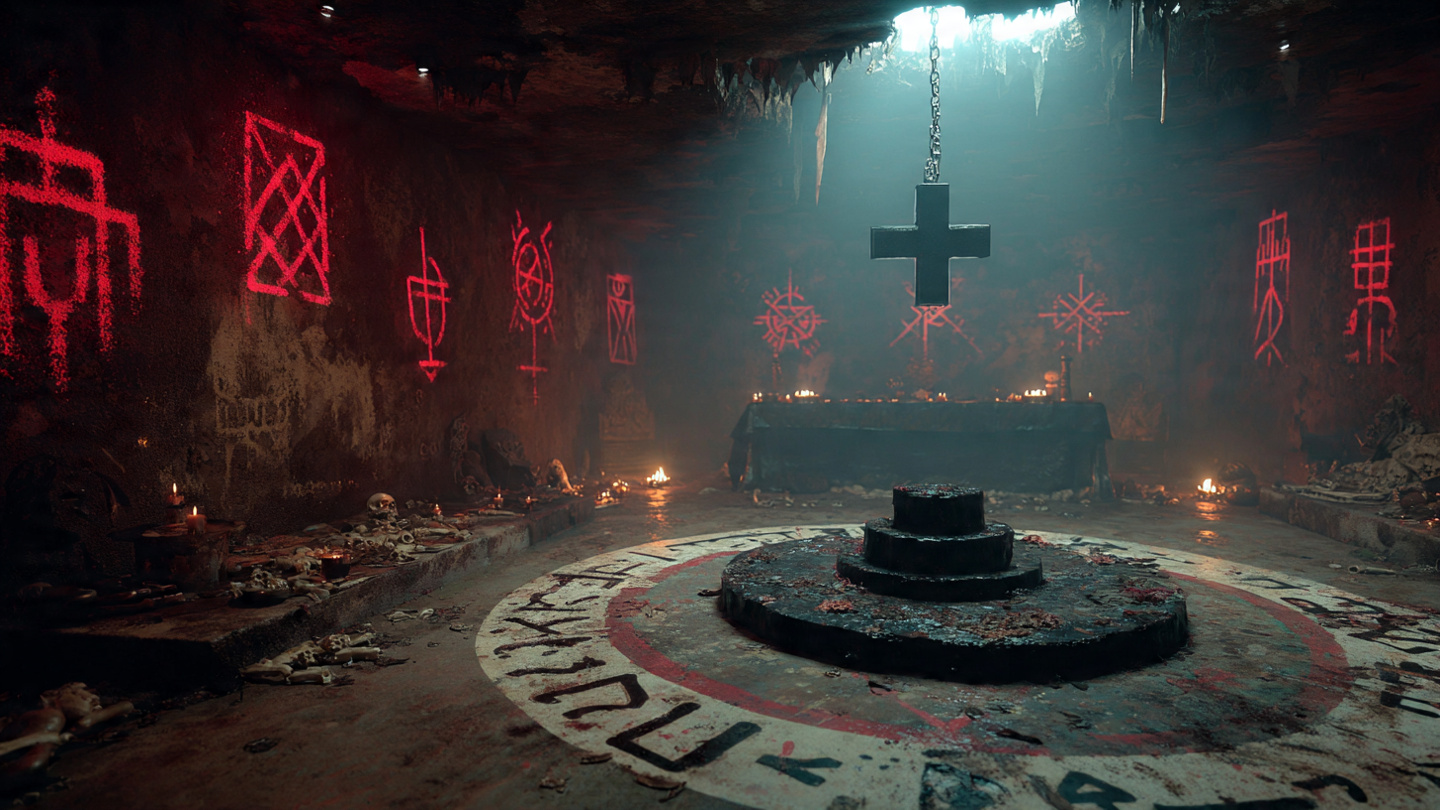
El Salvador’s war against MS-13 has produced something stranger than many outside observers realize. Police raids have uncovered weapons, torture sites, improvised shrines, Santa Muerte imagery, and other ritual objects that raise an obvious question: what role, if any, does religion or the occult actually play inside violent criminal organizations?
Separating documented evidence from speculation turns out to be more interesting than either dismissal or sensationalism.
What Bukele Actually Said
President Nayib Bukele’s actual public statements on this subject are on the record, precisely dated, and worth quoting directly rather than paraphrasing. Speaking at the National Prayer Breakfast in Washington on February 5, 2026, Bukele told the assembled audience: “Many people don’t know that our enemy was not just of flesh and blood, but is spiritual as well. The gangs didn’t just murder, rape, extort, they also worshiped Satan. Straight up, literally. When we went to their homes to arrest them, we discovered altars they’d been using for satanic rituals. This is well documented. We put up the pictures, the videos, right away.” In an earlier interview with Tucker Carlson, Bukele elaborated further, describing what he called a “spiritual war” running parallel to the physical crackdown: “There’s a spiritual war and there’s a physical war. If you win the spiritual war, it will reflect into the physical war.” Bukele frames his government’s anti-gang campaign in explicitly religious terms, consistent with his broader public embrace of Christian faith as central to his governing narrative. That’s a stated, documented political position. It’s a different claim than an independently verified demonstration of literal supernatural activity, and the distinction matters for evaluating everything that follows.
What Police Actually Found
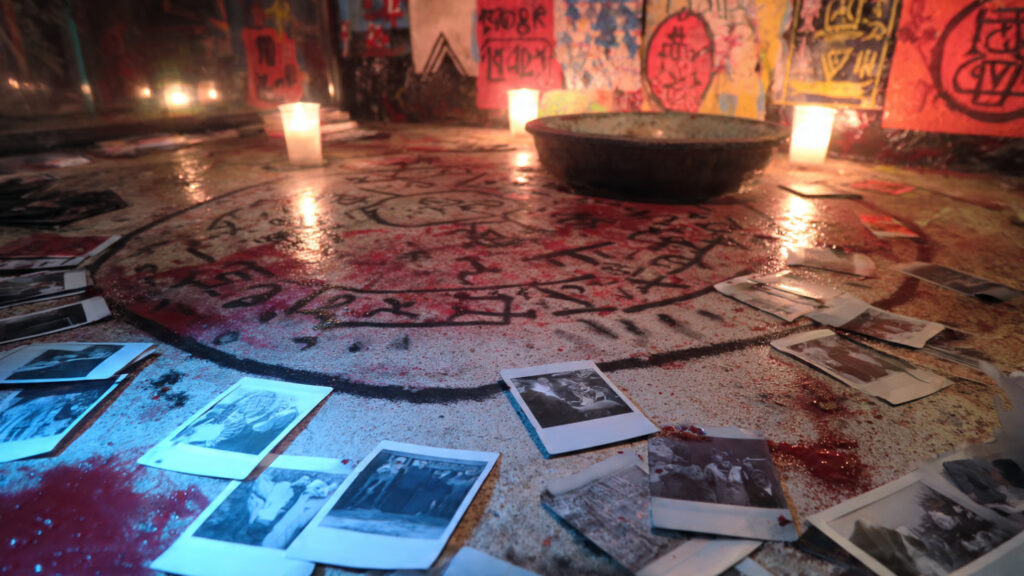
The physical evidence from Central American and Mexican gang raids is photographed and belongs to identifiable religious and folk traditions rather than an invented cosmology. Santa Muerte, the skeletal folk saint venerated widely across Mexico and increasingly in Central America, appears repeatedly at gang properties. Academic researcher Laura Roush’s fieldwork at a working Mexico City altar found that the great majority of ordinary devotees are poor, marginalized believers practicing a documented form of folk Catholicism, unconnected to organized crime. A separate criminalized variant does exist within narco-culture specifically, one that FBI Law Enforcement Bulletin researchers have documented as incorporating elements of Palo Mayombe, an Afro-Cuban tradition centered on a ritual cauldron called a nganga, alongside Santería and various forms of brujería, folk witchcraft. What gets found in raids, then, isn’t evidence of an invented predator cult. It’s a syncretic, well-documented set of overlapping religious practices, some entirely benign, some deliberately appropriated and distorted by criminal organizations seeking protection, intimidation value, or internal cohesion.

Ritual Violence Predates MS-13 by Decades
The pattern deserves historical grounding, because it’s documented well before El Salvador’s current crackdown. The most notorious case remains the 1989 “Narcosatánicos” of Matamoros, Mexico, led by Adolfo Constanzo and his associate Sara Aldrete, who built a criminal cult around a warped version of Palo Mayombe, performing ritual animal and eventually human sacrifice at Rancho Santa Elena, convinced the killings would provide supernatural protection from police and rival traffickers. The case was extensively documented by law enforcement and remains a standard reference point in FBI training literature on ritualistic crime. Separately, Mexican narco-culture has long venerated Jesús Malverde, an unofficial “narco-saint” associated with the state of Sinaloa, documented devotional practice with deep folk roots that predates the modern cartel era entirely. That documented history shows something specific: criminal organizations across Latin America have repeatedly reached for existing folk religious frameworks, adapting and often distorting them, to manage fear, signal loyalty, and provide psychological cover for extreme violence, a recurring pattern rather than a novel invention specific to MS-13.
Why Ritual Matters Psychologically
This is where genuine anthropology explains something rather than mystifying it further. Sociologist Émile Durkheim’s foundational work on religion argued that shared ritual generates what he called collective effervescence, an intense sense of group belonging that binds participants together and reinforces group identity, a well-established finding in the sociology of religion applicable equally to a church congregation and a criminal organization. Anthropologist Victor Turner’s theory of liminality describes how ritual creates a threshold state, a psychological space set apart from ordinary life, in which participants can undergo transformation, including transformation into a group member willing to commit acts they might not commit as an ordinary individual. Literary theorist and anthropologist René Girard’s scapegoat theory, meanwhile, proposed that ritualized violence directed at a designated victim serves to discharge accumulated group tension and reinforce internal cohesion, a mechanism he argued recurs across radically different cultures and eras. None of these frameworks require the supernatural to explain why criminal organizations use ritual deliberately: it recruits members psychologically, discharges guilt, cements loyalty through shared transgression, and manufactures the specific kind of group identity that makes extreme violence easier to commit and easier to demand of others.

More recent scholarship has sharpened this picture considerably. Sociologist Randall Collins, in his 2004 book Interaction Ritual Chains, describes how successful group rituals generate what he calls emotional energy, a real, measurable psychological charge that binds participants to group symbols and motivates them to seek out further rituals that recreate the same intensity, a mechanism he’s applied directly to violence and criminal solidarity in his own published work. Psychologist Jonathan Haidt’s research on sacred values describes how groups elevate certain beliefs or symbols to a protected status exempt from ordinary cost-benefit reasoning, binding members into what he calls a moral community that treats violation of those values as unthinkable betrayal rather than simple disagreement. Anthropologist Roy Rappaport, in his ecological studies of ritual, argued that participation in formal ritual constitutes a public, hard-to-fake commitment device, individuals who undergo costly, binding rituals signal loyalty in a way words alone can’t fake, a real, testable claim about why group ritual so often precedes major undertakings. Harvey Whitehouse’s research on what he calls identity fusion describes how intensely painful or frightening shared experiences, real or ritualized, can fuse individual identity with group identity so completely that members will act against their own self-interest, including committing violence, on the group’s behalf. Anthropologist Richard Sosis’s work on costly signaling makes a related, complementary point: rituals that impose a genuine cost on participants, whether physical risk, resource sacrifice, or moral transgression, function as reliable signals of commitment precisely because they’re difficult to fake, explaining why group loyalty tests so often escalate toward exactly the kind of extreme, hard-to-reverse acts documented in gang initiation and ritual violence more broadly. Together, this body of real, independently developed research converges on a consistent explanation: ritual works on group psychology through well-documented, testable mechanisms, not because a group’s chosen symbols carry inherent supernatural power.
Why Societies Repeatedly Sacralize Violence
This pattern is genuinely older and more widespread than any single criminal organization, which is part of what makes it worth taking seriously rather than treating as an isolated aberration. Aztec religious practice incorporated large-scale ritual human sacrifice as a documented, central feature of state religion. The medieval Crusades were framed by participants and church authorities alike as sacred warfare, violence explicitly sanctified by religious purpose. Twentieth-century Imperial Japan’s State Shinto fused nationalist violence with religious devotion to the emperor. The Nazi regime’s SS cultivated its own invented mystical and pseudo-religious symbolism, deliberately blending pageantry with ideology. The Khmer Rouge and, in the modern era, groups like ISIS have each constructed their own theological or quasi-theological justifications for organized mass violence. Historians and religious studies scholars have documented this pattern repeatedly across unrelated cultures and centuries: human societies show a persistent, well-attested tendency to wrap organized violence in sacred meaning, whether through state religion, invented mysticism, or borrowed and distorted folk tradition. That’s a genuinely unsettling finding on its own terms, and it doesn’t require any single global conspiracy to explain it, because it keeps happening independently, in unconnected times and places, for reasons historians and anthropologists actively study.

Three Levels of Evidence, Not Two Equal Readings
The honest summary isn’t a simple choice between two equally weighted interpretations. It’s a hierarchy, and the evidence supports each level differently. At the level of observed fact, the record is solid: altars, Santa Muerte iconography, and syncretic ritual objects were photographed during real gang raids, and Bukele made the statements quoted above, on the record, on specific dates, in specific venues. Neither of those claims is in serious dispute. At the level of historically supported interpretation, decades of independent, peer-reviewed research from Durkheim, Turner, Girard, Collins, Haidt, Rappaport, Whitehouse, and Sosis converges on a well-evidenced explanation: ritual strengthens group cohesion, shared transgression builds loyalty precisely because it’s costly and hard to fake, and religious or quasi-religious symbolism reliably legitimizes violence that would otherwise be harder to sustain. That’s not speculation. It’s a body of testable, cross-culturally replicated findings. At the level of metaphysical interpretation, literal demonic influence, active spiritual warfare, supernatural entities directing the violence, the evidence is different in kind, not just degree. Bukele’s sincere belief is real and worth taking seriously as his stated position. It isn’t independent confirmation of the metaphysical claim itself, any more than a group’s belief that their ritual objects hold power is proof that the objects hold power. The documented facts support the sociological explanation robustly. They don’t, on their own, establish the supernatural one. That distinction is where the evidence actually stops, and where the reader’s own judgment necessarily begins.