




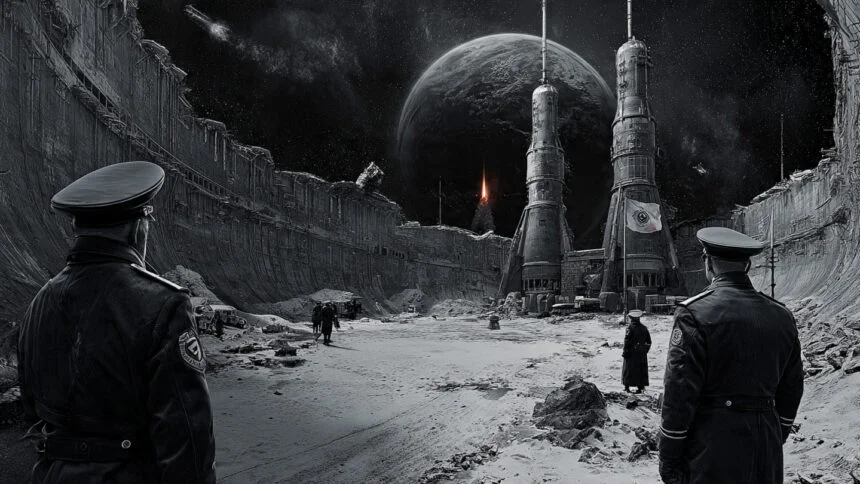
Hans Kammler really disappeared. He really was one of the most powerful SS engineers in Nazi Germany. He really oversaw projects connected to the Holocaust and the V-2 program. And his final days really are surrounded by an uncomfortable gap in the historical record. What the evidence does not show is the story that later filled that gap: that Kammler escaped Germany in 1945 aboard a secret rocket, reached the Moon, and established a hidden Nazi redoubt there.
The distinction matters because Kammler’s documented history is considerably darker than the mythology built around him. Before he became associated with Germany’s most advanced rocket projects, he was already deeply involved in the machinery of mass murder. He directed construction work connected with extermination facilities at Auschwitz, Majdanek and Belzec. Later, he was placed in charge of moving V-2 production underground after the bombing of Peenemünde, creating the vast Mittelwerk operation and the concentration camp at Mittelbau-Dora. Thousands of prisoners died producing the weapon. The real Hans Kammler does not need a secret lunar mission to become one of the most disturbing figures in the history of the German rocket program.

Who Hans Kammler Really Was
Hans Kammler was an SS civil engineer whose career placed him directly inside some of the Third Reich’s most important construction and weapons projects. His documented responsibilities included work on extermination facilities at Auschwitz, Majdanek and Belzec. After the Allied bombing of Peenemünde in August 1943, he was assigned a new task: move production of the V-2 rocket underground, away from Allied bombing and into a system of forced labor that would become synonymous with Mittelbau-Dora.

Roughly 60,000 prisoners passed through the Mittelbau-Dora camp system, and at least 20,000 died from the conditions there. An estimated 10,000 deaths have been associated specifically with the production of the V-2. The numbers are important because they destroy one of the most persistent distortions in the Kammler mythology: the idea that he was primarily a misunderstood technological visionary whose genius was hidden by history. The historical record instead places him inside a system in which technological achievement and mass death were physically joined together.
Kammler’s own recorded attitude toward the prisoners was brutally utilitarian. The work had to continue. The victims were secondary. That is the man who later became the protagonist of stories about secret weapons, hidden bases and impossible escapes. The mythology starts with a real figure, but it quietly changes what that figure means.
The Rocket Was Real. The Moon Mission Was Not.
The central technological claim can be tested much more easily than the mythology surrounding Kammler’s disappearance. The V-2, or A4, was a revolutionary weapon for its time, but it was still a suborbital ballistic missile. Operational launches reached the upper atmosphere and then followed a trajectory back to Earth. The rocket did not possess anything remotely resembling the performance required for a lunar mission.
There were, however, genuine experiments involving the upper atmosphere. Erich Regener’s research program developed scientific instruments carried by rockets, and an A4 test flight in January 1945 carried sensors above 100 kilometres before the payload returned to Earth by parachute. That is real and significant scientific work. It is also important precisely because it shows how easily a plain historical fact can be transformed into something it never was. Atmospheric research is not interplanetary travel. Carrying instruments above the atmosphere is not sending people to the Moon.

The A9 and A10 designs are equally revealing. They were proposed components of a much more ambitious rocket architecture: the A9 as a winged upper stage and the A10 as a proposed booster. But they never became a functioning lunar vehicle. The designs did not produce a secret crewed spacecraft sitting somewhere in the Harz Mountains waiting for its final launch. The paper concepts remained incomplete. The rocket that actually flew was the A4, and the A4 never came close to leaving Earth.
So Where Did the Moon Story Come From?
The interesting question is not simply why the claim is wrong. It is why the claim feels as though it could be true.
Kammler genuinely disappeared during the collapse of Nazi Germany. His body was never conclusively recovered. Nazi officials really did disappear into the chaos of the final months of the war, and some later escaped Europe altogether. The German state had produced genuine “wonder weapons” that seemed astonishingly advanced to the Allied powers. And after the war, the United States and Soviet Union really did compete to seize German scientists, engineers, documents and hardware.

Then there was Operation Paperclip. The United States really did bring German scientists into American weapons and space programs under circumstances that were sometimes secretive and politically uncomfortable. Wernher von Braun and Walter Dornberger really did become part of America’s postwar rocket effort. Classified Cold War programs really did exist, part of the same real secrecy culture behind why the US government keeps other Cold War material classified decades later. The government really did keep enormous amounts of technical and intelligence information out of public view.
None of those facts proves a lunar mission. But together they create an unusually fertile environment for one. Take a vanished SS engineer, add a missing body, surround him with actual secret weapons and actual postwar intelligence programs, place him at the center of the most advanced rocket technology of the era, and then give the story an obvious destination that no investigator could easily check in 1945. The Moon becomes the perfect hiding place.
There is even a real Kammler order that may help explain the later “hidden redoubt” imagery. On April 1, 1945, he ordered roughly 500 missile technicians evacuated toward the so-called Alpine Fortress, the mountainous Nazi redoubt imagined as a final defensive refuge. The Alpine Fortress itself became part of the mythology of the Reich’s final days. But a real order to move personnel toward a terrestrial refuge is not evidence of an escape to the Moon. It is simply another ordinary fragment of history onto which a later legend could attach itself.
How the Legend Learned to Cite Itself
One of the most revealing details in the entire story is that the mythology did not merely survive by repetition. It acquired the appearance of documentation.
A 2010 satire website published a joke story involving a supposedly Romanian conspiracy researcher who claimed that Kammler’s team had secretly conquered orbital space. The researcher was fictional. The quotation was fictional. The joke was the point. But once the material was separated from its original context, the fabricated quotation could be copied by other websites and presented as though it had come from a genuine researcher making a genuine claim.

This is how modern historical mythology often works. A story begins as speculation. Someone embellishes it. Someone else quotes the embellishment. A third person finds that quotation and assumes it represents an earlier source. Eventually the claim appears to have a paper trail because everyone is citing someone else who cited the same original invention.
The archive becomes circular. The citation becomes the evidence. And the fact that nobody can produce the original document is reinterpreted as proof that the document must have been suppressed.
Von Braun, Dornberger and the Real Rocket Story
Wernher von Braun and Walter Dornberger were real men at the center of the German rocket program, the same real historical territory a separate postwar-Nazi-escape investigation covers, and their wartime histories are serious enough without inventing a secret lunar mission. Both were involved in the Peenemünde program and both were brought to the United States through Operation Paperclip after the war. Their relationship to the V-2’s forced-labor system and Mittelbau-Dora has been extensively examined by historians.

Their subsequent careers are also important because they demonstrate how unnecessary the lunar mythology is. These men really did help create the technology that eventually carried humans into space. But the American and Soviet achievements that followed were not the continuation of a secret 1945 Moon landing. They were enormous, public, documented programs involving thousands of engineers, technicians, scientists and workers across decades of development.
The real history is already extraordinary. Germany built the V-2. The United States and Soviet Union captured the technology and the people behind it. Both superpowers transformed that knowledge into increasingly powerful rockets. And twenty-four years after the V-2’s first flight, humans actually landed on the Moon.
What Happened to Hans Kammler?
This is where the story should stop being certain.
Kammler disappeared in early May 1945 as the Third Reich collapsed. Multiple witness accounts have pointed toward suicide, with his death generally placed around May 7–9 near Prague and associated with cyanide. A German court subsequently established an official date of death on that basis. But the body was never recovered, and the surviving evidence has left room for historical debate about precisely what happened during his final days.

That uncertainty is real. It should remain uncertainty.
There have been alternative theories about capture, death during the chaotic retreat and other possible outcomes. One postwar witness statement supported the suicide account. The absence of a recovered body means the final chain of events cannot be reconstructed with the same confidence as Kammler’s earlier career.
But an unresolved death does not grant every imaginable explanation equal status. The fact that historians cannot produce a body does not make a lunar escape plausible. The gap is evidence of a gap. It is not evidence for the story someone later placed inside it.

The Archive That Never Appears
The most dramatic versions of the Operation Silverbond story eventually become extremely specific. They invoke Soviet intelligence files, radio operators, radiograms and supposedly classified records describing a German lunar launch in April 1945. Specific dates are given. Specific institutions are named. The language sounds archival.
But specificity is not documentation.

No credible historian, archivist or published researcher has produced the supposed Soviet GRU file or a verifiable transcript of the alleged radio traffic. No independently confirmed archival record establishes that Kammler launched a lunar mission from the Harz Mountains in April 1945. What exists instead is an extraordinary claim whose most important supporting documents remain inaccessible, uncited or unverified.
That is not how a suppressed historical discovery becomes established history. A genuine archival revelation can be difficult to obtain, but it still has to leave a trail that other researchers can examine. Documents can be translated. Archives can be revisited. References can be checked against other records. Dates can be compared. Names can be matched. Independent researchers can attempt to reproduce the discovery.

A dramatic citation that nobody can actually inspect is not stronger evidence because it sounds official. It is weaker evidence precisely because the central claim cannot be independently tested.
The Real Crime Behind the Rocket
There is an even deeper reason to resist the mythology.
Stories about secret Nazi Moon missions have a strange tendency to transform the people who built the V-2 into technological rebels. Kammler becomes an outlaw genius. Von Braun becomes the misunderstood visionary. Mittelbau-Dora becomes the setting for forbidden technological breakthroughs. The rockets become symbols of civilization’s secret leap into space.
But the V-2 was not built in a vacuum. It was built through a system of forced labor in which human beings were worked to death. The tunnels beneath the earth were real. The machinery was real. The rocket was real. The dead were real.

And that is what makes the documented history so much more disturbing than the legend. There was no need for Kammler to escape to the Moon to become extraordinary. He was already one of the senior figures in a regime that attempted to industrialize murder, and then applied the same administrative logic to the production of advanced weapons.
Kammler Really Vanished. The Moon Base Didn’t Follow Him There.
Hans Kammler most likely died in the final collapse of Nazi Germany, probably by suicide. But “most likely” is not “proved beyond every possible doubt,” and the missing body leaves a legitimate historical question at the end of his life. That question is worth preserving precisely because history should not pretend to know what the surviving evidence cannot establish.
What the evidence does establish is much less glamorous and much more terrible. Kammler was involved in the construction of extermination facilities. He oversaw the underground relocation of V-2 production. Mittelbau-Dora became a place of mass death. The A4 flew, but only on suborbital trajectories. The A9 and A10 never became a secret lunar spacecraft. Von Braun and Dornberger’s later careers unfolded in the enormous and extensively documented American space program. And the supposed archive proving a 1945 German Moon mission has never emerged as independently verifiable evidence.
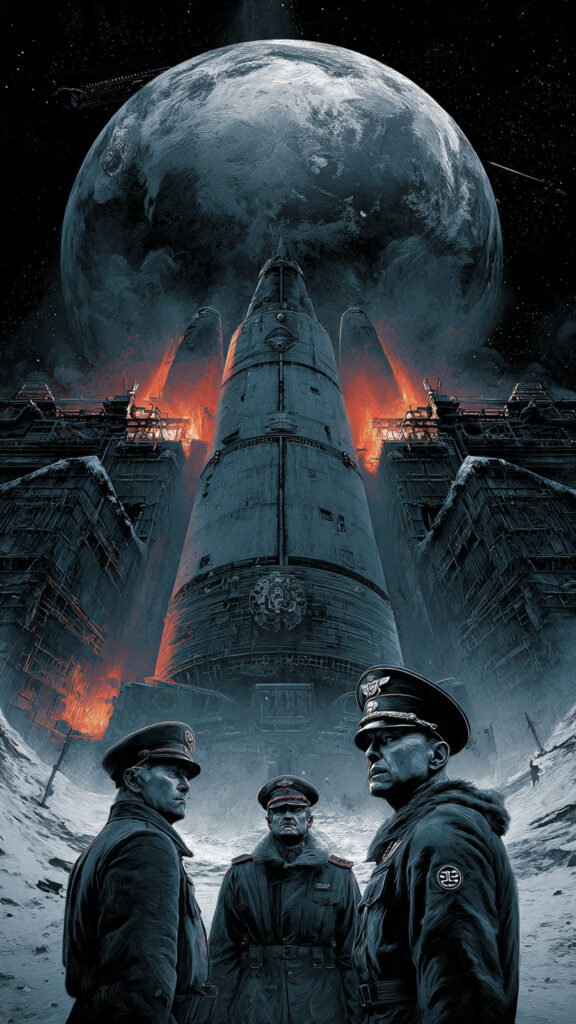
The legend begins with one real mystery: where did Hans Kammler go? Everything after that depends on what we are willing to insert into the empty space.
The Nazis really did build rockets. They really did hide factories underground. They really did exploit prisoners to build weapons. Kammler really did disappear. But there is no documented lunar exodus waiting inside that history. The rockets never carried him to the Moon. The archive never materialized. And beneath the myth is something far darker than a secret space program: a real man, a real regime, real technology, and thousands of real people who died building it.