




Eusapia Palladino was caught cheating. More than once, more than one investigator, in more than one country, across more than two decades. Her hands slipped free of controls. Her feet escaped observation. Furniture moved when investigators lost track of a limb. She was exposed by people whose entire purpose was to discover exactly how mediums performed such tricks. And yet Palladino remains one of the strangest cases in the history of psychical research because some of the same investigators who knew she cheated still reported phenomena they believed they could not explain.
That contradiction is the real story. Palladino does not belong comfortably in either of the two familiar categories. She was not a flawlessly controlled psychic who was unfairly dismissed, nor was she simply an incompetent fraud whom everyone eventually saw through, a case that stands in sharp contrast to Daniel Dunglas Home, a contemporary medium never once caught cheating. She was a physical medium with an extraordinary ability to create convincing phenomena in darkened rooms, under complicated systems of restraint, while surrounded by investigators who were watching for deception. The historical record shows repeated fraud. It also shows serious investigators becoming convinced that fraud did not explain everything they had witnessed. The important question is therefore not whether Palladino ever cheated. The answer to that is already in the record. The more interesting question is why the detection of cheating did not end the argument.

And that question leads somewhere more unsettling than the existence of spirits. It leads into the psychology of observation itself: how an investigator can know exactly what kind of deception to expect, build an elaborate system designed to prevent it, and still leave one small opening through which the entire performance can pass.
The Woman Behind the Legend
Eusapia Maria Palladino was born on January 20, 1854, in Minervino Murge in southern Italy, the daughter of farmers Michele Palladino and Irene Barbiere. Beyond those basic facts, her childhood becomes remarkably difficult to reconstruct with confidence. Her mother died around the time of her birth, her father was killed when she was still young, and she subsequently lived and worked in several households in Naples. Later accounts describe a childhood in which strange phenomena supposedly began when she was barely a teenager, but those stories largely come from Palladino’s own recollections and later biographical traditions. Modern historians have therefore treated her early biography cautiously rather than accepting every dramatic detail as established fact.
What is much better documented is her emergence as a professional medium during the 1870s. In Naples she came into contact with people interested in the rapidly expanding European spiritualist movement, and reports of unusual table movements, raps, sounds and other phenomena began circulating around her. Giovanni Damiani was among the early figures who promoted her abilities, and Palladino soon moved from local curiosity to an international subject of investigation. Her performances would eventually attract astronomers, physicians, psychologists, physicists, conjurors and some of the most prominent psychical researchers of the age.

One of the most consequential encounters came in 1891, when the Italian criminologist and psychiatrist Cesare Lombroso examined her. Lombroso had approached spiritualism from a skeptical position, but his experiences with Palladino contributed to a dramatic change in his views. He eventually published arguments defending at least some of her phenomena and attempted to interpret them within a scientific framework. His conversion mattered because it transformed Palladino from an entertainer on the fringes of European spiritualism into a problem that respectable investigators believed deserved serious attention.
Then the Investigators Started Catching Her
The problem for Palladino was that serious investigation did not simply produce believers. It produced exposures.
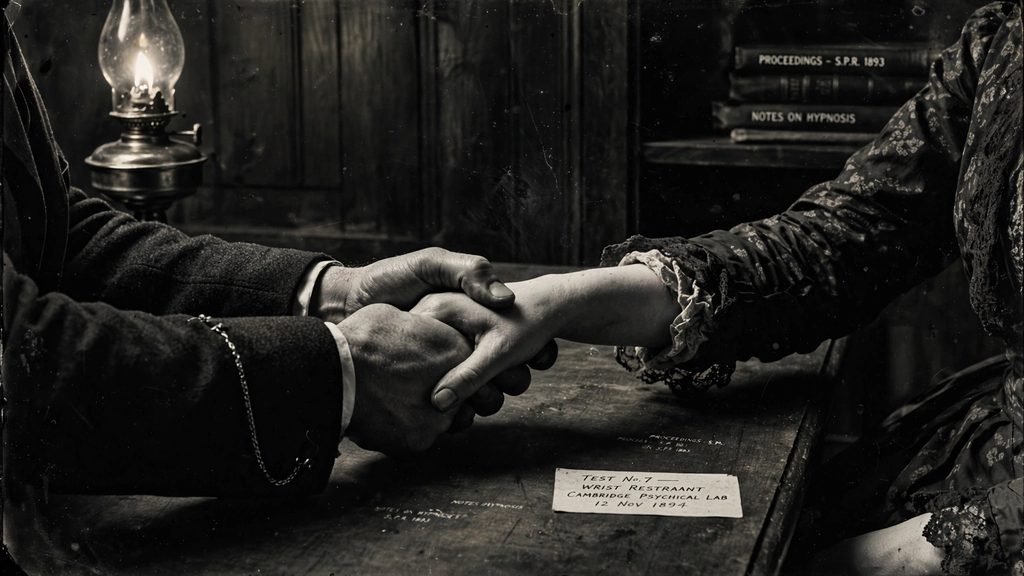
The 1895 Cambridge investigation became one of the most damaging episodes in her career. Frederick W. H. Myers and other investigators associated with the Society for Psychical Research examined Palladino under conditions specifically intended to determine whether her apparent phenomena could be produced by ordinary physical means. Richard Hodgson and the professional conjuror John Nevil Maskelyne were particularly alert to the possibility that she could manipulate the controls themselves. They were right to be suspicious. Palladino repeatedly attempted to free her hands, exploit the way the investigators were holding one another’s hands, and use her feet to interfere with objects around her. The investigators concluded that deliberate fraud had occurred, and Myers himself acknowledged that the deception was conscious and repeated.
The important detail was not simply that someone caught her cheating. It was how she cheated. The methods described in the Cambridge investigation were not dependent on sophisticated hidden machinery or elaborate technological devices. The central vulnerability was physical control. If investigators believed they were holding one of Palladino’s hands while actually holding each other’s hands, her hand was no longer controlled. If they thought her foot was in contact with a sitter’s foot while she had subtly altered the position of her leg, the lower part of her body could become an unseen instrument. In a darkened room, with everyone’s attention concentrated on a table or on an apparent movement elsewhere, a few inches of freedom could become the difference between an ordinary performance and an apparently impossible event.
That pattern recurred. Investigators in France reported further evidence of deception, and other researchers continued to disagree over whether fraud explained every phenomenon they had witnessed. The disagreement was not caused by an absence of evidence that Palladino cheated. Quite the opposite. Her cheating was sufficiently well established that the argument shifted from does she cheat? to a much more difficult question: does catching her cheating explain everything that happens in her séances?
That distinction is essential. Once a performer has been caught using one method of deception, it does not logically follow that every unexplained observation must have been produced by the same method. At the same time, an unexplained observation is not evidence for a paranormal explanation merely because investigators have not yet identified the trick. Palladino’s entire career became a battleground between those two possibilities.
The Strange Reputation of Eusapia Palladino
Palladino’s reputation therefore developed in a peculiar way. She could be simultaneously regarded as a fraud and as a serious experimental subject. Researchers who had personally witnessed her cheating sometimes continued to believe that she possessed some genuine, unexplained capacity. Others concluded that the cheating was the explanation, and that the apparent exceptions resulted from imperfect observation. The Society for Psychical Research itself preserved this dispute in its literature rather than reducing the case to a single unanimous verdict.

There is also a useful lesson in the terminology. Calling Palladino a “cheat” is justified by the historical record, but it can create the false impression that the case is thereby solved. A stage magician who is caught secretly moving an object has not demonstrated telekinesis. Equally, an investigator who fails to identify every mechanism by which the object moved has not demonstrated telekinesis either. The honest historical position lies between those two shortcuts. Palladino demonstrably used deception. The question is whether the surviving records contain any observations that cannot reasonably be explained by that deception.
Naples, 1908 | The Investigation That Refused to Go Away
By 1908, Palladino had already acquired a reputation that should have made experienced investigators extraordinarily cautious. That was precisely why the Society for Psychical Research’s Naples investigation became so important. Everard Feilding, W. W. Baggally and Hereward Carrington undertook a series of séances in Naples with Palladino. Between them they possessed extensive experience with mediums, and Baggally and Carrington had particular familiarity with conjuring and the practical mechanics of deception. This was not a group encountering physical mediumship for the first time.
The investigators conducted eleven sittings and kept detailed records. They attempted to maintain physical contact with Palladino’s hands and feet while observing the table and the surrounding room. They reported table movements and levitations, movements of objects, touches and other phenomena that they believed had occurred despite the precautions they had established. Their report, published by the Society for Psychical Research in 1909, became one of the most famous positive investigations in the literature of physical mediumship.

What makes the report historically fascinating is the investigators’ own attitude. They were not writing as men who had wandered into a séance expecting to discover ghosts. They knew the standard repertoire of fraudulent mediums. They knew that darkness was dangerous. They knew that physical restraints could fail. They knew Palladino’s reputation. And yet, after eleven sittings, they concluded that at least some of the phenomena they had recorded could not, in their judgment, be adequately explained by ordinary trickery.
That conclusion deserves to be taken seriously as a historical fact about what the investigators believed they had observed. It does not, however, settle what actually happened in the room.
The Foot Problem
Years later, the Naples report acquired a second life because investigators returned to its details and asked a brutally simple question: what if the investigators had been watching the wrong part of Palladino?
Massimo Polidoro and Gian Marco Rinaldi undertook a detailed reconsideration of the Feilding report and argued that Palladino’s foot could account for important portions of the phenomena. The logic was devastatingly simple. The investigators had devoted enormous attention to controlling her hands, because hands were the obvious tools with which a person might move objects. But if the feet were not controlled with equal precision at every instant, Palladino could potentially remove a shoe, extend a foot beneath the tablecloth, and use her toes or the sole of her foot to move or lift objects while the investigators remained convinced that her hands were immobilized.
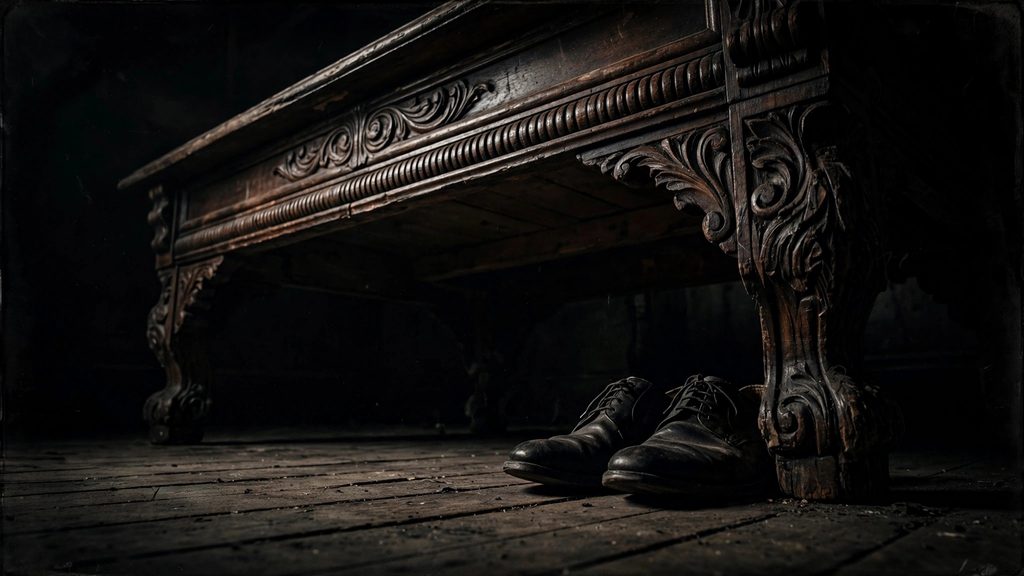
This was not merely a theoretical possibility invented after the fact. Earlier investigators had already reported Palladino using her feet, and later American investigators would catch her doing precisely that. The significance of the later analysis is therefore not that it produces a magical explanation for every single event recorded in Naples. It shows something more important: the controls that looked impressive on paper were not necessarily controls over the entire body of the performer.
There were other proposed explanations as well. In later analyses of the Feilding investigation, Richard Wiseman argued that the room itself may have offered possibilities for assistance from outside the séance area, while Polidoro and Rinaldi argued that an accomplice was unnecessary if Palladino’s own foot was sufficient. The fact that investigators can still debate the exact mechanism of particular incidents is not evidence that the phenomena were paranormal. It is evidence that the historical record is complicated enough that individual events must be analyzed one by one.
Then Harvard Put a Man Under the Table
Palladino’s American visit provided the experiment the earlier investigations had struggled to achieve. In late 1909 she travelled to the United States with Hereward Carrington, and her arrival generated considerable public interest. American investigators now had the advantage of a long paper trail. They knew what Palladino had been accused of doing in Europe. They knew the problem of her feet. They knew that physical contact could be simulated. They knew that darkness could transform a small movement into an apparently impossible event.
On December 18, 1909, Harvard psychologist Hugo Münsterberg attended a séance in New York and prepared a control that cut directly through the central problem. He arranged for a man to hide beneath the séance table, where he could observe what Palladino was doing from an angle the other sitters could not. During the sitting, the hidden observer watched her free her foot and use it to move the table. Münsterberg also reported other deceptive methods, including the use of a rubber bulb to create an air current capable of moving curtains that had initially seemed to move without an obvious cause.

The importance of the episode was not that Münsterberg possessed some special supernatural insight. He changed the geometry of observation. Instead of concentrating only on whether Palladino’s hands were being held, he put an observer in a position where the hidden lower part of her body could be watched directly. The mystery became considerably less mysterious.
That is one of the deepest lessons of the Palladino case. A control can be extremely elaborate and still be aimed at the wrong variable. Investigators can monitor the hands, record the movements of the table, check the doors and windows, examine the room, and take detailed notes while failing to monitor the one limb that is actually producing the effect. The experiment can therefore look rigorous from the outside while remaining vulnerable at its most important point.
Columbia’s Verdict
The American story did not end with Münsterberg. A separate series of investigations followed at Columbia University’s physics laboratory, involving physicists including Robert W. Wood. Their findings were published in Science in May 1910. The Columbia investigators reported no convincing evidence of genuine paranormal phenomena and described indications of trickery during the sittings.
That result mattered because it demonstrated the same pattern from another direction. Once investigators knew what they were looking for and designed their observations accordingly, the phenomena became much less impressive. The problem was not necessarily that Palladino suddenly lost an extraordinary ability. It was that the experimental environment had become hostile to the particular methods of deception that had previously worked.

This distinction is easy to miss when the story is retold as a battle between believers and skeptics. It was actually a battle between experimental arrangements. Put Palladino in a dark room, restrain her hands and feet imperfectly, divide the observers’ attention, and startling things can happen. Put observers where they can continuously monitor the body parts capable of producing those movements, and the apparent supernatural effect becomes much harder to sustain.
Why Did Smart Investigators Keep Getting Fooled?
This is where Palladino becomes much more interesting than a catalogue of séance tricks.
It is tempting to explain the entire episode by saying that the investigators were gullible. The historical record does not support such a simple conclusion. Some were highly accomplished scientists. Some were experienced conjurors. Some had already caught Palladino cheating. Several entered later investigations specifically aware of the methods she had previously used. Yet even knowledgeable observers sometimes became convinced that they were witnessing something beyond fraud.
The problem was partly structural. Séances were conducted under terrible observational conditions by modern standards. Rooms were often dim or dark because darkness was considered conducive to the phenomena. Participants were seated close together, sometimes holding hands or feet, while simultaneously watching furniture, curtains, cabinets and objects. Attention was divided. Physical contact was complicated. Expectations were strong. The performer knew that everyone was watching for movement but also knew exactly which movements the observers believed they had already secured.

And Palladino had an additional advantage that modern laboratory experiments would treat as a major confound: she was not a passive object being tested. She was an intelligent participant who could learn from every investigation. Every exposure taught her something about the investigators’ methods. Every new restraint revealed what they considered important. Every argument among investigators exposed differences in their procedures. The longer her career continued, the more information she possessed about how researchers tried to control her.
That makes the phrase “fraud detector” less comforting than it sounds. Detecting deception is not simply a matter of being intelligent enough to notice a lie. It requires designing an environment in which the deception has nowhere to operate. If the performer knows the rules better than the observer knows the loopholes, an apparently rigorous test can become a performance with the experiment itself serving as part of the misdirection.
The Mystery Was Real. The Explanation Was Not Necessarily Paranormal.
There is an important distinction between those two statements.
The mystery was real in the historical sense. Serious investigators really did encounter events they could not immediately explain. They really did record them. They really did disagree over what they meant. Palladino really did convince experienced observers that some phenomena survived their controls. Those facts should not be erased simply because later investigators found plausible mechanisms for some of the effects.
But an unexplained observation is not the same thing as evidence for a supernatural cause. That is the point at which the Palladino story becomes a lesson in scientific reasoning rather than an argument for or against spirits. If a table appears to move while a medium’s hands are being held, the first question is not “Could a spirit have done it?” The first question is whether the experimental conditions actually prevented the medium from moving the table herself. If the answer is no, the paranormal hypothesis has not yet earned its place in the explanation.

The later history of Palladino makes that distinction especially powerful. Her feet were repeatedly implicated. Her hands were repeatedly freed. Her controls repeatedly contained gaps. And when investigators changed the geometry of observation so that those gaps became visible, the apparent supernatural mechanism became considerably less mysterious.
Palladino Never Needed to Be a Perfect Fraud
This may be the strangest part of the entire story.
Palladino did not need every séance to be fraudulent in some perfectly choreographed sense. She needed only occasional access to an uncontrolled hand or foot, combined with darkness, divided attention and an audience already primed to interpret ambiguous movement as something extraordinary. A single successful trick could establish an atmosphere in which the next unexplained movement was interpreted through the same supernatural frame. Once investigators became convinced that something extraordinary was happening, every subsequent event was observed inside that expectation.

And she did not need to fool everyone. She only needed to fool enough people often enough to preserve the reputation that brought the next investigators through the door.
That is why Palladino’s career survived exposure after exposure. The discovery that she cheated did not erase the experiences of observers who believed they had witnessed something else. It created competing narratives. One investigator could say, “I saw her cheat.” Another could reply, “Yes, but you did not see her cheat during the moment when the table moved.” A third could say, “Perhaps the movement occurred normally, but we cannot explain how.” The argument could then continue indefinitely because uncertainty itself became part of the evidence.
The Final Trick Was Not the Foot
Palladino died in Naples on May 16, 1918. By then she had spent decades moving through the strange borderland between entertainment, spiritualism and experimental science. She had been investigated by some of the most prominent scientific figures of her generation. She had been exposed repeatedly. She had also inspired some investigators to defend the reality of phenomena they considered impossible to reduce to fraud.
Her legacy therefore cannot honestly be reduced to either “scientists proved the supernatural” or “a magician caught a fraud and the case was over.” The historical record is more revealing. Palladino demonstrates how easily an investigation can become a contest between observer and observed, with each side adapting to the other. She demonstrates that expertise does not eliminate perceptual error. She demonstrates that a sophisticated control is worthless if it does not control the mechanism that actually matters. And she demonstrates why an investigator’s inability to explain an event is evidence about the limits of the investigation before it is evidence about the nature of reality.
The most extraordinary thing about Palladino may therefore be neither spirits nor telekinesis. It may be the durability of a well-designed illusion once it has entered the machinery of serious investigation.

She was caught cheating, and the evidence is overwhelming. The remarkable part is what happened afterward: investigators kept returning, kept tightening the controls, kept disagreeing about what they had seen, and sometimes kept believing that something remained beyond explanation. That does not prove that Palladino possessed supernatural powers. It reveals something more interesting about human beings, the distance between seeing something happen and knowing what caused it can remain surprisingly large, even when the people standing in the room are experts.
The mystery was never that Eusapia Palladino could escape a hand or slip a foot beneath a table. The mystery was how long it took investigators to realize that the experiment was watching the performance instead of watching the performer.