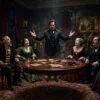



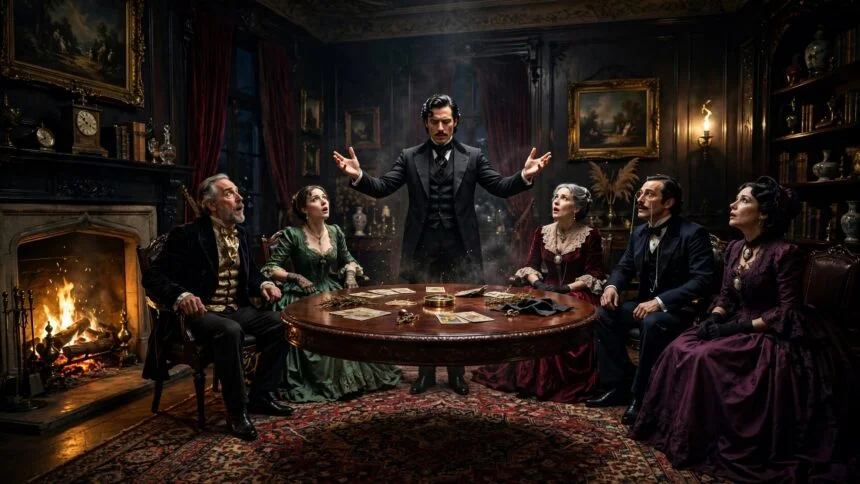
Daniel Dunglas Home is remembered as the Victorian medium who supposedly did what no other medium could do: levitate, move objects without touching them, make an accordion play inside a cage, handle fire without injury and perform in front of scientists, aristocrats and royalty without ever being caught in fraud. The claim that he was “never caught” is technically true. It is also one of the most misleading sentences ever attached to his career. Home was never exposed in the dramatic way some other mediums were. But he was investigated, challenged, sued, criticized by scientists, scrutinized by magicians and attacked by later historians. The most important investigation was conducted by William Crookes, one of the most eminent scientists of Victorian Britain, and the results remain controversial precisely because Crookes was convinced he had discovered a genuine physical force while his critics argued that his experiments never eliminated the possibility of deception.
Home’s story is therefore not the story of a fraud who was obviously exposed, nor of a supernatural man whom science proved genuine. It is the far more unsettling story of an extraordinary performer operating inside a system of evidence that was never quite strong enough to settle the question.
The Medium Who Never Needed a Ticket Booth
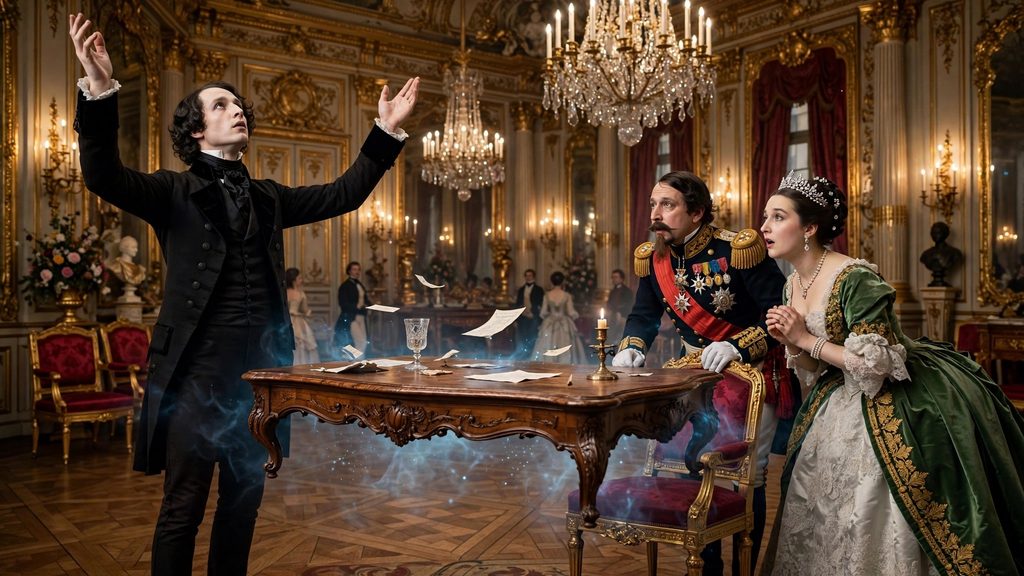
Daniel Dunglas Home was born near Edinburgh on March 20, 1833, and was taken to the United States as a child, where he was raised largely by an aunt. According to contemporary biographical accounts, strange phenomena began to surround him in adolescence: unexplained raps, apparent movements of furniture and other disturbances that became increasingly associated with his presence. By the early 1850s he had emerged as a medium, and by the middle of the decade he was traveling through Britain and Europe, giving séances to people who occupied an extraordinary range of social positions. His reputation eventually carried him into aristocratic and royal circles, where he encountered figures including Napoleon III and members of several European royal families.

But there was something unusual about the way Home built his career. Unlike many professional mediums of the period, he generally refused to accept payment for his séances. Contemporary biographical sources repeatedly emphasize the point. He did not sell tickets to public performances in the ordinary sense. Instead, he was supported by wealthy patrons and cultivated a social world in which the séance happened in private rooms, before invited witnesses. That arrangement became part of his defense. A medium who charged money could be accused of making a living from deception. Home’s supporters could argue that he had little obvious financial incentive to manufacture phenomena for individual sitters. But there was another side to the arrangement that is just as important: Home controlled access to the environment in which his abilities were displayed, and the people most eager to see something extraordinary were often his hosts, friends or patrons.
That does not prove deception. It establishes the problem that would follow him for the rest of his life. Home’s phenomena were not performed on a modern laboratory stage under standardized conditions. They occurred in Victorian drawing rooms, often at night, surrounded by people who already believed, or desperately wanted to believe, that something supernatural might happen. The witnesses were sometimes highly respectable. Respectability, however, is not the same thing as experimental control.
Then William Crookes Entered the Room
The most formidable argument in Home’s favor came from William Crookes. This was not an obscure enthusiast pretending to be a scientist. Crookes was a major Victorian chemist and physicist, a Fellow of the Royal Society, the discoverer of thallium and an inventor whose work contributed to the development of vacuum physics. He would later become president of the Royal Society. When Crookes began investigating spiritualist phenomena in the early 1870s, his scientific reputation was already substantial. His decision to take Home seriously therefore mattered enormously.
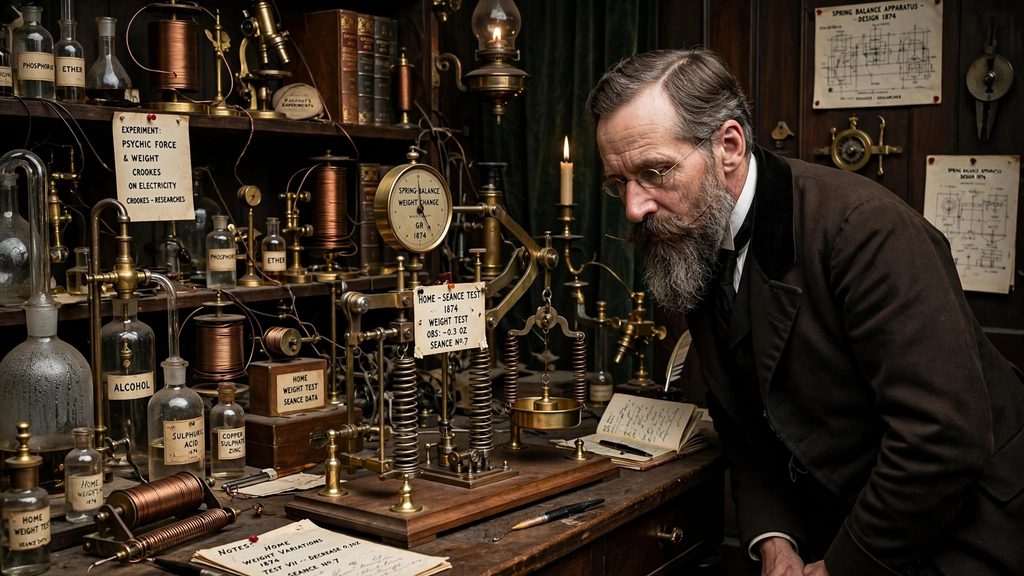
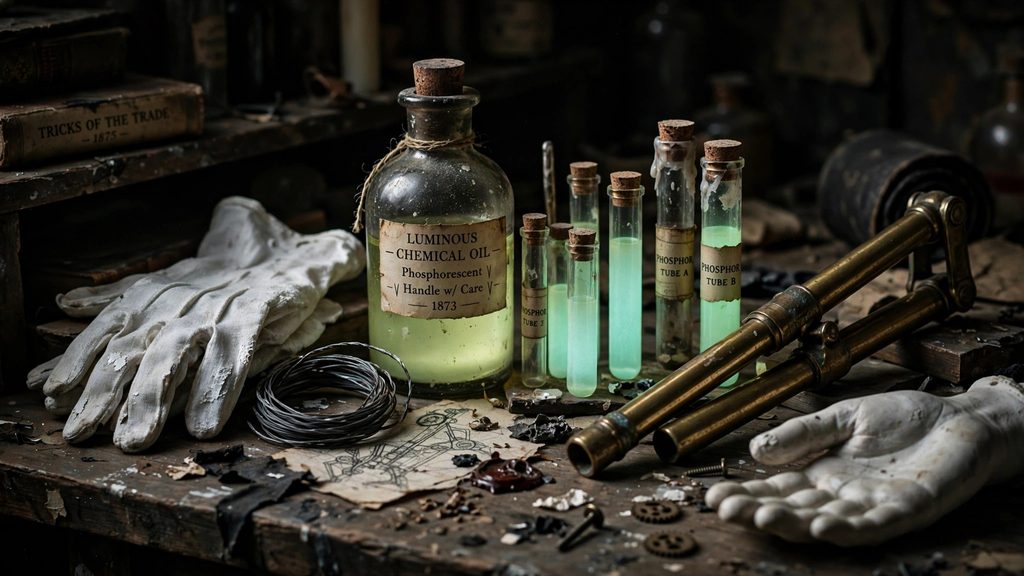
Crookes did not merely sit in a dark room and report that he felt a strange presence. He constructed instruments. In one of his best-known experiments, he arranged a wooden board so that one end rested on a fulcrum while the other was attached to a spring balance. Home was asked to place his fingers near the fulcrum end, and Crookes reported that the balance registered a substantial downward force. Crookes compared the result with the force he himself could produce mechanically and concluded that Home had generated an effect he could not explain by ordinary means. The maximum reading he reported was about 6½ pounds, not the much smaller figure sometimes repeated in modern retellings.

The other famous experiment involved an accordion. Crookes placed the instrument inside a wire enclosure beneath a table, with Home holding the accordion at one end while the keys were positioned beyond his apparent reach. Crookes reported that the instrument played music despite the apparent absence of ordinary contact. In his published work he treated the results as evidence for what he called “psychic force,” a physical effect associated somehow with the human organism.
That is the strongest historical case Home has. Not because Crookes proved spirits existed, he did not, but because an accomplished scientist claimed to have observed repeatable physical effects and attempted to quantify at least some of them. Crookes did not retract his conclusions. He defended his investigations against criticism and remained convinced that something genuinely extraordinary had occurred.
The Problem Was Not Crookes’s Reputation. It Was the Room.
The natural response is obvious: if William Crookes was a first-rate scientist, why not accept his testimony? Because the authority of the observer cannot substitute for the quality of the experiment. Crookes could be honest and still be mistaken. He could be careful and still miss a mechanism of deception. And most importantly, the experimental environment had characteristics that would be considered unacceptable in a tightly controlled modern test.
The accordion experiment is the clearest example. The instrument was placed beneath the table inside a cage-like apparatus. Home’s body was positioned close to the enclosure. The lighting conditions were not equivalent to a modern brightly illuminated laboratory. The keys and bellows were not continuously observable in the way a modern experiment would demand. Contemporary critics immediately recognized the weakness. If the objective was to establish that an accordion could produce music without human manipulation, why conduct the crucial part of the experiment in the least visible position in the room?
Later critics pointed to another uncomfortable detail. Home had performed accordion phenomena for years before Crookes investigated him, and accounts of his séances repeatedly associated the instrument with a remarkably limited repertoire, including “Home, Sweet Home” and “The Last Rose of Summer.” That does not prove that the Crookes experiment was a conjuring trick. It does, however, make the phenomenon look less like an unknown force spontaneously expressing itself through an instrument and more like a practiced performance whose mechanism had never been securely isolated.
And there was an even deeper problem. Crookes was investigating a performer who understood exactly what the observers wanted to see. In a normal scientific experiment, the investigator controls the variables and attempts to prevent the subject from knowing which result is expected. In a séance, the performer is part of the experimental system. Every movement, every lighting decision, every seating arrangement and every moment of distraction can potentially matter. The apparatus can be perfect while the protocol around it remains vulnerable.
Victorian Scientists Were Already Warning About This
This is not a modern skeptic imposing twenty-first-century standards on nineteenth-century science. Crookes’s colleagues were arguing about the problem at the time. His reports attracted serious criticism, and his attempts to bring the phenomena into the scientific establishment were met with resistance. His initial 1871 report on Home was formally submitted to the Royal Society and rejected outright, denied even the courtesy of having its title entered into the society’s published record. Neither of the society’s two secretaries would accept his invitation to attend a demonstration and observe Home firsthand. Crookes ultimately had to publish his findings in his own Quarterly Journal of Science instead. Named contemporary critics were direct about why. J.P. Earwaker, writing in 1871, called the experiments “inaccurately performed,” with details “not sufficiently examined” and concluded they were “not worthy of scientific consideration.” Charles Wheatstone, himself a Fellow of the Royal Society, wrote to Crookes directly that his experiment “does not offer an iota of proof” in favor of the claimed psychic force.
That contemporary resistance is important because it prevents the story from being rewritten as “science proved Home, and later skeptics came along to ruin it.” The controversy was present from the beginning. Some observers believed Crookes had uncovered something extraordinary. Others believed his experiments failed to exclude ordinary explanations. Even within the emerging field of psychical research, investigators disagreed about what could legitimately be inferred from séance testimony.
In other words, the scientific controversy surrounding Home is itself part of the historical evidence. There was no moment when the scientific establishment examined him under universally accepted controls, reproduced his effects independently and announced that levitation had been demonstrated.
There was a series of observations, reports and disputes, and Crookes stood firmly on one side of that dispute, having been formally rebuffed by his own scientific institution for it.
Crookes’s Other Medium Became a Problem for His Reputation
The Home controversy becomes even more complicated because Crookes did not stop investigating mediums. He later became closely associated with Florence Cook, a young medium famous for producing what was claimed to be a fully materialized spirit called Katie King. Crookes photographed and investigated the phenomenon and became convinced that Cook and the spirit were genuinely separate entities. The case generated intense suspicion during Crookes’s lifetime and became even more controversial after his death.
Trevor Hall later argued that Crookes’s relationship with Cook had compromised his judgment and alleged that the two had been sexually involved. That particular allegation remains disputed, and it should not be presented as an established historical fact. What is established is that historians and psychical researchers have seriously questioned Crookes’s handling of the Cook investigation. Even sympathetic scholars have treated parts of the episode cautiously. The relevance to Home is not that Crookes therefore must have been wrong about everything. It is that his scientific credentials cannot function as an automatic guarantee that every observation he made in a séance room was methodologically secure.
Then There Was the Most Famous Levitation
Home’s reputation did not rest entirely on Crookes. One of the most spectacular stories attached to him concerned a séance at Ashley House in London in 1868, where witnesses later reported that Home appeared to pass out of one third-floor window and back through another at a higher level. The story became one of the defining legends of Victorian Spiritualism: a man supposedly floated through the night air while several respectable witnesses watched.
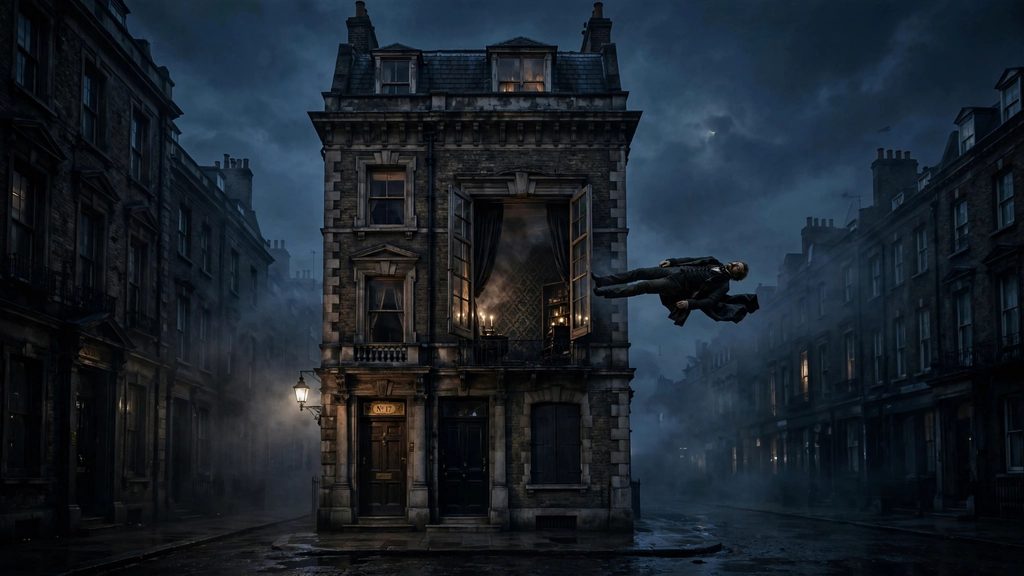
It is also one of the episodes most heavily contested by later investigators. Skeptical historian Trevor Hall argued that the event could have involved something considerably less supernatural than an actual levitation, and that the surviving witness accounts were not as mutually consistent as later retellings suggested. Other researchers have defended the witnesses and argued that the conventional explanations do not satisfactorily account for what they reported.
Again, the honest conclusion is narrower than either side usually wants. The surviving testimony tells us that people reported an extraordinary event. It does not give us a modern recording of the event. No surviving photograph shows Home suspended between the windows. No controlled recreation was performed at the time. The historical question therefore remains one of evidence, testimony and reconstruction rather than laboratory demonstration.
The £60,000 Mystery
Home’s career also produced a controversy that had nothing to do with levitation. In 1866, wealthy widow Jane Lyon adopted him and transferred property worth about £60,000 to him. She later regretted the arrangement and brought a legal action seeking restitution, alleging that the gift had been obtained through spiritual influence. The case ended badly for Home: the court ordered the return of the money.
But even here, precision matters. The court did not convict Home of performing fraudulent supernatural tricks, nor did it simply declare that he had stolen the money through a séance. Contemporary legal summaries indicate that the specific allegations did not survive cross-examination in the straightforward way later retellings sometimes imply. Instead, the court placed the burden on Home to establish the validity of the extraordinary gift, and he failed to do so. The result is therefore best described as a documented legal defeat over a highly unusual transfer of wealth, not as a formal judicial finding that Home was a fraudulent medium.
That distinction is precisely why the episode belongs in the story. Home’s defenders can accurately say that he was not convicted of fraud. His critics can accurately say that his relationship with a wealthy patron ended in litigation and that a court ordered him to give the money back. Neither side gets to erase the uncomfortable part.
What About Houdini?
Harry Houdini’s name inevitably appears whenever Home is discussed. Houdini became one of the most aggressive opponents of fraudulent mediums and claimed that many apparently supernatural feats could be reproduced through conjuring. He also expressed confidence that Home’s famous levitation could be duplicated and at one point proposed a demonstration. The demonstration never materialized.
But that does not prove either side of the Home argument. Houdini’s failure to reproduce a feat is not evidence that Home performed it supernaturally. At the same time, skeptics cannot simply invoke Houdini’s expertise as though that settles every historical question. Reproducing a séance trick more than half a century later, without the original room, lighting, social dynamics, objects and performer, is not the same as reproducing it under the conditions in which it was originally reported.
The absence of a successful modern recreation therefore cuts both ways. It means the supernatural claim has not been independently reproduced. But it also means the precise mechanism of the historical performance cannot simply be declared solved because a magician can imagine how it might have been done.
The Biggest Skeptical Case Came Decades Later
Trevor Hall’s The Enigma of Daniel Home: Medium or Fraud?, published in 1984, remains the most sustained skeptical examination of Home’s career. Hall argued that Home’s background, social connections and supernatural reputation had been embellished and that several of his celebrated phenomena could be explained as conjuring or misinterpretation. His work is important because it forced later writers to confront details that admirers had sometimes passed over.
But Hall should not be transformed into an infallible prosecutor. His work has itself been criticized by researchers in psychical studies, including Stephen Braude, who argued that Hall relied too heavily on unreliable testimony and selective evidence. This matters enormously. If the skeptical case depends on an investigator whose own historical methods are disputed, it cannot honestly be presented as a final conviction. The correct conclusion is that Hall supplied a powerful skeptical framework, not an incontrovertible reconstruction of every séance Home ever conducted.
So Was Daniel Dunglas Home a Fraud?
The surviving record does not justify the certainty with which that question is usually answered. There is no documented moment in which Home was caught red-handed performing one of his most famous phenomena under conditions that make deception impossible. That is genuinely significant. His reputation survived decades of scrutiny, including scrutiny from hostile observers. His contemporaries included people who were highly intelligent, socially prominent and capable of intense skepticism. Some remained convinced that they had witnessed things they could not explain.
But the opposite conclusion is equally unjustified. The fact that Home was never conclusively exposed does not mean his phenomena were scientifically established. His séances often depended on darkness, proximity, trust and environments he could influence. His most famous experiments were not independently replicated under modern controls. The crucial accordion experiment left important observational gaps. Crookes’s conclusions were challenged almost immediately, by name, and rejected by his own scientific institution. His later work with Florence Cook generated serious questions about his judgment. And the most spectacular levitation stories depend ultimately on testimony from people watching events more than a century ago.
The result is an evidentiary deadlock, but not an empty one. There are real reasons to take the Home case seriously, and there are real reasons not to accept its supernatural interpretation. The mistake is believing that one must destroy one side before acknowledging the other. A respectable scientist can be genuinely deceived. A medium can be extraordinarily skilled without being caught. A witness can be sincere and still be mistaken. And an experiment can contain real measurements while failing to control the human being standing beside the apparatus.
The Most Dangerous Phrase in the Story Is “Never Caught”
“Never caught” sounds like a verdict. It isn’t. It describes an absence of one particular kind of evidence: no decisive exposure in which Home was conclusively demonstrated to be cheating during the performance of his most famous phenomena. That is worth knowing. But it tells us nothing by itself about how strong the positive evidence was.
The same problem appears in reverse when skeptics say Home was “debunked.” He wasn’t. There is no single experiment, confession or forensic discovery that closes the case. What exists instead is a mountain of historical testimony surrounded by uncertainty about observation, lighting, experimental design, witness reliability, social pressure and the physical mechanisms available to a nineteenth-century performer.
That is why Home remains fascinating.
He was not the medium science proved.
He was not the fraud history caught.
He was the medium who managed to leave behind something far more troublesome: a record in which intelligent people saw extraordinary things, a distinguished scientist believed he had measured them, contemporary critics identified serious weaknesses, later investigators proposed ordinary explanations, and none of the surviving evidence is strong enough to close the case completely.
Daniel Dunglas Home died at Auteuil, France, on June 21, 1886. The séances stopped. The witnesses disappeared. The rooms were demolished or transformed. The instruments survived only in descriptions and drawings. And the one experiment that mattered most, the experiment that could have separated an unknown force from an unknown method of deception, can never be repeated exactly as it happened.
That is Home’s real legacy. Not proof of the supernatural. Not proof of fraud. A century and a half later, the evidence is still sitting precisely where he left it: just short of certainty.