Every autumn, the Greeks said, the god Apollo left his temple at Delphi and travelled north, beyond the mountains, beyond the cold, beyond the cave of Boreas, the north wind himself. There, at the edge of the world, lived a people the wind could not reach. They knew neither sickness nor old age. They feasted, sang and danced to the music of lyres and flutes, crowned with golden laurel, and the god stayed with them through the winter months before returning in spring. The Greeks called them the Hyperboreans, the people beyond the north wind.
Twenty-five centuries later, in the summer of 1922, a small Soviet expedition with the backing of the secret police pushed into the tundra of the Kola Peninsula, above the Arctic Circle, looking for something its leader believed the Greeks had only half remembered. Seventy-five years after that, Russian expeditions returned to the same lake and announced they had found pyramids.
Between those moments, the land beyond the north wind was joined to Atlantis, to a hollow Earth, to hidden kingdoms under the Himalayas, to Nazi racial mythology and to a secret diary of an American admiral. This file takes the knot apart, one strand at a time, and shows when and by whom each strand was tied.
Beyond the North Wind
- c. 700 BCEHesiodA fragment of the Catalogue of Women places a blessed people far to the north.Poetry
- c. 600 BCEAristeas of ProconnesusA lost poem, known through Herodotus, travels north past the one-eyed Arimaspians and the gold-guarding griffins to the Hyperboreans beyond.Poetry
- 498 BCEPindarPythian Ode 10. Perseus feasts among them. Neither sickness nor old age touches them, and Apollo delights in their sacrifices.Poetry
- c. 430 BCEHerodotusReports the offerings passed hand to hand from the far north to Delos, and Abaris and his arrow. Then the jab: if there are people beyond the north wind, there must be people beyond the south wind too.Doubt
- c. 300 BCEHecataeus of AbderaThrough Diodorus: an island beyond the land of the Celts, no smaller than Sicily, with a round temple to Apollo.Report
- 77 CEPliny the ElderDay lasts six months, night six months. They live long and happily, and when tired of life they leap from a rock into the sea.Report
The Hyperboreans first appear in Greek poetry. A fragment attributed to Hesiod, from around 700 BCE, places a blessed people far to the north. In 498 BCE the poet Pindar, in his tenth Pythian Ode, sent the hero Perseus to feast among them. Neither the Muse nor joy was ever absent there, he wrote, and no one could reach them by ship or on foot.
The historian Herodotus, writing around 430 BCE, took the subject more coolly. He knew a poem by Aristeas of Proconnesus that travelled north past the one-eyed Arimaspians and the griffins that guarded gold, to the Hyperboreans beyond. He reported the strange custom of the islanders of Delos, who said that sacred offerings wrapped in wheat straw arrived from the far north, passed from people to people until they reached the sanctuary of Apollo. He told of Abaris, a Hyperborean said to have carried an arrow around the whole world without eating. And then he allowed himself a dry joke. If there are people beyond the north wind, he wrote, there must also be people beyond the south wind.
Later writers added detail. Hecataeus of Abdera, quoted by Diodorus, described an island in the ocean beyond the land of the Celts, no smaller than Sicily, with a sacred precinct and a round temple to Apollo. Some readers have wondered whether this was a distant echo of Britain and its stone circles. Pliny the Elder, in the first century CE, wrote that in Hyperborea the day lasted six months and the night six months, that the people lived long and happily, and that when they had had enough of life, they feasted and leapt from a rock into the sea.
Taken together, the Greek and Roman sources describe a paradise at the edge of the known world, a place to which gods withdraw and heroes travel. None of them describes ruins, cities, technology or a civilisation that fell. The Hyperboreans were the north’s version of the Isles of the Blessed, a dream of happiness placed just beyond the reach of ordinary people.

The Islands at the Top of the World
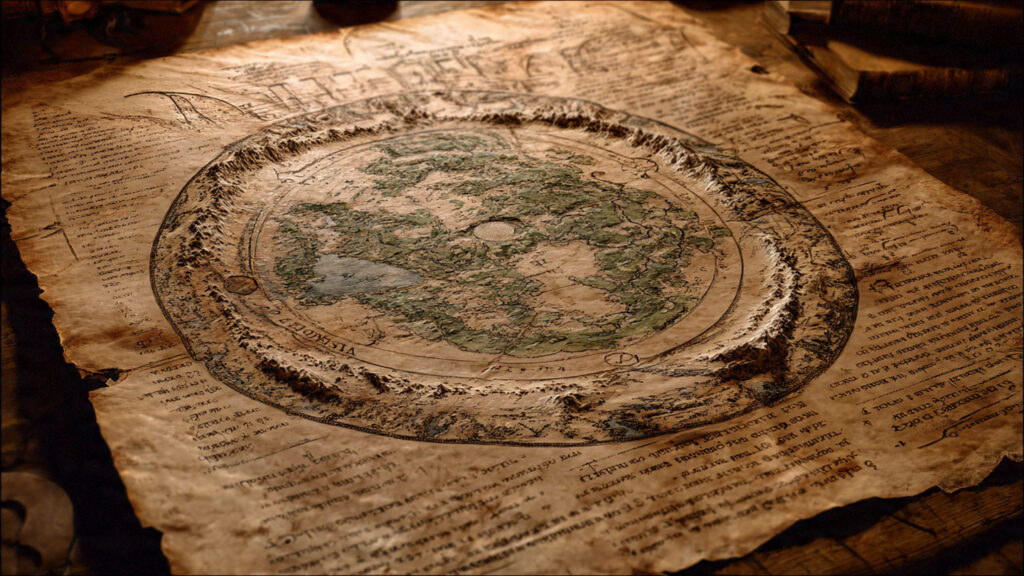
For centuries the far north stayed blank on European maps. Then, in 1569, the great Flemish cartographer Gerard Mercator added a small inset to the corner of his world map, and in 1595 his son published it as a full map of the Arctic, the first ever made.
- IThe island north of NorwayLabelled as home to pygmies “at most 4 feet tall”, like those the Norse met in Greenland.
- II-IVThe other three islandsThe best and healthiest of all the north, according to Mercator’s source.
- →The indrawing seasFour seas pour inward between the islands, so strongly that no ship can sail against them.
- ●The whirlpool and the black rock“Right under the Pole there lies a bare Rock in the midst of the Sea.” Mercator, writing to John Dee in 1577.
It shows the North Pole as a ring of four large islands, separated by four channels through which the ocean pours inward with such force that no ship can sail against it. At the centre the waters spiral into a whirlpool, and in the middle of the whirlpool stands a single black rock. One island is labelled as home to pygmies no more than four feet tall.

The image looks like Hyperborea made visible, and it is often presented that way. Mercator himself named his source. In a letter of 1577 to the English magus John Dee, he explained that the polar geography came from a lost fourteenth-century book called the Inventio Fortunata, the account of an English friar said to have travelled the northern seas, which he knew through a summary by a Dutch writer named Jacob Cnoyen. His Arctic was medieval travellers’ lore set down with a master’s precision. It lasted on European maps until explorers sailed far enough north to find only ice and open sea.
Atlantis Joins the Story
Hyperborea and Atlantis began as strangers. Atlantis comes from Plato, who described it around 360 BCE in two dialogues, the Timaeus and the Critias, as a great naval empire beyond the Pillars of Heracles that grew arrogant, was defeated by an ancient Athens, and sank into the sea in a single day and night. Plato presented the story as one handed down from the lawgiver Solon, who had heard it from priests at Sais in Egypt. His own student Aristotle seems to have treated it as Plato’s invention.
Atlantis stayed a philosopher’s tale for two thousand years. Then in 1882 the American congressman Ignatius Donnelly published Atlantis: The Antediluvian World, which argued that Atlantis had existed and was the mother of all the world’s civilisations. The book was a sensation, and it opened the door for what came next.
Blavatsky’s Root Races
The moment the separate legends were fused into a single system can be dated. In 1888 Helena Blavatsky, co-founder of the Theosophical Society, published The Secret Doctrine, a vast work of occult cosmology she said was based on ancient secret teachings. In it she described humanity as passing through a series of “root races”, each living on its own lost continent. After a first, ethereal race came a Hyperborean race in the far north, then the Lemurians on a sunken continent in the Indian Ocean, then the Atlanteans, and finally the Aryans of the present age.
For the first time Hyperborea, Lemuria and Atlantis stood in a single sequence, each the ancestor of the next. Blavatsky drew openly on Donnelly. Later writers drew on Blavatsky, often without naming her, and the sequence passed into countless books as if it were ancient tradition.

In 1903 the Indian scholar and nationalist Bal Gangadhar Tilak added another strand. In The Arctic Home in the Vedas he argued, from the astronomy of the oldest Hindu hymns, that the ancestors of the Aryans had once lived near the North Pole, in a warmer age, before the ice drove them south. The idea of a polar homeland was now attached to the Vedas as well as to the Greeks.
The German Arctic
In Germany the polar homeland took a darker turn. The Thule Society, founded in Munich in 1918, took its name from Ultima Thule, the far northern land of classical geography, and drew on ideas of an ancient Nordic master race. In the 1920s the Dutch-German scholar Hermann Wirth argued that the “Nordic race” had originated in a sunken Arctic homeland. In 1935 he helped Heinrich Himmler found the Ahnenerbe, the SS research institute that sent expeditions across the world in search of evidence for Aryan origins. The story of that institute is told in Himmler’s quest for Aryan supremacy.
The Greek Hyperboreans had been a happy people loved by a god. In these hands they became a race of ancestors, and their homeland a claim to superiority. It is the clearest example in this whole story of a myth being put to work.
Barchenko and the Kola Expedition
Alexander Barchenko was born in 1881 in Yelets, in central Russia. He studied medicine without finishing, wrote mystical fiction, experimented with telepathy and became fascinated by the idea of an ancient wisdom preserved in remote places. After the revolution he found powerful friends. Gleb Bokiy, head of the special department of the Cheka, the Soviet secret police, took an interest in his ideas, and Barchenko came to lead a secret laboratory studying the powers of the mind.
In 1922 Barchenko led an expedition to the Lovozero tundra and Lake Seydozero on the Kola Peninsula, connected by most accounts to Vladimir Bekhterev’s Brain Institute in Petrograd. Its stated task was to study meryachenie, a startle condition described among Arctic peoples, in which a person suddenly shocked may imitate others or obey commands without will. Barchenko had other hopes. According to the accounts of members, the team reported an ancient paved road, cubic blocks of stone, a column, pyramids and a chasm leading into the ground that they did not enter. Barchenko believed he had found the traces of a Hyperborean civilisation.
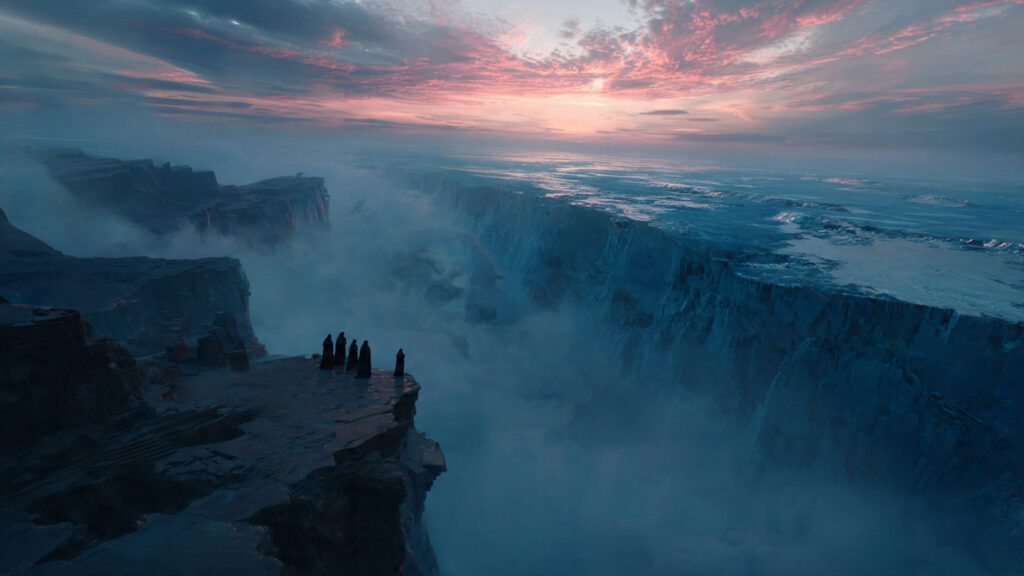
On a cliff above Seydozero stands a huge dark figure with outstretched arms, known in Sami legend as Kuyva, a giant turned to stone. It is a stain on the rock, darkened by water and lichen. To believers it became a carving left by the ancients.
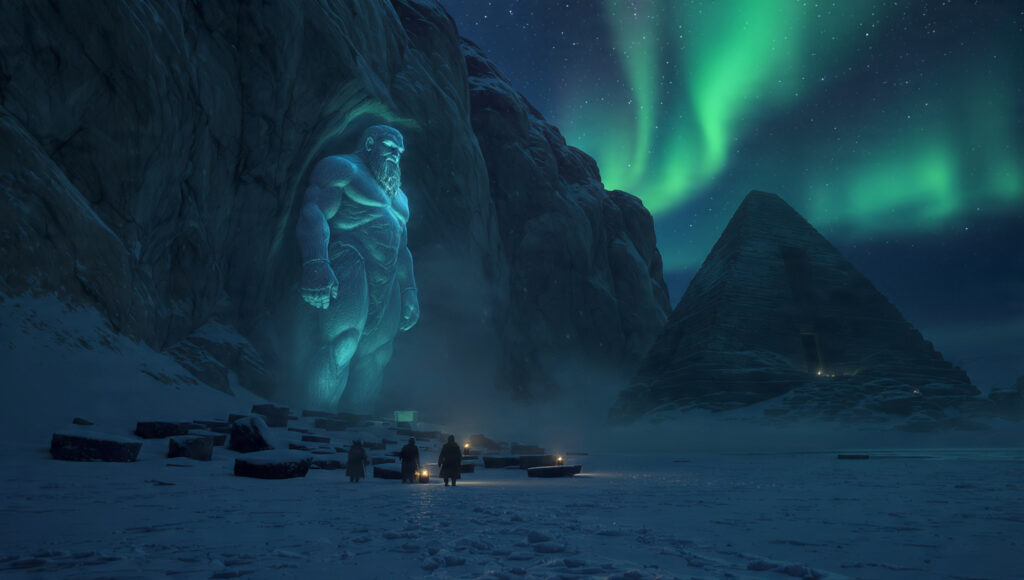
The story ended in the purges. Bokiy was arrested and shot in 1937. Barchenko was arrested the same year and executed in Moscow in April 1938. The expedition’s papers have never been released, and by some accounts they were destroyed in 1941. That silence is the space in which the modern legend has grown.

The Pyramids of Seydozero
In 1997 and 1998 the Russian philosopher and writer Valery Demin led amateur expeditions to Seydozero under the names Hyperborea-97 and Hyperborea-98, following Barchenko’s route. He described stone pyramids, observatories and stairways. Later expeditions announced pyramids fifty metres high joined by a bridge.
None of these finds has been published in a form that geologists or archaeologists could examine. The most famous photograph of the “Kola pyramids” shows two mountains in the Faroe Islands. The stepped “stairway” often shown with them is the Vottovaara rock formation in Karelia, bedrock split and polished by glaciers. The Kola Peninsula is glacier country, and ice leaves behind exactly the kinds of smooth domes, terraces and blocks that look built to a hopeful eye.
By the twenty-first century Hyperborea had become a political idea in Russia as much as a mystical one. The ethnologist Victor Shnirelman has described how “the Aryan myth was revived in Russia by occult scientists, Neo-Pagans and radical Russian nationalists.” The Arctic homeland of the Greek poets became an argument about who owns the north.
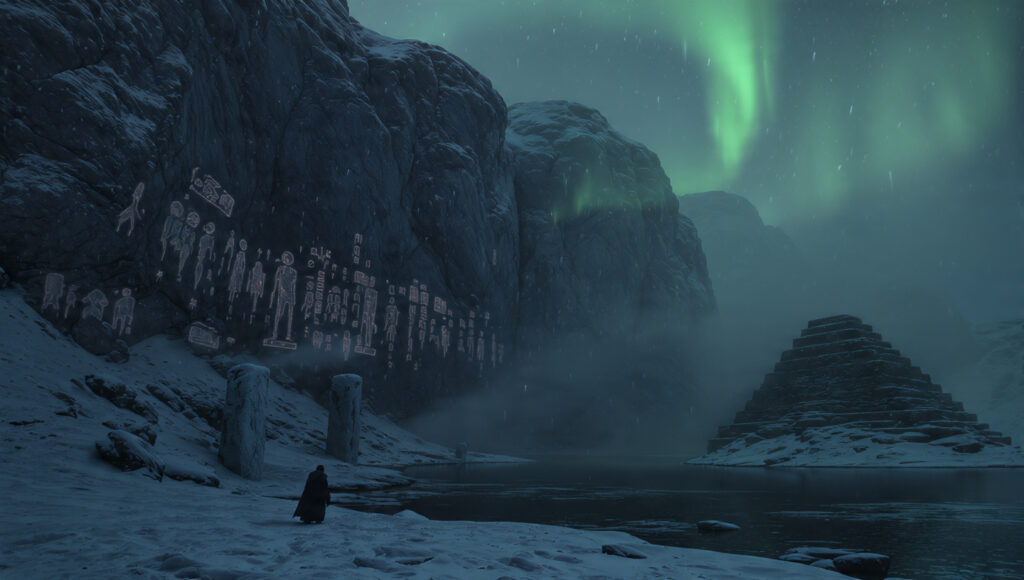
The Hollow Earth
The idea of a hollow planet began as science. In 1692 the astronomer Edmond Halley, of comet fame, published a paper suggesting that the Earth might be made of concentric shells around a central core, each turning at its own rate. It was a serious attempt to explain why the direction of a compass needle slowly changes over time.

In April 1818 an American army officer, John Cleves Symmes Jr., sent a circular to scientists and statesmen that began, “I declare the earth is hollow, and habitable within.” He proposed vast openings at both poles and campaigned for an expedition to sail into them. His follower Jeremiah Reynolds helped stir support for the United States Exploring Expedition of 1838, which charted the coast of Antarctica and found ice. In the 1870s Cyrus Teed went further still, founding a religious community, the Koreshan Unity, around the belief that humanity lives on the inside of a hollow sphere. In 1913 Marshall Gardner published A Journey to the Earth’s Interior, with a small sun burning at the centre.
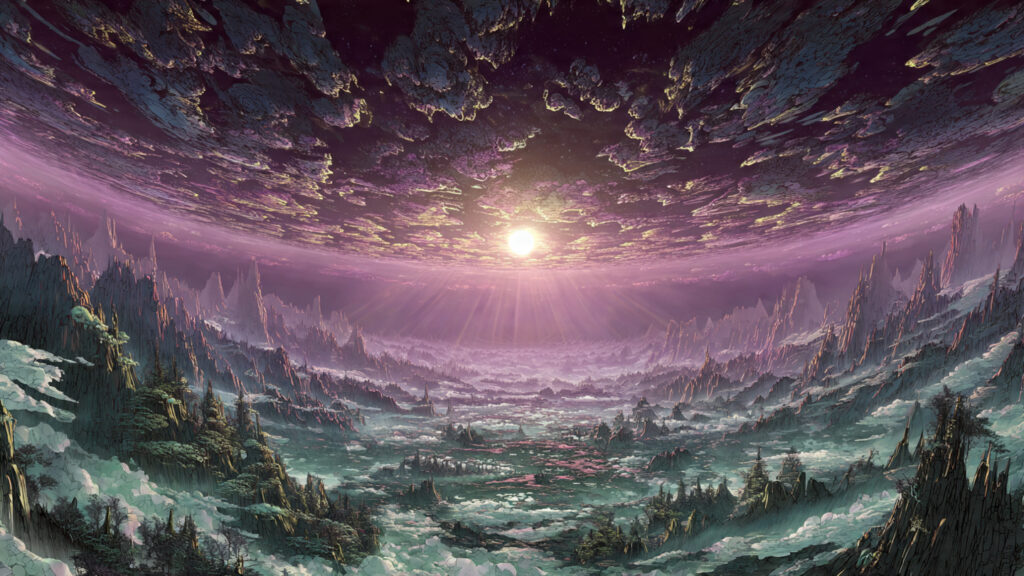
By then the science had long since moved on. In 1774 the astronomer Nevil Maskelyne measured how much the mountain Schiehallion in Scotland pulled a plumb line aside, and the calculations that followed showed the Earth to be, on average, far denser than the rocks at its surface. A hollow planet could not weigh what the Earth weighs. In the twentieth century seismologists went further, reading the echoes of earthquakes as they travelled through the planet. In 1936 the Danish seismologist Inge Lehmann showed that the Earth has a solid inner core inside a liquid outer one. The interior has been mapped by every large earthquake since.
On the Kola Peninsula itself, Soviet engineers began drilling in 1970 to find out how deep a hole could go. By 1989 the Kola Superdeep Borehole had reached 12,262 metres, still the deepest hole ever drilled. It found hot, dense rock all the way down, and the heat at the bottom, around 180 degrees Celsius, finally stopped the drill. A rumour that the crew had broken into a cavern and recorded the screams of the damned spread through Christian broadcasts in the years that followed. The rock cores, still held by geologists, say otherwise.
Meanwhile the hollow Earth was being furnished by mystics. In 1886 the French occultist Saint-Yves d’Alveydre wrote of Agartha, a hidden kingdom of sages beneath the earth, and in 1922 the Polish writer Ferdinand Ossendowski, in Beasts, Men and Gods, described an underground King of the World. Shambhala, a hidden kingdom in Tibetan Buddhist teaching, was swept into the same picture. In the 1960s Raymond Bernard’s The Hollow Earth joined the polar holes to flying saucers. The inner world now had cities, rulers and fleets.
The Admiral’s Diary
The last great strand belongs to Richard Byrd, the American naval aviator who flew towards the North Pole in 1926, flew over the South Pole in 1929 and commanded Operation Highjump, a vast US Navy exercise in Antarctica in 1946 and 1947 involving some 4,700 men and 13 ships.
In 1959 Ray Palmer’s Flying Saucers magazine claimed that Byrd had spoken of a mysterious “land beyond the pole” and had flown into the hollow interior. Much later, a “secret diary” appeared, in which Byrd describes flying through a polar opening into a warm valley with mammoths and meeting a wise race of inner beings. The diary has no known manuscript, no provenance and no place in Byrd’s papers, which are held in a university archive. It reads like the pulp fiction of its own time, because that is what it is. Byrd himself, who navigated across the polar ice by the sun, needs no such help to be remarkable. The legend of what Operation Highjump found is weighed in the Nazi ice fortress file.
How the Lost Earth Was Built
Laid out in order, the story has the structure of a cliff face. At the bottom lies the Greek dream of a happy people beyond the north wind. Above it, Plato’s drowned empire. Above that, Mercator’s islands and Halley’s nested shells, honest attempts to understand the world with the knowledge of their time. Then, in the 1880s, the great synthesis: Donnelly, Saint-Yves and Blavatsky, who took the separate legends and fused them into one story of lost races and hidden lands. Above them, the political layers of the twentieth century, German and Russian, and the pulp layer of flying saucers and admirals’ diaries.
Each layer was laid down by a named author, and each built on the ones beneath it. None of the older layers knew anything of the newer ones. Pindar never heard of a hollow Earth, Halley never mentioned Hyperborea, and Plato’s Atlantis had nothing to do with the north. The sense of many ancient voices agreeing is an illusion produced by modern writers quoting one another.
The Verdict | Debunked
Hyperborea is one of the oldest and loveliest legends of the Western world, a land of light and music where a god spent his winters. That legend is on the record, in Hesiod, Pindar, Herodotus, Hecataeus and Pliny, and it deserves to be read for what it is.
The modern Hyperborea is another thing: an advanced polar civilisation, remembered in the Vedas and the Greek poets, connected to Atlantis and a hollow Earth, its ruins hidden in the Russian Arctic. Every part of that picture was added after the fact, most of it in the last 140 years, and none of it is supported by the ground. The Arctic has yielded no ruins of a lost civilisation, the pyramids of Seydozero are rock shaped by ice, the hollow Earth was ruled out by the weight of the planet and the echoes of its earthquakes, and the diary of Admiral Byrd belongs to pulp fiction. The claim is stamped Debunked.
- Claim tested
- An advanced civilisation called Hyperborea once flourished at the North Pole, remembered in ancient texts, linked to Atlantis and a hollow Earth, and its ruins survive in the Russian Arctic.
- Oldest record
- Rung 5 · Retold
Greek poetry from about 700 BCE onward describing a blessed people beyond the north wind, with no claim of ruins, technology or a hollow world. - The record supports
- That Greek and Roman writers told of the Hyperboreans, that Mercator drew islands at the pole, that Barchenko led an expedition to the Kola Peninsula in 1922, and that a hollow Earth was once proposed by serious scientists.
- It does not support
- Any polar civilisation. No ruins have been found under or around the Arctic, the Seydozero pyramids are natural rock, the hollow Earth was ruled out by measurements of the planet’s density and by seismology, and the threads were joined only in the 1880s.
- Explanations weighed
- Hyperborea as a lost civilisation, as a Greek myth of paradise at the edge of the world, and as a modern composite assembled from separate legends.
- What would change it
- Excavated remains of a settled culture in the high Arctic far older and more advanced than the archaeological record allows, published for others to examine.
The Hyperborea cluster continues in the legend that Hyperborea vanished only in the sixteenth century and the claim that the Soviet Arctic hides Hyperborean remains. The inner world has its own files, from the Great White Brotherhood and the hollow Earth to polar entrances and underground civilisations, and the giants and fallen angels sometimes placed beneath the ice are traced in The Watchers and the Nephilim, the most misunderstood story in the Bible. Every verdict in the archive is listed in the Verdict Index, and the rules behind the stamps are set out in the Archive Standard.
Quick Answers About Hyperborea
What is Hyperborea?
In Greek mythology, the land of the Hyperboreans, a blessed people who lived “beyond the north wind”, free of sickness and old age, where Apollo spent the winter months. It appears in Greek and Roman writers from about 700 BCE to the first century CE.
Did Hyperborea exist?
No archaeological evidence shows a civilisation matching the legend. The Greek sources describe a mythical paradise at the edge of the known world, and Herodotus himself doubted it. Some scholars have suggested that faint knowledge of northern peoples, or of Britain, lies behind parts of the story.
What did Barchenko find on the Kola Peninsula?
His 1922 expedition to Lovozero and Seydozero reported stone blocks, a paved road and pyramids, which he took for Hyperborean remains. No finds were ever published, the expedition’s papers have never been released, and Barchenko was executed in 1938.
Are there pyramids at Lake Seydozero?
No. The landforms reported by expeditions since the 1990s are natural rock shaped by glaciers, and the most widely shared photograph of “Kola pyramids” shows mountains in the Faroe Islands.
Is Hyperborea connected to Atlantis?
Not in the ancient sources. Hyperborea comes from Greek poetry, Atlantis from Plato. The two were first joined in Helena Blavatsky’s The Secret Doctrine in 1888, as successive “root races” of humanity.
Is the Earth hollow?
No. Measurements of the Earth’s density since the 1770s and the study of earthquake waves since the early twentieth century show a dense, layered planet with a liquid outer core and a solid inner core.