




Novaya Zemlya hardly needs an imaginary civilization to become mysterious. It was home to the largest nuclear explosion in history, the workplace of brilliant and eccentric Soviet scientists, and the subject of decades of military secrecy. Those facts are well documented.
Around them, however, grew a much stranger modern legend: that beneath the Arctic ice lay the ruins of Hyperborea, guarded by a joint Soviet-German expedition, a labyrinth that altered consciousness, and two real men, Robert Bartini and Gleb Bokiy, whose actual lives turn out not to fit the legend at all.

The Archipelago’s Actual, Documented History
Novaya Zemlya became the Soviet Union’s primary nuclear proving ground, hosting weapons tests from 1955 through 1990. In 1961 it absorbed the Tsar Bomba, the most powerful nuclear device ever detonated, along with dozens of other underground and underwater shots at sites including Matochkin Shar and the settlement of Krasino. A 2005 review in Science & Global Security cataloged this testing history in specific, technical detail, seismic yields, tunnel locations, radioactive venting incidents, the kind of paperwork that survives fire rather than myth. That’s the verifiable reason the archipelago remains sparsely inhabited and heavily restricted today. No credible historical record, Soviet, German, or otherwise, supports a 1935 joint expedition to the archipelago in search of an ancient civilization. But the real silence around Novaya Zemlya, the classified maps, the closed archives, the decades of restricted access, left exactly the kind of vacuum a legend like Hyperborea grows well in.

Gleb Bokiy Supplied the Occult Reputation
If any single figure lent this legend its air of genuine strangeness, it was Bokiy, and his real biography needs no embellishment to earn that. Born in Tbilisi in 1879, he rose through the Cheka, then the OGPU, to head the secret police’s “Special Department” from 1921 to 1934, a real position overseeing Soviet cryptography and, separately, the early Soviet camp system including Solovki. His interest in the paranormal was genuine: he collaborated closely with occultist Alexander Barchenko, opened a secret laboratory at 21 Kuznetsky Bridge in Moscow as early as 1924, and explored Buddhist spiritual techniques and hypnosis for potential state use, drawing in Sami sorcerers, Buryat shamans, and prominent psychiatrist Vladimir Bekhterev along the way. Bokiy has even been floated as a possible inspiration for Bulgakov’s Woland, since accounts describe gatherings at his dacha resembling the ball in The Master and Margarita. None of that genuine strangeness involves Novaya Zemlya. Bokiy was arrested on 16 May 1937, tried summarily, and executed that November, one of thousands of Old Bolsheviks purged that year, a real fall with nothing to do with any Arctic expedition two years earlier.

If Bokiy Supplied the Occult Reputation, Bartini Supplied the Scientific One
Born Roberto Oros di Bartini in Fiume in 1897, he trained at Milan’s Politecnico, joined the Italian Communist Party, and fled Mussolini’s Italy for the Soviet Union in 1923, carrying advanced Italian aviation knowledge with him. He rose to lead an experimental aircraft design department by 1930, and developed genuine, published theoretical work on a six-dimensional model of space and time that colleagues called “the Bartini world,” a legitimate if unconventional piece of speculative physics, not evidence of practical time research. Then the Great Terror reached him too. Arrested in 1938, Bartini spent the next eight years imprisoned in a sharashka, one of the Soviet Union’s secret prison design bureaus, continuing his aircraft work at the Beriev Aircraft Company in Taganrog even as the state that condemned him kept using his mind. His captors needed his engineering more than they wanted him free. Rehabilitated in 1956, he went on working at the Siberian Aeronautical Research Institute, received the Order of Lenin in 1967, and died in Moscow in 1974, sharing rumored ties to a semi-legendary intellectual circle called ATON alongside Soviet science fiction writers. None of that actual life includes a Novaya Zemlya laboratory, a post-1953 Siberian exile, or research into reversing causality. The real Bartini remains one of Soviet aviation’s most genuinely mysterious figures without any of it.

The Ahnenerbe Never Actually Reaches This Far North
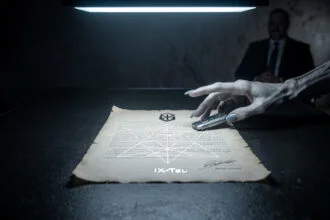
The organization lending the German half of this legend is real too. This site has covered the Ahnenerbe’s actual history elsewhere, a genuine SS research institute founded in 1935 with an explicit mission researching claimed Aryan racial origins, including its real 1938 expedition to Tibet. That expedition’s own published record involves Central Asia, not the Soviet Arctic, and no credible historical source connects the Ahnenerbe to a joint 1935 investigation of Novaya Zemlya alongside Soviet researchers, a partnership that would have been diplomatically extraordinary between two regimes already drifting toward open hostility. The specific artifacts described in the legend, silver pyramids etched with shifting Coptic-style writing, filigree statues of the crocodile god Sobek dressed for a laboratory, a thermally active labyrinth guarded by a mermaid statue, appear in no archive, museum catalog, or peer-reviewed survey of the region. They’re vivid invention, laid over two men and one archipelago whose real stories were already extraordinary enough to carry a legend on their own.

Why Silence Grows Legends
Places defined by secrecy invite myth almost by design. When archives stay closed, when military activity gets classified for decades, when maps show little more than blank Arctic coastline, imagination rushes in to fill exactly that silence. Novaya Zemlya became fertile ground for a legend like this one not because archaeologists ever uncovered Hyperborea beneath it, but because secrecy itself, real, extensive, decades-long Soviet secrecy, does the same work a genuine mystery would: it withholds the ordinary explanation long enough for an extraordinary one to take root instead. The men who actually worked in and around that silence, an occultist policeman, an imprisoned genius, a distant fascist research institute, were strange enough on their own record to make the substitution feel almost plausible.

The Secrecy Was Real. The Geography Was the Fiction.
Instead of glowing tunnels, it contains seismic records, declassified reports, engineering drawings, and radiation surveys, the paperwork left behind by an age that reshaped the Arctic with fire rather than myth. Novaya Zemlya’s actual history is a nuclear testing archive spanning thirty-five years and dozens of detonations. Bokiy’s actual history is a documented collaboration between Soviet state security and occult research, ending in a 1937 execution utterly unconnected to any Arctic expedition. Bartini’s actual history is a brilliant, imprisoned, eventually rehabilitated aviation engineer whose theoretical physics on multidimensional time remains a legitimate curiosity in the history of Soviet science, no invented laboratory required. Each of these three threads is checkable, on the record, and stranger for being true. None of them ever needed a joint German-Soviet Hyperborea expedition to become worth telling. The silence was always the more interesting story.