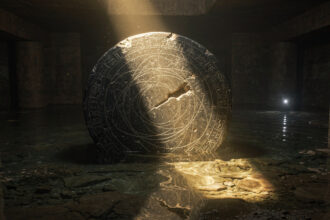





The Wedge of Aiud is in a museum in Romania.
It was recovered in 1974 from a sand pit near the town of Aiud, approximately ten meters below the surface, in the same geological layer as the bones of a Mastodon, a species that became extinct in the region at the end of the last glacial maximum, approximately ten to twelve thousand years ago. The object is approximately twenty centimeters long and weighs approximately three hundred grams. It was taken to the Institute for Archaeology in Cluj-Napoca for material analysis.
The analysis confirmed that the object is an alloy of aluminum. The composition is approximately 89% aluminum with trace elements including copper, zinc, lead, cadmium, nickel, and cobalt. The object has a flat upper surface, two holes on one end suggesting it was attached to something larger, and significant oxidation indicating genuine age rather than recent manufacture.
Aluminum metal was not produced by human technology until 1827, when the French chemist Henri Sainte-Claire Deville developed the first practical extraction process. The industrial production of aluminum at scale did not begin until the 1880s. An aluminum alloy object with trace elements consistent with intentional alloying rather than natural formation, recovered from a geological layer dated to at least ten thousand years before aluminum metallurgy existed, requires an explanation that the conventional history of human technology does not provide.
The explanation has not been provided. The object is in the museum. The analysis documentation is in the record. The gap between the object’s apparent age and the known history of aluminum production remains open.
The Mechanism That Should Not Have Been
The Antikythera mechanism is the most precisely documented out-of-place artifact in the conventional archaeological record, and the one whose anomalous character is most definitively established by mainstream institutional analysis.
It was recovered from a shipwreck off the Greek island of Antikythera between 1900 and 1901, brought up with a cargo of bronze and marble statues that were being transported from somewhere in the eastern Mediterranean to Rome. The wreck has been dated by ceramic and amphora typology to approximately 70-60 BCE. The mechanism was encrusted and partially fused when recovered and was not recognized as mechanically significant for several years after its initial recovery.
Systematic X-ray analysis beginning in the 1970s and continuing with computer tomography in the 2000s revealed an internal architecture of extraordinary complexity: at least thirty-seven interlocking bronze gears, some with as few as fifteen teeth and some with as many as 223, arranged in a system that modeled the motions of the Sun, Moon, and the five planets known to ancient Greek astronomy, predicted lunar and solar eclipses using the Saros cycle, calculated the position of the Moon in the zodiac, and tracked the four-year cycle of the Olympiad. The front face displayed a calendar ring and zodiac dial. The back face displayed two spiral dials for eclipse prediction and the Metonic cycle.
Research published in Nature in 2021 by the UCL Antikythera Research Team, led by Professor Tony Freeth, produced the first complete mechanical reconstruction consistent with all the surviving gear evidence and the inscriptions on the mechanism’s remaining fragments. The reconstruction confirmed that the device’s front display showed a model of the cosmos with the Sun, Moon, and planets moving at their correct relative rates, including the Moon’s variable speed due to its elliptical orbit.
The mechanical engineering required to produce this device, differential gearing capable of representing a two-argument mathematical function, was not formally described in the Western technical literature until the sixteenth century and was not in practical mechanical use until the seventeenth century. The Antikythera mechanism was built approximately fifteen centuries before the engineering theory required to design it was developed in the Western tradition.
The UCL team’s analysis noted that the device’s inscription references a tradition of astronomical modeling. Someone built the Antikythera mechanism from a tradition of astronomical mechanical modeling that produced it. That tradition’s prior history has not been recovered.
The Spheres in the Precambrian
The Klerksdorp spheres are a collection of metallic spheres and discs found in pyrophyllite deposits in the Ottosdal region of South Africa’s North West Province. The deposits in which they are found have been dated to approximately 2.8 billion years. The spheres range from one to ten centimeters in diameter. Their surfaces are typically dark reddish-brown with lighter flecks, and many of them display a precise groove or grooves running around their equators.
Roelf Marx, the former curator of the Klerksdorp Museum who documented the spheres in the 1980s, noted the character of the grooves: they are consistent in width and depth around their entire circumference, suggesting a process of formation whose precision is not characteristic of the natural concretion processes that geological formation proposes as the explanation.
The geological explanation for the Klerksdorp spheres, that they are natural concretions formed by mineral accretion around a core in the sedimentary matrix, is the mainstream position and is not implausible as an explanation for the spherical forms. Natural concretions occur in many geological formations. The feature that the geological explanation struggles with is the grooves: the equatorial groove on many specimens is uniform in a way that natural concretion processes do not typically produce, and is present on specimens that show no other evidence of the asymmetric accretion that typically produces elongated or irregular natural concretions.
The standard response to the anomalous character of the grooves is that natural geological processes can produce unexpected regularities and that without evidence of intelligent agency the default explanation is natural formation. This response is logically valid. It is also circular: the grooves are the proposed evidence of non-natural formation, and dismissing the grooves as insufficient evidence because no non-natural formation can be demonstrated without the grooves does not engage with the physical characteristics of the grooves that make natural formation difficult to explain.
The spheres are in institutional collections. The grooves are documented. The formation mechanism that produces grooves of this character in Precambrian pyrophyllite deposits has not been formally described.
Michael Cremo and What the Record Contains
In 1993, researcher Michael Cremo and physicist Richard Thompson published Forbidden Archeology: The Hidden History of the Human Race, a 900-page work that surveyed the scientific literature from the eighteenth century through the early twentieth century and documented hundreds of archaeological findings that were inconsistent with the conventional human timeline.

The work is the most systematic treatment of out-of-place artifact and anomalous fossil evidence available in the published literature. Its methodological approach was specific: Cremo and Thompson did not select only dramatic anomalies. They surveyed the literature comprehensively and categorized findings by the degree of scientific attention they received, noting that anomalous findings consistently received less attention and less rigorous follow-up investigation than findings consistent with the conventional timeline.
Their finding: the conventional human timeline is not established by the totality of the evidence. It is established by the selection of evidence that supports it. A significant body of evidence, recorded in the peer-reviewed literature of the nineteenth and early twentieth centuries and subsequently filtered out of the active research tradition, supports a much longer human or proto-human presence on Earth than the conventional timeline permits.
cases in the Cremo-Thompson survey include: anatomically modern human footprints in the Laetoli formation in Tanzania, dated to 3.6 million years and conventionally attributed to Australopithecus afarensis despite the prints’ morphological correspondence to modern human feet rather than Australopithecus. A modern human skull found in Buenos Aires in 1896 in a Pampean formation dated to the Pliocene. Gold chains, iron nails, and other manufactured objects found in coal seams dated to the Carboniferous period in Scotland, Illinois, and Pennsylvania in the nineteenth century.
Each of these findings was documented at the time of discovery, published in appropriate scientific venues, and subsequently either reattributed to contamination, dismissed as misidentification, or simply dropped from the active literature without formal refutation. Cremo’s argument is that the filtering process was not neutral: it consistently removed findings that challenged the conventional timeline while retaining findings that supported it.
Whether Cremo’s overall thesis is correct depends on whether the attributions of contamination and misidentification that mainstream archaeology applied to these findings are accurate. For some of them, the contamination or misidentification explanation is convincing. For others, it is applied without evidence that contamination or misidentification actually occurred.
The work is cited in the mainstream literature primarily in the context of dismissal. Its documented cases have not been formally refuted in their entirety.
Göbekli Tepe and the Revised Baseline
In 1994, German archaeologist Klaus Schmidt began excavations at a hill in southeastern Turkey called Göbekli Tepe, approximately twelve kilometers northeast of the city of Şanlıurfa. He had identified the site as archaeologically significant from surface survey work that revealed carved stone at a depth inconsistent with recent origin.
What the excavations revealed required a revision of the baseline for human civilizational capacity that the conventional timeline had established.
Göbekli Tepe contains circular enclosures built from T-shaped limestone pillars weighing between ten and twenty tons, carved with detailed bas-relief representations of animals including foxes, snakes, cranes, wild boar, ducks, and scorpions, as well as abstract symbols whose function and meaning are not established. The carving is not crude. It is accomplished: the animal representations show accurate anatomical observation and the abstract symbols are consistent across the site in ways suggesting a shared symbolic vocabulary.
The site has been dated to approximately 9600 BCE by radiocarbon analysis of organic material in the construction fills. This date makes Göbekli Tepe approximately six thousand years older than Stonehenge and approximately five thousand years older than the earliest conventionally recognized civilizations in Mesopotamia.
The conventional timeline of civilizational development placed the Neolithic Revolution, the transition from hunter-gatherer to agricultural civilization, at approximately 10,000-8,000 BCE in the Fertile Crescent. Göbekli Tepe was built at the beginning of this period or before it. Its construction required organized labor on a scale that the forager population of the period was not previously believed capable of sustaining, a shared iconographic vocabulary implying a sophisticated symbolic culture, and the quarrying and transport of multi-ton stone blocks using technology whose nature has not been recovered from the site.
Most significantly: the builders deliberately buried Göbekli Tepe. The enclosures were intentionally filled with rubble and the site was covered over. The burial was systematic and complete. Whatever the site represented to its builders, they considered its interment necessary. They buried the most sophisticated structure of their period in a way that preserved it for twelve thousand years.
Schmidt, who died in 2014, believed Göbekli Tepe indicated that the conventional sequence of civilizational development was inverted: organized religion or symbolic culture, rather than agriculture, drove the formation of complex society. The site’s existence requires accepting a level of organizational and symbolic sophistication approximately six thousand years earlier than the conventional baseline allows.
Graham Hancock’s argument in Fingerprints of the Gods, published in 1995 before Göbekli Tepe was fully excavated, and in America Before, published in 2019, takes the Göbekli Tepe implication further: if this level of sophistication existed at 9600 BCE, what existed in the period of the Younger Dryas, the civilizational catastrophe period between approximately 12,900 and 11,700 BCE that the Younger Dryas Impact Hypothesis attributes to a cosmic impact or airburst event? The answer the physical record gives is that we do not know, because the evidence is either underwater, buried under meters of post-glacial sediment, or was destroyed by the catastrophe itself.
The Mohenjo-Daro Event
The Indus Valley city of Mohenjo-Daro, dated to approximately 2500-1900 BCE, contains a stratum of vitrified material at an archaeological layer documented by David Davenport and Ettore Vincenti in a paper published in the journal East and West in 1979.
The vitrified material is glass: fused rock and brick whose formation required temperatures exceeding 1,500 degrees Celsius, significantly above the combustion temperature achievable through wood or charcoal fire, and consistent with a directed high-energy event rather than a general conflagration.
The distribution of the vitrified material is not random. It is concentrated in an area of the city that the researchers identified as the apparent epicenter of the event, with intensity decreasing radially outward in a pattern consistent with a point source of high-energy input rather than a spreading fire.
The skeletons recovered from the site show no evidence of the disease that would accompany a conventional epidemic explanation for the city’s abandonment, and are found in positions suggesting sudden death rather than organized burial following illness. Some were found in the streets in positions suggesting they fell while walking. Their bone analysis showed elevated radiation consistent with acute radiation exposure at the time of death.

The vitrification and radiation findings at Mohenjo-Daro appear in the archaeological literature. Their explanation in terms of a conventional historical event, warfare using weapons available to Bronze Age civilizations, is inconsistent with the physical characteristics of the vitrification pattern and the radiation signatures. A directed high-energy event at Bronze Age Mohenjo-Daro implies a technology operating in the city at a date when the conventional history of technology says no such technology existed.
The piece on Mount Kailash in this site’s library connects Mohenjo-Daro to the broader pattern of ancient sites with anomalous physical evidence. The two sites are approximately 2,500 kilometers apart and belong to the same general geographic and civilizational region. The Mahabharata, the Sanskrit epic, describes advanced weaponry called brahmastra and vimanas, flying vehicles, engaged in warfare over this region. The physical evidence and the literary record are pointing at each other across the archaeological period.
The Theosophical Record
The Theosophical framework introduced in the source material, the four root races of Asuras, Atlanteans, Lemurians, and Boreans, derives from Helena Blavatsky’s The Secret Doctrine, published in 1888. Blavatsky claimed the framework was transmitted from an ancient Tibetan text called the Stanzas of Dzyan, which she described as the oldest book in the world.

The Stanzas of Dzyan cannot be verified in any academic library. No original manuscript has been produced. The scholarly consensus is that Blavatsky composed the Stanzas or drew on sources she did not disclose. The measurements attributed to the root races in the popular Theosophical literature, fifty-meter Asuras, have no physical archaeological corroboration.

What Blavatsky was attempting to preserve in the Theosophical framework, whatever its accuracy, was a tradition that organized human history on a longer timescale than the conventional account permitted and that attributed the physical record’s anomalies to civilizational predecessors rather than to isolated inventive genius. The framework’s measurements and named civilizations are not confirmable. The general argument it expresses, that the conventional timeline omits a prior chapter of sophisticated civilizational development, is supported by the physical evidence examined in this piece.
The Theosophical tradition’s claim about the Lemurian civilization and its nuclear conflict with the Boreans echoes the Mohenjo-Daro evidence without providing the physical corroboration that would make it more than a tradition. It also echoes the Sanskrit texts’ descriptions of brahmastra warfare in the same general region. Three independent traditions pointing at the same class of event in the same geographic region and the same general period is the pattern that the monkeyandelf evidence standard takes seriously without requiring any of the three to be authoritative alone.
The Question the Objects Raise
The Wedge of Aiud is an aluminum alloy object in a museum in Romania, in the same layer as Mastodon bones, from a period when aluminum metallurgy did not exist. The Antikythera mechanism is a precision astronomical calculator from a period when its mechanical engineering theory had not been formally developed. The Klerksdorp spheres are grooved metallic objects in Precambrian deposits from before multicellular life existed on Earth.
Each of these objects has a conventional explanation that the relevant institutional literature applies. The aluminum alloy might be a natural geological formation, though natural aluminum alloys are not documented. The Antikythera mechanism was produced by a craft tradition that exceeded the theoretical understanding of its period, a tradition whose predecessors have not been found. The Klerksdorp grooves might be natural concretion artifacts, though the groove geometry is not characteristic of known natural concretion processes.
The conventional explanations are available. Their application requires accepting physical claims that are not supported by physical evidence in every case. The objects’ anomalous character is not explained away by the application of conventional explanations. It is assigned to a category, natural formation or unexplained craft tradition, that postpones rather than resolves the anomaly.
Cremo’s survey of the historical archaeological literature shows that findings inconsistent with the conventional timeline have been consistently filtered from the active research tradition across two centuries. Göbekli Tepe shows that the conventional baseline for civilizational capacity was too conservative by at least six thousand years. The Younger Dryas catastrophe period is established in the geological record as a major civilizational disruption event whose consequences for any civilizations operating at that time would have been devastating.
The physical record contains objects that should not exist by the conventional timeline. The institutions that hold them have not provided explanations that fully account for their physical characteristics. The research tradition that would systematically investigate the anomalies has been consistently deprioritized relative to research that confirms the conventional timeline.
Göbekli Tepe was buried by its builders twelve thousand years ago and preserved until 1994. What preceded it, what the builders of a site that complex emerged from, has not been found.
The Wedge of Aiud is in the museum. The groove on the sphere is on the sphere. The mechanism calculated eclipses in 100 BCE using gears that should not have existed.
The physical record is making an argument. The question is not whether there was civilization before the conventional timeline. It is whether the institutions managing the record of that question are prepared to answer it.