




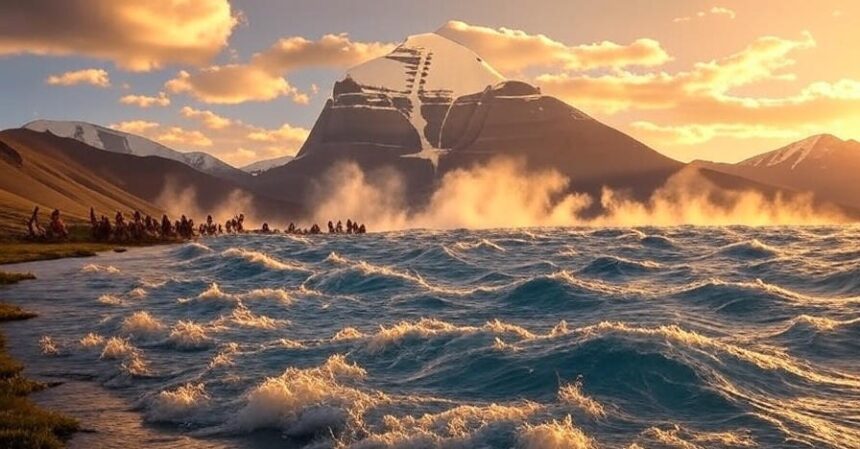
Mount Kailash does not need a vanished expedition, a hidden nuclear reactor, a subterranean gene bank, or an ancient civilization to be one of the strangest and most compelling mountains on Earth.
Rising to 6,638 meters in western Tibet, the black, sharply sculpted peak sits inside a landscape where four major South Asian river systems begin in the surrounding highlands, two extraordinary lakes lie almost side by side, and four religious traditions have independently made the mountain sacred. Yet Kailash has acquired another layer of identity in the modern imagination: the forbidden pyramid, the mountain that supposedly changes time, the place where scientists disappear, where hidden chambers contain sleeping sages, and where ancient builders may have encoded secrets into the rock. Some of those stories are ancient religious traditions. Some are modern speculation. Some are demonstrably unsupported. And that distinction is precisely what makes Kailash worth investigating.
The deeper story is not that science has failed to explain Kailash. It is that a real geological and cultural landscape has been repeatedly overlaid with claims that sound scientific, mystical, archaeological, or conspiratorial until the boundary between observation and invention becomes difficult to see. Strip those layers away and something more interesting remains: a mountain whose physical geography helped create a sacred geography, whose isolation preserved mystery, whose summit remains closed to climbers, and whose meaning has accumulated for centuries across civilizations. The question is not whether Kailash is supernatural. The harder question is why human beings have found this particular mountain so difficult to leave alone.
The Mountain Is Real. The Number 6,666 Is Not Its Height.
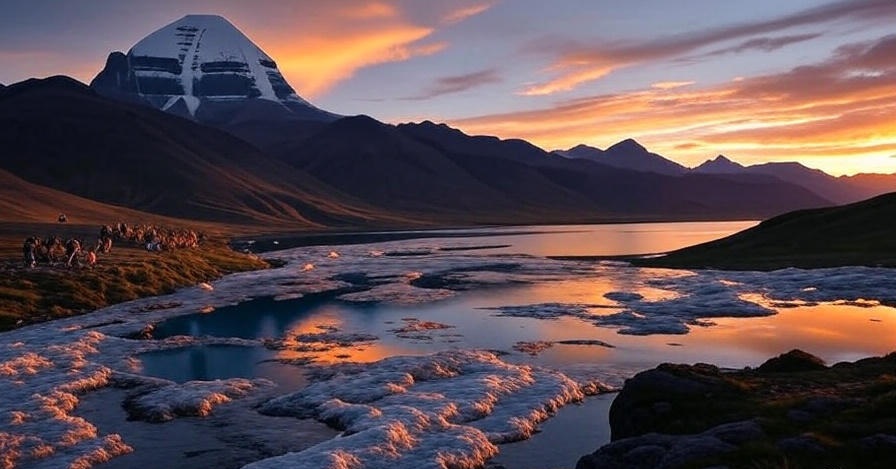
Mount Kailash, known in Tibetan as Kang Rinpoche, stands at 6,638 meters above sea level. The often-repeated figure of 6,666 meters belongs to the world of esoteric numerology rather than accepted geographic measurement. That distinction sounds trivial until it becomes a pattern. Kailash has accumulated numbers, alignments, measurements and comparisons that are often presented as though the mountain itself produced them, when in reality many were imposed upon it by later interpreters.
Geographically, Kailash belongs to the Gangdise or Trans-Himalayan system of the Tibetan Plateau rather than sitting on the main Himalayan crest. It rises from an immense, high-altitude landscape of glaciers, valleys, sedimentary formations, lakes and faulted terrain. The surrounding country is severe: thin air, little vegetation, enormous temperature swings and long distances between settlements. Even before anyone attached a supernatural explanation to the mountain, this was a place capable of generating a powerful sense of remoteness.
The Four Rivers Do Not Actually Begin on the Summit
One of the most remarkable facts about Kailash is also one of the most frequently exaggerated. Four major river systems are associated with the Kailash-Manasarovar region: the Indus, the Sutlej, the Brahmaputra and the Karnali, which becomes part of the Ganges system. Their headwaters lie in the surrounding mountains and glaciers, spread across a broad regional watershed rather than emerging as four streams directly from the summit of Kailash itself.
That correction actually makes the geography more impressive, not less. Within a relatively compact region, water begins moving toward radically different destinations. The Indus ultimately travels toward the Arabian Sea. The Sutlej joins the Indus system. The Brahmaputra crosses Tibet before turning south into India and Bangladesh. The Karnali descends through Nepal into the Ganges basin. The mountain therefore occupies a hydrological landscape in which the great rivers of South Asia seem to radiate outward toward different civilizations.
For Tibetan religious traditions, this geography became sacred symbolism. The rivers were not merely watercourses. Their directions, sources and names became part of a cosmological map in which Kailash occupied an axis between heaven, earth and the human world. Modern geography and ancient sacred geography are therefore describing the same landscape in radically different languages. One measures watersheds. The other gives them meaning.
The Pyramid Is Striking. That Does Not Make It Artificial.
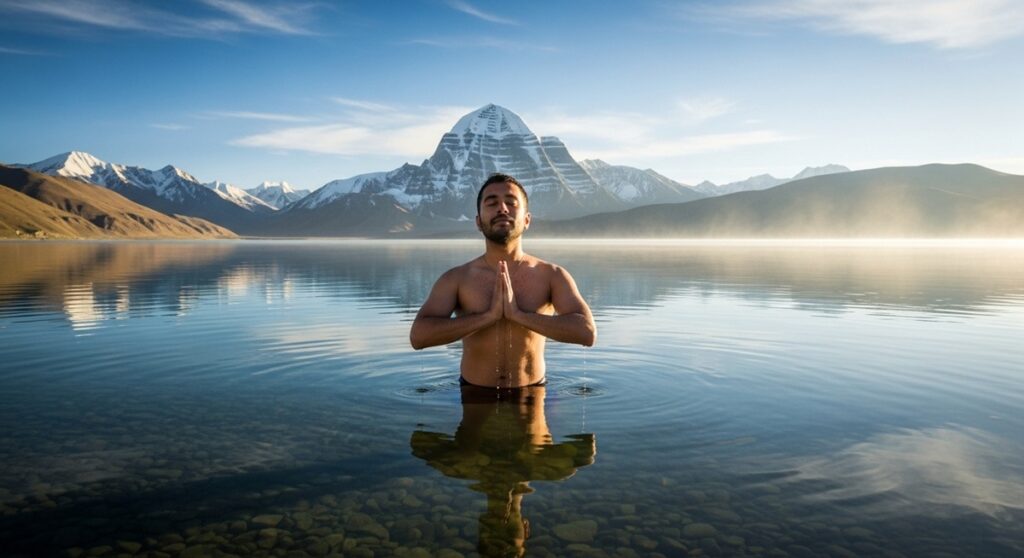
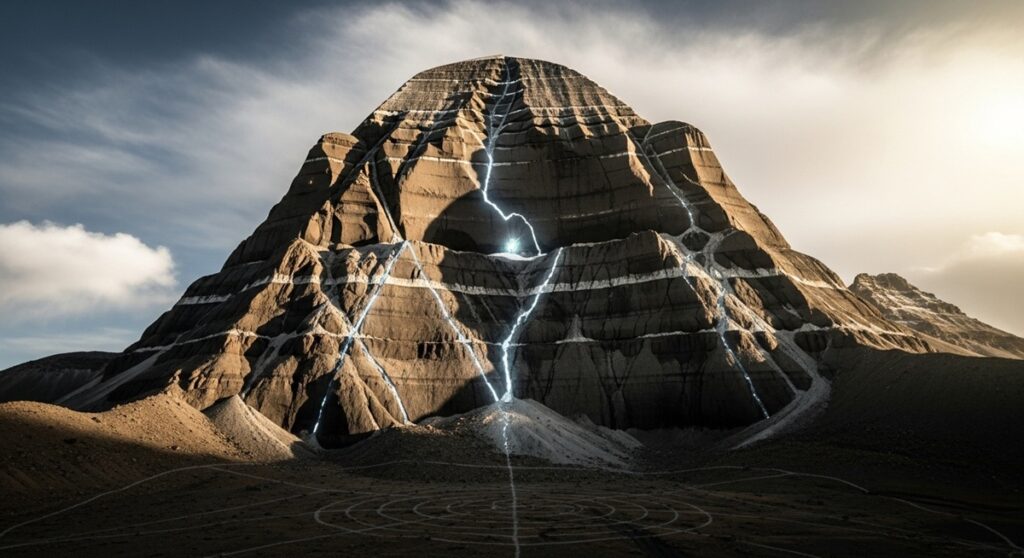
From several angles, Kailash looks uncannily geometric. Its steep faces, broad summit and dramatic vertical features can make the mountain resemble an enormous pyramid carved out of the plateau. Photographs intensify the effect because perspective compresses the surrounding terrain, while snow and shadow can emphasize straight lines that would be much less obvious from another viewpoint.
This is where the modern mystery begins to outrun the geology. The claim that Kailash is an artificial pyramid connected to Egypt, Teotihuacan or a lost global civilization is not supported by archaeological evidence. Nor is there a credible geological requirement for an artificial explanation. Kailash is part of a complex Trans-Himalayan geological environment shaped by the collision of the Indian and Eurasian plates, faulting, uplift, erosion and the deformation of ancient rocks.
But there is an important distinction here. Saying that natural geological processes can produce the mountain is not the same thing as claiming that every detail of Kailash’s formation has been reduced to a single, perfectly understood mechanism. Geology is not a magic word that closes an investigation. It is an evidence-based explanation grounded in the rocks themselves. That is a much stronger position than simply declaring the mountain a “natural pyramid” and moving on.
Two Lakes, Two Worlds
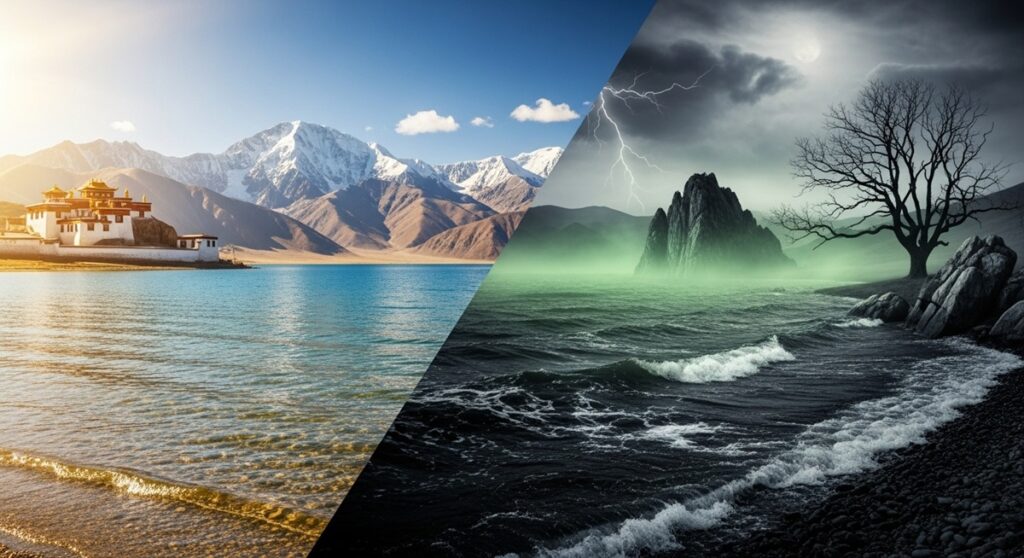
South of Kailash lie two famous lakes separated by a narrow strip of land: Manasarovar and Rakshas Tal. Their proximity has fascinated pilgrims and travelers for centuries because their physical and religious identities appear almost deliberately opposed.
Manasarovar
Lake Manasarovar is freshwater and has enormous religious importance, particularly in Hindu and Buddhist traditions. Pilgrims have long treated its waters as sacred, and bathing or visiting the lake forms part of pilgrimage practice. Its setting beneath the high Tibetan sky, surrounded by enormous mountains and exposed plateau, makes the psychological power of the place easy to understand without reducing that experience to a medical diagnosis.
The temptation is to explain the atmosphere itself as a “phenomenon.” A more defensible explanation is simpler: altitude, isolation, physical exhaustion, expectation, ritual, landscape and the emotional intensity of pilgrimage can profoundly alter how a place is experienced. None of that makes the experience unreal. It means the experience belongs to the interaction between landscape and human consciousness rather than automatically proving an external supernatural force.
Rakshas Tal
Immediately beside it lies Rakshas Tal, traditionally known as the “Demon Lake.” Its water is saline or brackish and the lake has a fundamentally different hydrological character from Manasarovar. The contrast is striking precisely because the lakes are so close together. Yet there is no need to invoke ancient oceans, curses or invisible energies. Differences in drainage, evaporation and water exchange can produce major differences in salinity between neighboring closed or semi-closed basins.
The irony is almost too perfect: two lakes sitting beside one another became symbols of purity and danger, holiness and darkness, life and death. Nature supplied the contrast. Religion gave it a vocabulary.
Four Religions, One Mountain
Kailash is sacred in Hinduism, Buddhism, Jainism and the Tibetan Bon tradition. That makes it unusual even among the world’s great sacred mountains, but “four religions worship the same mountain” should not be misunderstood as though all four traditions share one identical story. They do not. Each tradition places Kailash within its own religious geography.
For Hindus, Kailash is traditionally associated with Shiva and Parvati. Tibetan Buddhists associate the mountain with the deity Demchog, or Chakrasamvara, and with the sacred geography surrounding Mount Meru. Jain tradition associates the region with liberation and the first Tirthankara, Rishabhanatha. Bon traditions possess their own sacred relationship with the mountain and the surrounding landscape.
The Kora Is the Journey. The Summit Is Not the Point.
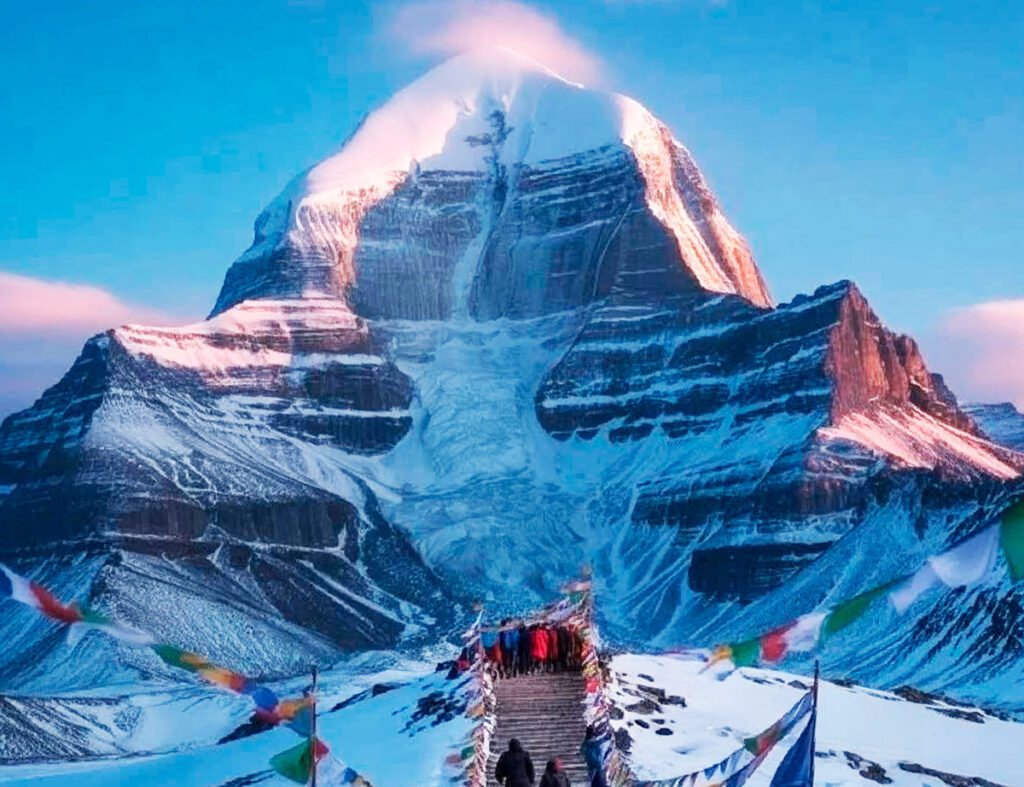
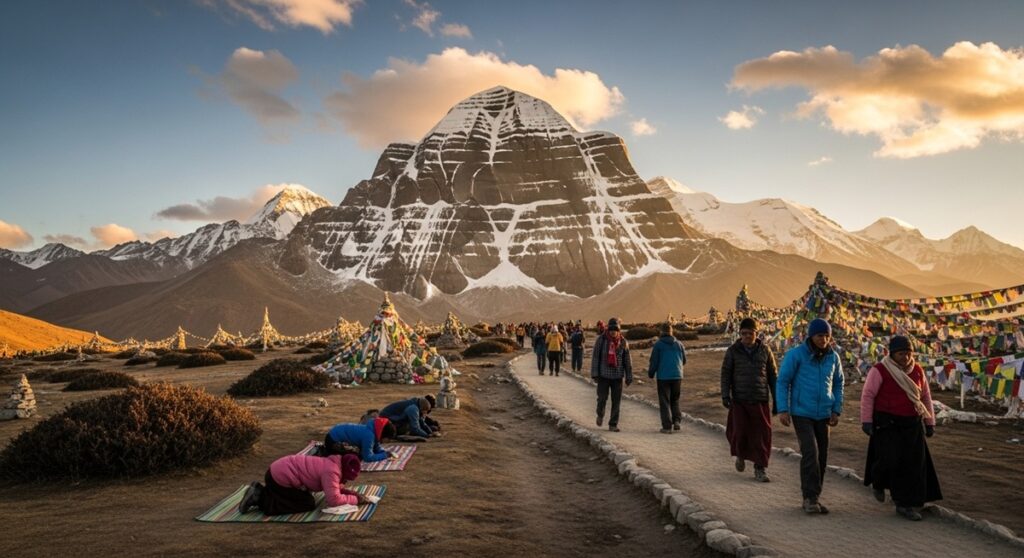
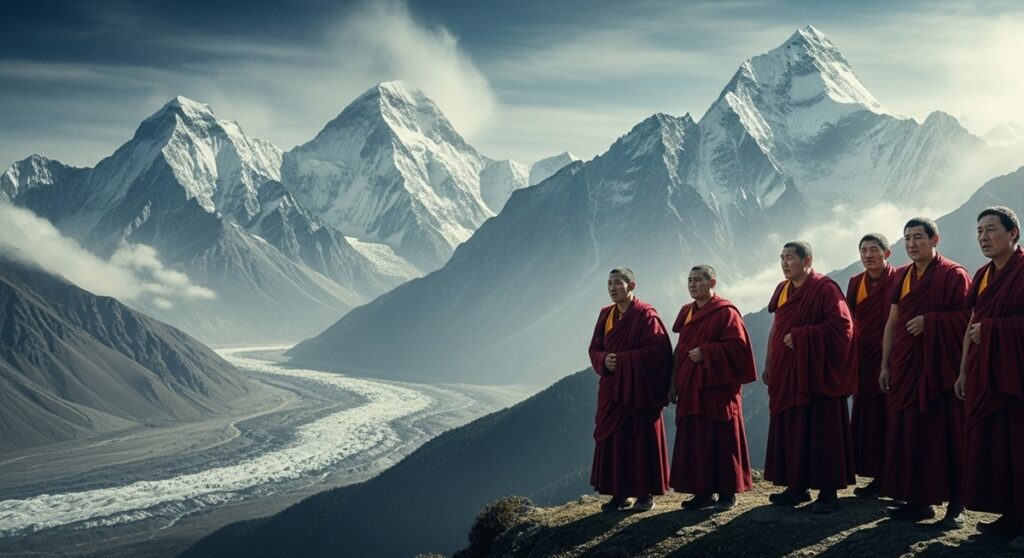
The defining physical act of pilgrimage is the kora, the circumambulation of Kailash. The circuit is roughly 50 to 53 kilometers depending on how it is measured and which route is followed, and it crosses extreme altitude and difficult terrain. Some pilgrims walk. Others undertake repeated full-body prostrations, advancing only a small distance at a time.
That matters when discussing the mountain’s “unconquered” status. The modern Western mountaineering idea of success is reaching the summit. Kailash’s religious traditions invert that logic. The mountain is not an obstacle waiting for a climber to defeat it. The sacred act is to go around it.
Why Has Nobody Officially Climbed Kailash?
Kailash is one of the world’s best-known unclimbed mountains, but the story is more complicated than saying that climbers repeatedly tried and mysteriously failed. There is no known successful official ascent, and climbing the peak is prohibited by the authorities responsible for the area. A proposed Spanish expedition in 2001 triggered international controversy before permission was denied. The issue was not simply that the mountain was technically impossible. Religious and cultural considerations are central to its protected status.
Reinhold Messner was reportedly offered the opportunity to climb Kailash in the 1980s and declined. His reasoning became famous because it recognized something mountaineering culture sometimes forgets: a mountain can be physically climbable and still not belong to the climber. Messner’s refusal was not evidence that the summit contained something supernatural. It was evidence that even one of the world’s most celebrated mountaineers understood the difference between technical possibility and cultural permission.
There are also genuine physical hazards. Kailash is a high-altitude mountain in an extreme environment, and steep rock, weather, ice and exposure would make any ascent serious. But the crucial point is simpler: the summit is protected. Its unclimbed status is therefore not an unexplained failure of mountaineering.
The “2007 Disappearance” That Leaves No Evidence
This is one of the stories that should not be preserved merely because it sounds mysterious.
The claim that eight scientists disappeared at Kailash in 2007, sometimes accompanied by the names Christopher and Linda Mabel, has no identifiable primary documentation supporting the event. There is no reliable expedition record establishing the alleged scientific team, no credible contemporary reporting that documents their disappearance, and no verifiable chain of evidence showing that an investigation occurred.
That does not make the disappearance “unexplained.” It makes the underlying event unsupported. Those are different categories. An unresolved disappearance begins with evidence that somebody existed, traveled somewhere and vanished. A fabricated or unsourced disappearance begins with a story and asks the reader to supply the missing evidence.
For an investigative article, that distinction is non-negotiable.
Ernst Muldashev | Real Doctor, Extraordinary Claims
Ernst Muldashev presents a more interesting case because he was not an invented internet personality. He is a Russian ophthalmologist and surgeon who became associated with a series of extraordinary theories about Kailash and other ancient sites. His medical credentials are real. His expeditionary work was real. His conclusions are another matter entirely.
Muldashev has promoted ideas involving a hollow or artificial Kailash, hidden chambers, an ancient “gene pool,” Shambhala and connections between Kailash and monumental sites elsewhere in the world. These propositions have not been established by independent geological or archaeological research. A successful career in ophthalmology cannot by itself establish expertise in tectonics, Himalayan geology or ancient archaeology.
This is an important distinction because it is easy to make the opposite mistake and simply call Muldashev a fraud. That goes further than the evidence permits. A person can be a genuine physician, conduct a genuine expedition and reach extraordinary conclusions that are not supported by the evidence. The correct criticism is not that his entire biography is fictional. It is that his professional credentials in one discipline do not validate claims in another.
Those credentials are genuinely substantial, which is exactly why the distinction needs stating carefully. Muldashev has nearly 300 scientific publications and more than 50 patents registered across several countries, and founded a real eye and plastic surgery center in Ufa, Russia. His 1999 Kailash expedition was a real, organized undertaking too, called the Russian Adventure Travel Team, backed by the Russian Geographical Society and the newspaper Komsomolskaya Pravda, staffed with specialists in geology, physics, and history who camped at the mountain’s base for months. None of that is invented. What doesn’t follow from any of it is the conclusion he drew, that the mountain is an artificial pyramid linked to Giza and Teotihuacan, a claim no geologist outside his own team has corroborated.
Does Kailash Make Hair and Nails Grow Faster?
This is one of those claims that survives because it is easy to experience and difficult to test casually. Travelers have reported that hair and fingernails seem to grow unusually quickly around Kailash, sometimes accompanied by the claim that time itself is moving faster.
There is no established scientific evidence that Kailash accelerates biological time or causes human hair and nails to grow at an extraordinary rate. High altitude certainly affects the human body: reduced oxygen availability, cold, dehydration, exertion, sleep disruption and changes in routine can alter perception and physiology. But those facts do not demonstrate a Kailash-specific biological acceleration effect.
The more interesting phenomenon may be psychological. A pilgrimage performed over several days in a radically unfamiliar environment can distort ordinary perception of duration. Exhaustion changes attention. Altitude changes sleep. Expectation changes observation. When someone has already been told that Kailash is a place where time behaves strangely, ordinary bodily changes become easier to interpret as evidence of that expectation.
The Alleged Energy Vortex
Stories about magnetic anomalies, energy vortices and invisible forces supposedly causing travelers to turn away from Kailash circulate widely, but there is no established geophysical evidence demonstrating a unique energy field that behaves in the manner these stories require.
That does not mean visitors feel nothing. A landscape this extreme can produce powerful physical and psychological responses without requiring unknown physics. Altitude, dehydration, cold, exhaustion, fear, reverence, expectation and group influence can all affect judgment. In a sacred environment, the decision to stop climbing may be precisely what a pilgrim intends to do.
The Nuclear-Reactor Story
Among the more extreme modern claims is that Kailash conceals some form of ancient nuclear installation or that mysterious radioactive material exists inside the mountain. The usual supporting language invokes “nuclear ash,” radiation or an ancient reactor, but the crucial evidence is absent: there is no credible published archaeological or geophysical investigation demonstrating an artificial nuclear installation beneath Kailash.
The idea also illustrates how modern technological language can be projected backward onto ancient landscapes. Once a mysterious object is called a “reactor,” readers unconsciously begin looking for fuel, radiation, engineering and technological purpose. But giving a geological or archaeological mystery a modern technological name does not create evidence for the technology.
The Sleeping Sages and the Hidden Chambers
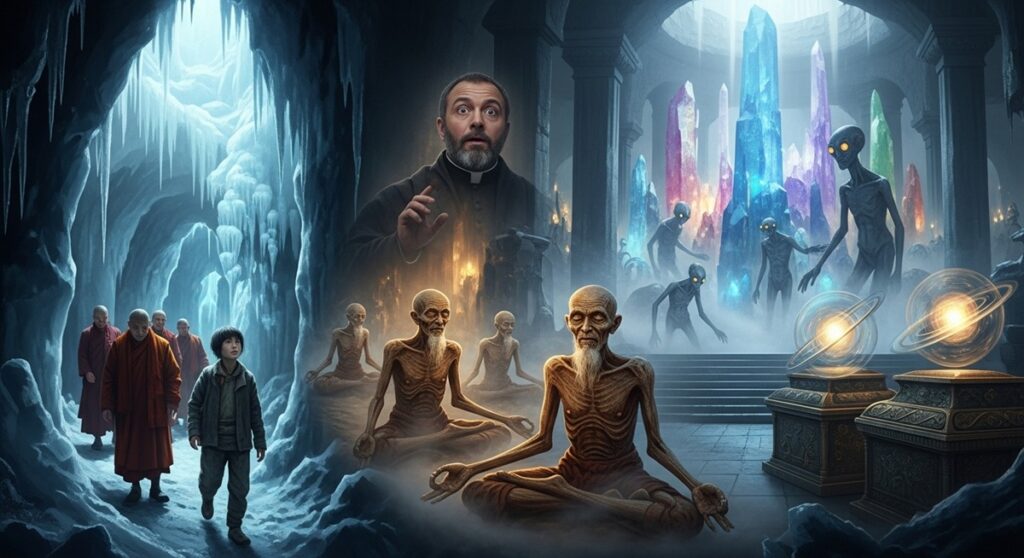
The legends of hidden chambers, secret sanctuaries and spiritually advanced beings belong to a much older and richer tradition than the modern conspiracy stories. Tibetan religious traditions contain extensive ideas about sacred landscapes, hidden places, enlightened teachers and extraordinary spiritual attainment. These traditions should not be flattened into “ancient aliens” or treated as failed geological hypotheses.
Accounts of individuals claiming visionary journeys into crystal chambers or encounters with sleeping sages occupy a different evidentiary category. Such experiences can be spiritually meaningful without being independently verifiable physical events. A personal religious experience is not invalid because a laboratory cannot reproduce it. But neither can an unverifiable experience be presented as archaeological evidence for a subterranean civilization.
Shambhala Is a Religious Tradition, Not a GPS Coordinate
Kailash is frequently connected online with Shambhala, the legendary hidden realm associated with Tibetan Buddhist literature and later Western esoteric writing. But the modern internet often turns a religious and literary concept into something resembling a lost country that can be located on a satellite map.
That is not how the tradition works. Shambhala belongs to a complex religious and textual tradition whose meaning cannot be reduced to a claim that an archaeological kingdom is physically buried somewhere beneath Kailash. Treating every symbolic landscape as a literal archaeological coordinate produces the appearance of mystery by changing the rules of interpretation halfway through the story.
The Prophecy of Renewal
Claims that Tibetan lamas predicted a future transformation of Kailash or an approaching global renewal also require context. Tibetan Buddhist traditions contain extensive teachings concerning impermanence, cycles, decline, renewal and the transformation of consciousness. Those ideas should not automatically be converted into dated predictions of future geological or geopolitical events.
There is a recurring problem in modern mystery literature: a metaphor becomes a prophecy, a prophecy becomes a prediction, and a prediction eventually gets presented as though it were a scientific forecast. Kailash has suffered from this process repeatedly.
Kailash Is Not the Only Sacred Mountain Humans Refused to Climb
The mountain’s unclimbed status becomes less mysterious when placed beside other sacred peaks. Machapuchare in Nepal provides a striking comparison. In 1957, British climbers Wilfrid Noyce and A. D. M. Cox reached within roughly 46 meters of the summit and stopped without stepping onto the top. The mountain has subsequently remained closed to climbing.
Other Himalayan peaks have similarly complicated relationships with climbing, religion and cultural boundaries. Kangchenjunga, for example, has a long tradition of climbers stopping short of the true summit out of respect for local beliefs. The principle is broader than Kailash: mountains are not merely physical objects. Communities can regard them as persons, deities, ancestors, sacred territories or homes of spiritual beings.
What Makes Kailash Truly Unusual
After the disappearances disappear, the nuclear reactor disappears, the time machine disappears and the artificial pyramid disappears, the mountain is still extraordinary.
It sits within one of Asia’s great headwater regions. Four major river systems begin in the surrounding landscape. Two famous lakes lie beside one another with radically different physical and symbolic identities. A mountain of 6,638 meters has remained outside conventional summit climbing, not because generations of climbers mysteriously died trying to reach it, but because the peak is religiously protected. And four distinct religious traditions have developed profound sacred relationships with the same landscape.
Those facts are not substitutes for the mystery. They are the mystery.
The Pilgrimage Is Still Happening
Kailash is not an abandoned archaeological site waiting for someone to discover what happened there. It is a living sacred landscape. Pilgrims continue to travel through one of the most difficult environments on Earth, obtain the necessary permissions, endure extreme altitude and complete the kora around the mountain.
That living tradition matters because much of the modern mystery surrounding Kailash has been produced from a distance. Someone photographs the mountain. Someone notices its symmetry. Someone hears that nobody climbs it. Someone finds an old story about hidden chambers. Someone adds a disappearance. Someone adds nuclear technology. Someone adds Shambhala. Eventually the mountain becomes almost invisible beneath the mythology constructed around it.
But the people making the pilgrimage do not need any of that.
The Real Mystery of Mount Kailash
There is a temptation in every mystery story to assume that if the spectacular explanation is removed, nothing interesting remains. Kailash proves the opposite.
The mountain is real. The geology is real. The rivers are real. The lakes are real. The pilgrimage is real. The religious traditions are real. The restrictions on climbing are real. The human experiences of awe, fear, exhaustion, devotion and altered perception are real.
What is not equally real is everything later attached to them.
The alleged 2007 scientific disappearance has no demonstrated evidentiary foundation. The nuclear-reactor story has no credible archaeological basis. The claims of accelerated biological time have not been established experimentally. The supposed energy vortex has not been demonstrated by reliable geophysical evidence. The artificial-pyramid theory remains speculation rather than archaeology. The hidden gene vault belongs to the realm of extraordinary personal claims, not established science.
And yet removing those claims does not diminish Kailash. It reveals something far more durable.
Humans did not need to discover a secret inside Mount Kailash to make it sacred. They made the mountain itself the secret.
For centuries, pilgrims have walked around it rather than over it. Rivers have flowed away from its surrounding heights toward distant civilizations. Religious traditions have placed their own cosmologies upon the same rock. Modern science has mapped its geology and hydrology while modern mythology has tried to turn every unanswered question into evidence of something hidden.
Perhaps the most revealing mystery is therefore not what is inside Kailash.
It is why, when confronted with a mountain already extraordinary enough to stand on its own, we keep insisting that there must be something underneath it.
Shambhala and the hidden worlds of myth belong to the larger story, but Kailash itself remains stranger, richer and more consequential when we refuse to confuse mythology with evidence.