




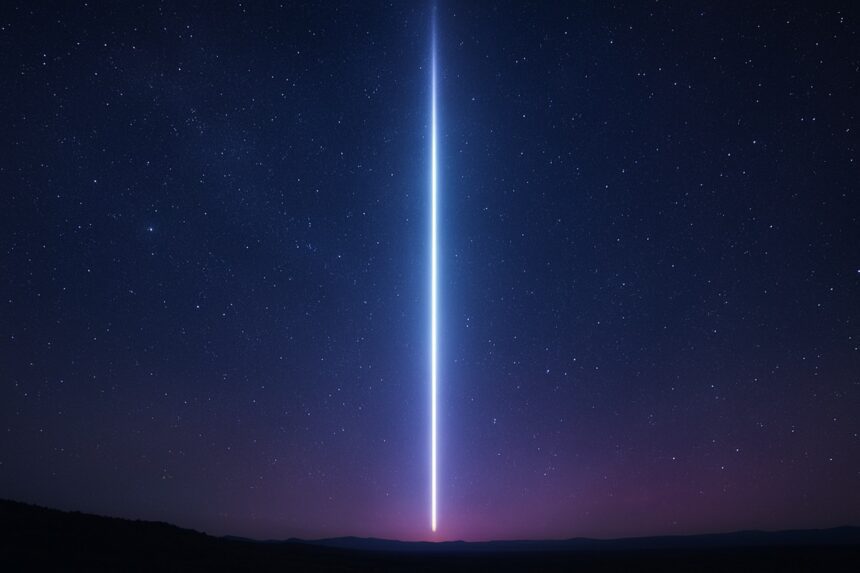
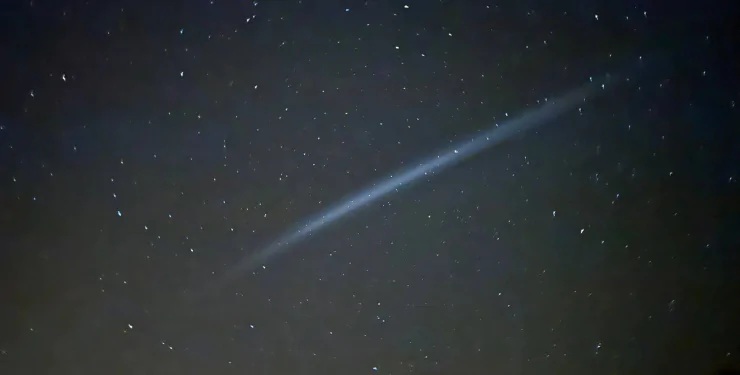
On the night of August 25-26, 2025, a strange blue-white streak appeared over Ukraine and was seen across parts of Europe. It looked almost impossibly straight in photographs: a narrow luminous structure hanging against the stars, with a pale blue core and violet-looking edges, moving slowly enough to seem unnatural and bright enough to attract thousands of witnesses. For a few hours, the internet supplied everything from a meteor to an atmospheric optical effect. The answer was already in the sky’s flight path. The phenomenon was the upper stage of China’s CZ-8A rocket dumping unused propellant high above Europe after a successful launch from Wenchang. What looked like an unexplained beam was not a beam at all. It was a rocket stage turning its leftover fuel into an enormous temporary cloud of light.
The important part of the story is not that the first explanations were ridiculous. They weren’t. A bright meteor, an atmospheric optical effect and rocket exhaust can all produce photographs that look bizarre when stripped from their context. The interesting part is what happened next: the original uncertainty gave way to a specific launch, a specific rocket, a specific launch time and independent observations of the same upper-stage event over Europe. Once the chronology is reconstructed, the mystery becomes considerably less mysterious, and considerably more interesting as an example of how orbital mechanics can briefly turn ordinary engineering into something that looks almost extraterrestrial.
The First Reports Made It Look Like Something Unknown
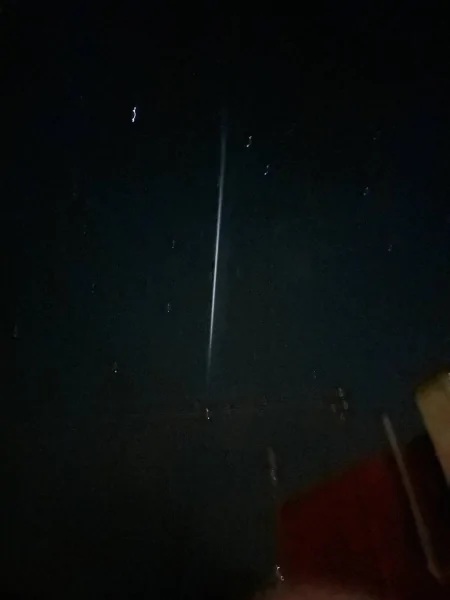
The first reports were understandably uncertain. Witnesses across Ukraine described a thin, bright object or streak moving through the night sky and leaving a luminous trail behind it. Reports subsequently appeared from elsewhere in Europe, including Germany, France and the Czech Republic. That geographical spread was important, but not for the reason initially assumed. A phenomenon visible across multiple countries does not necessarily have to be enormous, local or mysterious. Something occurring tens or hundreds of kilometres above the ground can be visible across a vast area because the observer’s line of sight reaches far beyond the immediate horizon.
That is precisely why rocket launches so often produce spectacular sky phenomena. The vehicle itself may be thousands of kilometres away, but its upper stage can enter an extremely high portion of the atmosphere or near-space environment where sunlight remains available even after darkness has reached the ground. Exhaust or dumped propellant can then expand into a huge cloud that catches sunlight against a dark sky. The result can look detached from the rocket that created it, which is one reason photographs of these events are so easily mistaken for unexplained astronomical objects.
The Comet Theory Fails on the Calendar
One of the first explanations attached to the Ukrainian images involved Comet C/2023 A3, better known as Tsuchinshan-ATLAS. The comet itself is completely real and was one of the major naked-eye astronomical events of 2024. It passed perihelion on September 27, 2024, and became particularly prominent to northern-hemisphere observers in October. By August 2025, however, it was long past the period in which it could plausibly explain a dramatic new luminous display over Europe. The comet’s spectacular 2024 appearance was not an event waiting to reappear almost a year later over Ukraine.
This is an important lesson in source tracing because the comet explanation was not absurd on its face. The images contained something that looked vaguely comet-like, and Tsuchinshan-ATLAS had recently been famous enough that its name was readily available in online discussions. But an astronomical identification has to survive orbital mechanics, not just visual resemblance. The actual position and activity of the comet on the date in question make it a poor candidate for the phenomenon. The explanation collapses not because comets cannot produce spectacular tails, but because this comet was not in the right place at the right time to produce this event.
The Missile Theory Confused Two Completely Different Things
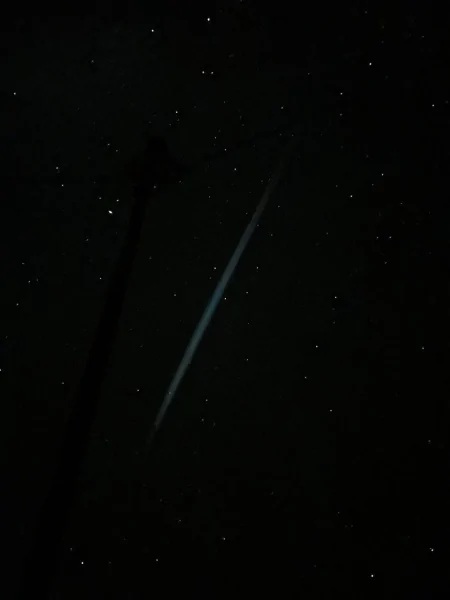
The next theory was understandably more sensitive in wartime Ukraine: could the light have been a missile or some other military launch? Rocket exhaust really can produce extraordinary visual effects, so the physical resemblance was not the problem. The problem was classification. A ballistic missile and an orbital rocket are not interchangeable simply because both use rocket propulsion. One is a weapon, the other is a launch vehicle carrying a payload into space.
That distinction became decisive once the actual launch was identified. There was no need to invent an unidentified military trajectory when a documented civilian orbital launch had taken place at almost exactly the relevant time. The phenomenon was associated with the upper stage of China’s CZ-8A, also known as Long March 8A, rather than an incoming weapon. The original public uncertainty therefore had a perfectly reasonable explanation: observers were looking at rocket-related activity without yet knowing which rocket had produced it.
The Rocket Was Already in the Launch Logs
On August 25, 2025, a Chinese CZ-8A lifted off from the Wenchang Commercial Space Launch Site in Hainan at 19:08 UTC. The mission carried nine satellites for the SatNet constellation and was successfully inserted into its intended orbit. The launch is independently recorded in launch databases, and the time is precise enough to make the subsequent European sighting immediately interesting. This was not a hypothetical rocket that might have existed somewhere in the world. It was a real vehicle, launched at a documented moment, on a trajectory that subsequently carried its upper stage over Europe.
Then came the crucial observation. Around 20:40 UTC, roughly an hour and a half after launch, the upper stage was observed over Europe while dumping unused propellant. A Dutch observer recorded the event from Deventer and identified it specifically as a CZ-8A propellant dump. The observation was timestamped at approximately 20:40 UTC, with the launch having occurred at 19:08 UTC. That independent observation is especially valuable because it connects the spectacular appearance not merely to “some rocket,” but to the exact vehicle and the exact sequence of events occurring after launch.
Contemporary reporting from Ukraine reached the same conclusion. Astronomer Jonathan McDowell identified the phenomenon as fuel being dumped from the upper stage of the CZ-8A. Reports noted that the phenomenon was also seen in Germany and elsewhere in Europe, and McDowell addressed the obvious objection raised by viewers: if it was a rocket plume, why did the structure look so unnaturally straight? His explanation was that the apparent geometry could be related to the design of the upper stage’s venting system.
Why Fuel Dumping Can Look Like a Giant Beam
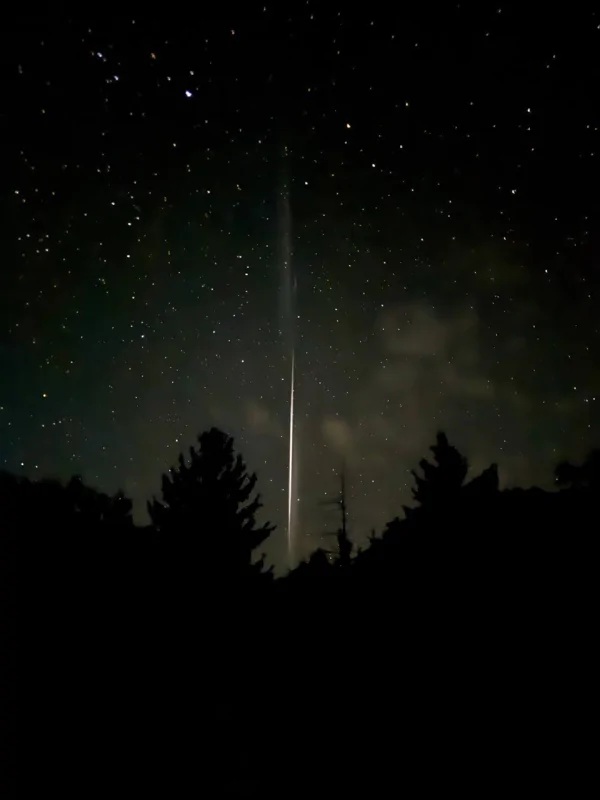
The phrase “fuel dump” sounds disappointingly ordinary until you consider where the fuel is being released. An upper-stage rocket is moving through an environment that is almost completely unlike the air at ground level. Released propellant can expand rapidly, form a large diffuse cloud and reflect sunlight long after the launch site itself has fallen into darkness. The observer therefore sees neither a conventional flame nor a compact rocket plume. Instead, the sky can suddenly fill with a pale, ghostly structure whose apparent dimensions are determined by the expanding exhaust cloud, the viewing angle, the illumination geometry and the optics of the camera.
That geometry also explains why a photograph can be misleading without being fake. A camera compresses an enormous three-dimensional event into a two-dimensional frame. A broad cloud viewed from a particular angle can appear like a razor-thin shaft. An expanding plume can look stationary or strangely elongated depending on exposure time. The absence of a visible rocket body does not mean the luminous structure was independent of a rocket, it can simply mean that the camera is recording the illuminated exhaust while the much smaller hardware responsible for it is too faint to see.
The “Purple” Color Doesn’t Require Exotic Physics
The blue-white and violet appearance was one of the details that made the event look stranger than an ordinary rocket launch. But color alone is a dangerous diagnostic tool in night-sky photographs. The human eye, camera sensors, exposure settings, atmospheric scattering and the spectrum of the illuminated material all contribute to the final appearance. A luminous exhaust cloud seen against a dark sky can produce colors that look far more exotic in a photograph than they would to a calibrated scientific instrument.
This is another reason the early bolide interpretation was understandable but ultimately unnecessary. Meteor composition can influence color, and atmospheric optical effects can certainly produce unusual hues. But once a specific rocket and propellant-dumping event are independently matched to the time and location, color ceases to be evidence for an unusual object. It becomes a property of a known physical phenomenon that still needs to be understood in detail, not a reason to resurrect an unidentified one.
The Bolide Was a Reasonable First Guess, Then It Was Withdrawn
There is a useful piece of detective work buried in the history of the story. Ukraine’s Alpha Centauri astronomy channel initially considered the possibility that the object was a bolide. That was a reasonable hypothesis given the brief duration, apparent movement and brightness. But after the rocket connection was identified, the channel issued a correction explicitly saying the earlier assessment was wrong and that the phenomenon was the Chinese CZ-8A, with the upper stage dumping fuel. That correction is important because it shows how scientific identification actually works: an initial hypothesis is not a sacred commitment. When a better explanation arrives with stronger timing and trajectory evidence, the earlier hypothesis gets discarded.
The original meteor interpretation therefore should not be preserved merely because it sounds more mysterious or because a meteor would be a satisfying astronomical explanation. It was an early hypothesis. The subsequent evidence is better. In investigative writing, that distinction matters: “experts initially considered a bolide” is accurate, “the bolide remains equally likely” is not.
What the Event Actually Was
Put the evidence in chronological order and the strange beam becomes almost mundane. At 19:08 UTC on August 25, a CZ-8A launched from Wenchang in China. Roughly ninety minutes later, its upper stage was passing over Europe. Around 20:40 UTC, observers recorded the stage dumping unused propellant and producing a large luminous structure. People in multiple European countries saw the same event from different locations. Photographs captured the expanding cloud, making it appear like a narrow blue-white beam suspended among the stars. The apparent mystery came from seeing the final optical effect without seeing the launch that created it.
That is also why the international reports are not evidence against the rocket explanation. They are evidence for it. A high-altitude event can be seen across a huge geographic footprint, and the European observations were consistent with a single upper-stage event moving through the sky. A Czech report from the Astronomical Institute of the Czech Academy of Sciences likewise identified the strange luminous stripe seen across the region as fuel released by the upper stage of the Chinese CZ-8A.
The Real Mystery Was How Fast We Misidentified It
There is a temptation to think that solving a mystery makes it less interesting. In this case the opposite is true. The event demonstrates how dramatically human perception can change when an object is removed from its physical context. A rocket launch from China, an upper stage traveling across the planet, residual propellant expanding in near-space and sunlight illuminating the resulting cloud are all individually ordinary pieces of aerospace engineering. Combined at the correct altitude, geometry and time of day, they produce something that looks like a glowing structure hanging over half a continent.
It also illustrates why the strongest explanations are often the ones that connect the most independent facts. The comet theory had a calendar problem. The meteor theory had an initial visual appeal but was subsequently withdrawn by the astronomy channel that proposed it. The atmospheric-light explanation lacked the necessary environmental context. The military-missile interpretation was displaced by a documented civilian launch. The rocket explanation, by contrast, supplies a launch time, launch vehicle, launch site, upper-stage activity, European observations and a mechanism capable of producing exactly the kind of enormous luminous cloud that observers photographed. That is what an identification looks like when the pieces begin locking together.
The light over Ukraine was real. The photographs were real. The strangeness was real. But the object did not need to be unknown. It was the upper stage of a Chinese rocket, turning leftover propellant into a spectacular temporary cloud high above Europe. For a few minutes, ordinary aerospace engineering produced a sight that looked like something from another world.
And that is the part worth remembering: the Ukraine sky beam did not become mysterious because something extraordinary arrived in it. It became mysterious because something completely ordinary happened at an altitude, angle and moment most people were never taught to recognize.