The problem is not any single artifact.
The problem is that the same artifact keeps appearing.
A figure in a confined space. The figure is operating something: handles, controls, a mechanism whose form varies by culture but whose relationship to the figure is consistently that of an operator interface. The figure is surrounded by machinery or structural elements that in conventional iconography would be read as decorative but that in the context of mid-twentieth-century aerospace engineering look like something else. The figure’s posture is constrained in the way that an operator in a vehicle is constrained, not the free posture of worship, dance, or combat.
This compositional arrangement appears in the art of cultures separated by oceans, by centuries, and by the complete absence of any documented contact pathway. If it appeared in one culture it would be iconography. If it appeared in two connected cultures it would be diffusion. When it appears in six or more independent cultures with no known contact, the diffusion explanation requires a diffusion mechanism that has not been identified.
The conventional response is that the similarity is in the eye of the beholder: that modern observers trained in aerospace imagery are projecting their own interpretive frameworks onto ancient art whose actual meaning is completely different and completely understood within its own cultural context. This response is legitimate for some of the cases. It is not equally compelling for all of them.
The Lid at Palenque
The Temple of the Inscriptions at Palenque in the Mexican state of Chiapas contains the tomb of K’inich Janaab’ Pakal, who ruled the Maya city of Palenque from 615 CE until his death in 683 CE at approximately eighty years of age. The tomb was discovered in 1948 by Mexican archaeologist Alberto Ruz Lhuillier, who spent four years excavating the staircase sealed inside the temple before reaching the burial chamber. The sarcophagus was covered by a carved limestone lid measuring 3.8 meters by 2.2 meters and weighing approximately five tons.
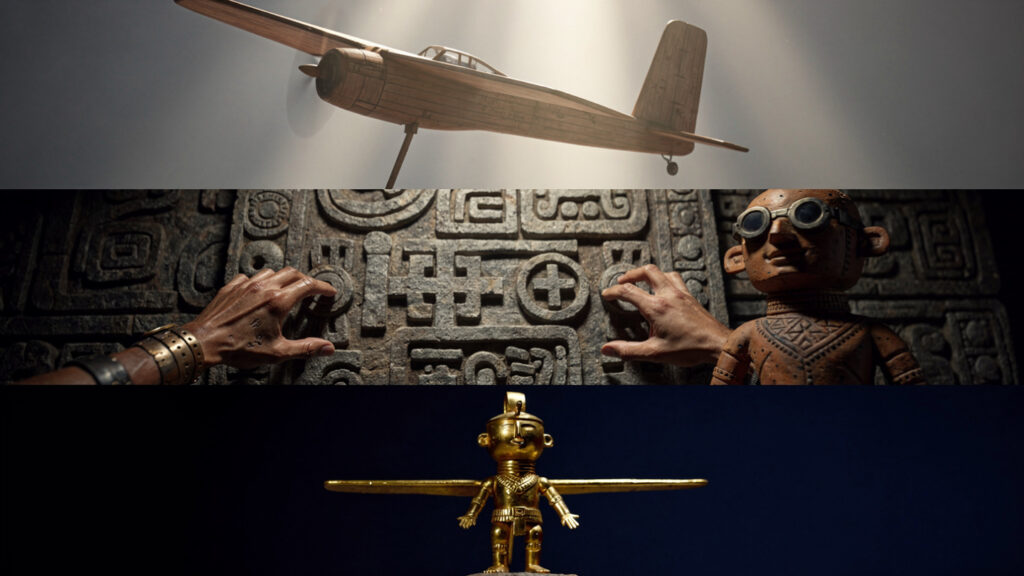
The lid’s carved surface depicts a complex scene. A human figure occupies the center of the composition in a reclining position with the upper body angled backward. The figure’s hands are positioned in contact with what appears to be a cross-shaped object. Below the figure’s feet is a protrusion with bifurcated forms suggesting either a plant root structure or an exhaust configuration. Above the figure is a bird figure and above that a disk with geometric subdivisions. The entire scene is framed by a band of celestial glyphs.
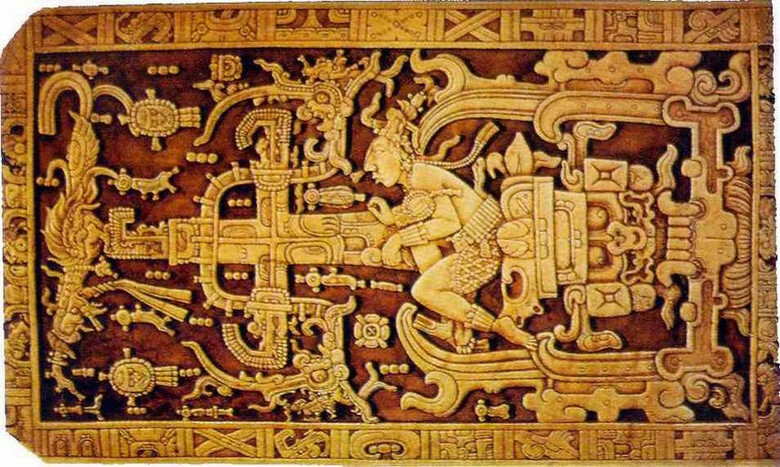
Erich von Däniken’s 1968 analysis in Chariots of the Gods proposed that the lid depicts Pakal operating a spacecraft: the reclining posture is that of a launch position, the cross-shaped object is the control mechanism, the bifurcated protrusion below his feet is a rocket exhaust, the surrounding decorative elements are the machinery of a vehicle. This interpretation was dismissed by mainstream Mayan scholars as the projection of aerospace imagery onto a scene with a completely understood iconographic program: the cross is the World Tree, the central axis of Mayan cosmology connecting the underworld to the celestial realm, Pakal is descending into the underworld at death, and the surrounding elements are standard funerary iconography.
Both interpretations are applied to the same physical object. The mainstream interpretation is internally consistent with the broader program of Mayan iconography and is supported by glyphic inscriptions surrounding the lid that clearly describe Pakal’s death and descent. The von Däniken interpretation requires reading the same object through a completely different interpretive framework.
The element that makes the mainstream dismissal of the von Däniken interpretation less than fully satisfying is the posture. Mayan funerary iconography depicting the descent of a ruler into the underworld does not typically show the figure in a reclining position with hands at a control interface. The World Tree iconography in other Mayan art shows the tree as a vertical axis with the ruler standing or seated formally beside it. The postural relationship between the Pakal figure and the cross-shaped element is unusual within the canonical Mayan iconographic tradition.
Whether the unusual posture reflects a narrative requirement of this particular funerary program or reflects something being depicted that required a different posture than conventional iconography provided, is a question that the available evidence does not definitively resolve.
The Japanese Operator
The Dogu figurines of Japan’s Jomon period are the most visually striking of all the ancient astronaut iconographic evidence because they have no obvious conventional interpretation that accounts for their features.
The Jomon period spans approximately 14,000 BCE to 300 BCE, making it one of the longest continuous pottery-using cultures in the human archaeological record. The Dogu figurines appear throughout this period in various forms, with the most elaborate examples dated to the Late Jomon period between approximately 1000 and 400 BCE.
The figurines depict humanoid forms with consistent features across a wide geographic distribution: large, round, goggle-like eyes that are among the most prominent features of the face, a structured surface covering the body that shows geometric patterning inconsistent with simple textile representation, articulated joints at the knees, elbows, and shoulders that are structurally detailed in ways that simple fertility figurine production does not require, and an overall impression of a figure in constrained or structured clothing rather than natural human body form.

The mainstream interpretation is that the Dogu are ritual figurines, possibly associated with fertility or healing practices. The goggle eyes are interpreted as a stylized artistic convention. The surface patterning is interpreted as representing tattoos or textile clothing. The joint articulation is interpreted as an artistic expression of human form.
The problem with the mainstream interpretation is the goggle eyes. Human eyes in every other context in Jomon art, including the same figurines’ other facial features, are represented with the simple conventions of ancient ceramic art: small holes, incised lines, or simple depressions. The goggle eye structure, with its raised circular frame and the relationship between the eye sphere and the surrounding structure, has no parallel in Jomon artistic conventions for representing the human face. It is a unique feature that appears specifically on the Dogu figurines and nowhere else in the artistic tradition.
If the goggle structure represents a physical object covering the eyes rather than a stylized artistic convention for eyes themselves, the Dogu figurines are depicting figures whose eyes are covered by a structured protective device. The context in which human eyes require a structured protective device in a constrained suit with joint articulation is not a fertility ritual. It is an environment where the face and body require protection.
The Colombian Aircraft
In 1969 the Smithsonian Institution included several pre-Columbian gold artifacts from the Tolima culture of Colombia in a traveling exhibition titled Before Columbus. The artifacts, dated to approximately 500-800 CE and representing a category of objects found across multiple pre-Columbian cultures, depict what conventional archaeology classifies as stylized animal forms: birds or fish rendered in gold with geometric simplification.
The proportions of the objects include features that aeronautical engineers Algund Eenboom and Peter Belting identified in 1996 as inconsistent with stylized animal forms but consistent with functional aerodynamic configurations.
The leading edges of the wings are straight and sharply defined rather than the curved profile of bird wings. The wing cross-section in the surviving gold examples shows a flat bottom and cambered top: an aerofoil cross-section that generates lift in an airstream rather than the symmetrical cross-section of a decorative object or the cambered cross-section of a bird wing in flight. The vertical tail structure rises from a horizontal body in a configuration that has no analog in any fish or bird species. The horizontal tail surfaces, separate from the main wing surfaces and positioned behind the vertical tail, form a conventional aircraft empennage arrangement.
Eenboom and Belting built scaled-up versions of two of the artifacts adding only a small electric motor and propeller. Both models flew stably with the propulsion added. Neither required aerodynamic modification to achieve stable flight: the proportions of the original artifact produced a functional aerodynamic configuration.

The conventional response is that the objects represent stylized animals and that the aerodynamic properties are coincidental: the artistic conventions of the culture happened to produce proportions that are also aerodynamically functional. The problem with this response is the vertical tail. No bird or fish has a vertical stabilizer rising perpendicular to the horizontal body axis. The vertical stabilizer is an aircraft design element with no counterpart in any natural form that the stylized animal interpretation would be based on.
The Saqqara Bird
The wooden bird figure recovered from a tomb shaft at Saqqara in Egypt in 1898 and dated to approximately 200 BCE is one of the few ancient astronaut artifacts that has been formally analyzed by specialists in the relevant field without being commissioned by researchers with predetermined conclusions.
Khalil Messiha, an Egyptian archaeologist at the Cairo Museum of Antiquities, formally analyzed the artifact in 1972 and presented his findings to a symposium. His claims: the wing cross-section is flat-bottomed and cambered, the configuration that generates lift in an airstream. The tail is vertical, rising perpendicular to the horizontal body axis in a configuration that no bird possesses. The wing sweep and dihedral angle are consistent with stable gliding flight. The artifact has no legs, which is unusual for a decorative bird model but is consistent with a flying vehicle that does not land on legs.
He proposed that the artifact is a model of a functional glider or a scaled model of a larger functional aircraft. He built a replica and demonstrated that it glides stably when launched.
The mainstream response has been that the object is a decorative bird, possibly a weather vane or a cult object, and that its aerodynamic properties are incidental. The absence of legs has been attributed to damage or incompleteness.
The absence of legs is the feature that the damage explanation requires: a bird model from which the legs have been broken would show breakage marks at the attachment points. The Saqqara bird shows no such marks. The tail configuration, unlike the wing configuration, does not reflect any bird species’ actual anatomy even through significant artistic stylization.
What the Vimanas Describe
The Sanskrit texts of ancient India contain technical descriptions of flying vehicles that exceed anything that stylized animal iconography can explain. The Ramayana and the Mahabharata, two of the most extensive literary works in the ancient world, contain detailed accounts of aerial vehicles, their operational characteristics, their propulsion systems, their military applications, and their limitations.
The Vimana is described in these texts as a vehicle capable of vertical takeoff and landing, hovering, and high-speed horizontal flight. The texts describe multiple Vimana types with different configurations and capabilities. The Pushpaka Vimana of the Ramayana is specifically described as capable of carrying large numbers of passengers across continental distances. The Mahabharata contains accounts of aerial combat between Vimanas using directed energy weapons.
The Vaimanika Shastra, a text claiming to be an ancient technical manual for Vimana construction and operation transmitted through channeling by Pandit Subbaraya Shastry beginning in 1904, contains engineering descriptions including material specifications, propulsion system designs, and operational parameters. Aeronautical engineers at the Indian Institute of Science in Bangalore analyzed the Vaimanika Shastra designs in 1974 and concluded that the proposed vehicles would not fly as described. The conclusion was that the designs were not based on aerodynamic principles that would produce the claimed performance.
This analysis does not resolve the question of the Ramayana and Mahabharata Vimanan accounts. The Vaimanika Shastra’s twentieth-century transmission through channeling means it cannot be treated as an ancient technical document regardless of its claimed origin. The Ramayana and Mahabharata are genuine ancient texts whose Vimanan accounts are the subject of ongoing debate.
What is not in dispute: the texts describe aerial vehicles in technical detail that far exceeds the decorative or metaphorical use of flight imagery in other ancient literary traditions. Whether the descriptions reflect genuine transmitted knowledge of a pre-deluge aerial technology, as the ancient astronaut framework proposes, or elaborate mythological elaboration of real flight experiences with birds and insects, as the conventional interpretation holds, the texts contain the most extensive ancient written record of aerial vehicles in any literary tradition.
The Lines That Require Altitude
The Nazca lines in southern Peru present the ancient astronaut pattern’s most logical argument.
The lines were created by the Nazca culture between approximately 500 BCE and 500 CE by removing the surface reddish-brown iron oxide-coated pebbles to reveal the lighter ground beneath. The individual lines are visible at ground level as simple cleared paths. The figures, geoglyphs depicting hummingbirds, spiders, fish, monkeys, llamas, and geometric forms, are invisible as coherent images at ground level and become recognizable only when viewed from an altitude of several hundred feet.
The mainstream interpretation is that the Nazca created the figures for the gods to see from above, or as markers for astronomical alignments, or as part of ritual walking paths. All of these interpretations acknowledge that the figures are only meaningful when viewed from altitude. The ritual walking path interpretation requires that the practitioners walking the paths were not supposed to see the image they were creating or traversing, only the gods above were to see it.
The question the ancient astronaut interpretation asks is: if the figures were created for aerial observers, what was the evidence that aerial observers existed to create them for?
The conventional answer is theological: the gods were imagined to inhabit the sky and see from above, and the figures were created as offerings visible to these imagined aerial beings. The ancient astronaut answer is empirical: the figures were created for aerial observers because aerial observers were known to exist from direct experience.
The same logical structure applies to the broader iconographic pattern. The figures in vehicles depicted in the art of multiple independent ancient cultures were either imagined through independent convergent mythological development, which requires explaining why the same mechanical details appeared in the independent imaginations of cultures with no contact, or they were depicted because the beings in vehicles were known from direct observation.
The Pattern and Its Persistence
The strongest version of the ancient astronaut iconographic argument is not any single artifact. It is the distribution of the pattern across cultures with no recorded contact pathway.
The Pakal sarcophagus lid is Maya, seventh century CE, Mesoamerica. The Dogu figurines are Jomon, up to fourteen thousand years old, Japan. The Colombian gold aircraft are Tolima, first millennium CE, South America. The Saqqara bird is Egyptian, third century BCE, North Africa. The Vimana texts are Indian, second millennium BCE and earlier, South Asia. The Pourangahua silver bird tradition is Maori, Polynesia.
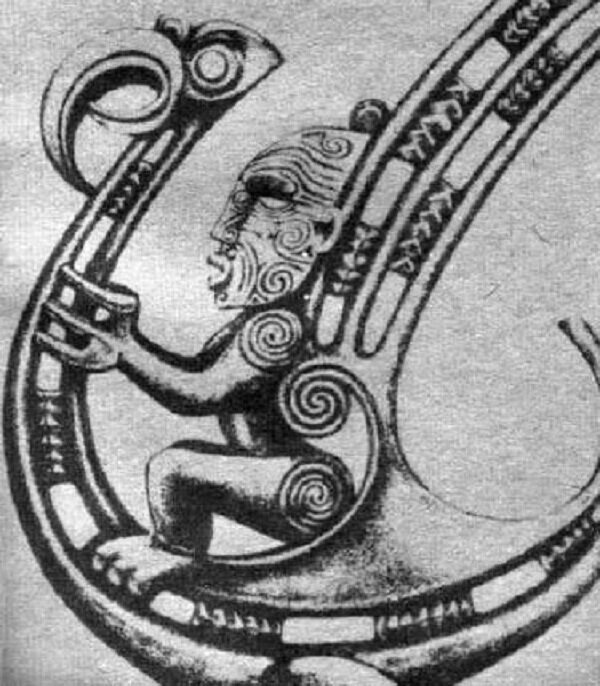
The conventional explanation for each individual case is available and internally consistent within that culture’s iconographic tradition. The conventional explanation for the global pattern requires accepting that independent cultures on every inhabited continent developed the same iconographic vocabulary of operators in vehicles without any contact between them.
The convergent evolution argument applies here with the same logic as in the alien morphology piece in this library: if the same environmental pressure produces the same solution independently, the pressure is universal rather than local. The pressure producing the figure-in-vehicle iconographic complex across all these independent cultures is either a universal human cognitive tendency to imagine operators in vehicles, which has no parallel in any other domain of prehistoric art, or an actual vehicle-operating figure that multiple cultures independently observed and recorded.
The site’s Watchers pieces document the tradition of beings from outside the Earth arriving, teaching, and departing. The Egyptian gods piece documents the beings of the First Time with their technological attributes. The Anunnaki piece documents the Sumerian account of beings who arrived in vehicles from another planetary system. The ancient contact framework that these pieces build is the interpretive context in which the global iconographic pattern makes the most sense.
The same figure keeps appearing because the same figure was seen.
The cultural encoding varies because the observers were in different places with different artistic traditions and different theological frameworks for understanding what they saw. The core observation was the same: a being sitting at the controls of a vehicle, arriving from the sky, doing things that required mechanical systems the observers could not build or replicate.
They drew what they saw. They drew it in stone, in clay, in gold, in wood. They drew it in Japan and in Mexico and in Egypt and in Colombia and in New Zealand without knowing about each other.
The drawings are still here.