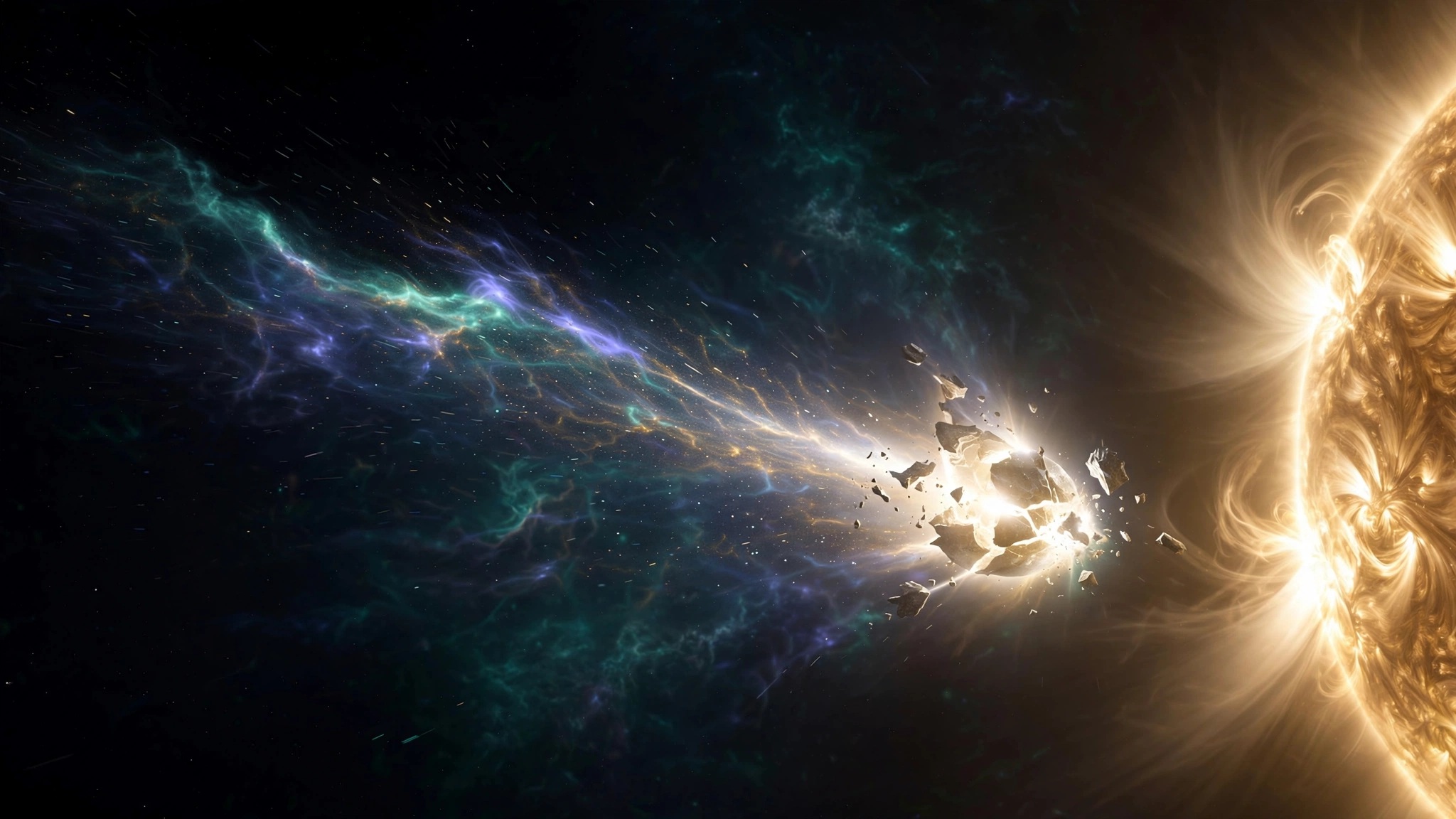
On the morning of 4 April 2026, the eve of Easter, a comet fell toward the Sun. For eighty days it had been watched from Earth, growing brighter as it dived. Spacecraft stationed between the Earth and the Sun saw its head blaze brighter than almost any star in the sky. Then, hours before it reached the Sun, Comet MAPS vanished. What came out on the far side was a ghost, a long tail with no head.
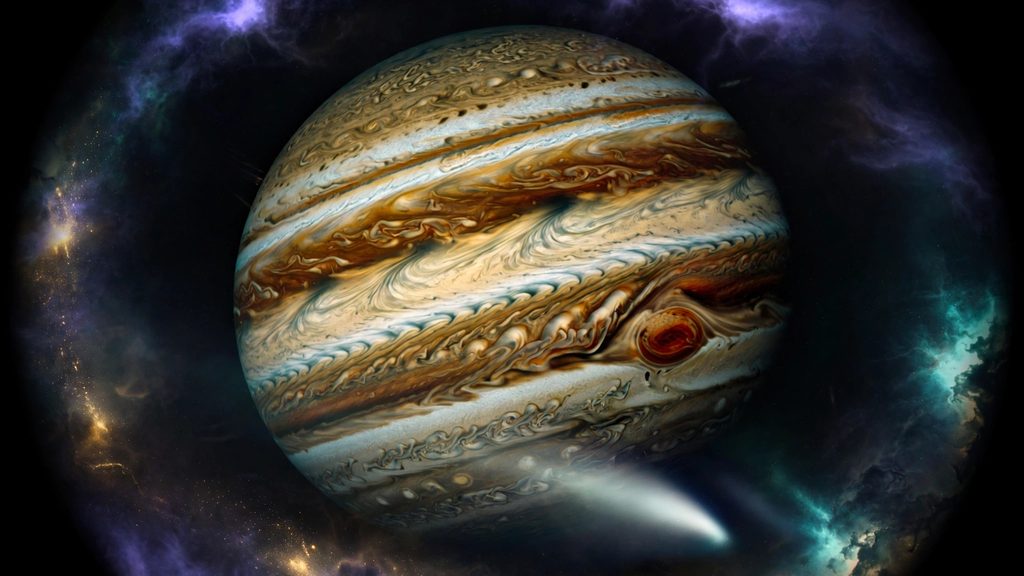
Online, the comet had already become something else. A signal, it was said, sent ahead of a commander who watches from behind the great red eye of Jupiter. But the comet carried an older message than that. Its orbit points back across seventeen centuries to a season when the Romans saw comets burning in broad daylight, and its family tree reaches back to a comet seen by Aristotle.
The Signal
The story spread in the spring of 2026, as the comet brightened. Its name, MAPS, was read as a code, a planetary mapping system sent to survey the Earth. Its arrival at Easter was taken as a sign. Behind it, the story said, stood an intelligence watching from the red eye of Jupiter, and beneath the far side of the Moon, remote viewers claimed to have seen pale human captives kept in tunnels, a population bred to serve it. The wars on Earth, in this telling, were a cover, noise arranged to hide what was coming.
None of it has a source beyond posts and the visions of remote viewers. But the comet itself was no invention. And its true story begins in a desert in Chile, with an automatic telescope and a faint smudge on a screen.
The Comet From the Desert
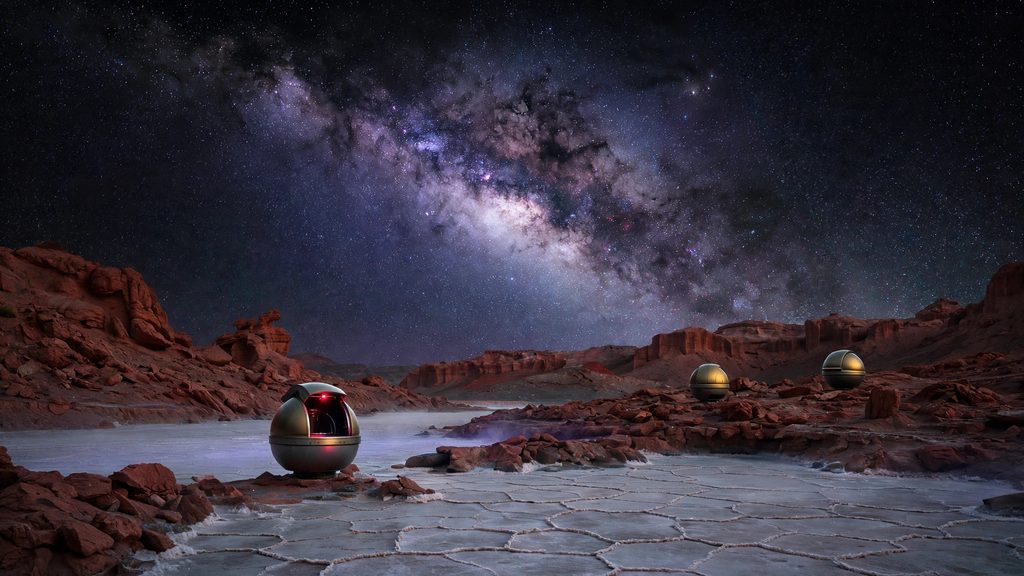
On the night of 13 January 2026, four small telescopes were scanning the sky by themselves at San Pedro de Atacama, high in the Chilean desert. They belong to a private search for asteroids run by a handful of amateur astronomers. That night the software flagged an unknown object with a faint halo around it. The astronomer Alain Maury looked at it, checked it with a second telescope and wrote to a colleague four words in Spanish. Creo que 4721 es un cometa. I think 4721 is a comet.
It was named for the four people behind the search, Maury, Attard, Parrott and Signoret. MAPS. Not a mapping system, but four surnames. And when its orbit was worked out, astronomers realised what they had. The comet was a Kreutz sungrazer, a member of a family of comets that dive almost into the Sun. It was the most distant member of the family ever found on its way in, spotted more than three hundred million kilometres from the Sun, with eighty days of warning before it reached it.
A Family Born in Fire
In 1888 the German astronomer Heinrich Kreutz noticed that three great comets, those of 1843, 1880 and 1882, followed almost the same path. They were, he argued, pieces of a single giant comet that had broken apart on an earlier pass around the Sun. The family that bears his name has produced some of the brightest comets in history.
The Great March Comet of 1843 was seen in daylight, and its tail stretched more than three hundred million kilometres, a record for well over a century. The Great September Comet of 1882 was the brightest comet ever recorded, visible beside the Sun at noon, and after its pass it broke into four pieces. At the Cape of Good Hope the astronomer David Gill photographed it, and his plates caught so many background stars that they helped inspire the first great photographic map of the heavens. In 1965 two Japanese amateurs found Comet Ikeya-Seki, which grew so bright it was seen in daylight beside the Sun, and split in three. Since the SOHO spacecraft began watching the Sun in 1995, it has caught thousands of small members of the family, most of them falling to pieces as they dived. Only one SOHO sungrazer, Comet Lovejoy in 2011, is known to have come out the other side.
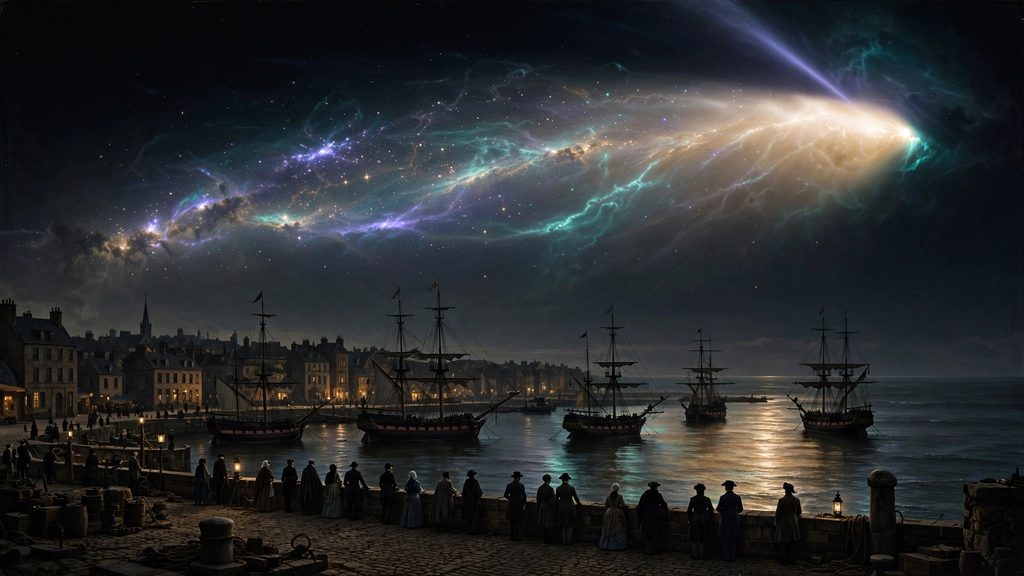
- 371 BCE
A great comet over Greece. Aristotle writes of it, and Ephorus says it split in two. A candidate parent of the family.
- AD 363
Ammianus Marcellinus writes that comets were seen in broad daylight. MAPS may have broken away from its parent that year.
- 1106
The Great Comet, a star wonderful to behold, seen from Wales to Japan.
- 1843
The Great March Comet, seen in daylight, with a tail longer than the distance from the Earth to the Sun.
- 1882
The Great September Comet, the brightest on record. It breaks into four.
- 1888
Heinrich Kreutz shows that the great sungrazers are pieces of one comet.
- 1965
Ikeya-Seki, seen in daylight, splits in three at the Sun.
- 2011
Comet Lovejoy survives its dive, the only SOHO sungrazer known to have done so.
- 13 Jan 2026
MAPS is found in the Atacama Desert, the most distant sungrazer of the family ever found on its way in.
- Spring 2026
Online posts call it a mapping system and a signal from behind Jupiter’s eye.
- 4 Apr 2026
MAPS breaks apart hours before reaching the Sun, on the eve of Easter.
The Comet Aristotle Saw
The family has an ancestor. In 371 BCE a great comet appeared in the skies of Greece. Aristotle wrote about it, and the historian Ephorus claimed it had split in two. Many astronomers suspect that this comet, or a giant like it, was the parent of the whole Kreutz family, a body perhaps tens of kilometres across that broke apart near the Sun and sent its fragments out on orbits that return every few centuries.
One of those returns was in February 1106. In Wales the chroniclers called it a star wonderful to behold, with a beam like a pillar. In England it hung in the south-west at evening with a very bright ray. In Japan a courtier logged it night after night in his diary. It was seen in China, in Vietnam and in Egypt. Its fragments came back in 1843 and 1882.
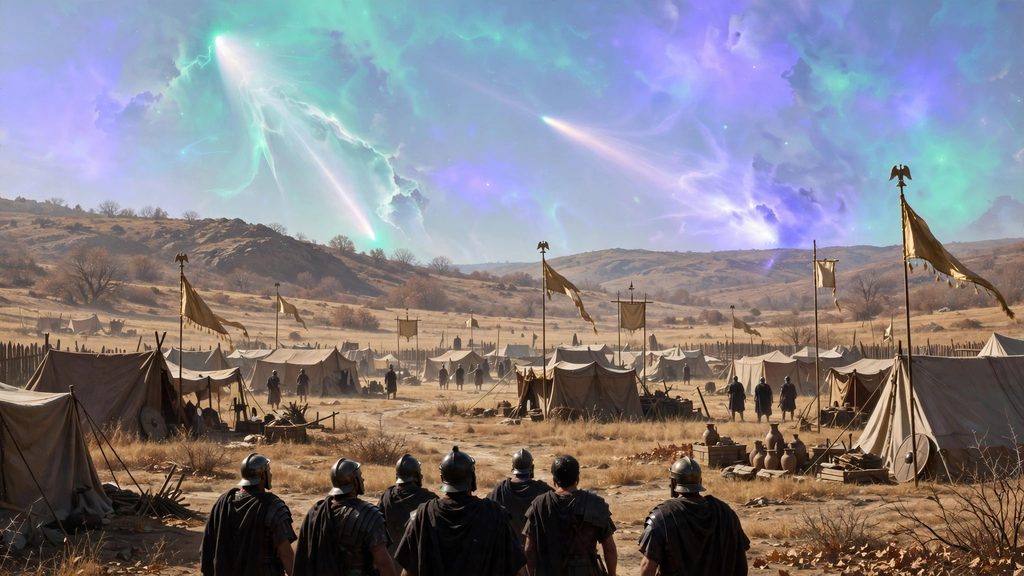
And in late AD 363, by the account of the Roman soldier and historian Ammianus Marcellinus, something strange happened. In broad daylight, he wrote, comets were seen. The astronomer Zdenek Sekanina has long argued that this was a cluster of Kreutz fragments arriving at the Sun together. When Comet MAPS was found, its orbit seemed to point straight back to that year. Its previous pass around the Sun, by the first calculations, came about seventeen centuries ago.
Ammianus did not treat the sight as a curiosity. He listed the daylight comets among many fearful portents seen for days on end at Antioch, where the new emperor Jovian was lingering after the death of Julian in Persia, and he noted that those skilled in such signs declared they would have sad results. Jovian left Antioch in midwinter and died on the road a few weeks later, in February 364, before he ever reached Constantinople.
In July 2026 Sekanina and Małgorzata Królikowska published a fuller study. MAPS, they suggest, was part of a larger body that broke away in AD 363 from the ancestor of the Great Comet of 1843, and then fell apart again far out in space. Three small sungrazers that arrived at the Sun between 31 March and 12 April 2026 may be its distant companions. The date still depends on which observations are used, because the comet’s jets pushed it off course as it dived. But if they are right, the comet that fell into the Sun on the eve of Easter may last have been seen by the Romans.
The Last Hours
By late March MAPS was low in the evening twilight, easiest to see from the Southern Hemisphere. On 2 April it slid into the view of SOHO’s coronagraph, an instrument that blocks the Sun’s disc to reveal what moves around it. A day later it appeared in a second coronagraph aboard a weather satellite. At 08:15 universal time on 4 April, about six hours before its closest approach, its head shone at magnitude minus 0.6, brighter than every star in the night sky except Sirius and Canopus.
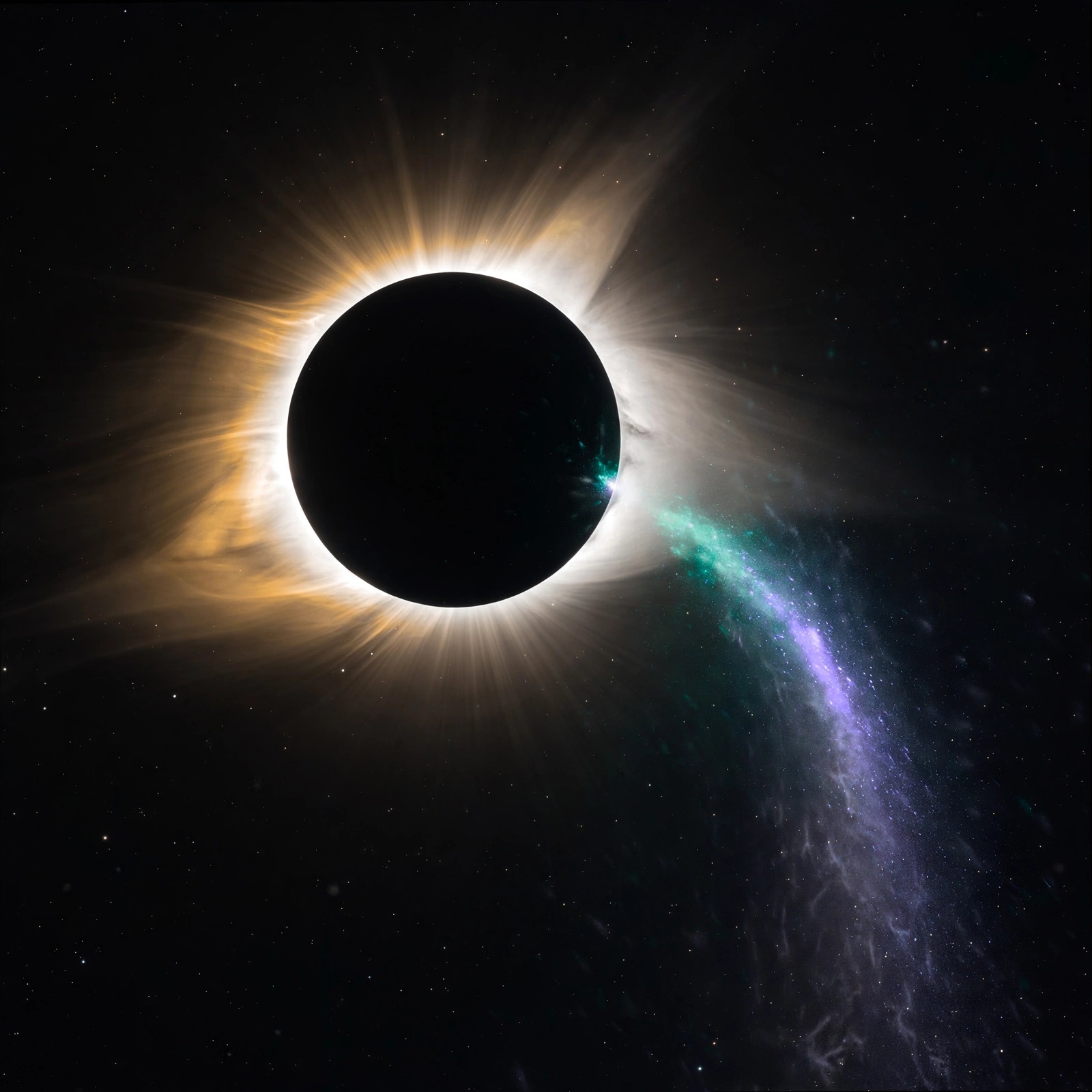
Then it broke. Somewhere in the hours before it reached the Sun, the nucleus, perhaps four hundred metres across by one estimate from the James Webb Space Telescope, came apart. SOHO saw the comet slip behind the disc that hides the Sun. NASA’s STEREO, watching from another angle, saw it curve around the Sun as it disintegrated. What emerged on the far side was a cloud of dust with no head at all. The leader of SOHO’s coronagraph team, Karl Battams, said the comet had clearly been destroyed, likely several hours before its closest approach.
Its closest approach, at about 14:22 universal time, would have carried it some 161,000 kilometres above the surface of the Sun. It fell apart on Holy Saturday. The next day was Easter Sunday.
The Eyes That Watch the Sun
MAPS died in front of an audience that did not exist a generation ago. SOHO, the Solar and Heliophysics Observatory run by ESA and NASA, was launched in 1995 to study the Sun from a point between it and the Earth. It became, by accident, the greatest comet finder in history. Its coronagraph images are posted online within hours, and volunteers around the world comb them for faint moving smudges. Through the NASA-funded Sungrazer Project, led by Karl Battams of the US Naval Research Laboratory, they have found almost all of SOHO’s comets. In March 2024 the observatory reached its five-thousandth, spotted by Hanjie Tan, a PhD student in Prague searching in his spare time. Most of those comets are Kreutz fragments, too small to see from the ground, falling into the Sun and vanishing.
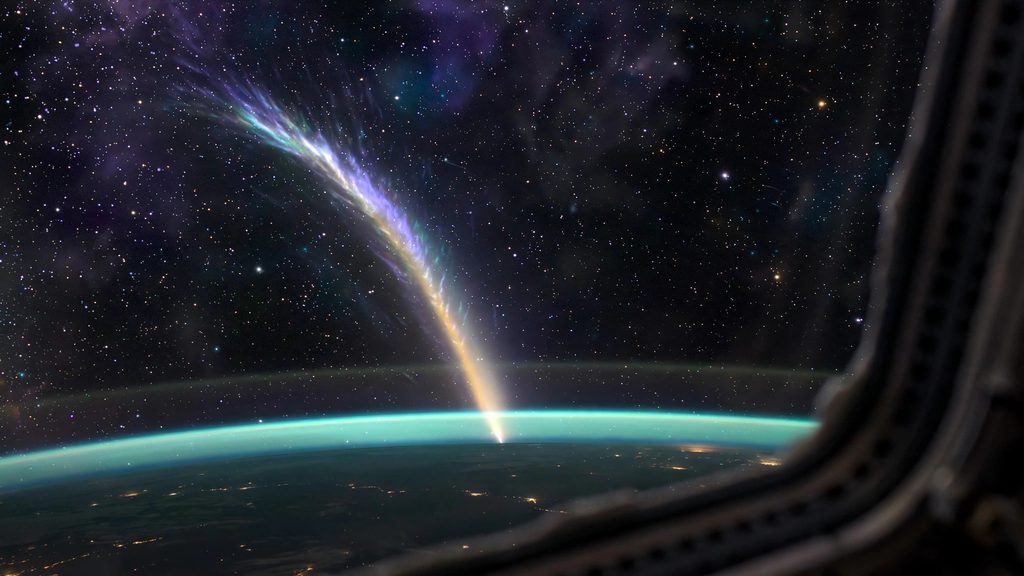
A few have put on a show. In December 2011 Comet Lovejoy plunged through the Sun’s outer atmosphere and came out the other side, and days later the astronaut Dan Burbank photographed its long curved tail from the International Space Station. In November 2013 Comet ISON, hailed as the comet of the century though not a Kreutz member, fell apart on its way around the Sun on the American Thanksgiving. MAPS joined that short list of famous deaths, watched from three spacecraft at once.
The Messenger in the Sky
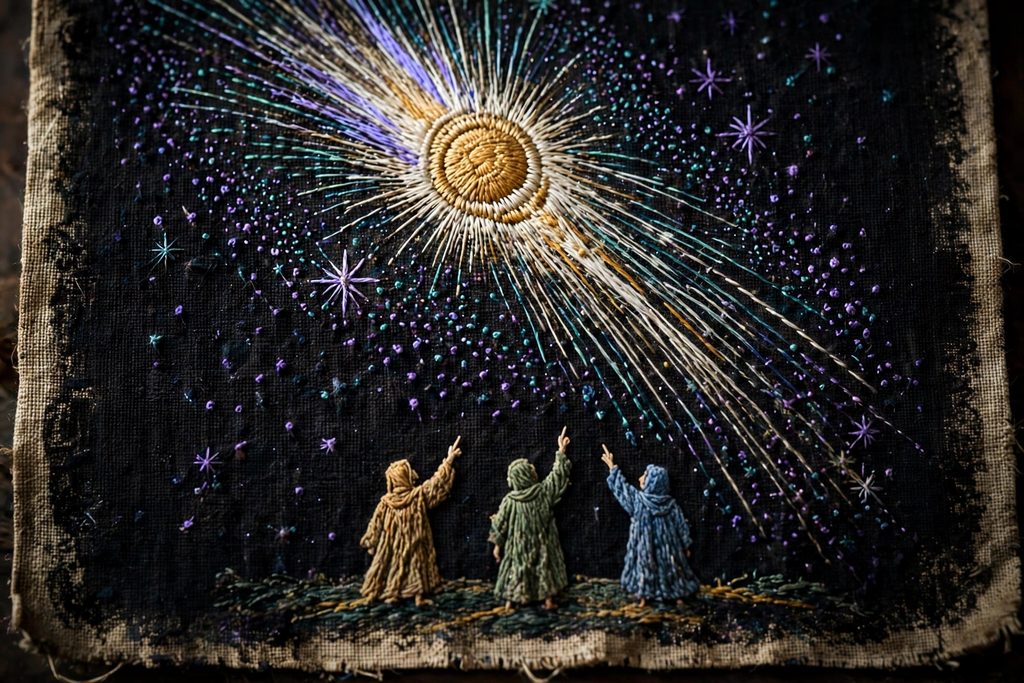
Comets have always been read as messages. The Greeks called them long-haired stars. Halley’s Comet is stitched into the Bayeux Tapestry, with men pointing up at it in wonder, an omen of 1066. Chroniclers in 1106 wrote of the new star with awe and dread. The story of MAPS as a signal from Jupiter belongs to the oldest habit of the human eye, the sense that something so strange and bright must have been sent.
Its details are new, but each has a source in the sky. Jupiter’s red eye is the Great Red Spot, a storm larger than the Earth that astronomers have watched for more than a century and a half. The far side of the Moon, never seen from Earth, was first reached by a lander in 2019, when China’s Chang’e 4 touched down in the Von Kármán crater and found dust, rock and silence. Remote viewing was studied by the United States government for more than twenty years, and the programme was closed in 1995 when a review found it of no use for intelligence. In the same months as MAPS, the interstellar comet 3I/ATLAS, only the third object known to have come from another star, was drawing theories of its own.
The Long Fall Back
A comet arrives without warning, burns in the sky for a few weeks and is gone. It does not follow the regular round of the planets. For most of history it was the one thing in the heavens that seemed to be doing something, and so it seemed to be saying something. The Easter timing, the code in the name, the distant planet watching. Each is the old reading of comets in a new form.
The message MAPS carried is older than any of that. It is a piece of a comet that may have blazed in daylight over the Roman world in AD 363, part of a family that may go back to the comet Aristotle watched. It crossed the dark for seventeen centuries and came back to die beside the Sun, watched by spacecraft, on the eve of the feast of the resurrection. No commander sent it. Gravity set its date seventeen centuries ago, and it kept the appointment.
The Verdict | Debunked
The only signal Comet MAPS sent was light. Its name joins the surnames of its four discoverers, Maury, Attard, Parrott and Signoret, and its orbit, its brightening and its breakup near the Sun on 4 April 2026 were followed by telescopes in Chile and by SOHO and STEREO, and match those of a Kreutz sungrazer. The planetary mapping system, the commander behind Jupiter’s Great Red Spot, the captives under the Moon’s far side and the staged wars rest on online posts and remote viewing claims, with nothing behind them.
Debunked, then, for the message from Jupiter. The comet’s own past is still being worked out. A link to the daylight comets Ammianus saw in AD 363 has been proposed by Sekanina and Królikowska, and the date depends on observations that the comet’s jets made hard to read.
- Claim tested
- Comet MAPS was a planetary mapping system or signal arriving at Easter for an intelligence behind Jupiter’s Great Red Spot, linked to captives beneath the far side of the Moon and to wars staged as cover.
- Oldest record
- Rung 5 · Retold
Social media posts and remote viewing claims from late 2025 and spring 2026. The comet itself was found on 13 January 2026 by the MAPS search in Chile. - The record supports
- A bright Kreutz sungrazer that reached the Sun on the eve of Easter 2026 and broke apart, with a possible link to the daylight comets of AD 363.
- It does not support
- Any meaning of MAPS beyond the surnames of its discoverers, any signal from the comet, any intelligence at Jupiter and any population beneath the Moon.
- Explanations weighed
- A signal from a hidden intelligence, and the orbit and breakup of a sungrazing comet followed by observatories and spacecraft.
- What would change it
- A signal or object from the comet or from Jupiter recorded by independent observatories.
Visitors from the dark keep arriving on these pages. The interstellar comet that crossed the sky in the same months gathers its own theories in 3I/ATLAS, and the quiet of the Moon’s hidden face waits in the Von Kármán crater. A whisper from the probe now drifting beyond the planets is weighed in the Voyager 2 signal, points of light that flared on old glass plates in the Palomar transients, and a scheme to steer the Sun itself in an engine to move the solar system. The desert where four telescopes found the comet is marked in the Atlas of Mysteries, and this sungrazer, measured by the rules of the Archive Standard, takes its place in the Verdict Index as one more messenger that burned out short of the Sun.
Quick Answers About Comet MAPS
What was Comet MAPS?
Comet C/2026 A1 (MAPS) was a Kreutz sungrazer found on 13 January 2026 by a private asteroid search at San Pedro de Atacama in Chile. It broke apart near the Sun on 4 April 2026.
What does MAPS stand for?
The name comes from the surnames of the four people behind the search, Alain Maury, Georges Attard, Daniel Parrott and Florian Signoret.
Did Comet MAPS survive the Sun?
No. It shone at about magnitude minus 0.6 on the morning of 4 April 2026, then disintegrated hours before its closest approach. Only a headless dust tail emerged.
What are Kreutz sungrazers?
A family of comets on almost the same orbit, believed to be fragments of one giant comet. They include the Great Comets of 1843 and 1882 and Comet Ikeya-Seki of 1965.
Is Comet MAPS linked to the comets of AD 363?
Possibly. Astronomers Zdenek Sekanina and Małgorzata Królikowska suggest it broke away from a larger comet in AD 363, the year Ammianus Marcellinus wrote of comets seen in daylight. The date is still uncertain.
Was Comet MAPS a signal from Jupiter?
No source beyond online posts and remote viewing claims supports it. The comet followed the orbit of a Kreutz sungrazer.
How many comets has SOHO found?
More than five thousand. The five-thousandth was found in March 2024 by a volunteer, and most are small Kreutz sungrazers found by citizen scientists through the Sungrazer Project.