



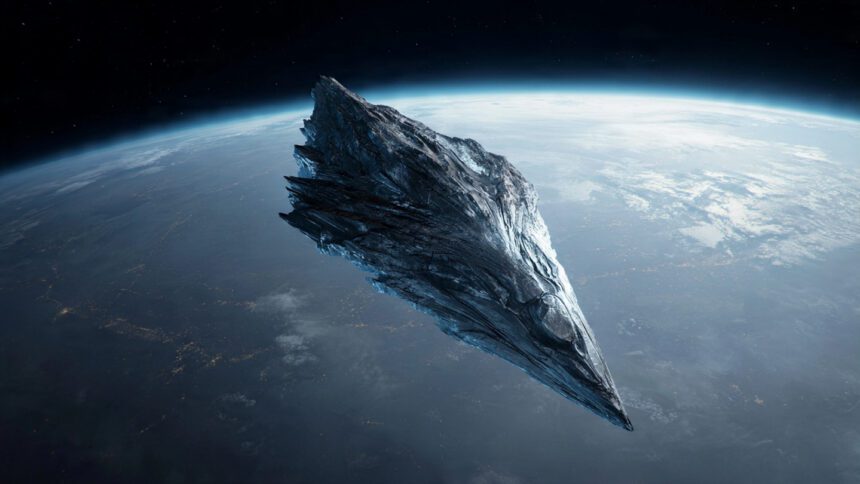
The most damaging evidence against the Black Knight satellite does not come from skeptics. It comes from the story’s own sources. Duncan Lunan, the Scottish writer whose 1973 analysis is routinely presented as the scientific foundation for a 13,000-year-old alien probe, now explicitly says the Black Knight story has nothing to do with him and that he has never heard of the supposed voices allegedly heard by astronaut Gordon Cooper. NASA’s own Mercury history does not contain the famous Cooper episode. The 1998 shuttle photographs are genuine, but NASA’s records place the object in the category of space debris. The 1960 “mystery satellite” was subsequently connected to America’s secret Discoverer/CORONA program. And the radio phenomenon that Lunan interpreted as an extraterrestrial message was real, but his particular interpretation was withdrawn after he found errors in the underlying material.
That does not mean nothing happened. Almost the opposite. The Black Knight story is fascinating precisely because its ingredients are real. Tesla really did detect strange signals. Radio engineers really did record long-delayed echoes. The U.S. military really did track an unidentified object in orbit during the early satellite era. Duncan Lunan really did publish a paper proposing an extraterrestrial probe. Astronauts really did photograph an unexplained-looking object during STS-88 in 1998. What never appears in the evidence is the missing step: a single object connecting all of those events across nearly a century.
The Black Knight is therefore best understood not as a spacecraft that has survived thirteen thousand years in orbit, but as a modern composite legend. Separate events were stripped from their original contexts, moved across decades, and eventually placed beside one another until they appeared to describe a single machine. Once the chronology is restored, the legend begins to come apart, not because every mystery was imaginary, but because the mysteries were never the same mystery.
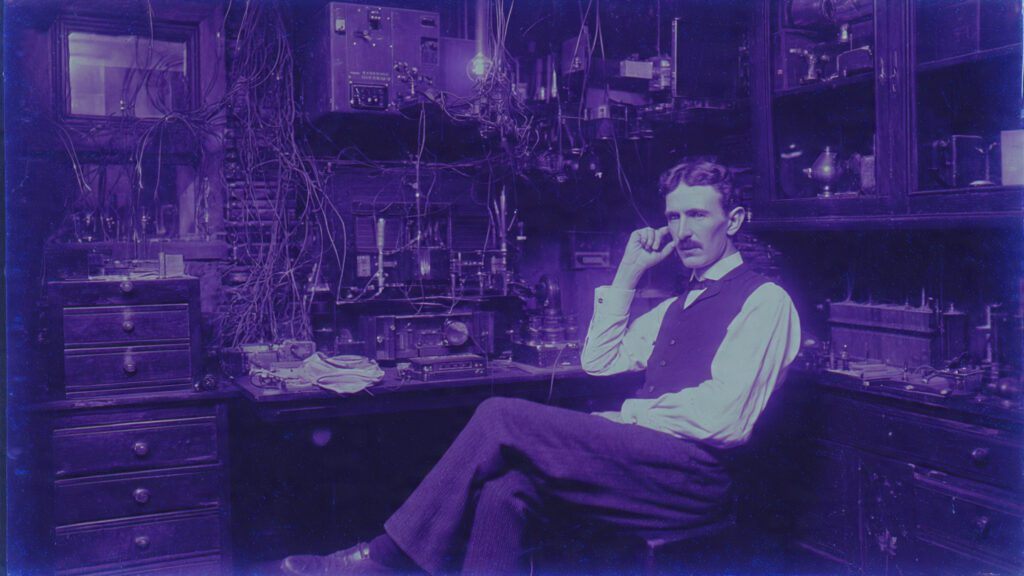
Tesla Heard Something. He Did Not Hear the Black Knight.
In 1899, Nikola Tesla was conducting high-voltage electrical experiments at his Colorado Springs laboratory when his instruments registered rhythmic disturbances that he considered unusual enough to investigate. Tesla eventually became convinced that he might have detected a signal from another world, and in a 1901 Collier’s Weekly article he specifically associated the phenomenon with Mars. That part of the story is genuine. Tesla was not secretly describing an object in Earth orbit, and he certainly was not describing something called the Black Knight. The Black Knight name did not belong to his experiment, and there is no contemporary record connecting Tesla’s observations to an ancient satellite.
Later investigators proposed several possible explanations for what Tesla detected. Kenneth Corum and James F. Corum, the latter holding a Ph.D. in electrical engineering from Ohio State University and a career that included work as an electronic engineer for the National Security Agency and a tenured professorship at West Virginia University, argued in a 2003 study that some of the signals could be consistent with very-low-frequency emissions associated with Jupiter’s moon Io and the electromagnetic environment around Jupiter. Other historians and radio specialists have considered interference, terrestrial transmissions, instrumental effects and other possibilities. The important point is not that one modern explanation has magically transformed Tesla’s observation into a solved case. It is that none of the serious explanations requires an artificial satellite orbiting Earth, and Tesla himself never supplied evidence for such an object.
There is an even more revealing problem with the later legend. Tesla was conducting his experiment in 1899, long before the Space Age, before Sputnik, before the existence of artificial satellites had been demonstrated. His question was whether unusual radio phenomena could be coming from elsewhere in the cosmos. The Black Knight story reverses that historical context and quietly converts an early radio experiment into the first alleged detection of an ancient spacecraft.

The Long-Delayed Echoes Were Real. The Alien Map Was an Interpretation.
In 1927, Norwegian radio engineer Jørgen Hals reported a phenomenon that was genuinely strange: radio echoes appeared seconds after the original transmission. These became known as long-delayed echoes, or LDEs, and they were investigated by radio engineers and physicists for decades. The phenomenon is part of the historical record. It was not invented by UFO writers, and it did not begin with Duncan Lunan.
What caused the echoes has never been reduced to one universally accepted explanation. Researchers have investigated ionospheric propagation, plasma effects, reflections and other mechanisms. That uncertainty is real, and it is precisely the sort of scientific anomaly from which later speculation can grow. But an unexplained radio phenomenon is not automatically a message, and a message is not automatically evidence of a spacecraft.
The crucial distinction becomes even clearer when the story reaches physicist Ronald Bracewell. Bracewell genuinely proposed that an extraterrestrial civilization might someday deploy an automated probe in another star system to observe or communicate with emerging technological civilizations. The famous “Bracewell probe” is therefore a legitimate concept in SETI history. But the existence of that concept does not establish that Hals’s echoes came from such a probe. The connection was made later, when unrelated pieces of the scientific record were assembled into a more dramatic narrative.
Then Duncan Lunan Gave the Legend Its 13,000 Years
This is where the modern Black Knight mythology acquires its most memorable number. In 1973, Duncan Lunan published “Space Probe from Epsilon Boötis” in Spaceflight, analyzing the timing of long-delayed radio echoes and treating the sequence as though it might encode astronomical information. Lunan reported finding what appeared to him to be a stellar map associated with Epsilon Boötis and calculated an arrival date thousands of years in the past. The story quickly escaped the technical context in which it had been proposed and entered the wider UFO literature.
But Lunan himself supplies the next part of the story. On his current website, he explains that the original records he had worked from contained inaccuracies and that facts he had deduced about the Epsilon Boötis system were wrong. He says he withdrew the translation and identifies the 1976 paper in which he addressed the long-delayed echoes and extraterrestrial hypothesis. He also makes a point that is devastating to the later Black Knight narrative: “Black Knight, nothing to do with me.”
There is an important nuance here. Lunan did not subsequently become a conventional skeptic of every possibility of extraterrestrial contact. His website shows that he continued to explore speculative ideas about ancient contact and later revisited aspects of the Epsilon Boötis question. That makes the history more interesting, not less. The point is not that Lunan suddenly declared extraterrestrial life impossible. The point is narrower and much more defensible: the specific 1973 analysis cannot honestly be presented as a continuing scientific proof of a 13,000-year-old Black Knight satellite when its author withdrew the original interpretation and explicitly says the Black Knight story is unrelated to his work.
There is another subtle detail that later retellings routinely erase. Lunan’s original hypothetical probe was associated with the Earth-Moon system’s Lagrange regions, not with a gigantic spacecraft sitting in a mysterious polar orbit around Earth. His own account says the press subsequently transformed the location into something else. The modern legend therefore changed not only the conclusion but the address.
The “13,000-Year-Old Satellite” Was Never What Lunan Actually Claimed
This matters because the phrase sounds much more precise than the evidence ever was. “A 13,000-year-old satellite” suggests that an object was physically observed, its orbit measured, its age established and its artificial construction demonstrated. None of those things happened. The 13,000-year figure emerged from an interpretation of radio-echo timing, not from carbon dating, orbital mechanics or an archaeological measurement of an object.
The number survived because it is memorable. Once attached to the word “satellite,” it stopped sounding like a speculative calculation and started sounding like a measurement. That is one of the most powerful transformations in conspiracy folklore: an inference becomes a fact by losing the sentence that originally qualified it.

The 1954 “Satellites” Were Newspaper Claims, Not Ancient Hardware
Another layer appeared in the 1950s. Newspaper reports attributed to UFO researcher Donald Keyhoe claimed that the U.S. Air Force had detected two mysterious satellites at a time when the Soviet Union had not yet launched Sputnik and the public knew of no operational artificial satellite. The reports became another tantalizing piece of the future Black Knight story.
But the evidentiary status of these reports is radically different from the way they are presented today. There is no comparable public technical record establishing that the Air Force had discovered a 13,000-year-old spacecraft. The claims circulated through newspaper coverage and UFO literature rather than through a documented chain of orbital measurements, photographs and independent tracking observations. The story is therefore evidence that people were reporting mysterious satellites, not evidence that such a satellite actually existed.
That distinction becomes critical once the legend is reconstructed chronologically. The 1954 newspaper claims predated the 1973 Lunan interpretation. Neither was originally presented as part of a single Black Knight case. The connective tissue came later.
The 1960 Mystery Object Was Real. So Was the Cold War Secret Behind It.
The 1960 episode is stronger than the 1954 newspaper claims because something really was tracked. TIME reported that the U.S. Navy had detected a dark object in orbit and initially considered the possibility that it might be a Soviet reconnaissance satellite. That was a genuine Cold War mystery: radar had detected something that had not yet been publicly identified.
Then the mystery acquired an earthly identity. Contemporary reporting subsequently connected the object with hardware from the American Discoverer program, the public-facing cover for the highly classified CORONA reconnaissance effort. The exact Discoverer designation is itself muddled in later retellings, some accounts identify Discoverer VIII, while other historical material points to a different lost Discoverer payload. That is precisely why the safest conclusion is not to manufacture false precision. What matters is that the object was associated with known American reconnaissance hardware, not an ancient craft of unknown origin.
And the secrecy surrounding CORONA explains something that can otherwise look suspicious. The United States really was hiding satellites from the public during the Cold War. But it was hiding them because they were reconnaissance systems, not because officials had discovered an extraterrestrial object. A classified human satellite can produce exactly the kind of temporary identification gap that later generations interpret as a cover-up.
Gordon Cooper Did Fly Into Space. The Famous “Black Knight” Encounter Is Another Matter.
Gordon Cooper’s Mercury-Atlas 9 mission is thoroughly documented. He launched aboard Faith 7 on May 15, 1963, completed 22 orbits and spent more than 34 hours in space. NASA’s historical record describes the mission in detail, including the spacecraft malfunctions Cooper encountered, his observations from orbit, the worldwide tracking network and his successful manual reentry.
Cooper did report unusual visual phenomena during his career, and his account of spaceflight should not be erased simply because later writers attached other claims to it. But the specific Black Knight version, that Cooper saw an alien craft, that tracking stations confirmed it, and that strange voices were involved, does not appear in NASA’s documented Mercury history. Lunan goes further: on his own website he says he has never heard of the supposed voices and notes that they do not appear in the official histories or detailed first-hand accounts he checked.
There is a revealing alternative hiding in the actual Mercury record. During Faith 7, Cooper observed the phenomenon known as “fireflies,” small luminous particles around the spacecraft. NASA’s historical material documents such observations and later accounts have associated these particles with spacecraft-related material and condensation. A genuine astronaut seeing unexplained-looking objects in orbit is therefore entirely possible without producing an ancient alien satellite.

The British Black Knight Was Real. It Was a Rocket.
The name itself has another perfectly terrestrial history. Britain really did have a Black Knight rocket program during the late 1950s and early 1960s. It was a sounding-rocket and re-entry research program associated with upper-atmosphere work and missile technology. It did not secretly place a 13,000-year-old alien satellite into orbit.
According to Lunan’s own account, this is essentially the only genuine “Black Knight” he recognizes: the British rocket. The name is therefore not evidence that an extraterrestrial spacecraft existed. It is another example of how a real aerospace program supplied a memorable label that later mythology could borrow.

Then Came the Photograph Everyone Has Seen
In December 1998, the Space Shuttle Endeavour launched on STS-88, the first shuttle mission devoted to assembling components of the International Space Station. During the mission, astronauts photographed a dark, irregular object against the blackness of space. The photographs are completely genuine. They are among the most visually persuasive pieces of the Black Knight legend because the object looks strangely geometric, dark and apparently separate from the shuttle.
But a photograph is not a label. It records what the camera saw, not what a later caption claims the object was.
NASA’s STS-88 documentation places the image within the mission’s debris and thermal-protection assessment, and the widely accepted explanation is that the object was a piece of material lost during the construction activity around the International Space Station, most commonly identified as a thermal insulation blanket or related protective material. The NASA technical record itself documents extensive analysis of debris, ice and thermal-protection material during the mission. Later independent analysis has likewise treated the object as mission debris rather than an enormous spacecraft.
Its appearance is not evidence against that explanation. Thin reflective material can look surprisingly solid when photographed at high magnification against deep black space, where there is no familiar background scale. An irregular sheet illuminated from one direction can acquire hard edges, bright highlights and dark folds that make it look engineered. That is precisely why the image is compelling, and precisely why the image alone cannot establish what the object was.

The Most Important Problem Is the Missing Chain of Custody
Every extraordinary object needs a chain of evidence. Where was it first observed? At what distance? What was its trajectory? Was it independently tracked? Did different instruments observe the same object? Can its orbit be reconstructed? Does its physical behavior remain consistent with the proposed explanation? Can the object be distinguished from debris, satellites, reflections, atmospheric effects or observational artifacts?
The Black Knight legend never supplies that chain for one object. Instead, it supplies fragments from different centuries and asks the reader to perform the connection personally. Tesla supplies the signal. Hals supplies the echoes. Lunan supplies the extraterrestrial interpretation. The Cold War supplies the mysterious satellite. Cooper supplies the astronaut. STS-88 supplies the photograph. The British rocket supplies the name. The narrative then places all of them inside one imaginary dossier.
But chronology is evidence too. Tesla died in 1943. Hals’s echoes belong to the 1920s. The 1954 satellite stories appeared decades before Lunan’s paper. The 1960 radar object belonged to the early satellite era. Cooper flew in 1963. Lunan published in 1973. STS-88 happened in 1998. The fact that later writers can put those dates on one timeline does not mean the people involved were observing the same thing.

What Happens When the Legend Is Disassembled?
Remove the Black Knight label and the underlying history becomes much more interesting. Tesla was an early electrical pioneer confronting radio phenomena he did not yet understand. Long-delayed echoes became a genuine problem in the history of radio propagation. The early Cold War produced mysterious orbital detections because governments were launching hardware they were not yet willing to identify publicly. CORONA was genuinely secret. Mercury astronauts genuinely saw things in an environment humans had only recently entered. And STS-88 produced photographs of genuine objects whose identity had to be reconstructed from mission records and orbital context.
None of that is boring. In fact, it is a better story than the legend because every piece has a history.
Why the Black Knight Story Is So Difficult to Kill
The legend survives because every time one component is explained, another remains genuinely strange. Explain Tesla and the long-delayed echoes remain. Explain the echoes and Lunan’s star map remains. Explain Lunan and the 1960 object remains. Explain the object and the STS-88 photographs remain. Explain the photograph and someone can still point to the astronaut stories. The argument constantly moves to the remaining unexplained fragment, giving the impression that the whole case has survived every challenge.
But that is not how evidence works. Five unresolved questions do not become one solved mystery merely because they are placed in the same paragraph. A collection of anomalies is not automatically a common cause. And a story becomes weaker, not stronger, when its central witnesses and sources have to be repeatedly reinterpreted to keep them inside it.
The most extraordinary example is Lunan himself. His name remains attached to the claim precisely because the legend needs his authority. Yet the source itself says that the Black Knight has nothing to do with him. The original analysis was withdrawn. The location was later distorted. The alleged Cooper connection is rejected by Lunan himself. The famous 13,000-year figure survives, but the person whose calculation supplied it does not endorse the use later made of it.
The Real Mystery Is How Five Stories Became One
That is the part of the Black Knight legend that deserves more attention than the satellite itself. The myth was not manufactured from nothing. It was assembled from things that actually happened, which makes it far more durable than an ordinary fabrication. Every component carries a little piece of credibility. A famous scientist. A radio anomaly. A classified program. An astronaut. A NASA photograph. A real British rocket. Put them together and the resulting story feels heavily documented because each individual fragment really is documented.
But documentation is not connection.
That single distinction changes the entire case. A real photograph does not authenticate a fictional history attached to it. A real radio anomaly does not prove that the same phenomenon was photographed seven decades later. A classified satellite program does not establish that officials were concealing an extraterrestrial craft. A scientist’s speculative paper does not remain evidence after the author withdraws the interpretation. And an astronaut’s genuine observations cannot be expanded into statements that do not appear in the mission record.
The Black Knight satellite therefore does not fail because every strange event in its history was fake. It fails for a more interesting reason.
The events are real. The connection is not.
There is no documented chain carrying one artificial object from Tesla’s laboratory to Hals’s radio echoes, from Lunan’s 1973 interpretation to a Cold War radar track, from Gordon Cooper’s Mercury flight to the STS-88 photographs. There is no continuous orbital record spanning thirteen thousand years. There is no authenticated object. There is no physical sample. There is no independently tracked ancient spacecraft hiding behind the photographs.
What exists instead is something much more human: a legend constructed backward, gathering anomalies as it travels through time and making them look like clues to a single hidden machine.
And perhaps that is why the Black Knight story refuses to disappear. It offers the seductive possibility that all the strange things were strange for the same reason. Reality is usually less cooperative. Sometimes Tesla really did hear something he could not explain. Sometimes a radio signal really does behave strangely. Sometimes a secret military program really does put an unidentified object into the sky. Sometimes a camera really does capture something that looks impossible.
The mistake is not being fascinated by any of those things. The mistake is assuming they were all the same thing.
That is the Black Knight’s real secret: not an ancient satellite watching Earth, but a modern myth powerful enough to make unrelated evidence orbit one another.
Check out the official NASA images of “The Black Knight” by visiting these links: Link 1, Link 2, Link 3, Link 4, Link 5