



The Kepler Space Telescope changed the solar system’s self-image permanently.
Before Kepler, the solar system was the only planetary system whose architecture was known in detail. Astronomers could theorize about what planetary systems around other stars looked like, but they had only one data point. The solar system was the norm by default because there was nothing to compare it to.
After Kepler confirmed more than two thousand exoplanets between 2009 and 2018, and the subsequent TESS mission confirmed thousands more, the database of known planetary systems grew large enough to establish genuine statistical patterns. The statistical patterns established a finding that the planetary science community has been processing since: our solar system is not representative of how planetary systems form. It is a genuine and unusual outlier in the catalog.
The most systematic analysis of solar system anomalousness in the context of the exoplanet catalog was published by researchers including Gregory Laughlin at Yale and Konstantin Batygin at Caltech, whose prior work on Planet Nine appears in this library’s dedicated piece. Their finding: the solar system’s architecture, particularly the absence of super-Earth planets in the inner solar system and the size and arrangement of its outer giants, is found in fewer than ten percent of the known planetary systems with sufficient data for comparison.
Nine out of ten planetary systems whose architecture can be compared to ours are organized differently in ways that suggest different formation histories. The solar system is not the template for planetary system formation. It is an unusual case whose characteristics require an explanation.
What makes those characteristics significant for the questions this library raises is that several of the solar system’s anomalies directly contribute to Earth’s unusual habitability.
The Architecture of Habitability
The solar system’s anomalous characteristics, taken individually, might reflect unusual but non-directed formation dynamics. Taken together, they produce a configuration that has been noted by researchers in the rare Earth and fine-tuning literature as extraordinarily favorable for the development and persistence of complex life on Earth.
Jupiter’s mass and orbital position is the first and most extensively discussed example. Jupiter is approximately three hundred Earth masses, making it by far the largest object in the solar system after the Sun. Its gravitational influence on the inner solar system is profound and well established: Jupiter’s gravity deflects a significant fraction of the asteroids and comets that would otherwise collide with the inner planets, reducing the impact frequency on Earth by an estimated factor of approximately one thousand compared to what it would be without Jupiter’s protective influence.
The orbital resonances between Jupiter and Saturn, the 5:2 resonance that appears in the orbital mechanics literature, stabilize both planets’ orbits in a way that prevents them from migrating into the inner solar system. In the exoplanet catalog, planetary migration is a common feature of planetary system evolution: gas giants frequently migrate from their formation positions in the outer disk inward toward their parent star, disrupting or ejecting the inner planetary systems as they do so. Our Jupiter did not migrate. The orbital resonance with Saturn appears to have halted the migration that would otherwise have happened.
The absence of super-Earths in the inner solar system is the anomaly that the exoplanet catalog has highlighted most sharply. Super-Earths, planets between one and ten Earth masses, are the most common type of planet in the galaxy. They appear in the inner orbital zones of the majority of planetary systems in the Kepler catalog. The solar system has none. Whether this absence reflects Jupiter’s influence, a feature of the Sun’s protoplanetary disk, or something else is not established, but the absence itself is confirmed and anomalous.
The Moon’s mass and orbital characteristics, recorded in the Hollow Moon and pre-lunar Earth pieces in this library, contribute to Earth’s habitability through the axial stabilization that prevents the dramatic climate variability that an unstable axial tilt would produce. Whether the Moon’s properties are the product of the Giant Impact that mainstream planetary science proposes, or of something else that the pre-lunar traditions and physical anomalies suggest, the stabilization function is well established and its contribution to Earth’s habitability is calculated in the literature.

The solar system’s anomalous architecture does not prove that it was designed. It establishes that it is specifically and unusually favorable for complex life in ways that the statistical distribution of planetary systems makes difficult to explain as chance.
Iapetus
The Cassini spacecraft, which orbited Saturn from 2004 until its deliberate atmospheric destruction in 2017, produced the most comprehensive dataset ever collected on the Saturnian system. Its close flybys of Iapetus on September 10, 2007 at approximately 1,640 kilometers altitude and on December 31, 2004 at approximately 125,000 kilometers produced the highest-resolution imaging of Iapetus available.
What the imaging confirmed was not less strange than what the pre-Cassini observations had suggested.
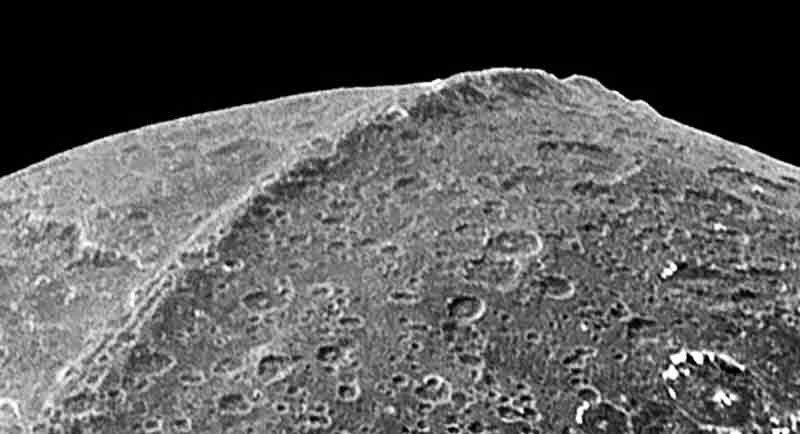
The equatorial ridge. Iapetus has a mountain range running almost precisely along its equator, extending approximately 1,300 kilometers in its confirmed extent and reaching heights of up to 20 kilometers, making its peaks approximately twice as high as Mount Everest relative to the local surface. The ridge is the highest mountain range in the solar system relative to the size of the body it sits on. No comparable equatorial ridge exists on any other body in the solar system. The formation mechanism for an equatorial ridge of this geometry on a body of Iapetus’s size is not established by any consensus-accepted planetary geological process.
The two-tone coloration. The leading hemisphere of Iapetus, the side facing the direction of orbital motion, is as dark as coal, with an albedo of approximately 0.03 to 0.05. The trailing hemisphere is as bright as snow, with an albedo of approximately 0.5 to 0.6. The boundary between the two regions is sharp rather than gradual. The reflectivity difference between the two hemispheres is approximately a factor of ten.
The conventional explanation for the color dichotomy is that the dark material on the leading hemisphere is accumulated from micrometeorite bombardment picking up dark material from other Saturnian moons, particularly Phoebe, whose dark surface material Cassini’s instruments characterized as carbonaceous. The dark material then accumulates preferentially on the leading hemisphere due to Iapetus’s synchronous rotation.
The Cassini data partially supports this explanation for the dark material’s origin, finding chemical signatures in the dark regions consistent with carbonaceous material from outer moon sources. But the Cassini data also produced a complication: thermal segregation. The dark material, being darker, absorbs more solar heat, which causes volatile material to migrate from the warm dark regions to the cooler bright regions, amplifying the contrast over time through a thermal runaway mechanism. The initial contrast was enhanced by physics to produce the current extreme dichotomy.
Whether this thermal segregation mechanism fully accounts for the observed contrast, or whether the initial dark material’s deposition pattern itself has an explanation beyond micrometeorite accumulation from Phoebe, remains an active question in Saturnian geology.
The shape anomaly. Iapetus has a shape that the Cassini imaging established does not correspond to a simple equilibrium shape for a body of its mass and rotation rate. It is oblate in a way consistent with a much faster historical rotation rate than it currently has, suggesting that it froze into its current shape during a period of rapid rotation and has maintained that shape while slowing to its current synchronous rotation. The frozen shape is a recorded finding whose formation timescale implies either that Iapetus formed much faster than planetary formation models predict for a body in its position, or that it was formed in a different location and subsequently moved to its current orbit.
The orbital lock itself. Iapetus has one of the largest orbital inclinations of any major moon in the solar system, inclined approximately 15 degrees to Saturn’s equatorial plane. Most large regular moons orbit close to their planet’s equatorial plane because they formed from the same rotating disk as the planet. Iapetus’s inclination suggests an unusual formation or capture history.
The Iapetus Walnut
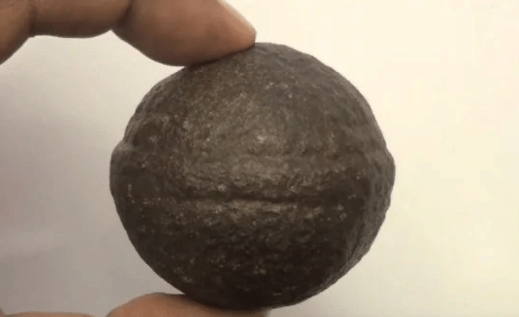
The equatorial ridge’s form in the highest-resolution Cassini imaging produced a comparison that has been noted by both alternative researchers and mainstream planetary scientists: the ridge makes Iapetus look, in profile, like a walnut or a stacked two-disk structure rather than a simple sphere.
The segmented appearance of the ridge in Cassini images, where individual mountain masses project above a lower baseline ridge structure, has been noted by researchers including Richard Hoagland, whose work on lunar and Martian anomalies appears in this library’s dedicated Apollo piece, as potentially consistent with an artificial structure rather than a natural geological feature.
The mainstream planetary geological explanations for the ridge include: remnant shape from the spindown of a rapidly rotating Iapetus early in solar system history, where the equatorial bulge froze before the rotation slowed, material from a former ring system falling onto the equator as the ring material’s orbit decayed and endogenic processes related to internal heat. None of these explanations has been accepted as definitively established by the available Cassini data.
Brian Castillo of the University of California published an analysis in 2014 proposing that the equatorial ridge formed through tidal despinning, with the mountain chain representing stress features from the despinning process rather than an accreted or volcanic structure. This analysis was received as one of the most physically plausible conventional explanations but has not achieved consensus because the topographic characteristics of the ridge, its height, its narrowness, and its equatorial precision, are more extreme than the model predicts.
The equatorial ridge is confirmed by Cassini data. Its formation mechanism is not established. The combination of the ridge’s characteristics with Iapetus’s bicolor surface, anomalous shape, and unusual orbital inclination produces a body whose overall anomalous character is more than the sum of its individually unexplained features.
Arthur C. Clarke noted in a letter to the Planetary Society that Iapetus was the strangest object in the solar system. His 1968 novel 2001: A Space Odyssey, published in the same year as the film’s release, made Iapetus the location of the monolith that triggers human evolution’s next phase. Clarke said in interviews that he chose Iapetus specifically because its real properties were stranger than anything he needed to invent. The fictional monolith on Iapetus is Clarke’s response to a real object’s real anomalies.
The Orbital Synchronicities
The source material raises a claim about the orbital synchronicities between Mercury, Venus, and Earth that deserves careful examination against the established astronomical record.
Mercury’s orbital resonance is well established: Mercury has a 3:2 spin-orbit resonance with its own orbit around the Sun, meaning it rotates exactly 1.5 times for every one orbit. This was established by radar measurements in 1965, correcting a previous erroneous belief that Mercury was tidally locked. The claim in the source about Mercury always presenting one side to Earth is not accurate for Mercury’s situation. What is established is that Earth and Mercury have an orbital relationship that produces a pattern of conjunctions whose geometry is not random.
Venus’s rotation and its relationship to Earth is one of the most genuinely anomalous facts in the solar system. Venus rotates extremely slowly in the retrograde direction, taking 243 Earth days to complete one rotation, which is longer than its orbital period of 225 Earth days. The result is that a Venusian solar day is approximately 117 Earth days. The resonance between Venus’s rotation and its orbital configuration with respect to Earth means that Venus always presents almost the same face toward Earth when the two planets are at inferior conjunction. Whether this is a coincidence or a genuine resonance that requires explanation is a question in planetary dynamics whose answer is not settled.
Jupiter’s formation location and migration history is the most directly anomalous claim in the source. The Nice model and the Grand Tack hypothesis in planetary formation science propose that Jupiter formed further from the Sun than its current position and migrated inward before being halted and pushed back out by gravitational resonance with Saturn. The Grand Tack hypothesis proposes that Jupiter migrated as far inward as 1.5 AU before the resonance with Saturn reversed it. Whether this migration history is accurate is actively debated in planetary science, but the general principle that Jupiter’s formation involved migration is recorded as a theoretical necessity in models that attempt to reproduce the solar system’s current architecture.
The Design Question
The solar system’s anomalous architecture, Iapetus’s unexplained morphology, and the orbital relationships between the planets raise the same question that the Klerksdorp spheres, the Antikythera mechanism, and the Mohenjo-Daro vitrification all raise in this library’s Out of Place Artifacts piece: when physical evidence produces anomalies that conventional natural explanations handle imperfectly, how much anomalous evidence needs to accumulate before the hypothesis of directed design deserves serious evaluation alongside the hypothesis of unusual but undirected natural processes?
The conventional philosophy of science provides an answer: extraordinary claims require extraordinary evidence, and the evidence for directed design of the solar system is not extraordinary because the anomalies described have plausible natural explanations even if those explanations have not been definitively confirmed.
The alternative framework that the Directed Panspermia piece in this library develops provides a different answer: Crick’s molecular improbability argument establishes that the conventional explanation for the origin of life requires accepting a degree of improbability, and Directed Panspermia is not more improbable than undirected abiogenesis. The same logic applies to solar system architecture: an unusual configuration that is highly favorable for complex life is not more improbable as a result of directed design than it is as a result of undirected chance, and the directed design hypothesis gains plausibility from each additional anomaly that the undirected explanation handles imperfectly.
The solar system is anomalous. Iapetus is anomalous within the anomalous system. The Klerksdorp spheres are anomalous in the geological record. The pre-lunar traditions, the Hollow Moon physical anomalies, and the out-of-place artifacts all point in the same direction: toward a history of the solar system and of life on Earth that the conventional natural account does not fully explain.
No single anomaly requires a directed design explanation. The accumulation of anomalies across independent domains, orbital architecture, moon morphology, geological artifacts, genetic structure, and physical constants, produces a cumulative case whose dismissal requires accepting that an extraordinary number of individually unusual features all resulted from undirected natural processes simultaneously.
The Drake equation asks how many civilizations exist in the galaxy. The rare Earth argument asks why Earth is so specifically configured for complex life. The directed panspermia hypothesis asks whether the configuration is directed. The answer to the third question determines whether the answer to the first question is millions or one.