



Henri Lhote was the first Western researcher to systematically document the Tassili n’Ajjer rock art, and his description of first encountering the Great God of Jabbaren is preserved in his 1958 publication and has not been improved upon by any subsequent researcher’s description of the same experience.
He wrote that the figure was about three meters tall, that it was holding an egg-shaped object in its raised hand, and that seeing it in the first grotto made his team freak out. The figure was subsequently photographed, measured, and published. Its height is documented at approximately six meters including the full composition. Lhote named it the Great Martian God, a designation he intended as evocative rather than literal, but whose visual logic any modern viewer seeing the photograph will understand immediately.
The figure has a large round featureless head. It has a full body covering whose character, completely enclosing the body without the anatomical detail that the same period’s human and animal figures show, distinguishes it from ritual costume depictions in the surrounding art. Its arms are raised. Its proportions are not the proportions of an ordinary human figure depicted in the artistic conventions of any known prehistoric culture.
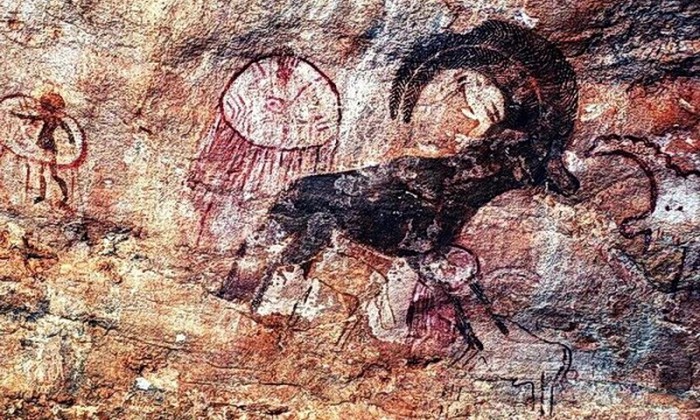
Tassili n’Ajjer is a sandstone plateau in the Algerian Sahara whose geology has preserved rock art in concentrations that make it one of the most important prehistoric art sites on Earth. UNESCO designated it a World Heritage site in 1982. The site contains more than 15,000 recorded drawings and engravings spanning approximately 12,000 years of human activity, from approximately 10,000 BCE through the first centuries of the Common Era. The art is not a single style but a sequence of styles whose stylistic phases document the transformation of the Sahara from a green, river-rich, fauna-abundant environment to the desert it is today.
The Round Head period, dated by most researchers to approximately 8,000-6,000 BCE, is the earliest major stylistic phase and the one whose imagery has generated the most sustained discussion in both the mainstream archaeological literature and the alternative research community.
The Green Sahara and the People Who Lived In It
The Sahara’s current condition, the largest hot desert on Earth covering approximately 9.2 million square kilometers of northern Africa, was not its condition ten thousand years ago. The African Humid Period, also called the Green Sahara, appears in the paleoclimatological record through multiple independent lines of evidence: lake sediment cores showing deep freshwater lake levels across the region, pollen records documenting savannah and woodland vegetation, fossil river systems visible in satellite imagery under the current desert surface, and the Tassili art itself, whose depictions of hippos, crocodiles, elephants, cattle, and hunters pursuing these animals in a landscape of rivers and lakes constitute a biological inventory of a very different environment.
The African Humid Period is dated to approximately 11,000-5,000 BCE, driven by the northward shift of the African monsoon system during the Northern Hemisphere’s high summer insolation period produced by Milankovitch orbital cycles. The Sahara’s transformation from green to desert was not instantaneous but progressive, occurring over several thousand years as the monsoon boundary retreated southward.
The human populations recorded in the Tassili art lived in this green environment. They herded cattle, hunted large game, fished in rivers and lakes, and produced one of the most extensive and most technically sophisticated prehistoric art records in the world. Their identity is not fully established: the Round Head period’s people are the earliest in the sequence and the least understood, because the art they left is the most anomalous in its stylistic vocabulary and the least connected to any subsequent cultural style in the region.
The Neolithic herding cultures that follow the Round Head period in the Tassili art sequence are more easily connected to recorded African cultures. The Round Head people are specifically the phase whose imagery raises the most questions.
The Round Head Period and Its Features
The Round Head period’s figures are the element that makes the Tassili corpus significant beyond its value as documentation of the Green Sahara’s ecology.
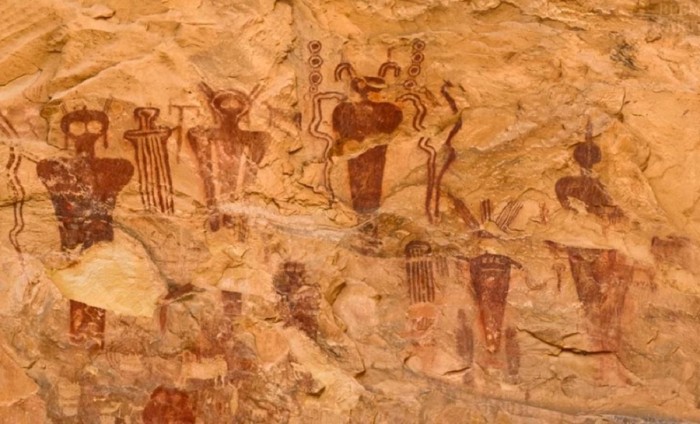
The standard Round Head figure has the following characteristics recorded across multiple sites and multiple researchers’ analyses:
A head that is disproportionately large relative to the body, drawn as a complete circle or oval without internal facial features or with minimal facial indication. The absence of facial features in a style that shows detailed anatomical and behavioral features in animal depictions is the diagnostic anomaly: these are not schematic human figures made simple by artistic convention, because the same period’s animal figures are specific, detailed, and naturalistic.
A body covering that completely encloses the figure without showing anatomical detail. The Round Head figures’ bodies are shown as solid, enclosed forms whose appearance suggests a covering over the body rather than the body itself. The absence of visible hair, skin texture, fingers, and toes, all of which the same period’s art depicts in other human figures, is consistent with a covering rather than a simplified artistic convention.
Antennae or projections from the round head that appear in multiple independent figures across geographically separated sites in the Tassili region. Whether these represent ritual headgear, hair treated in a manner, or something else whose character the available context does not establish, is a question whose answer depends on the interpretation of the full figure rather than the head projection alone.
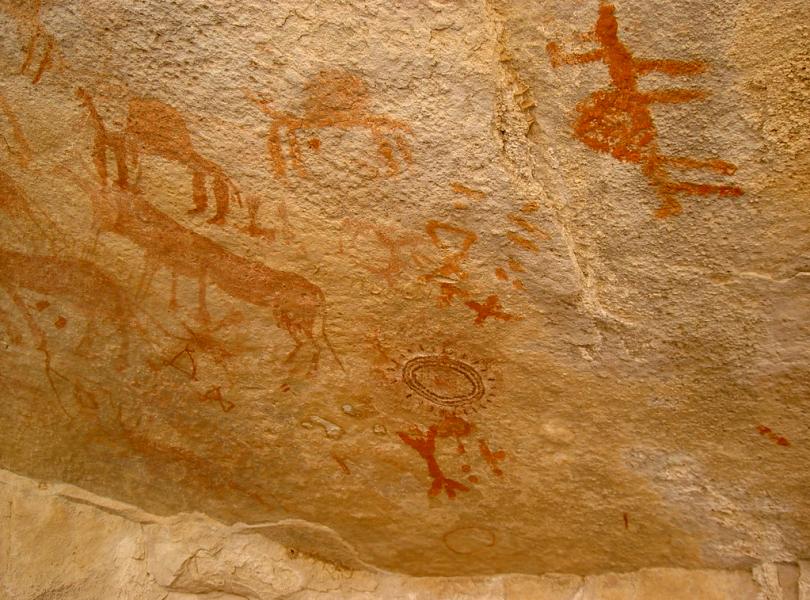
The size. The Great God of Jabbaren is six meters. Other Round Head figures of significant size appear at multiple Tassili sites. Whether the large size represents depictions of large beings or the conventions of sacred art whose important figures are depicted larger than their human companions, is the interpretive question that the comparative size of different figures in the same composition would help to answer.
The egg-shaped objects. Lhote’s description of his first figure holding an egg-shaped object in a raised hand is the detail that most directly connects the Tassili imagery to the broader framework of objects depicted in ancient hands across this library’s Master of Animals and Sumerian Apkallu pieces.
The Wandjina Parallel
Wandjina belief in the Kimberley region of northwest Australia, covered in this library’s dedicated piece, is the most cross-cultural parallel for the Tassili Round Head figures and the one whose geographic and cultural separation makes independent convergence on the same visual vocabulary most significant.
The Wandjina figures share with the Round Head figures: large round heads with no or minimal facial features, specifically including the absence of mouths; full body coverings that show the complete figure without anatomical detail; halo or circular structures surrounding the head; and a continuous practice of maintenance that connects the ancient figures to a living community whose relationship to the depicted beings is ongoing rather than historical.
The geographic separation between the Algerian Sahara and the Australian Kimberley is approximately 12,000 kilometers. The temporal overlap between the Round Head period in the Tassili and the earliest dated Wandjina figures in the Kimberley is within the range of contemporary scholarship’s estimates for both, with some Kimberley figures dated to 17,000 years ago or more and the Round Head period dated to approximately 8,000-6,000 BCE.
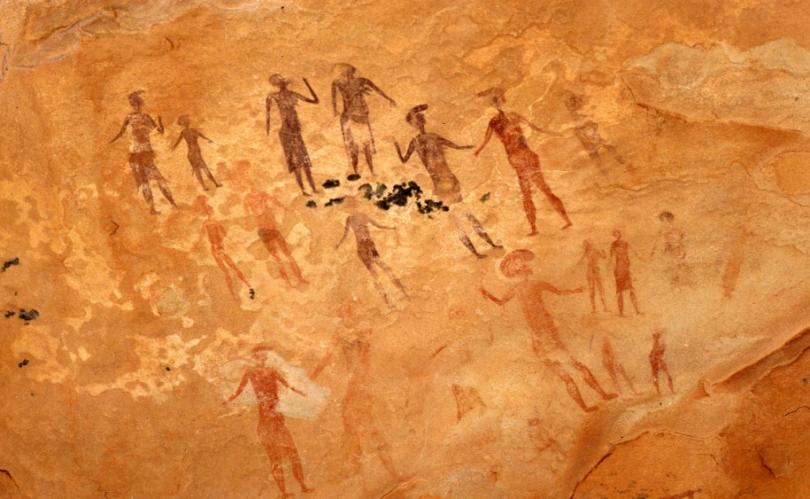
Whether the visual correspondence between the two reflects: independent artistic development of the same visual vocabulary by separate cultures responding to the same class of encountered beings, a genuinely ancient transmission of imagery through routes whose character the conventional prehistoric cultural contact model does not accommodate, or the universal tendency of human artists to represent round-headed supernatural beings in full body coverings as a cross-cultural symbolic convention, is the interpretive question that the visual parallel raises.
The symbolic convention explanation has the weakest support because the convention, if universal, should appear in more places than the clustering in the Tassili and the Kimberley suggests. The full body covering and absent facial features combination is not a generic human-figure simplification: it appears alongside art with sophisticated anatomical depiction capability, making the stylistic choice anomalous rather than conventional.
Lhote’s Documentation and the Academic Debate
Henri Lhote’s expeditions of 1956-1957, which produced the most comprehensive initial documentation of the Tassili art, were not without controversy in the academic archaeological community.
The controversy centered on Lhote’s interpretive framework, his use of popular terminology including Martian God, and his attribution of figures to cultural influences that mainstream archaeologists found overstated. Whether the controversy reflects genuine methodological objections to his documentation, institutional resistance to the alternative interpretations his findings suggested, or a combination of both, is a question that the academic record partially answers: Lhote’s documentation of the figures themselves, their locations, dimensions, and photographic records, is accepted in the mainstream literature even when his interpretations are not.
The mainstream archaeological interpretation of the Round Head figures is that they represent ritual humans wearing ceremonial costumes, possibly including masks, whose design encoded theological or cosmological content that the Round Head period’s cultural context does not allow to fully reconstruct.
This interpretation is not unreasonable. Ritual costume practices in which celebrants wear large round head coverings and full body suits appear in African, American, and Pacific Island cultures. Whether the Tassili Round Head figures are within the known range of ritual costume practice or represent something outside it depends on the details of the figures’ construction that the photographs and field reports document.
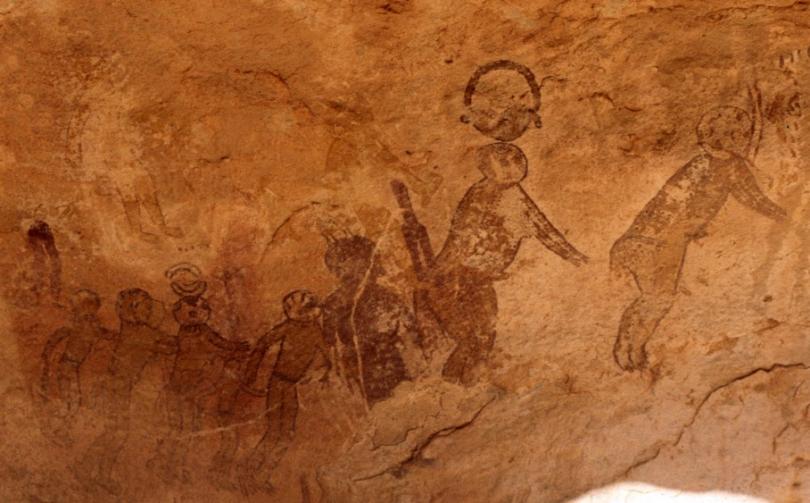
The features most difficult to accommodate in the ritual costume interpretation are the consistent absence of facial features across multiple figures at multiple sites, the size of the largest figures which exceeds the range of human costume, and the body covering that in the most elaborate figures shows no seams, joints, or structural elements consistent with costume construction from available Neolithic materials.
Whether these features represent artistic conventions that lose their literal meaning when interpreted outside their cultural context, or accurately document the visual characteristics of the beings depicted, is the question that the available evidence does not definitively resolve.
What the Tassili Art Establishes
The Tassili n’Ajjer rock art is documented. Its UNESCO designation and its place in the mainstream archaeological literature are established. The Round Head period’s existence and its stylistic characteristics are documented. The figures Lhote photographed and described are preserved in the published record.
Whatever the Round Head artists were depicting, they depicted it consistently across multiple sites and multiple individual artists across a period spanning several thousand years. The consistency is the evidentiary element that distinguishes the Tassili Round Head period from individual artistic innovation or single-site anomaly.
The beings shown have round heads, full body coverings, absent faces, and in some cases objects in raised hands. They appear in postures and sizes that the surrounding art’s human figures do not replicate. They were considered important enough to carve and paint at the largest scale available, with the most elaborate artistic treatment applied to the most anomalous figures.

Henri Lhote called the largest one the Great Martian God.
He meant it as a metaphor.
Whether it was also an accurate description is the question that the Wandjina figures 12,000 kilometers away, showing the same round head and absent face, makes impossible to dismiss with the confidence that the mainstream archaeological literature applies to its ritual costume interpretation.

Both are still active in their own way. The Worrorra, Ngarinyin, and Wunambal peoples of the Kimberley maintain the Wandjina paintings. The Sahara preserves the Round Heads under its desert light.
The round heads are still there. The featureless faces are still watching.
Whatever they documented, both cultures considered it worth maintaining.