



The paintings are maintained.
This is the first fact about the Wandjina practice that distinguishes it from most ancient rock art: the Aboriginal communities of the Kimberley region in northwest Australia continue to repaint the Wandjina figures on a regular cycle, refreshing the images not to create new representations but to maintain the connection with the beings depicted. The repainting is not artistic restoration. It is a religious practice whose function is to keep the Wandjina’s power active in the painted form.
The protocol for repainting appears in ethnographic research: only certain community members are authorized to repaint figures. The repainting must follow the original composition precisely rather than introducing new artistic interpretations. The practice is continuous, documented from the earliest European contact with the Kimberley communities in the nineteenth century through to the present.
What this means for the dating question is significant. The Wandjina figures have been continuously maintained by a practice that stretches back to the original painting, and the original painting’s date is one of the most contested questions in Australian rock art research. The techniques available for dating ancient rock art, optically stimulated luminescence of overlying sediment deposits, uranium-thorium dating of calcite crusts overlying pigment, and accelerator mass spectrometry of carbon-containing organic pigments, have been applied to Kimberley rock art with results whose implications for the conventional history of human artistic development are significant.
Some Kimberley figures have been dated to between 17,000 and 20,000 years ago by these methods. Other researchers have proposed dates exceeding 50,000 years for Kimberley rock art sites based on stratigraphic evidence and indirect dating of overlying deposits. The Aboriginal communities themselves hold that their occupation of the Kimberley region has been continuous for a period that far exceeds the conventional archaeological dating of human arrival in Australia.
Whatever the date of the earliest Wandjina paintings, what they represent is recorded as among the oldest continuously maintained religious practices in human history.
What the Wandjina Look Like
The iconographic program of the Wandjina figures is the most immediately striking element of this practice and the one that has generated the most discussion in the alternative archaeology literature.
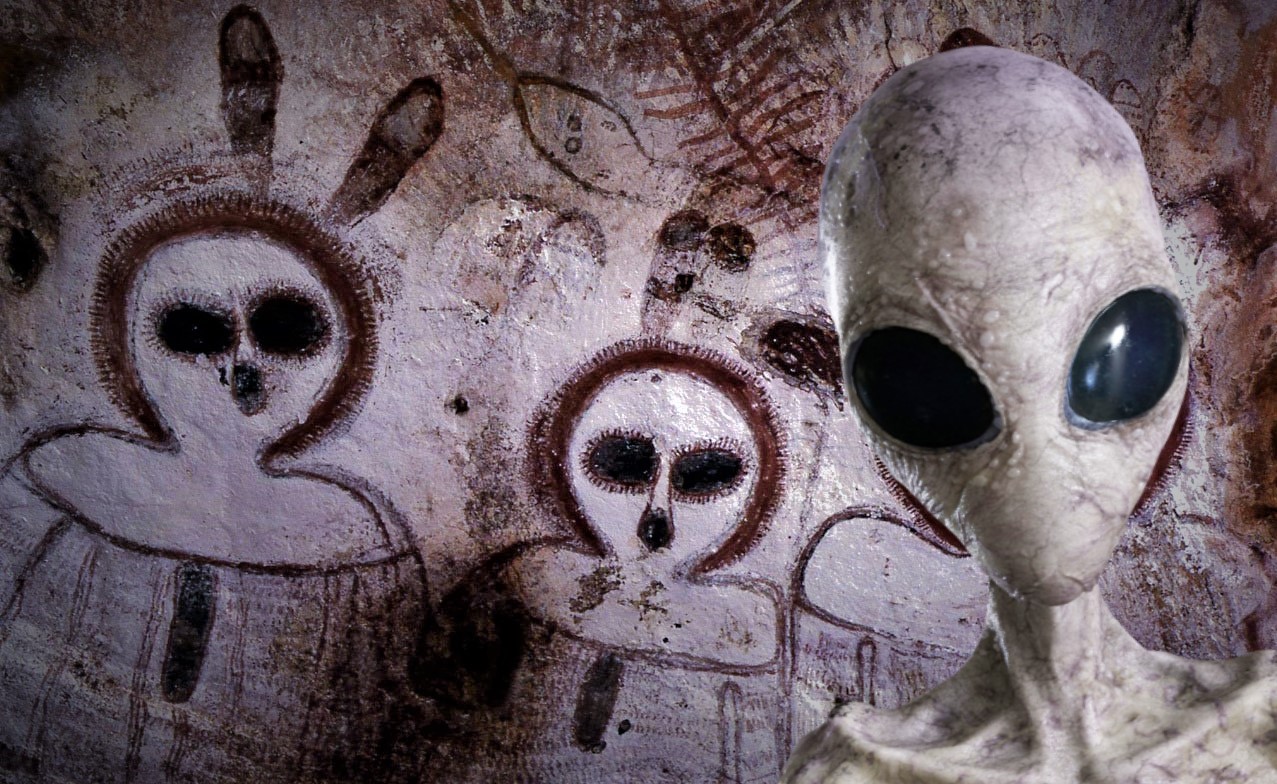
The standard Wandjina figure is painted in white, red, and black. The body is white. The eyes are large, dark, and almond-shaped. The face has no mouth. The head is surrounded by a circular feature described as clouds and lightning but that the visual impression most immediately suggests is either a halo or a helmet with a circular frame. The body is typically shown from the front in a simplified but anatomically representation. The hands are often painted with detailed finger articulation.
Each of these features deserves examination rather than simple observation.
The white skin is the most immediately anomalous feature for a practice developed by communities whose members have dark skin. Aboriginal artistic conventions do not depict human ancestors with white skin in other contexts. The Wandjina’s white skin is an iconographic choice explained as reflecting the Wandjina’s nature as beings of light and cloud rather than as a representation of the beings’ actual appearance in non-artistic contexts.
The large dark eyes without pupils that are disproportionate to the face are among the most striking features of the Wandjinan iconographic program and show the least variation across the recorded examples. The shape and size of the eyes are consistent enough that they appear to be a precisely maintained iconographic requirement rather than a stylistic variation. In the oral accounts, the Wandjina’s eyes are associated with their powers: the ability to see across vast distances and into the dream time simultaneously.
The absent mouth is the feature that the communities themselves most specifically discuss when asked about the Wandjina’s appearance. The explanation passed down is that the Wandjina do not need mouths because they communicate directly with the mind rather than through speech. Whether this reflects a genuine ancient understanding of telepathic communication or is a theological rationalization of an artistic convention is a question that remains unresolved.

The circular head surround is described in what has been passed down as the Wandjina’s cloud, the meteorological presence that accompanies these beings and through which they bring rain and fertility to the land. The visual appearance of this feature in the rock art, a rounded frame enclosing the face rather than a cloud-like diffuse halo, is the element whose resemblance to a helmet or space suit has generated the most discussion in the ancient astronaut literature.
Whether the circular head surround represents a genuine piece of technology, a symbolic representation of the Wandjina’s meteorological association, or a convention of Kimberley artistic practice that developed for aesthetic rather than representational reasons, is a question the available evidence does not definitively resolve.
The Gwion Gwion and the Question of Who Was Here First
Before the Wandjina figures in the Kimberley rock art sequence, there are the Gwion Gwion.
The Gwion Gwion figures, also known as Bradshaw figures after the European settler Joseph Bradshaw who first documented them in 1891, are found across the Kimberley region at sites distinct from the Wandjina sites and represent a completely different artistic style. They are among the most technically sophisticated ancient rock art figures in the world: elongated, precisely proportioned human forms shown in dynamic postures, wearing elaborate headdresses, decorated garments, and in some cases carrying implements, depicted with a naturalism and technical precision that is unusual in ancient art of any period.
The technical quality of the Gwion Gwion figures has been noted by every researcher who has analyzed them. Their proportional accuracy, their rendering of movement, and their detailed depiction of clothing and decoration represent an artistic style of considerable sophistication.
The Aboriginal communities of the Kimberley region, whose Wandjina practice is maintained with community authority and ceremonial protocol, hold an account about the Gwion Gwion: these paintings were not made by Aboriginal people. They were made by a different people who came before. The Gwion Gwion figures are maintained by small birds called Gwion Gwion, whose blood contains the pigment that keeps the paintings fresh.
Whether the Aboriginal communities’ account that the Gwion Gwion were painted by different people represents a genuine historical memory of a different population that occupied the Kimberley before the ancestors of the current communities, or whether it reflects a theological framework that attributes particularly ancient or powerful artworks to supernatural rather than human agency, is a question that the archaeological record of the Kimberley has not definitively resolved.
The dating of the Gwion Gwion figures is contested. The pigments used contain no carbon and cannot be directly radiocarbon dated. The stratigraphic evidence for dating based on overlying deposits has been interpreted as suggesting a minimum age of approximately 17,000 years for some figures, with other evidence suggesting significantly greater antiquity.
If the Gwion Gwion figures predate the Wandjina figures in the same geographic region, and if both represent non-human beings or a different human population rather than the current communities’ direct ancestors, the Kimberley rock art sequence records multiple distinct contacts between the indigenous population of Australia and beings treated in what is passed down as fundamentally different from ordinary human beings.
The Dreamtime Cosmology and Its Astronomical Content
The Dreamtime, the foundational cosmology of Australian Aboriginal peoples across multiple cultural groups, is the most extensively recorded example of a living cosmological belief system whose astronomical content has been studied by researchers in the ethnobotanomy and archaeoastronomy fields.
The Kimberley version of the Dreamtime cosmology preserved through the Wandjina practice describes a universe organized around two serpents: Ungud, the rainbow serpent who represents the Earth and whose body forms the waterways and geographic features of the landscape, and Wallanganda, whose body is the Milky Way.
The cosmological framework in which the Milky Way is a serpent is not unique to the Kimberley. The Mesoamerican feathered serpent belief, specifically Quetzalcoatl for the Aztec and Kukulkan for the Maya, includes associations between the serpent deity and the Milky Way that archaeoastronomers have recorded. Egyptian celestial serpent beliefs, including the serpent on the horizon of the Duat in the Amduat and the serpent forms associated with solar and stellar mythology, show correspondences with the Kimberley’s Wallanganda.

Whether these cosmological correspondences reflect genuine independent astronomical observation of the Milky Way’s serpent-like form by independent cultures, or reflect the transmission of a cosmological framework from a common source whose existence the conventional history of cultural contact does not acknowledge, is the question that the cross-cultural consistency raises.
The Wandjina’s origin in the Milky Way, as recorded in the account provided by Mowanjum artist Mabel King, places them in exactly the cosmological location that the feathered serpent, the Dogon Nommo account, and the Sirius-based beliefs covered in other library pieces also identify as the origin point of the civilizational teachers.
The chief of the Wandjina, Wallungunder, came from the Milky Way specifically to create the Earth and its inhabitants. His subsequent return to the Milky Way to bring other Wandjina to help govern the first humans follows the structural pattern of the Anunnaki account of divine beings organizing a creation project and deploying subordinate beings to manage its implementation.
The Rain Bringers
The function attributed to the Wandjina in what continues to be told is meteorological: they bring rain and control the weather. This function is maintained as an active theological claim rather than a historical narrative: the contemporary communities explain that the Wandjina continue to manage rainfall and that the maintenance of the rock art figures is necessary to sustain this meteorological management.
The meteorological function attributed to beings depicted with technological or non-human iconographic features is a recurring element in the ancient astronaut framework that this library has explored from multiple directions. The Anunnaki’s control of the flood, the Watchers’ teachings about weather manipulation, and the weather-control capabilities attributed to advanced beings in multiple belief systems, all suggest a consistent ancient understanding that beings of superior technology could manage meteorological conditions.
Whether the Wandjina’s meteorological function reflects a genuine technological capability of beings who could influence weather systems, a symbolic framework connecting the divine to the most practically significant environmental variable for a desert-adjacent culture, or a theological rationalization of the meteorological association of the coastal Kimberley region’s seasonal rainfall patterns, is a question the available evidence cannot resolve.
What is recorded is that the communities’ maintenance of the Wandjina paintings is specifically understood as necessary for meteorological stability: when the paintings are not maintained or when unauthorized people interact with them, belief holds that the meteorological balance is disrupted. Whether this belief has ever been tested against meteorological records is not established.
The Moving Lights
The element passed down that connects the Wandjina most directly to the contemporary UAP disclosure framework is the community members’ identification of moving lights observed in the sky as Wandjina activity.
This identification is not a recent development in response to the modern UFO phenomenon: it appears in ethnographic research from the period before the modern UFO narrative became widely known in Australia, and it reflects the continuous association of the Wandjina with the sky as their domain of activity rather than the clouds as a purely symbolic location.
Whether the moving lights that community members identify as Wandjina activity represent the same class of aerial phenomena recorded in the UAP disclosure record, or represent a theological interpretation of natural atmospheric phenomena including ball lightning, aurora, and meteors, or represent genuine observations of the same objects that the global UAP record documents, is a question that connects the Kimberley material to the broader contact literature this library has assembled.
The connection between the Wandjina and the contemporary UAP record is not that the Wandjina are obviously extraterrestrial space travelers in the conventional science fiction sense. It is that a living practice maintained by communities with a well documented, continuous occupation of their territory for tens of thousands of years identifies a class of beings who came from the Milky Way, created humanity, established law and governance, returned to the sky, and continue to be observed in the sky as moving lights. What is claimed here about these beings’ origin, purpose, capabilities, and continued presence is consistent with the contact literature’s recorded accounts from multiple independent cultures.
The rock art is maintained. What is told is still passed down. The moving lights are still observed.
Whatever the Wandjina are, they have been consistently described, consistently depicted, and consistently maintained in the active religious practice of a continuous human community for a period that may exceed sixty thousand years.
Nothing else covered in this library combines this level of antiquity with this level of continuity.