



The deadline has passed. Nothing activated. 3I/ATLAS did not trigger a hidden mechanism beneath Giza, did not alter the pyramids, and did not produce the catastrophe or transformation promised by the online prediction attached to it. What actually happened is more interesting in a different way: the third confirmed interstellar object to pass through our solar system behaved like a natural comet, while astronomers kept watching it, measuring it, and publishing new results long after the prediction’s January deadline had expired.
That distinction matters because 3I/ATLAS was never an ordinary object in the first place. It came from outside the Solar System, survived a journey through interstellar space, passed through our planetary neighborhood on a hyperbolic trajectory, and carried chemical and isotopic signatures unlike those found in known Solar System comets. A June 2026 Nature study found an exceptionally high deuterium abundance and unusual carbon-isotope ratios, consistent with formation at temperatures below roughly 30 kelvin and suggesting that its material may have been assembled as long ago as 12 billion years. In September, a separate Monthly Notices of the Royal Astronomical Society study using the WEAVE instrument found 3I/ATLAS to be unusually rich in nitrogen-bearing volatiles. The science kept getting stranger. The pyramid did not wake up.
The Object Was Real. The Activation Was the Prediction.
3I/ATLAS was discovered on July 1, 2025, by the NASA-funded ATLAS survey in Chile and was quickly identified as only the third confirmed interstellar object ever observed passing through the Solar System, following 1I/’Oumuamua and 2I/Borisov, an interstellar visitor genuinely rare enough that a dedicated audit of every claim made about it is worth keeping current. Its trajectory was not a matter of interpretation: observations established a hyperbolic path through the Solar System, and NASA’s subsequent tracking showed it continuing along that predicted route. Its closest approach to Earth occurred on December 19, 2025, at roughly 1.8 astronomical units, about 270 million kilometres away, far beyond any plausible impact scenario. NASA states that the small trajectory perturbations observed were compatible with normal cometary outgassing rather than evidence of powered manoeuvring.

That chronology is important because it removes one of the easiest ways an extraordinary prediction can survive: ambiguity about what the object actually did. 3I/ATLAS did not disappear into an unknown trajectory after arriving. It was tracked before and after perihelion, observed by spacecraft and ground-based telescopes, and followed as it moved back toward the outer Solar System. NASA’s observational record describes exactly the sort of passage expected from an interstellar comet: approach, solar heating, outgassing, perihelion, fading activity, and eventual departure. The object was extraordinary because it came from somewhere else. Nothing in that trajectory required an activation event at Giza.
What the New Science Actually Found
The most important correction to the original story is that calling 3I/ATLAS an “ordinary ancient comet” undersells what researchers actually found. The object appears natural, but its chemistry is unusual. The Nature team led by Martin Cordiner measured a deuterium-to-hydrogen ratio in its water of about 0.98 percent, more than an order of magnitude above that of known Solar System comets, along with distinctive carbon-isotope ratios. The researchers interpreted those measurements as evidence that the comet formed in an exceptionally cold environment, below roughly 30 K, in a relatively metal-poor setting, and their modelling suggests its material may have been incorporated into a planetary system as long ago as approximately 12 billion years. That is an inference about the age of the material, not a stopwatch reading for the entire comet, but it would make 3I/ATLAS an extraordinary archaeological sample of another planetary system.
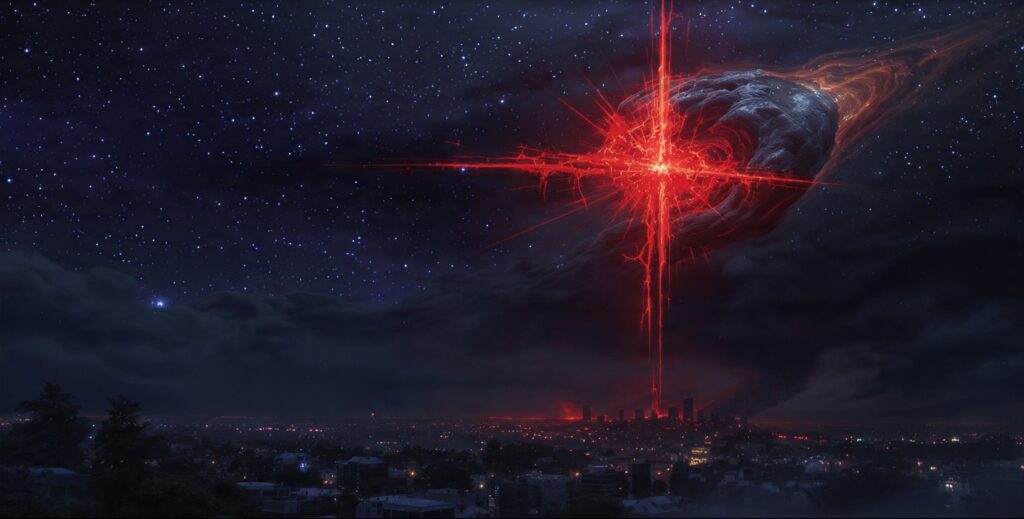
Then came another piece of the puzzle. In September 2026, Léa Ferellec, Cyrielle Opitom and Colin Snodgrass published a Monthly Notices of the Royal Astronomical Society study based on observations from the WEAVE-LIFU instrument on the William Herschel Telescope. They detected several ions in the comet’s plasma tail and found a lower-limit nitrogen-to-carbon-monoxide ratio indicating that 3I/ATLAS is nitrogen-rich compared with Solar System comets. The result is consistent with the broader picture of an object formed in exceptionally cold conditions, where volatile compounds that are easily lost from warmer comet-forming environments could survive. Again, the new result adds chemistry to the mystery. It does not add machinery.
The “Alien” Question Was Tested More Directly Than the Internet Admits
There is also an important difference between asking whether 3I/ATLAS is unusual and claiming that it is artificial. Those are not the same proposition. Scientists have repeatedly looked for evidence that could distinguish an artificial object from a natural interstellar body, including targeted technosignature searches. Breakthrough Listen observed 3I/ATLAS with the 100-metre Green Bank Telescope on December 18, 2025, covering roughly 1–12 GHz, immediately before its closest approach to Earth. The search found no credible narrowband radio technosignatures and reported a nondetection down to approximately the 100-milliwatt level under the observing assumptions. Breakthrough Listen and collaborators also carried out observations with other facilities, likewise reporting no technosignatures localized to the object.

That does not prove that 3I/ATLAS could not possibly be artificial. Science rarely permits that kind of absolute conclusion from a finite observation. It does mean that one of the most straightforward things an artificial interstellar visitor might plausibly do—produce an identifiable radio technosignature—was not observed in the searches conducted. The evidentiary picture therefore remains what it has been: a natural interstellar comet is strongly supported, while an engineered origin remains speculative, the same evidentiary standard applied to broader questions about whether extraterrestrial life has already been found and hidden from the public. Most importantly for the pyramid prediction, neither interpretation supplies evidence that anything beneath Giza was waiting for the comet.
Avi Loeb’s Speculation Is Not the Same Thing as the Activation Story
Avi Loeb belongs in this story, but he needs to be separated from the internet mythology built around him. Loeb is a real astrophysicist who has argued that unusual interstellar objects deserve serious investigation and has entertained the possibility that some could be technological. His willingness to explore that hypothesis is part of a legitimate scientific discussion, even when other researchers disagree with his interpretation. It does not establish that 3I/ATLAS is a spacecraft, and it certainly does not establish that the object was designed to activate an ancient structure on Earth.
This distinction is especially important because speculative arguments often undergo a kind of narrative fusion online. One researcher raises a genuine scientific anomaly. Another person supplies an ancient monument. A third adds a prediction. A fourth adds a supposed medium or leaked document. By the time the story reaches social media, all four pieces can appear to have originated together, even though they came from completely different sources and carry completely different evidentiary weight. The existence of speculation by a credentialed scientist cannot retroactively authenticate a prophecy whose original source cannot be established.
The Missing Source Is the Weakest Link
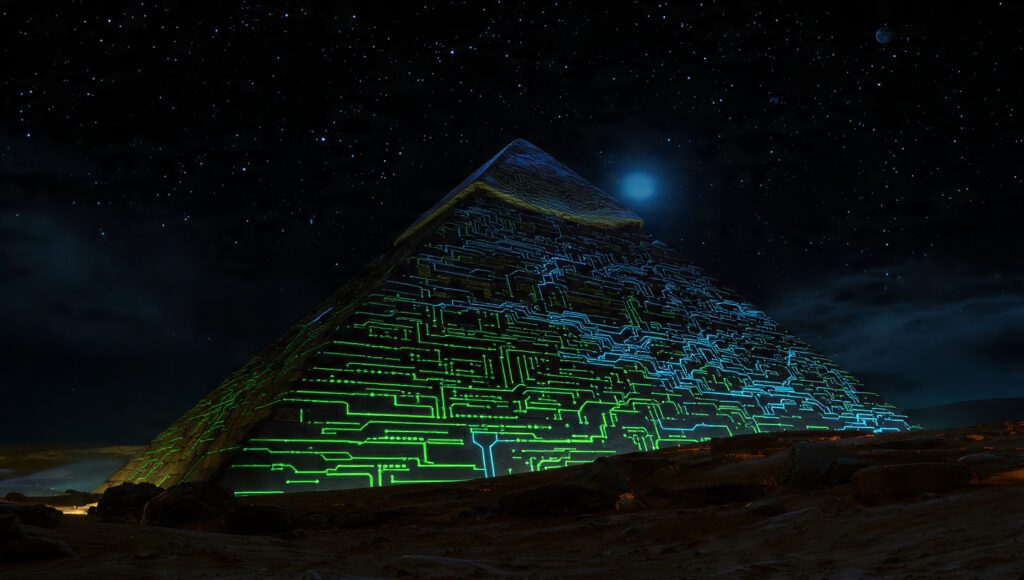
The alleged activation narrative has a much more basic problem than its physics. Its provenance is unclear. The prediction circulated with a specific sequence—3I/ATLAS arriving during a particular period, positioning itself in relation to Earth or Giza, followed by an activation event around the end of January 2026—but a claim this specific should leave a documentary trail if it really existed as a long-standing prediction. There should be an identifiable original speaker, a dated recording, an archived webpage, a publication predating the event, or some other primary evidence showing that the prediction existed before the outcome was known. Without that chain, the story cannot be treated as an established prophecy simply because later posts repeat it.
That is the critical difference between a prediction and a retrospective story. A prediction has a timestamp. A prediction has an author. A prediction has wording that existed before the event. Without those things, a claim can be endlessly rewritten after the fact: the date can move, the mechanism can change, the “activation” can become invisible, or a failed event can be redefined as a success that happened on another level. The only reason this particular claim can be tested cleanly is that it was attached to a deadline. The deadline arrived.
The Deadline Was the Experiment
The prediction did not merely say that something mysterious might happen someday. It attached an expected event to a period that has now passed. January 2026 came and went. The Great Pyramid did not begin broadcasting an anomalous signal. Khafre did not open into a machine. No independently documented energy event occurred at Giza corresponding to the proposed activation. No scientific observatory reported a new physical phenomenon associated with the pyramids. No archaeological authority announced the discovery of a functioning device waiting for an interstellar visitor, the same conclusion reached when examining the earlier, separate claim that the pyramids came back online and nobody filed a report.
None of this requires a scientist to “disprove” the prediction in some grand metaphysical sense. The claim made a concrete forecast about the physical world, and the physical world supplied an outcome. When a dated prediction fails to produce the event it specifies, the rational conclusion is not that the event became invisible. It is that the prediction failed. That is precisely what makes falsifiable claims valuable: they give reality the opportunity to answer back.

The Pyramid Does Not Need the Comet
There is a subtler problem with the entire premise. It assumes that because the pyramids are extraordinary human achievements, they must therefore contain an undiscovered purpose proportionate to their scale. But archaeology has already shown that the Giza pyramids belong to a specific historical landscape of royal tombs, temples, quarrying, labour, logistics, religious practice, and state organization. There are still unanswered questions about construction techniques, internal spaces, chronology, and ritual use. Unanswered questions are not evidence of a dormant machine.
The same principle applies to 3I/ATLAS. Its origin is not completely reconstructed. Its exact journey through the Galaxy is uncertain. Its chemistry is unusual enough to produce new papers months after discovery. Its isotopes preserve information from an environment radically different from our own. Those are genuine unknowns. But an unknown does not become evidence for a particular explanation merely because that explanation is more dramatic.
What Actually Survived the Prediction
Something genuinely extraordinary did survive the failure of the activation story: the comet itself. 3I/ATLAS entered our Solar System carrying material that may have formed billions of years before the Sun existed. Telescopes measured its gases. Spacecraft watched it move. Radio astronomers listened for artificial emissions. Isotopic measurements pushed its possible formation history deep into the early history of the Galaxy. And new spectroscopy is still refining the picture.
That is the part of the story worth keeping.
The pyramid activation had a deadline. The comet had data.
One expired. The other is still teaching us what another planetary system was like before our own existed.
A comparable gap between forecast and outcome shows up in the Peruvian shamans who predicted Nicolas Maduro’s fall, correctly naming the outcome while missing the actual mechanism entirely.