Before Isis there was Hathor.
This is not a minor chronological detail. It is the foundational fact of Egyptian religious history that the popular tradition’s focus on Isis has systematically obscured. The Pyramid Texts, the oldest surviving religious corpus in the world, dated to the Fifth and Sixth Dynasties but preserving material whose origins are recognized as significantly earlier, contain more references to Hathor than to any other goddess. She is present in the earliest attested Egyptian religious material. She is there before the dynastic synthesis, before the Osirian theological framework that became the template for all subsequent Egyptian religion, before the theological infrastructure that produced Isis as her apparent successor.
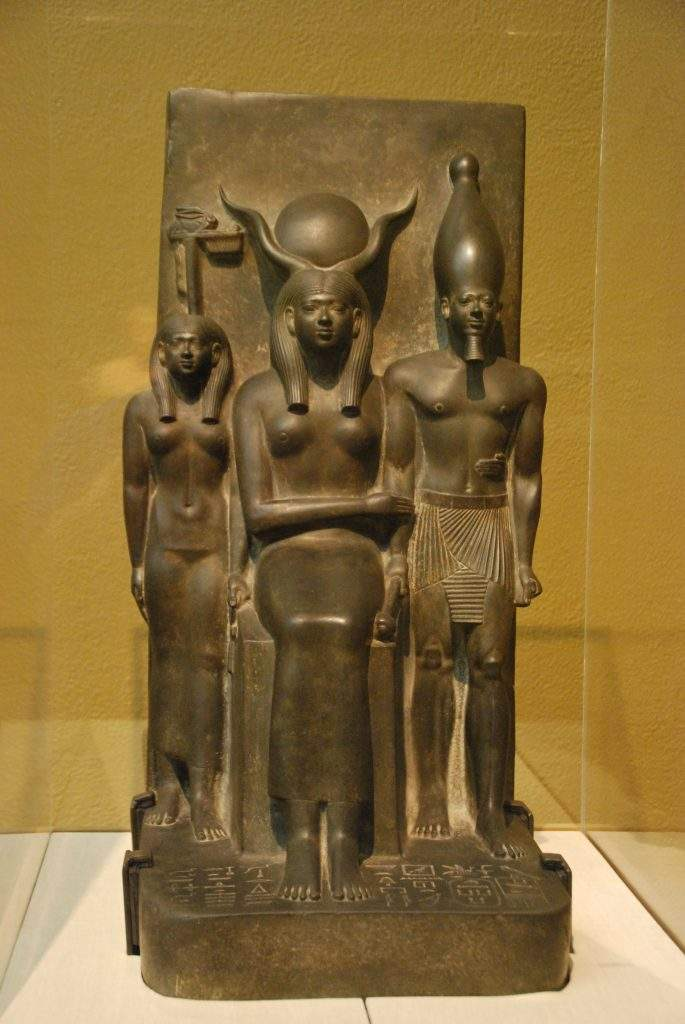
Hathor did not give way to Isis. She was absorbed into her. The crown that Isis wears in the New Kingdom period, the sun disk between cow horns, is Hathor’s crown. The role that Isis occupies as divine mother and protector of the deceased in the later funerary tradition is the role that Hathor occupied before her. The funerary epithet that Isis carries in the later texts, the Great Cow, is borrowed from Hathor’s primary iconographic identity.
The Egyptians understood this relationship. They described Isis as a form of Hathor. The scholarly convention that treats Isis as the primary goddess and Hathor as a secondary figure inverts the actual chronological and theological priority.
Understanding Hathor requires understanding what she actually represented, which requires reading the texts that describe her rather than the texts that describe her successor.
The Milky Way and the Celestial Cow
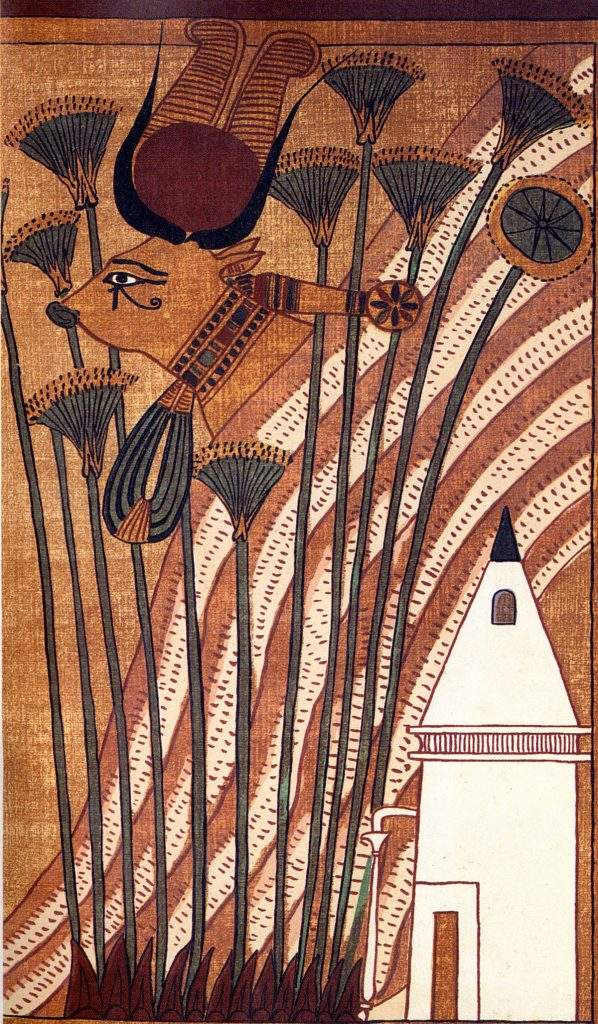
Hathor’s primary cosmic identification is with the Milky Way, the band of the galaxy visible in the night sky whose ancient Egyptian representation was a celestial cow whose milk flows as stars from her body.
The astronomical mythology embedded in this identification is more precise than it appears. The Milky Way in the Egyptian sky appears as a band of light crossing the celestial sphere at an angle to the ecliptic. The celestial cow whose body forms this band is oriented in relationship to the other major astronomical features of the Egyptian sky: her legs stand on the horizon, her belly forms the Milky Way, and the stars she bears represent the full stellar field.
The Nut-Hathor conflation that appears in late Egyptian astronomical texts, in which the celestial cow and the sky goddess Nut are identified as aspects of the same cosmic being, preserves the most complete surviving account of the Egyptian cosmological framework’s astronomical specificity. The circular astronomical chart on the ceiling of the Senenmut tomb, dated to approximately 1473 BCE, and the more elaborate Dendera zodiac, dated to approximately 50 BCE, both represent versions of this astronomical framework whose star positions and planetary cycles encode genuine observational astronomy.
The Dendera zodiac is the most extensively analyzed ancient astronomical artifact in Egyptological scholarship. Its content, the positions of the planets within the zodiac at a historical moment, has been analyzed by multiple researchers and the astronomical date it encodes has been variously calculated as falling in the first century BCE, consistent with the temple’s construction date, or as encoding a significantly earlier date from an original astronomical observation.
Whether the Dendera zodiac preserves an astronomical observation from a period significantly predating its physical installation, encoded in the zodiac’s star positions for preservation in a temple context whose permanence guaranteed its survival, is the Egyptological question that the Zep Tepi framework developed in this library’s Egypt cluster pieces addresses from a different direction.
The Face
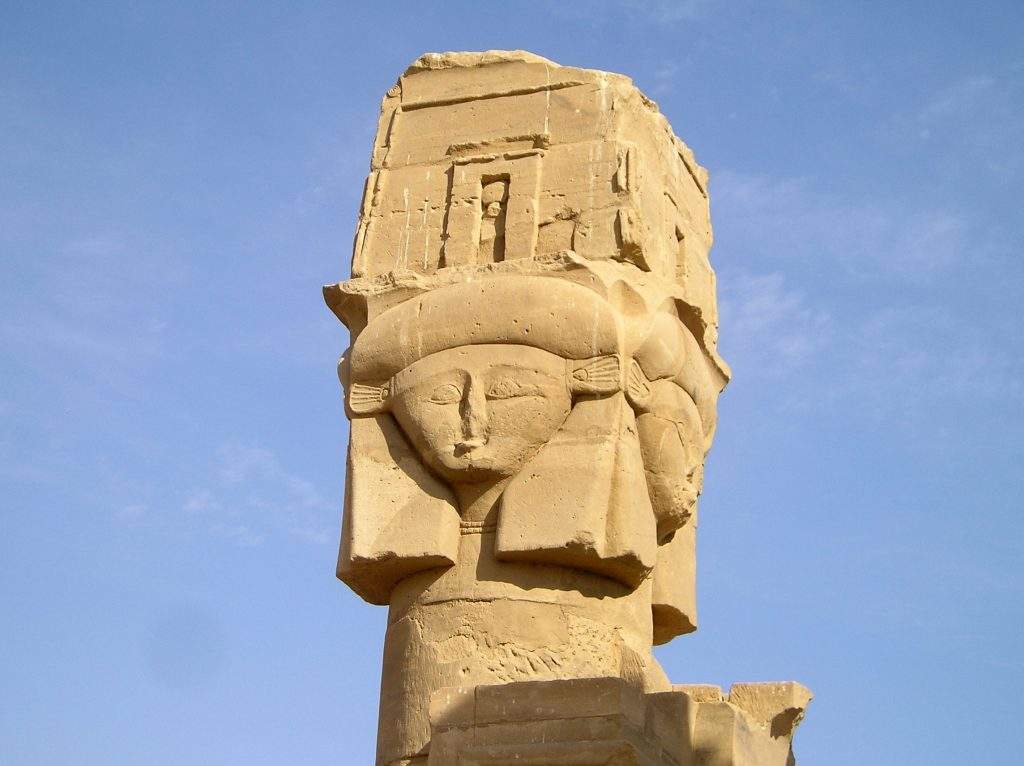
Hathor is depicted in full face.
In the conventions of Egyptian art, whose rules were established in the earliest dynastic period and maintained with remarkable consistency across three thousand years, human beings and gods were depicted in combined frontal and profile views: the face in profile, the eye in frontal orientation, the torso in frontal orientation, the legs in profile. The composite view maximized the informational content of the representation by combining the most characteristic views of each body part.
Full-face depiction in Egyptian art is rare. It is specifically reserved for entities whose direct frontal gaze was considered to have power. The goddess Bes, a protective deity associated with childbirth and domestic protection, is depicted in full face. The Gorgon Medusa in the Greek tradition, whose gaze was specifically described as lethal to those who met it directly, is depicted in full face. The apotropaic use of the full-face depiction across ancient Mediterranean cultures, placing it at doorways, on shields, and on protective amulets, reflects a consistent ancient understanding that the frontal gaze of entities had power to protect or to harm.
Hathor’s full-face depiction is not primarily apotropaic. She is shown in full face in contexts of welcome, of offering, and of direct divine engagement with the viewer. The implication of the full-face depiction in her context is not warning but invitation: her gaze is one that can be met without destruction, because she has been transformed from the destroying Sekhmet into the protecting Hathor.
The iconographic relationship between the full-face Hathor and the full-face Sekhmet, the same face in different states, is one of the most technically sophisticated theological statements in any ancient religious art tradition. The same being, the same gaze, is either destroying or protecting depending on its state. The full-face convention makes this identity explicit in visual terms.
Sekhmet and the Transformation
The myth of Sekhmet’s transformation into Hathor is the most explicitly recorded account of a deity’s destructive phase being resolved through a consciousness-altering substance in any ancient tradition.
The narrative, recorded in multiple versions across Egyptian textual and artistic sources including the Destruction of Mankind text in the Book of the Heavenly Cow, is this: Ra, the sun god, decides that humanity has become too corrupt and sends Hathor in her Sekhmet aspect to destroy it. Sekhmet’s destruction is so effective and so uncontrollable that she threatens to exterminate humanity completely. Ra reconsiders and decides to stop her. The method he uses is not force but intoxication: a large quantity of beer is dyed red to resemble blood and poured across the fields. Sekhmet drinks it, becomes intoxicated, loses her destructive drive, and awakens as Hathor the benevolent.
The mechanism of transformation, intoxication producing a state change in a being of divine power, is worth examining for what it implies about the ancient Egyptian understanding of consciousness and its relationship to behavior. Sekhmet’s destructiveness is not evil in the generic sense: it is the expression of her nature in a state. The transformation to Hathor is not a moral conversion: it is a state change in the same being. The Sekhmet state and the Hathor state are both authentic expressions of the same divine nature, what determines which state manifests is the being’s current consciousness condition.
This is a subtle and sophisticated psychological theology whose implications for the human condition are not developed in the surviving texts but are implied by the parallel between the divine transformation and the human use of the same intoxicants in the same goddess’s ritual context.
The annual Festival of Drunkenness, celebrated at Hathor’s temples and recorded in the Dendera Temple’s ritual inscriptions, was a religious observance in which participants consumed significant quantities of beer and wine in a ritual context explicitly connected to the Sekhmet-Hathor transformation myth. The festival’s theological framing was that the human participants’ intoxicated state replicated the divine transformation, moving the participants from their ordinary consciousness, associated with the Sekhmet aspect, into the expanded consciousness of the Hathor aspect.
Whether this ritual framing reflects a genuine understanding of intoxication’s effects on consciousness, including the well established loosening of the ego boundaries and the enhanced capacity for positive social engagement that modern neuroscience attributes to alcohol’s GABA-A receptor effects, or reflects purely symbolic theology, is a question whose answer the ritual’s recorded effects in the participant communities would clarify.
The ritual is recorded as having produced states that participants described as genuine transformation rather than simply pleasant intoxication. Whether this reflects a pharmaceutical effect of the beer used, which is recorded as including botanical additives whose psychoactive properties are under investigation in the ethnobotanical literature, or a genuine consciousness state accessed through the ritual’s combined pharmacological and psychological elements, is a question the available evidence cannot definitively resolve.
The Sistrum and Its Properties
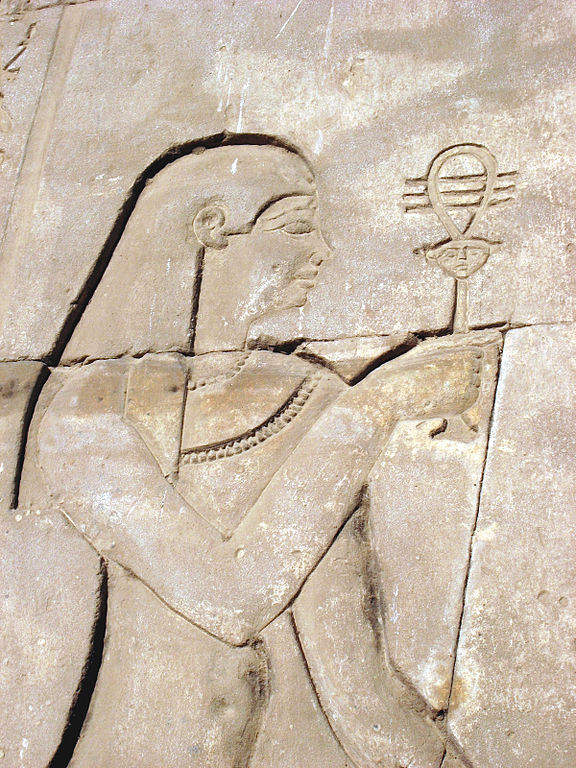
The sistrum, the ritual instrument specifically associated with Hathor, is one of the most specifically recorded ritual acoustic instruments in any ancient tradition, and its physical and acoustic properties deserve examination that the popular mythology survey format does not provide.
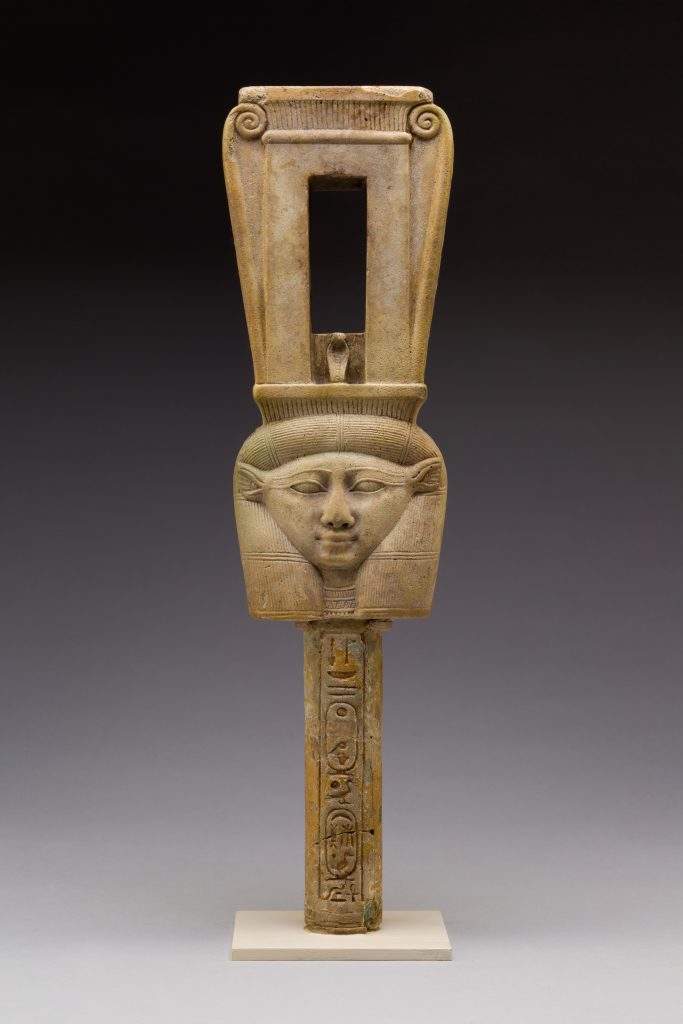
The sistrum was a rattle-like instrument consisting of a handle and a frame through which metal rods were strung with loose rings or plates that rattled when the instrument was shaken. The sound produced, a high-frequency metallic rattling in the range of several thousand hertz, appears in the textual tradition as having effects: banishing evil, protecting spaces, and facilitating the access of divine presence.
Whether these described effects reflect a genuine acoustic phenomenon, an interaction between the high-frequency metallic sound and states of consciousness or subtle energy conditions, or purely symbolic attribution, is a question that the acoustic properties of the sistrum’s sound range make worth examining.
The human auditory system’s sensitivity to high-frequency transient sounds in the range produced by the sistrum appears in neuroscience: these frequencies activate the superior olivary complex and the inferior colliculus with patterns of neural response that differ from responses to low-frequency sustained sounds. Whether the ancient Egyptian priests who developed the sistrum as a ritual instrument understood this neurological specificity through empirical observation of the instrument’s effects on human states of consciousness, or attributed its effects to supernatural agency without understanding the mechanism, is a question the available evidence does not answer.
The association of the sistrum with Hathor rather than with other deities is itself informative: Hathor is the deity whose primary domain includes transformation of consciousness through music, dance, intoxication, and ecstatic states. The sistrum as her primary instrument is consistent with a tradition that understood the instrument’s effects on consciousness and embedded them in a theological framework whose purpose was to make those effects reliably accessible in ritual contexts.
The Dendera Temple and Its Anomalies
The Hathor Temple at Dendera is the best-preserved temple complex in Egypt and one of the few that retains significant amounts of its original polychrome decoration. It was constructed primarily in the Ptolemaic period, between approximately 54 BCE and 20 CE, but its foundations incorporate earlier structures whose origins appear in inscriptions claiming connections to the First Time period.
The temple’s astronomical ceiling is the most complete surviving ancient Egyptian astronomical document. The inner hypostyle hall’s ceiling contains the circular Dendera zodiac, now in the Louvre after its removal in 1820, whose content has been analyzed extensively in the Egyptological and archaeoastronomical literature.
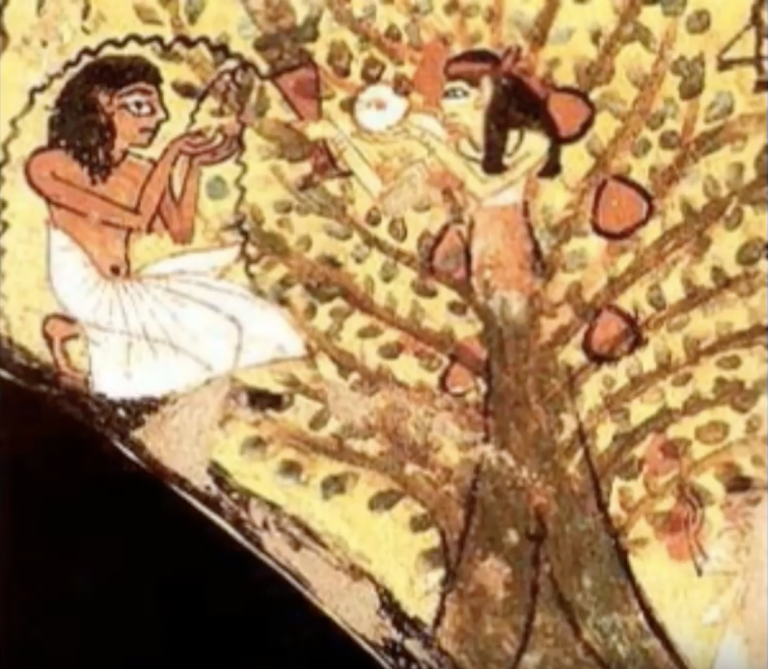
The Dendera Temple is also the site of the reliefs that the alternative archaeology tradition has interpreted as depicting electrical devices. The reliefs in question are located in subterranean crypts beneath the main temple structure and show elongated bulb-like forms from which serpents emerge. The alternative interpretation proposes that these forms represent Crookes tube-like electrical discharge tubes powered by a current transmitted through a cable supported on a djed pillar, with the serpent representing the electrical filament or plasma discharge within the tube.
The mainstream Egyptological interpretation identifies the forms as lotuses from which protective serpents emerge, consistent with the temple’s standard decorative program of protective natural forms.
Whether the alternative interpretation is correct depends on whether the technical details of the depiction, the cable-like form connecting the base to the bulb, the serpent’s position within the translucent bulb form rather than emerging from it, and the proportions that differ from standard lotus-serpent representations, are accurately described in the alternative literature.
The Electricity in Ancient Egypt piece in this library develops this question. The relevance to the Hathor piece is that the Dendera crypts’ reliefs are in Hathor’s temple, and that if they do depict electrical devices, the theological context of Hathor as the goddess of light, transformation, and the solar disk between cow horns provides the framework within which electrical phenomena would have been theologically classified.
Hathor’s epithet, Mistress of Heaven and Life, combined with her visual representation as the bearer of the sun disk, connects her to the solar and luminous aspects of the divine in a way that makes the presence of light-producing devices in her temple theologically coherent regardless of what those devices were physically.
Hathor’s Column
The First Goddess
The Egyptians said that all later goddesses were forms of Hathor. They said she was the goddess from whom all others came. They said she was the daughter and mother and wife of Ra simultaneously, a theological formula that encodes a relationship to the solar divine principle that transcends ordinary temporal and relational categories.
She predated the dynastic synthesis. She was there when the first religious texts were composed. Her identification with the Milky Way places her at the cosmological foundation of the Egyptian astronomical tradition. Her identification with Venus connects her to the planetary system’s most visible body after the Sun and Moon. Her full-face depiction acknowledges the power of her gaze in a visual tradition that otherwise consistently avoided it.
The transformation from Sekhmet to Hathor through the mechanism of intoxicant-induced consciousness change is the most direct ancient Egyptian statement about the relationship between consciousness state and the expression of divine nature. The same being is destroyer or protector depending on its current consciousness state. The same intoxicant that resolves the divine destructive state is used ritually to access the divine protective state in human practitioners.
The sistrum produces the acoustic frequencies that the tradition associated with the resolution of harmful states and the access of divine presence. The temple at Dendera that preserves the most complete version of her astronomical tradition also contains the reliefs that have been proposed as depicting the technology that her tradition used to produce light.
Whether Hathor was a genuine cosmic being whose properties were accurately recorded by the Egyptian priests who transmitted her tradition, or was a human theological construction whose characteristics reflect a sophisticated ancient understanding of psychology, cosmology, and acoustics without implying any non-human reality, is the question that the Egypt cluster’s accumulated evidence makes impossible to answer simply in either direction.
She was there before the other gods. She survived the later gods who absorbed her attributes and her iconography. She is still depicted on the walls of Dendera with her face intact, despite the early Christians’ recorded attempts to erase her.
The full face. The direct gaze. The cow horns. The sun disk.
The first goddess. Still watching.