



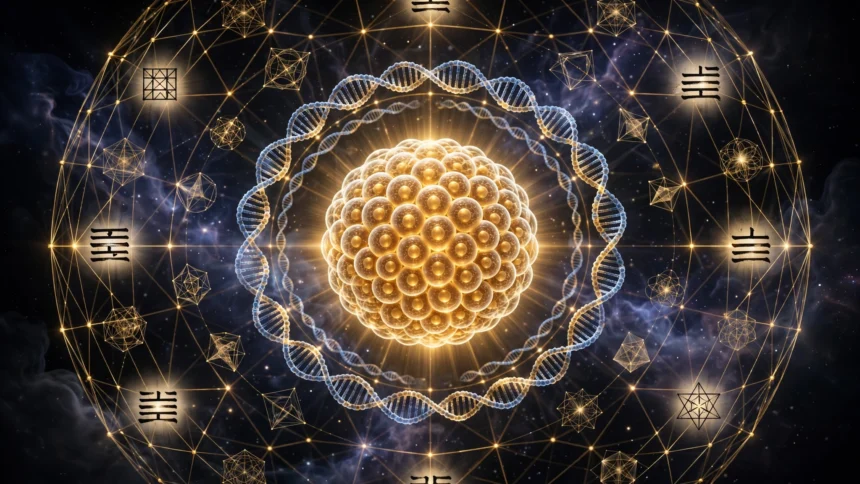
The number 64 shows up in your DNA. It shows up in a three-thousand-year-old Chinese divination system. It shows up in the exact moment a fertilized human egg stops being one thing and starts becoming two. Nobody planned this. The people who catalogued the genetic code in the 1960s had never read the I Ching. The people who wrote the I Ching had no concept of DNA. And the embryologists counting cell divisions under a microscope were not thinking about either one.
And yet, here it is, in four unconnected fields, at four different moments in human history: 64.
What Actually Landed on 64
Start with the part that is not in dispute. The genetic code is written in triplets. Every group of three nucleotide bases, drawn from an alphabet of four, A, T (or U in RNA), G, and C, forms one codon. Four options, three positions: four times four times four. Sixty-four possible codons. Only twenty amino acids get built from them, plus three stop signals, which means the code is heavily redundant, several different codons can specify the same amino acid, but the total number of possible three-letter combinations is fixed and exact. Sixty-four. This is not interpretation. It is arithmetic, confirmed in every genetics textbook and every sequencing machine on Earth.
Now the I Ching. The oldest core of the text, the hexagram sequence itself, is built from broken and unbroken lines stacked six high. Each line has two possible states, so each hexagram is a six-digit binary number in disguise. Two options, six positions: two times itself six times over. Sixty-four possible hexagrams, and the text that grew up around them, composed and recomposed across centuries of the Zhou dynasty and after, assigns each one a name, an image, and a body of commentary on how change moves through a situation.
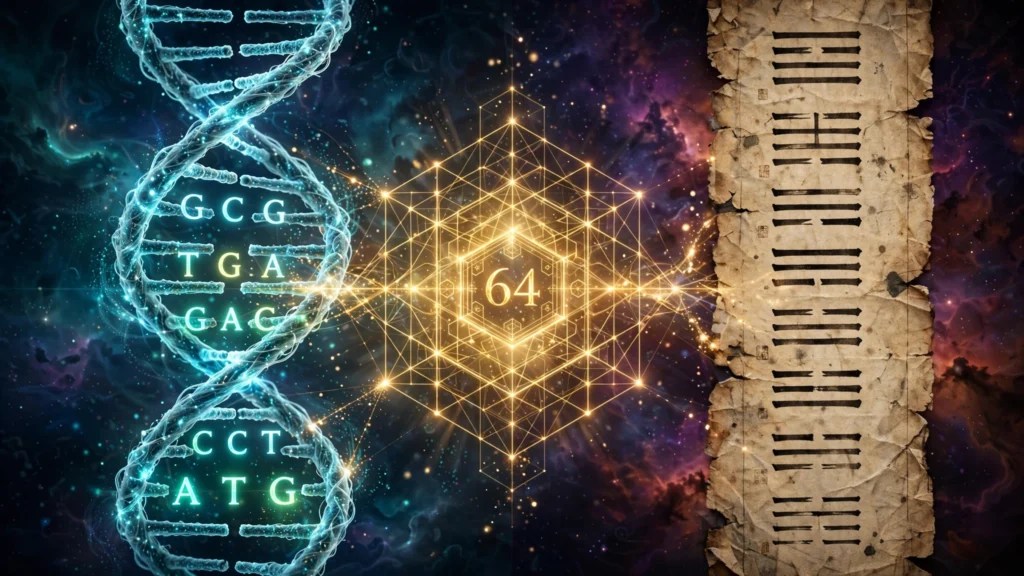
Two systems. Two totals of 64. And here is where a lot of writing on this subject goes wrong, so it is worth being exact about it before going any further: these are not the same mathematical structure arriving at the same place by coincidence. They are two different structures that happen to produce the same number. The genetic code is four choices repeated three times. The I Ching is two choices repeated six times. Four cubed and two to the sixth power both equal 64, but a codon and a hexagram are not built the same way, and treating them as identical twins because they share a headcount would be sloppy in exactly the way this convergence does not need to be sloppy. The real story is stranger than that, not weaker: two unrelated counting systems, invented by nobody who could have known about the other, independently arrive at the identical total through entirely different arithmetic. That is the actual coincidence, and it does not need embellishment.
The Man Who Tried to Connect Them
In 1973, a German physician named Martin Schönberger published a book called, in its English translation, The I Ching and the Genetic Code: The Hidden Key to Life. Schönberger had noticed the matching count and gone further, attempting to build a systematic one-to-one correspondence between specific hexagrams and specific codons, assigning the four DNA bases to the four classical elements the I Ching’s imagery draws on and mapping the yin-yang line structure onto the purine-pyrimidine chemistry of the bases themselves.
This needs to be described accurately rather than inflated. Schönberger’s book is real. It was really published in 1973, it really exists in English translation, and it really does lay out tables attempting to match specific hexagrams to specific codons position by position. It is not, however, a peer-reviewed scientific finding, and no serious molecular biology journal has ever validated the specific correspondences he proposed. The book’s own marketing describes it as “a link between science and spirituality,” which is an honest description and also a way of saying it was never trying to clear the bar of experimental biology. What Schönberger noticed, that both systems land on 64, is arithmetically true. What he built on top of that noticing, a detailed symbolic translation table between an ancient Chinese oracle and a twentieth-century biochemical code, is speculative construction, not confirmed science, and the two should not be filed under the same heading.
The Sixty-Four Cells That Changed Everything
Here is the piece of this story that does not need any hedging at all, because it comes straight out of mainstream developmental biology with no symbolic interpretation required.
A fertilized egg divides. One cell becomes two, two become four, four become eight, and so on, roughly doubling with each division in the earliest rounds of cleavage. By the time a mammalian embryo, human included, reaches approximately the 64-cell stage, something happens that had not happened at any earlier stage: the cells stop being identical. Up to this point, every cell in the ball is essentially interchangeable, any one of them could in principle become any part of the developing organism. At the 64-cell stage, the outer layer of cells and the inner cluster of cells commit to two separate fates. The outer cells become the trophoblast, the tissue that will form the placenta and support the pregnancy from the outside. The inner cluster becomes the inner cell mass, the cells that will actually become the embryo itself. Developmental biologists describe this specifically as the first differentiation event in mammalian development, the precise moment a formerly undifferentiated cluster of cells splits into two distinct developmental destinies. It happens at 64 cells. Not at 32. Not at 128. At 64.
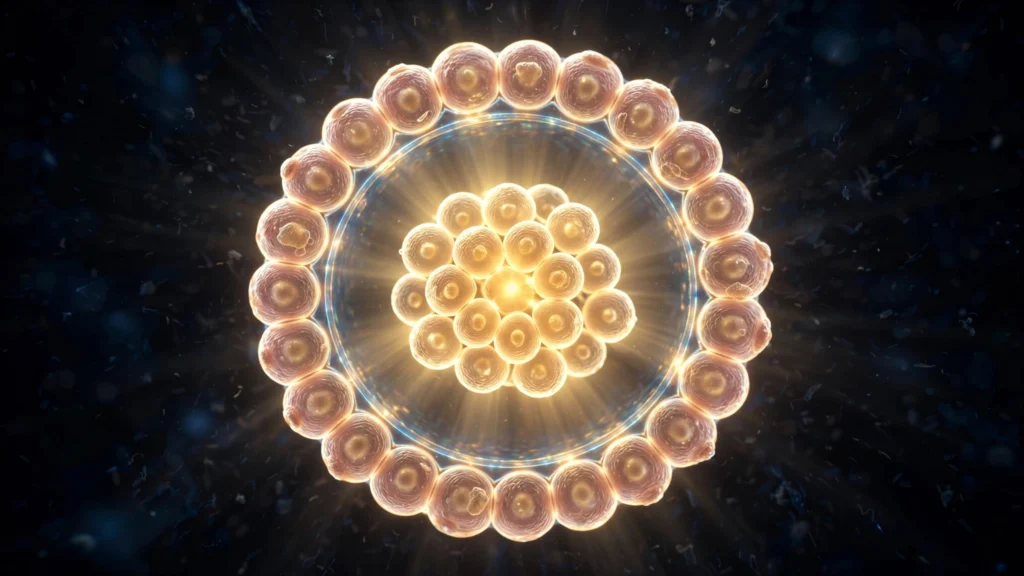
Nobody chose that number for symbolic reasons. It falls out of the biology, a consequence of how many division cycles it takes a mammalian embryo to reach the point where its cells have enough positional information, inside versus outside the cluster, to start reading their surroundings differently. But it means that the exact number stamped into the genetic code as its total combinatorial capacity is also the exact number of cells present at the exact moment that code’s products first split into two different jobs. Whatever else is uncertain in this piece, that correspondence is not speculative. It is in the developmental biology literature, plainly stated, waiting for anyone who wants to notice it.
The Sixty-Four Arts
Move to an entirely different culture and a different kind of number. Classical Sanskrit literature, most famously the commentary corpus built up around the Kama Sutra but appearing in other texts as well, describes a curriculum of chatuḥṣaṣṭi kalā, the 64 arts, a body of accomplishments a cultivated person in ancient and classical India was expected to master. The list varies somewhat between sources, running from music, dance, and poetry through perfumery, cooking, gambling strategy, and the interpretation of gems, but the number attached to the curriculum is remarkably stable across the textual record: 64.
This one sits differently from the others. There is no combinatorial arithmetic behind it, nothing equivalent to four bases in three positions or two states in six positions producing the total by necessity. It is a curated cultural list, and 64 was the number this body of texts settled on and preserved across centuries of commentary and revision. That makes it a weaker data point than the codons, the hexagrams, or the embryonic cell count, all three of which are numbers a calculator would produce whether or not any human had ever noticed them. The 64 arts are a human curatorial choice, not a mathematical inevitability. It belongs in this piece as an interesting cultural echo of the same number recurring across a civilization with no contact with the others discussed here, not as evidence of the same kind or strength as the biology.
The Weakest Link, Named Honestly
Anyone researching this convergence will eventually run into the claim that the Flower of Life, the geometric pattern of overlapping circles found in sacred sites and popular sacred-geometry literature, encodes its own 64-based structure. This claim deserves the most caution of everything in this piece, and it would be dishonest to present it with the same weight as the codons or the embryology.
The specific “64” attached to the Flower of Life traces to one identifiable modern source: Drunvalo Melchizedek’s 1999 book The Ancient Secret of the Flower of Life, in which he describes superimposing a 64-square grid, borrowed from his own reading of Leonardo da Vinci’s proportional drawings, onto diagrams of early embryonic cell division and onto his own sacred-geometry constructions. This is not an independently verifiable property of the Flower of Life symbol the way a codon count is an independently verifiable property of the genetic code. It is one modern teacher’s personal construction, built inside an explicitly spiritual framework that also includes material on Atlantis, Lemuria, and extraterrestrial visitors, offered without external mathematical verification and not treated as an established finding by anyone working in geometry outside that specific teaching lineage. It belongs in a complete account of where the number 64 gets invoked. It does not belong at the same evidentiary table as DNA and cell biology, and stating that plainly is more useful to a reader than pretending otherwise.
What Actually Holds Up
Strip out the shaky pieces and what remains is still genuinely interesting. Two independently invented human systems, a Bronze Age Chinese divination text and a twentieth-century decoding of molecular biology, land on the identical total of 64 through completely different arithmetic, four things taken three at a time against two things taken six at a time. Neither system’s inventors could have known about the other. That is a real convergence, not a manufactured one, and it does not need the mathematics fudged to be worth noticing.
Layered onto that is a separate and independently solid fact: the number 64 is not just present somewhere in the genetic code’s combinatorics, it is also the specific number of cells present at the exact developmental moment when a mammalian embryo’s cells first split into two different futures. The code’s total capacity and the embryo’s differentiation threshold share a number that neither field borrowed from the other. One is a fact about chemistry. One is a fact about cell biology. They were established by different researchers, in different decades, using different methods, and they agree on 64 without either discipline needing the other to be true.
What that agreement means is a genuinely open question, and it is worth resisting the pull toward a tidy answer. It could be coincidence, the kind of thing that looks meaningful only because humans are built to notice patterns and stop looking once we find one we like. It could be that 64 is simply a number combinatorics produces often enough, at these particular small scales of four and two, that its recurrence is less remarkable than it first appears. Or it could be pointing at something about how information organizes itself at the boundary between chemistry and biology that neither the I Ching’s authors nor Schönberger nor the developmental biologists who counted those embryonic cells had the framework to fully name. The honest position is that the number is real in every case where the underlying claim is real, the correspondence between the two combinatorial systems is a fact worth sitting with, and the meaning of that fact is not yet settled by anyone, in any field, working from any framework.
The DNA in every cell of your body is running a 64-option code. Somewhere around the 64-cell mark, long before you had a face or a name, your own cells split into the ones that would become you and the ones that would only ever support you from the outside. An old book of hexagrams landed on the same number without any way of knowing either of those things. That much is not speculation. What to make of it is still an open question, and it deserves to stay open rather than be closed prematurely in either direction.