



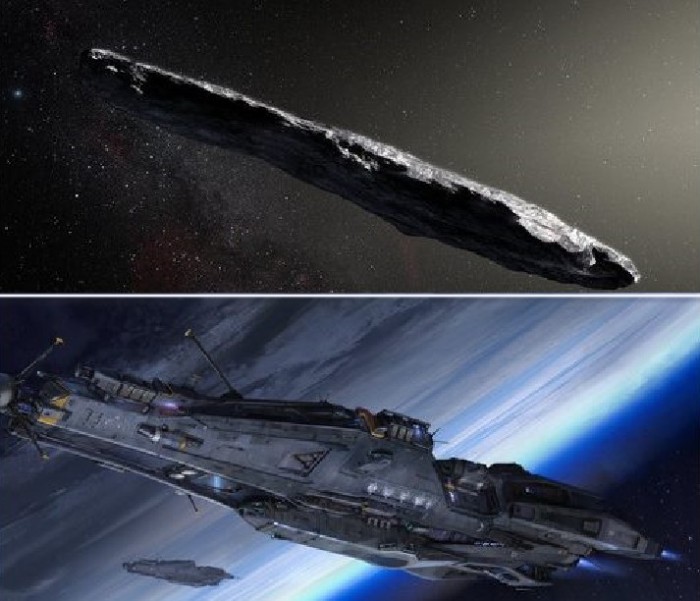
The object arrived from the direction of Lyra.
On October 19, 2017, the Pan-STARRS1 survey telescope at Haleakalā Observatory on Maui, Hawaii, detected a point of light moving on a trajectory that immediately distinguished it from anything in the known solar system catalog. Its path was hyperbolic: it had not arrived from the asteroid belt, the Kuiper belt, or the Oort cloud, but from interstellar space, traveling at 87.3 kilometers per second relative to the Sun, far too fast to be gravitationally bound to the solar system.
Astronomer Robert Weryk, who identified the object in the survey data, designated it 1I/2017 U1 in the catalog, the 1I indicating it as the first confirmed interstellar object detected passing through the solar system. The Hawaiian name ‘Oumuamua, meaning roughly the first messenger arriving from far away, was given by the Haleakalā team.
In the weeks that followed, as every available telescope tracked the object’s departure from the inner solar system, the anomalies accumulated.
The shape was wrong for a natural asteroid. ‘Oumuamua’s brightness varied dramatically as it rotated with a period of approximately 7.3 hours, dimming and brightening by a factor of approximately 10 as different faces and edges oriented toward Earth. The light curve implied an extreme aspect ratio, estimated between 5:1 and 10:1 length to width, making the object shaped like a cigar, a pancake, or some other elongated form unlike the approximately equidimensional shapes of typical asteroids and comet nuclei.
The trajectory was wrong for a natural comet. When the observations were precise enough to detect any deviation from a purely gravitational path, they found one. ‘Oumuamua was accelerating slightly beyond what the Sun’s gravity, the planets’ gravitational perturbations, and the pressure of sunlight could account for. Something was pushing it.
And no coma appeared. The standard explanation for this kind of non-gravitational acceleration in small solar system objects is cometary outgassing: volatile ices heated by the Sun release gas and dust that act as a weak rocket exhaust, modifying the object’s trajectory. But ‘Oumuamua showed no detectable coma, no dust trail, no spectroscopic signature of outgassing, in the observations of any telescope trained on it.
The Spitzer Space Telescope’s upper limits on ‘Oumuamua’s thermal emission established that if it were outgassing, the outgassing material would need to be invisible to every observational technique applied, which is problematic for standard volatile ices.
Whatever was pushing ‘Oumuamua was doing so without leaving the standard signatures of the only known natural mechanism that produces this kind of acceleration in small solar system objects.
The Non-Gravitational Acceleration Paper
The scientific record of ‘Oumuamua’s anomalous acceleration is the 2018 paper by Marco Micheli and twenty-one co-authors published in Nature under the title Non-gravitational acceleration in the trajectory of 1I/2017 U1 (‘Oumuamua). The paper’s author list includes astronomers from multiple institutions including ESA’s Space Situational Awareness office, the Harvard-Smithsonian Center for Astrophysics, the European Southern Observatory, and multiple university departments.

The paper’s methodology used the available observational data from multiple telescope systems to fit ‘Oumuamua’s trajectory against the standard gravitational model incorporating all known solar system perturbations, solar radiation pressure, and the Yarkovsky effect, the small force produced by uneven thermal emission from a rotating body. None of these standard effects could account for the observed trajectory deviation.
The residual non-gravitational acceleration was parameterized as a force decreasing with the square of distance from the Sun, which is the distance dependence that would be produced by either cometary outgassing driven by solar heating or by radiation pressure on a large thin surface.
The paper’s conclusion was appropriately scientific rather than interpretive: ‘Oumuamua has experienced a non-gravitational acceleration that is inconsistent with any known solar system body and whose cause requires additional investigation. The standard cometary outgassing explanation was noted as problematic given the absence of detected outgassing, but was not formally ruled out in the paper, which is the appropriate scientific posture when a mechanism cannot be confirmed but also cannot be definitively excluded.
Loeb and Bialy’s Light Sail Hypothesis
On November 12, 2018, Shmuel Bialy, a postdoctoral researcher at the Harvard-Smithsonian Center for Astrophysics, and Abraham Loeb, Chair of the Harvard Astronomy Department, published a paper in The Astrophysical Journal Letters titled Could Solar Radiation Pressure Explain ‘Oumuamua’s Peculiar Acceleration?
Their argument was direct and quantitative: if ‘Oumuamua were a thin sheet of material with an area-to-mass ratio approximately 20 times larger than any known natural solar system body, solar radiation pressure alone could account for the observed non-gravitational acceleration without requiring any outgassing or additional thrust mechanism.
The area-to-mass ratio required corresponds to a sheet approximately one millimeter in thickness covering an area comparable to a city block. Whether such an object could exist naturally, as a thin shard of rock or metal produced by some extraordinary natural process, or requires artificial manufacture, is the question that the paper addressed.
Bialy and Loeb argued that while natural production of such a thin, large sheet is not obviously impossible, it faces physical challenges. The strength required to survive the gravitational, tidal, and thermal stresses of interstellar travel at the distances and durations involved is difficult to achieve with natural rocky or metallic materials at the required thinness. A manufactured light sail of the type that current human engineering programs including Breakthrough Starshot are attempting to develop would have the appropriate area-to-mass ratio and the material properties required to survive interstellar travel.

The paper’s conclusion included the statement that ‘Oumuamua may be a fully operational probe sent intentionally to Earth’s vicinity by an alien civilization, while noting that more conventional explanations should be preferred if they can be shown to work.
The immediate institutional response was significant: the paper was published in a peer-reviewed journal of the American Astronomical Society. Its reception in the astronomy community ranged from serious engagement to dismissal, with the dismissals often focusing on the low prior probability of artificial origin rather than on faults in the paper’s calculations.
The Alternative Hypotheses and Their Problems
The astronomy community’s response to Loeb’s light sail paper produced a series of alternative natural hypotheses whose content is worth examining against the observational constraints.
The hydrogen iceberg hypothesis, proposed by Darryl Seligman and Gregory Laughlin in 2020 and published in The Astrophysical Journal Letters, proposed that ‘Oumuamua was a solid hydrogen object whose sublimation during its passage through the inner solar system produced the non-gravitational acceleration without the optical signatures of standard cometary outgassing, because sublimating hydrogen is transparent and produces no dust. The hypothesis is physically motivated and the thermodynamics of hydrogen sublimation can reproduce the observed acceleration profile.

The problem with the hydrogen iceberg hypothesis is the survival problem: a solid hydrogen object large enough to explain ‘Oumuamua’s observed mass at ‘Oumuamua’s observed aspect ratio would be expected to sublimate essentially completely during its interstellar transit to the solar system, as the interstellar radiation environment would destroy solid hydrogen at the timescales involved. Whether the conditions of ‘Oumuamua’s interstellar trajectory could allow a hydrogen iceberg of the required properties to survive is contested in the subsequent literature.
The nitrogen ice hypothesis, proposed by Steven Desch and Alan Jackson in 2021 and published in the Journal of Geophysical Research Planets, proposed that ‘Oumuamua was a fragment of a nitrogen-ice surface layer, similar to Pluto’s nitrogen ice, ejected from an exoplanet during a collision event. The nitrogen sublimation rate at ‘Oumuamua’s observed temperatures could produce the observed acceleration, and nitrogen ice is transparent, explaining the absence of visible coma.
The problem with the nitrogen ice hypothesis is the production rate problem: the number of such nitrogen ice fragments that would need to be produced across the galaxy to explain ‘Oumuamua as a random interstellar visitor is estimated to be approximately 47 Earth masses of material per star, which is difficult to reconcile with the known mass budgets of planetary systems.

The fractal dust aggregate hypothesis, proposed by Jane Luu, David Jewitt, and colleagues, proposes that ‘Oumuamua was an extremely porous aggregate of dust, similar to the fluffy interplanetary dust particles known in the solar system, whose very low density and large effective surface area could produce an anomalously high response to radiation pressure. The hypothesis addresses the radiation pressure acceleration without requiring exotic composition.
Each of these hypotheses resolves some aspects of the ‘Oumuamua anomaly while introducing new problems. The Loeb light sail hypothesis resolves all the observed anomalies with a single mechanism but requires the extraordinary assumption of artificial origin. The natural hypotheses resolve anomalies but face physical challenges in their proposed mechanisms.
Breakthrough Listen and the Absence of Signals
The Breakthrough Listen initiative, the most comprehensively funded SETI program in the history of the field, used the Green Bank Telescope in West Virginia to observe ‘Oumuamua on December 13, 2017, approximately two months after the object’s discovery. The observations covered four frequency bands from 1.1 to 11.6 GHz, representing the most sensitive radio emission search ever conducted of an interstellar object.

No radio signals of any kind were detected above the detection threshold of the observations.
Whether this null result is evidence against the artificial object hypothesis depends on what assumptions are made about any civilization capable of producing an interstellar light sail. If the light sail is an active probe transmitting signals to its creators, the absence of detected transmission is significant evidence against its being a probe in operation. If the light sail is an artifact, either a defunct probe or an object manufactured and launched without active communication systems, the absence of radio signals is exactly what would be expected and provides no evidence against the artificial hypothesis.
Loeb’s response to the null result, recorded in his published statements, was to note that a light sail deployed as a passive propulsion mechanism would have no intrinsic reason to transmit radio signals, and that the Breakthrough Listen null result is therefore not informative about the object’s origin.

The source of the null result’s interpretive ambiguity is the same as the source of all null results in SETI: the absence of detected signals does not establish the absence of signals, only the absence of detectable signals above the threshold of the instruments pointed at the location for the duration of the observation.
What the Loeb Research Program Established
‘Oumuamua’s departure from the solar system in 2018, at which point it was too faint for any telescope to track, ended the direct observational period. The questions its observed properties raised remain unanswered in the peer-reviewed literature.

The Galileo Project, which Loeb founded at Harvard in 2021, represents the institutional response to the ‘Oumuamua questions: a systematic program for collecting high-quality observational data on anomalous interstellar objects and atmospheric UAP phenomena, designed to produce evidence that meets the standards of scientific proof rather than requiring inference from limited observational windows.
The IM1 interstellar meteorite recovery expedition, covered in this library’s dedicated piece, is the Galileo Project’s first major field operation. Whether the material recovered from the Pacific floor is the most important consequence of the research program that ‘Oumuamua’s anomalies initiated, or whether the next interstellar object detected will provide more definitive evidence, is the question that the Galileo Project’s ongoing operations are designed to answer.
‘Oumuamua has crossed the orbit of Pluto and is now beyond the reach of any instrument humanity currently operates. Whatever it was, it is gone.
What remains is the set of observations whose anomalies cannot be fully explained by any current natural hypothesis, the peer-reviewed paper proposing a light sail as an alternative, and the research program that ‘Oumuamua’s passage initiated.

The first interstellar object confirmed to pass through the solar system had a shape unlike any known natural body, accelerated without the standard outgassing signature, and left no detectable radio emissions when the most sensitive instrument trained on it listened for two months.
The standard account says it was a comet or asteroid of unusual type.
Loeb’s account says the standard account cannot fully explain what was observed.
Both are on the record.
The object is gone.
The question is not.