The heat coming off the server racks in Northern Virginia became part of the mythology almost immediately. By late 2025, stories were circulating online that somewhere behind the walls of America’s largest data centers, software had crossed an invisible threshold, a hidden November breakthrough, a silent singularity, a government that quietly closed the curtain before the public understood what had happened. No evidence supports that specific event.
The genuine mystery is different, and arguably more interesting: why governments and the world’s largest technology firms simultaneously concluded that computing infrastructure now belongs in the same strategic category as ports, oil reserves, and nuclear power stations, and did so in public, on the record, over a year before this story’s version of events even begins.
A Cathedral Announced at the White House
The data centers rising across Texas increasingly resemble the cathedrals of the algorithmic age, not because they conceal a hidden intelligence, but because governments and corporations alike now treat computational capacity as civilizational infrastructure, and they’ve said so directly, on camera, at a podium. OpenAI, SoftBank, Oracle, and Abu Dhabi’s MGX stood beside President Trump on January 21, 2025, announcing Stargate: $100 billion deployed immediately, $500 billion committed over four years. By late 2025 the project had reached roughly 8 gigawatts of planned capacity and over $450 billion in committed investment, ahead of its own schedule, with NVIDIA separately pledging $100 billion for processors and AMD agreeing that October to supply 6 additional gigawatts of GPU capacity.
Construction centers on Abilene, Texas, and the project already extends internationally through deployments announced in the UAE, Norway, and Argentina. What is documented here is total: the dates, the dollar figures, the named companies, all public from the announcement’s first hour. What witnesses claim, a secret capability so dangerous the government sealed it in silence, has no equivalent paper trail anywhere, because the actual story was never quiet to begin with.
The Reactors That Arrived Before the Story Did
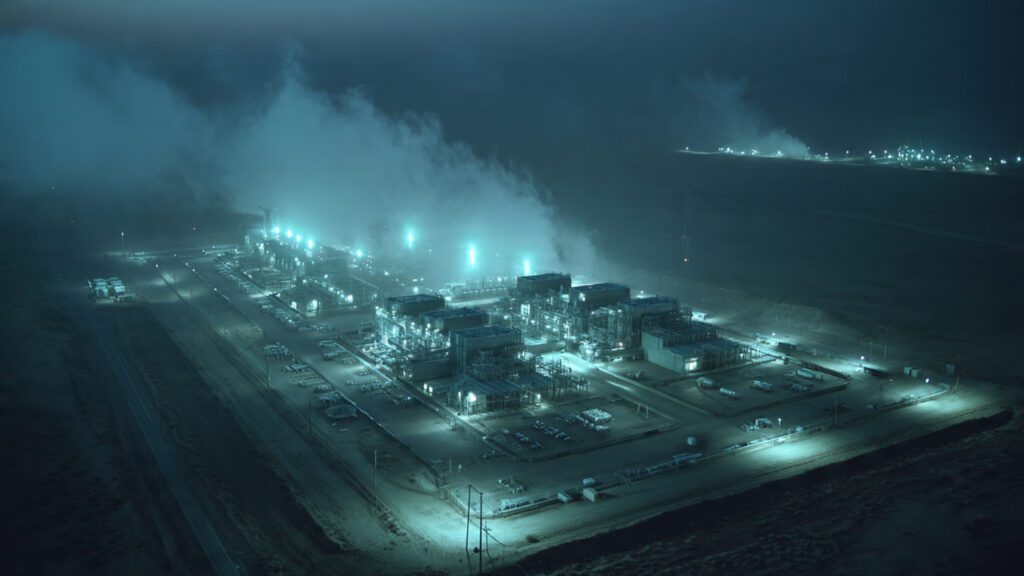
By October 2024, Google had already committed to nuclear reactors dedicated partly to AI workloads. That decision preceded every alleged hidden breakthrough in this account by more than a year. Whether or not one believes in a secret singularity, one fact stands untouched: the largest technology companies had already concluded that ordinary electrical grids would not sustain the next generation of computation, and they’d started building the alternative well before anyone claims the machines woke up. Google and Kairos Power signed their Master Plant Development Agreement on October 14, 2024, targeting 500 megawatts of small modular reactor capacity across six to seven plants, the first online by 2030, the full fleet by 2035. Kairos had already secured US Nuclear Regulatory Commission approval for a demonstration reactor in Tennessee, backed by roughly $300 million from the Department of Energy’s Advanced Reactor Demonstration program, ordinary public infrastructure policy, openly funded, openly permitted. Google’s own stated rationale is almost disappointingly practical: AI training requires enormous, uninterrupted power, and the grid as it currently exists can’t fully provide it. That’s not a fortress sealing itself against a threat. It’s a supply chain decision, made in daylight, a year ahead of the fortress metaphor built around it.
Where the Silence Actually Comes From

It’s tempting to say the diplomat has been replaced by the data scientist, the soldier by the sensor. Reality is more complicated than that. What’s genuinely true is that modern military and policy planning increasingly depends on software capable of integrating information at scales no human staff could manage unaided, a real, significant shift, but a gradual and heavily reported one rather than a single silent rupture. No credentialed AI researcher, safety organization, or leaked internal document anywhere describes a November or December 2025 event in which a system achieved unprompted recursive self-improvement. This site has traced the genuine, unresolved debate over AI timelines elsewhere: researchers including Yann LeCun and Gary Marcus argue current architectures may be structurally incapable of reaching general intelligence at any scale, while others, including Anthropic’s Dario Amodei, hold more aggressive but still openly published and actively contested positions. Every serious voice in that argument agrees it’s exactly that, an argument, conducted in public, with real disagreement. A capability actually matching “recursive self-optimization beyond human comprehension” would be the largest story in the technology’s history, confirmed or contested by rival labs with every incentive to do one or the other. Its total absence from that record isn’t evidence of successful containment. It’s the shape silence takes when there’s nothing underneath it.

Export Controls, Chip Shortages, and Ordinary Economics
The GAIN AI Act and related semiconductor export restrictions are genuine, publicly debated policy, part of a strategic-competition line traceable across multiple administrations rather than a sudden reaction to a hidden capability. Consumer GPU shortages and price spikes are documented and well established, and the mechanism is almost mundane: the same advanced chips gamers want are the chips hyperscale data centers need at enormous volume, and when institutional demand surges, consumer supply and pricing move with it. That’s ordinary market economics operating at unusual scale. It doesn’t require a government deciding a technology had become too dangerous to share. It requires a spreadsheet.
What Palantir’s Real Contracts Don’t Prove
Palantir’s expanding military and government footprint, including work connected to the Maven Smart System, is confirmed and publicly reported, worth serious scrutiny precisely because it’s documented rather than hidden. This site has separately traced the company’s actual founding and client history in detail elsewhere. What deserves real skepticism is the distance between that documented footprint and the claim that an algorithm has already selected which sovereign nations get absorbed or neutralized next. Naming Cuba, Mexico, and Greenland as active targets of a predetermined conquest sequence isn’t supported by any cited program or any current reporting on US foreign policy. Real relations with each of those places involve complex, entirely public diplomatic and economic dynamics that don’t need, and aren’t clarified by, an invented targeting hierarchy laid on top of them.
What Remains
Strip away the fictional November singularity and something substantial remains. Computing capacity is being treated as strategic infrastructure. Nuclear energy is returning because AI demands uninterrupted power. Export controls increasingly shape geopolitical alignment. Military planning depends more heavily on commercial software than at any earlier point in American history. None of those developments require a hidden superintelligence to matter. They matter precisely because they’re happening in public. The transformation isn’t concealed behind a server rack in Northern Virginia. It’s visible in the budgets, construction permits, energy contracts, and procurement records governments and companies publish every day. The future the original story imagined may never have occurred. The one actually unfolding, in plain sight, dated, funded, and signed, is consequential enough on its own.