



Frederick Norden was not given to exaggeration.
The Danish naval officer and explorer arrived in Egypt in 1737 at the command of King Christian VI, who wanted accurate documentation of Egypt’s antiquities. Norden was a trained observer whose drawings and descriptions of Egyptian monuments were subsequently used by historians as reliable primary sources. When he published his account of the journey posthumously in 1755 as Voyage d’Égypte et de Nubie, it became one of the most important European records of Egyptian antiquities from the pre-Napoleonic period, consulted by researchers for two centuries.
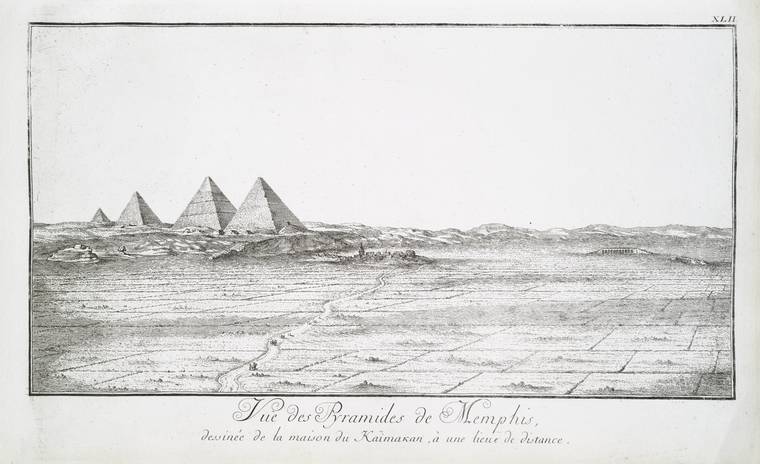
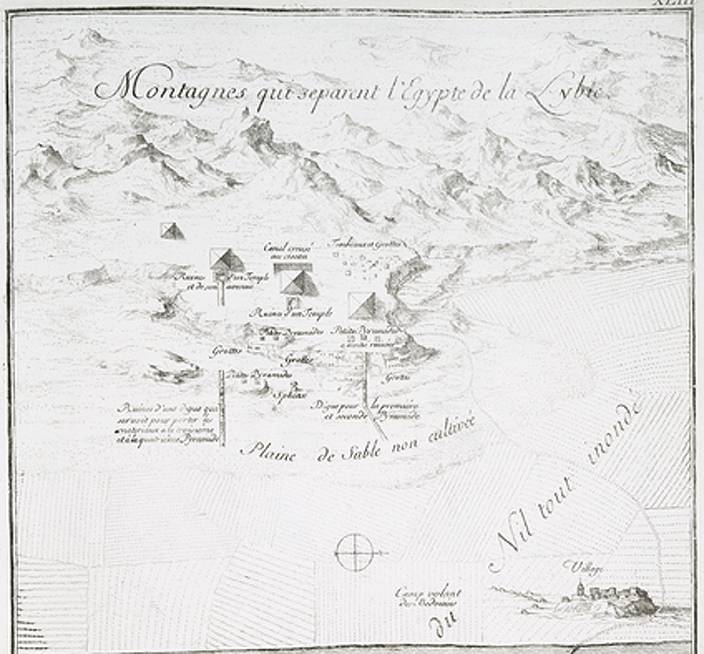
In his description of the Giza plateau, Norden counted four pyramids.
His account is preserved in the published text: there are four of them, he wrote, and they deserve the attention of the curious. He noted that there were seven or eight other pyramids in the neighborhood but that these four were the primary structures. He described the two largest to the north as having 500 feet perpendicular height. He described the other two as much smaller but possessing peculiarities that caused them to be examined and admired.
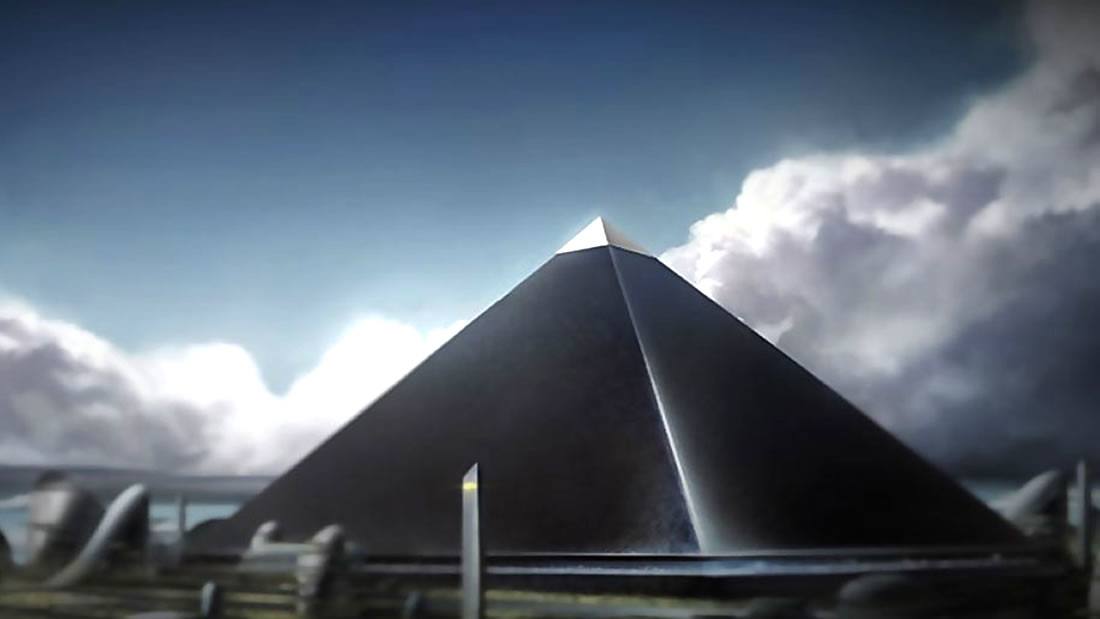
The peculiarities he described for the fourth pyramid were specific: its top was of a stone more black than common granite, and it was crowned by a single large stone that seemed to have served as a pedestal.
The three main Giza pyramids are well established. The fourth pyramid, dark-stoned with a pedestal at its apex, is not. Frederick Norden described it with the same precision and observational care that makes his other Egyptian records historically valuable. What he saw at Giza in 1737 is not there now, or has not been identified as such, and no satisfactory explanation has been established for where it went.
Norden’s Credentials and What They Mean
The evidentiary weight of a historical account depends substantially on the quality of the observer. Norden’s credentials make his account significantly more interesting than a casual traveler’s impression.
He was trained in naval architecture and cartography at the Danish Royal Academy before his Egyptian mission. His mandate from the king was specifically to document what he found with precision. His published drawings of Egyptian monuments, including detailed plans and elevations of temple complexes, have been used by Egyptologists as a record of structures before nineteenth-century clearance and restoration work altered their appearance.
The historian Percy Newberry, in early twentieth-century Egyptological scholarship, noted Norden’s account as one of the most reliable European descriptions of the Giza complex from the eighteenth century precisely because of his training and his royal mandate to observe accurately.

Whether his description of the fourth pyramid reflects genuine observation, a confusion with another structure he identified incorrectly, or something else, is a question that his established track record of accurate observation makes more interesting than it would be for a less credentialed source.
The detail that makes Norden’s fourth pyramid most difficult to dismiss as a simple error is the darkness of the stone. He specifically compares it to common granite and says the fourth pyramid’s stone was darker. This is a material observation rather than an approximate impression. A trained observer making this comparison was describing something whose visible surface material differed markedly from the limestone-cased structures he had been observing throughout the Giza plateau.
The Candidate Structures
The Giza plateau’s known subsidiary pyramids in the eighteenth century included several structures that have been proposed as candidates for Norden’s fourth pyramid.
The queens’ pyramids of Menkaure, three subsidiary pyramids located to the south of the third main pyramid, were in varying states of preservation in 1737. John Shae Perring’s nineteenth-century excavations recorded their condition and found them in a significantly deteriorated state. Whether any of the three could have appeared as a coherent pyramid structure with a distinctive dark stone apex to an observer in 1737 is a question whose answer depends on what clearance work had been done on the Giza plateau between 1737 and Perring’s nineteenth-century investigations.
The historical evidence for the Giza plateau’s precise condition in 1737 is limited. Napoleon’s Egyptian campaign of 1798-1801 produced the most extensively recorded survey of the Egyptian monuments before the major nineteenth-century clearance and restoration projects, and the Description de l’Égypte published by Napoleon’s scholars is the standard reference for the pre-modern Giza plateau. Whether any structure visible in Norden’s 1737 account had disappeared or been buried by the time of the 1798-1801 survey is a comparison that scholars have attempted.
The stone description is the most difficult element to account for with the known satellite pyramid candidates. The queens’ pyramids of Menkaure are constructed of local limestone with some granite facing in their lower courses. Norden’s description of stone more black than common granite does not match the known material of the satellite pyramids in the archaeological record.
Whether a previously unidentified subsidiary pyramid constructed of darker stone existed at Giza and was demolished between 1737 and the nineteenth-century systematic excavations is the hypothesis that Norden’s account requires if it is taken as accurate observation rather than misidentification.
The Demolition Question
The Giza plateau’s history between the Arab conquest in the seventh century CE and the modern era includes documented episodes of stone removal for construction purposes. The casing stones of all three main pyramids were substantially removed in the medieval period, with many used in the construction of Cairo’s monuments. The dating of this removal for the main pyramids is well established: the 1303 earthquake that damaged Cairo’s old city prompted major construction using available stone, and surviving accounts record the removal of Giza casing stones for this purpose.
Whether a smaller subsidiary pyramid of distinctive dark stone was completely demolished during any such episode is a question that the historical record partially addresses. Complete demolition of a pyramid, including its core masonry, requires significantly more effort than casing stone removal. The main Giza pyramids retained their core structure even after complete casing removal. Complete elimination of a subsidiary pyramid, including its foundations, would leave construction pits and foundation stones in the archaeological record.
Egyptologists who have addressed Norden’s fourth pyramid specifically note that no construction pits or foundation stones have been identified at the location where his description and drawing place the structure. Whether this absence reflects the completeness of any demolition, the burial of foundation evidence under subsequent construction or natural sediment deposition, or the absence of any structure in that location, is not established in the available archaeological record.
The absence of archaeological evidence is not the same as the established non-existence of the structure. The Giza plateau’s archaeological survey, while extensive in the twentieth and twenty-first centuries, has not been equally thorough across all areas of the plateau. Whether the location where Norden’s fourth pyramid should be has been fully excavated and found to contain no foundations is not clearly established in the available published excavation records.
The Pedestal Stone
The most striking and most puzzling detail in Norden’s description is the single large stone at the apex that seemed to have served as a pedestal.
Egyptian pyramids were typically capped with pyramidion stones, small pyramid-shaped stones that extended the structure’s form to its apex. Several pyramidia are preserved in Egyptian museums, including the famous black granite pyramidion from the pyramid of Amenemhat III at Dahshur, which is on display in the Egyptian Museum in Cairo. The Amenemhat III pyramidion is recorded as being made of polished black granite, is inscribed with solar symbols, and is approximately 1.4 meters high.
Whether Norden’s description of a fourth pyramid at Giza with dark stone and a capping stone that seemed to serve as a pedestal could describe a pyramid whose pyramidion stone had a flat rather than pyramidal top is an interpretive possibility. A flat-topped capping stone, serving as a platform or pedestal for a statue or other object, would be visually distinctive and would match Norden’s description of a pedestal.
The combination of unusually dark stone and a flat capping stone that served as a pedestal would make the fourth pyramid visually distinctive from the three main structures in exactly the way that Norden’s account describes, and would be consistent with a smaller subsidiary pyramid of a different design tradition than the main structures.
Whether this design was used for any Giza subsidiary pyramid is not established in the archaeological record. The known satellite pyramids do not show this combination of features in the excavated material.
What Other Eighteenth-Century Accounts Say
Norden was not the only European traveler to record the Giza plateau in the eighteenth century. Several other accounts from the same period provide comparative material that could corroborate or contradict his fourth pyramid description.
Richard Pococke, a British traveler and clergyman, visited Giza in 1737 and published his account in A Description of the East and Some Other Countries in 1743, twelve years before Norden’s posthumous publication. Pococke’s description of the Giza plateau mentions three main pyramids and subsidiary structures but does not describe a fourth pyramid matching Norden’s account. Whether this absence reflects that Pococke did not observe the structure, that he attributed it to the satellite pyramid category without noting its distinctive features, or that Norden was describing something Pococke did not see, is a question that the comparative reading of the two accounts raises.
The discrepancy between Pococke’s account, which does not describe a distinctive fourth pyramid, and Norden’s, which does, could mean that Norden was more thorough, that Pococke dismissed as a satellite structure what Norden examined more closely, or that one of the two observers was confused about what they saw.
Whether any other eighteenth-century traveler’s account corroborates Norden’s fourth pyramid description is a question that a systematic review of the period’s Egyptian travel literature would address, and that the available published Egyptological scholarship has not definitively resolved.
What the Record Establishes
Frederick Norden’s Voyage d’Égypte et de Nubie is a real historical primary source authored by a credentialed observer with a royal mandate for accuracy. His description of a fourth pyramid at Giza with unusually dark stone and a distinctive capping stone is in that published text. His overall track record as an observer is established in the Egyptological literature as reliable.
The fourth pyramid he described has not been identified in the archaeological record of the Giza plateau. No foundation stones, construction pits, or other physical evidence for a structure matching his description has been published in the available excavation reports.
Whether this absence reflects the complete removal of the structure between 1737 and the systematic nineteenth-century excavations, the burial of foundation evidence in unexcavated areas of the plateau, Norden’s misidentification of an existing satellite pyramid whose material he observed under unusual conditions, or the genuine disappearance of a structure whose existence the historical record preserves through a single reliable but unconfirmed account, is the question that the available evidence does not answer.
Frederick Norden counted four pyramids. He described the fourth specifically. He published the description. He was not given to exaggeration.
The fourth pyramid is not there now.
What was dark-stoned, capped with a pedestal, and standing at Giza in 1737 has not been found.
The decorated ostrich egg raises a related Giza puzzle from a different direction, symbols once misread as the three pyramids that turned out to be the oldest known writing in the world.
A comparable unresolved discrepancy surrounds a reported white pyramid near Xi’an, where pilot and traveler accounts from the early twentieth century have never been reconciled with the site later identified as Maoling.