




The sound of a letter carrier’s shoes on a quiet porch is usually the rhythm of mundane commerce, but in January 2026, it carries the weight of a mobilization order. While the general public remains fixated on the latest political theater, a very type of paperwork has begun to circulate within the belly of the federal bureaucracy.
History has shown that the largest shifts in human control are never announced with a trumpet. They arrive in the form of administrative updates and logistical adjustments. In the weeks leading up to the 2020 lockdowns, departments began issuing movement permits to essential personnel. Those letters were the quietest sirens in history. They signaled that the world was about to stop, even while the official narrative was one of business as usual. Now, the same mechanisms are vibrating again. The United States Postal Service has issued a new set of directives that feel less like business continuity and more like a map for an occupied territory.
Postal Service as a Signal of Imminent Restriction
The memo arrived on January 5, 2026. It originated from 475 L’Enfant Plaza SW, the headquarters of the United States Postal Service in Washington DC. Signed by Doug A. Tulino, the document is a cold piece of bureaucratic prose that outlines how employees and contractors must behave during large scale emergencies. It mentions epidemics, hurricanes, and civil unrest, but the language is strikingly broader than previous iterations. It instructs postal workers to carry their identification at all times. It mandates that they possess a letter of essential service to present to law enforcement or military patrols if they are stopped during a curfew. The letter is designed to override state and local laws through the supremacy of federal mandate. When the postal service prepares for a world where its workers are the only ones allowed on the street, it is a signal that the street is about to become a very lonely place.
This is the physical residue of a coming global emergency declaration. Bureaucracy is slow, so it must anticipate the freeze. If the government expects a situation by March or April where local law enforcement is actively questioning every civilian on the road, then the decision to lock down has already been made in the dark. The memory of 2020 still lingers like a bad taste. Back then, the packaging for certain diagnostic tests was discovered to have been printed years in advance. The logistics were settled long before the biology was even a factor. Today, the logistics are being settled again. Whether the trigger is a new variant, a simulated cyber attack on the grid, or a sudden escalation in the Middle East, the paperwork is already in the pockets of the men in blue uniforms.
The Architecture of the Essential Service Memo
The text of the Tulino memo is instructive because of what it assumes about the near future. It explicitly states that local governments may issue orders restricting movement and commercial activities. It notes that while many orders exempt essential providers, some do not. The Postal Service is positioning itself as an entity that operates outside the reach of local civil authority. This is a federalization of movement. It suggests a scenario where the internal borders of the United States become hard lines. If you are a contractor for the USPS, you are granted a passage that the average citizen is denied. This creates a two tier society under the guise of infrastructure.
The timing of this memo in early January suggests a countdown. In the previous cycle, the gap between the quiet distribution of movement letters and the total cessation of public life was roughly eight weeks. We are looking at a window that opens in February and peaks in April. By then, the reasons for the restriction will be televised, but the mechanism for the restriction is being tested right now. The USPS is the nervous system of the old world. It is the only agency that reaches every single door in the country. If the government needs to maintain a presence on every doorstep while the population is confined, the mail is the perfect mask.
Military Positioning and the Diego Garcia Mobilization
While the postmen are receiving their letters in Washington, a much darker mobilization is occurring in the Indian Ocean. Six B-2 Spirit stealth bombers have landed at Diego Garcia. This is not a routine exercise. These aircraft represent a significant portion of the total American stealth fleet. They are the primary tools for the penetration of deep, hardened targets. Their arrival coincides with dozens of KC-135 tankers touching down in Qatar. A stealth bomber is a ghost, but a tanker is a neon sign. You do not move that much fuel into the Middle Eastern theater unless you are preparing to keep heavy bombers in the air for extended periods.
The pattern of commercial flight cancellations is the final tell. Lufthansa, Qatar Airways, and Emirates have begun adjusting schedules or avoiding corridors. When the sky clears of civilian traffic, it is usually because the military is about to occupy the vacuum. The logistics here mirror the lead up to Operation Midnight Hammer in 2025. Back then, the strike on Iranian nuclear facilities was preceded by the same clearing of the board. But the current tension feels different. It is not just about a nuclear program anymore. It is about a regional realignment that has reached a breaking point. The stacks of bodies at Kahrizak and the crossing of red lines in Tehran are being used as the moral justification for a final kinetic solution.
Operation Midnight Hammer and the Stealth Fleet
The residue of the 2025 strike is still visible in the satellite images of Fordow and Natanz. Those facilities were hit with 30,000 pound Massive Ordnance Penetrators. But the Iranian regime did not collapse. Instead, it decentralized. The current presence of B-2s at Diego Garcia suggests that the job was not finished. Or perhaps, the target has changed. When Marco Rubio calls Netanyahu as hundreds of bodies are being processed in Iranian morgues, the conversation is not about diplomacy. It is about the coordination of a strike that will redefine the next decade.

The B-2 Spirit is an aging platform, but it is the only one that can deliver the GBU-57. If six of them are on an island in the Indian Ocean, they are not there for deterrence. They are there for the execution of a mission that requires absolute silence until the moment of impact. The flight from Diego Garcia to the Iranian coast is a ten hour sortie. The tankers in Qatar are the umbilical cords for these ghosts. We are witnessing the assembly of a strike package that is designed to decapitate the leadership of the resistance axis. This is the external component of the global emergency declaration. War abroad always necessitates control at home.
The Apocalyptic Crossroads of the Middle Eastern War
The conflict in the Middle East has shed its skin of political disputes and revealed its ancient, religious bone structure. For the practitioners of messianic Zionism, the goal is the destruction of Al-Aqsa and the construction of the Third Temple. This is not a fringe theory. It is a stated objective of elements within the current Israeli government. For the Shiite world, this is the literal arrival of the Dajal, the false messiah. The resistance is no longer just about territory. It is an eschatological drama being played out with precision guided munitions.

The most interesting development is the shift in the Sunni world. Mohammed bin Salman has begun to steer the Sunni axis away from its traditional Western alignment. The idea of a Greater Israel is as much a threat to Riyadh as it is to Tehran. This has forced an uncomfortable alliance. We are seeing a convergence where the Sunni powers are looking toward Russia and China as buffers against the perceived messianic ambitions of the West. If the Sunnis wake up to the reality that they are next on the list for regional re-engineering, the entire American security architecture in the Gulf will dissolve.
Dajal and the Construction of the Third Temple
The Third Temple is the ultimate trigger. In the occult traditions, the temple is the physical anchor for a new world order. It is the end of the current age. If the 2026 timeline includes a move on the Temple Mount, then a global emergency is a mathematical certainty. The reaction from the Islamic world would be so violent and so pervasive that every major city in the West would require a total lockdown just to maintain a semblance of order. This brings us back to the USPS letter. You cannot have a religious war of this magnitude without a curfew in the suburbs of Virginia and the streets of London.

The symbols are everywhere for those who know how to read them. The psyche of the population is being tested daily through a barrage of conflicting reports and manufactured crises. We are being conditioned to accept the state of emergency as a permanent feature of modern life. The construction of the temple is the symbolic finish line. It represents the transition from a world of national identities to a world of spiritual and technological control. The Dajal is not a single person; it is a system. It is a digital and physical mesh that monitors every movement and every transaction.
The Convergence of the Axes of the End Times
We are standing at the intersection of several distinct timelines. There is the geological timeline, where the San Andreas and Yellowstone are whispering of a physical reset. There is the military timeline, where the B-2s are circling their prey. And there is the administrative timeline, where Doug Tulino is handing out movement permits to mail carriers. These are not separate events. They are the synchronized movements of a machine that is preparing to enter its final phase. A global emergency declaration is the only way to manage the friction generated by these converging forces.
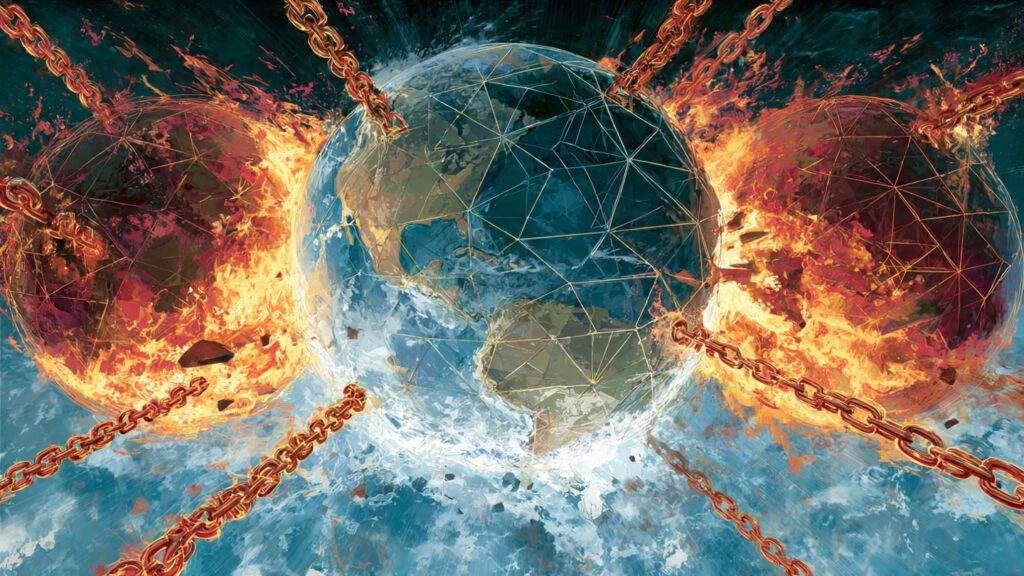
The 2026 window is the most critical period since the end of the last world war. The world is exhausted. The spiritual capital of the West has been spent on consumerism and envy. Human curiosity has been weaponized against us. We watch the skies for aliens or comets while the real chains are being forged in the local post office. If a global emergency is declared in the next two to three months, it will not be because of a single disaster. It will be the result of a systemic decision to freeze the world before it can react to the shift in the Middle East.
End of Movement and the Rise of the New Axis
The new axis of Russia, China, and a resurgent Islamic world is the primary obstacle to the Western dream of total dominance. The only way to counter this axis is to move the conflict into a domain where the West still has an advantage | the control of information and the management of domestic populations. A lockdown is a laboratory for this control. It allows the state to see who complies and who resists. It allows for the deployment of a digital identity system under the guise of public safety.
The USPS letter is the most honest document we have. it tells us that the government expects the law to fail. It tells us that they expect the streets to be contested. And it tells us that they are ready to bypass every local authority to keep their essential services running. The service being provided is not the delivery of mail. It is the maintenance of the federal presence in a world that is falling apart. We are following the developments, but the pattern is already clear. The silence of the Indian Ocean and the bureaucratic chill of L’Enfant Plaza are two sides of the same coin.

The next few months will determine if the world remains a collection of nations or becomes a managed territory. The red lines have been crossed. The tankers are full. The letters have been delivered. When the siren finally sounds, it will only be for those who weren’t paying attention to the silence. The logistics are perfect. The land is not prepared. The water is coming, and the earth is ready to move. We are at the crossroads of the axes of end times, and there is no turning back.