



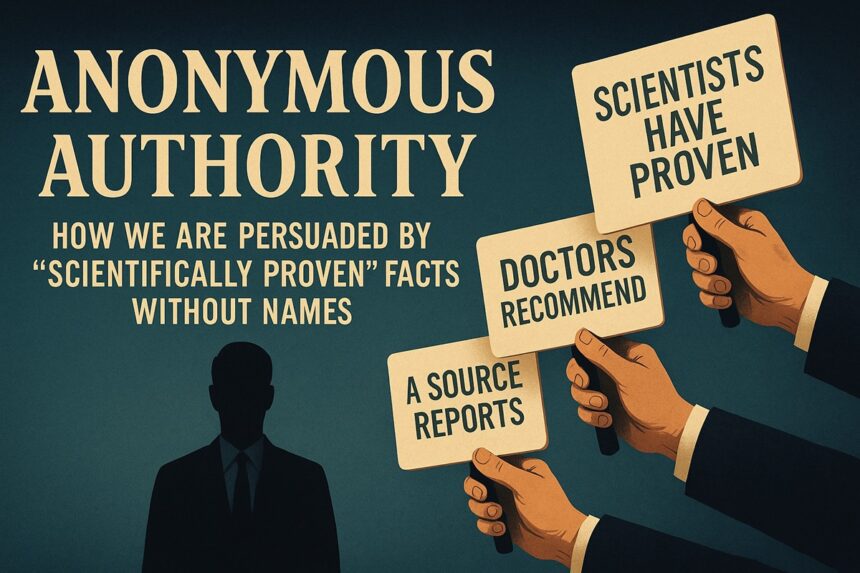
In an age of information overload, trust has become a currency, and anonymous authority has become a hidden, manipulative force.
You’ve probably heard phrases like:
- “Doctors recommend…”
- “Scientists have proven…”
- “According to sources close to the matter…”
These kinds of statements sound authoritative, factual, and reliable. But here’s the catch: you’re not told who said it, where it came from, or whether it can be verified.
Welcome to the world of anonymous authority, a subtle but powerful tool that influences public opinion without ever showing its face.
What Is Anonymous Authority?

Anonymous authority refers to the use of unnamed experts, sources, or institutions to support a claim. The power of the message rests on the implied credibility of the anonymous figure, not on actual evidence or verifiable facts.
This technique is frequently used in:
- Advertising (“9 out of 10 dentists agree…”)
- Journalism (“A senior official who asked to remain anonymous…”)
- Politics (“Sources within the administration revealed…”)
- Social media (“Experts are warning about a new trend…”)
These tactics aim to persuade without proof. The strategy relies on the listener’s instinct to trust authority, even when it’s faceless.
Why Is Anonymous Authority So Persuasive?

1. We Trust Experts, Even Imaginary Ones
Humans are psychologically wired to respect knowledge and experience. When someone mentions “scientists” or “doctors,” we assume those people have credentials, data, and integrity, even when no names are given.
This cognitive shortcut helps us make quick decisions, but it’s also a perfect opening for manipulation.
2. It Creates the Illusion of Consensus
Phrases like “studies show” or “experts agree” subtly imply that there is a broad agreement within a field, even if there’s no actual study, no expert, and no consensus.
It gives a false sense of certainty, which makes the claim feel objective, data-driven, and immune to doubt.
3. It Prevents Accountability
Anonymity shields the supposed source from scrutiny. You can’t question the methodology, credentials, or motives of an expert you can’t identify.
And that makes debunking nearly impossible.
Real-World Examples of Anonymous Authority in Action

Advertising Manipulation
“Studies have shown that people lose 10 pounds in 2 weeks with this supplement!”
Which studies? Conducted where? Peer-reviewed? Without this information, such claims are marketing tools, not facts.
Media and Political Influence
“A high-level intelligence official, who asked to remain anonymous, confirmed the operation.”
Such quotes may seem credible, but without transparency, they serve as a vehicle for strategic leaks, spin, or political agendas.
Health and Lifestyle Claims
“Doctors recommend this toothbrush.”
Which doctors? Based on what research? Often, these are vague generalizations that serve to sell products, not protect your health.
The Hidden Dangers of Anonymous Authority

1. Lack of Verifiability
You can’t evaluate what you can’t trace. Anonymous claims can’t be fact-checked, challenged, or investigated. This makes them ideal tools for misinformation.
2. Data Distortion or Misuse
Even if research exists, selective citation or out-of-context quoting can skew the facts to fit a narrative.
3. False Objectivity
When statements are dressed in scientific or expert-sounding language, without offering proof, they appear neutral but may carry strong bias.
4. Manufacturing Consent
By invoking invisible authorities, organizations can nudge people toward certain behaviors, like buying a product, supporting a policy, or fearing a non-existent threat.
Related Propaganda Techniques to Watch Out For

Anonymous authority isn’t alone. It often works in tandem with other rhetorical fallacies that are just as misleading.
1. Appeal to the Majority (Argumentum ad Populum)
“Everyone uses this brand, it must be the best!”
Just because something is popular doesn’t mean it’s true, right, or good. History has shown us that the majority can be catastrophically wrong.
Example: “All my friends vape, so it’s totally safe.”
2. Appeal to Authority (Argumentum ad Verecundiam)
“A famous scientist says this theory is correct.”
Even experts can be wrong, or biased. Their opinion should be part of a conversation, not the end of it.
Example: “A celebrity doctor recommends this miracle cure!”
3. Appeal to Tradition (Argumentum ad Antiquitatem)
“This is how it’s always been done.”
Tradition is not inherently logical or beneficial. Societies evolve, and so must our values and decisions.
Example: “Men should work, women should stay home, it’s tradition.”
How to Protect Yourself from Anonymous Authority

1. Always Ask: Who Said It?
If you hear “scientists say…”, ask which ones. Are they credible? Do they work for an independent body or a commercial interest?
Pro tip: Google their name and check whether the study is peer-reviewed.
2. Seek Source Material
If someone claims “studies prove…”, look for the actual study. Trustworthy sources link directly to evidence, not just paraphrased sound bites.
Use tools like:
- Google Scholar
- PubMed
- ResearchGate
3. Compare Multiple Sources
Don’t rely on one outlet or one voice. Truth emerges from diversity of perspectives, not echo chambers.
4. Identify Red Flags
Watch for:
- Passive voice: “It is believed that…”
- No direct quotes or citations
- Overuse of vague terms like “experts,” “studies,” or “many believe”
These are all signs of information without foundation.
5. Separate Fact from Opinion
An expert’s personal view is still just an opinion, unless backed by data, replication, and peer consensus.
A Documented Case Study | The “9 Out of 10 Dentists” Formula
It’s worth examining a specific example of this technique in action, since seeing how it actually works makes the pattern much easier to spot elsewhere. Advertising historians have traced the “9 out of 10 dentists recommend” formula back to mid-20th-century marketing campaigns, and consumer protection researchers have specifically studied why this phrasing remains so persistently effective decades later. The underlying issue researchers identify is rarely outright fabrication. It’s usually technically true survey data presented without essential context: how many dentists were actually surveyed, how the survey question was worded, and whether respondents were shown a curated list of acceptable answers rather than asked an open question. A sample of ten surveyed dentists, none independently verified as representative of the broader profession, can technically produce a “9 out of 10” statistic that sounds authoritative while resting on a tiny and potentially cherry-picked foundation.
Legitimate Uses of Source Anonymity
It’s worth being fair and precise here, since not all unnamed sourcing is manipulative. Journalism ethics organizations, including the Society of Professional Journalists, explicitly recognize legitimate reasons for source anonymity: protecting whistleblowers from retaliation, protecting sources whose safety could genuinely be at risk, or allowing a government official to discuss sensitive but genuinely newsworthy information without violating security protocols. Established news organizations that use anonymous sourcing responsibly typically apply specific editorial standards: requiring corroboration from multiple independent sources before publication, internal editorial review of the source’s credibility and access, and explicit explanation to readers of why anonymity was granted in that specific case. This responsible practice looks meaningfully different from the vague, uncheckable “sources say” or “experts agree” framing warned against above, specific accountability structures exist behind legitimate anonymous sourcing, even when the source’s name itself isn’t published.
The Psychological Research Behind This Vulnerability
This pattern is worth grounding in the psychological research that actually explains why it works so reliably. Foundational studies in social psychology, including research on obedience to authority conducted by psychologist Stanley Milgram in the 1960s, demonstrated that human beings are strongly inclined to defer to perceived authority, sometimes even when that authority conflicts with their own independent judgment. More recent research in cognitive psychology has specifically studied a related phenomenon sometimes called the “authority heuristic,” a documented mental shortcut where people assign greater credibility to a claim simply because it’s attributed to an expert or institutional source, often without further evaluation of the claim’s actual substance. Researchers studying misinformation have found this heuristic becomes especially powerful precisely when the named authority is vague or entirely absent, since an unnamed “expert” or “scientist” can be mentally filled in by the reader with whatever image of credibility feels most persuasive to them personally, an individually tailored illusion of authority that a specific named source, who might turn out to have a checkable and imperfect background, could not provide.
Organizations Doing This Verification Work
Dedicated organizations exist specifically to do this verification work professionally, and consulting them directly is often faster and more reliable than attempting to trace a vague claim back to its source alone. Established fact-checking organizations, including Snopes, FactCheck.org, and the Poynter Institute’s International Fact-Checking Network, employ researchers who specialize in tracing viral claims back to their actual origin, contacting named experts directly, and publishing detailed explanations of what they found. Science journalism organizations, including the Knight Science Journalism program and university-affiliated science communication centers, have also published extensive guidance on evaluating scientific claims in media, consistently emphasizing the same core principle: a claim’s credibility rests on whether it can be traced to a checkable, named source, not on how confidently or authoritatively it happens to be phrased. Building a habit of consulting these established verification resources, rather than accepting or rejecting a claim based on gut instinct alone, is itself one of the most practical defenses available against anonymous authority in all its forms.
Why Critical Thinking Is Your Best Defense

We live in an age where influence is invisible, algorithms amplify falsehoods, and narratives are engineered to feel like facts. Anonymous authority thrives in this environment.
But if you ask the right questions, seek reliable evidence, and stay skeptical of faceless claims, you’ll be far less vulnerable to manipulation.
Think critically, question deeply, and never accept “truth” without transparency.