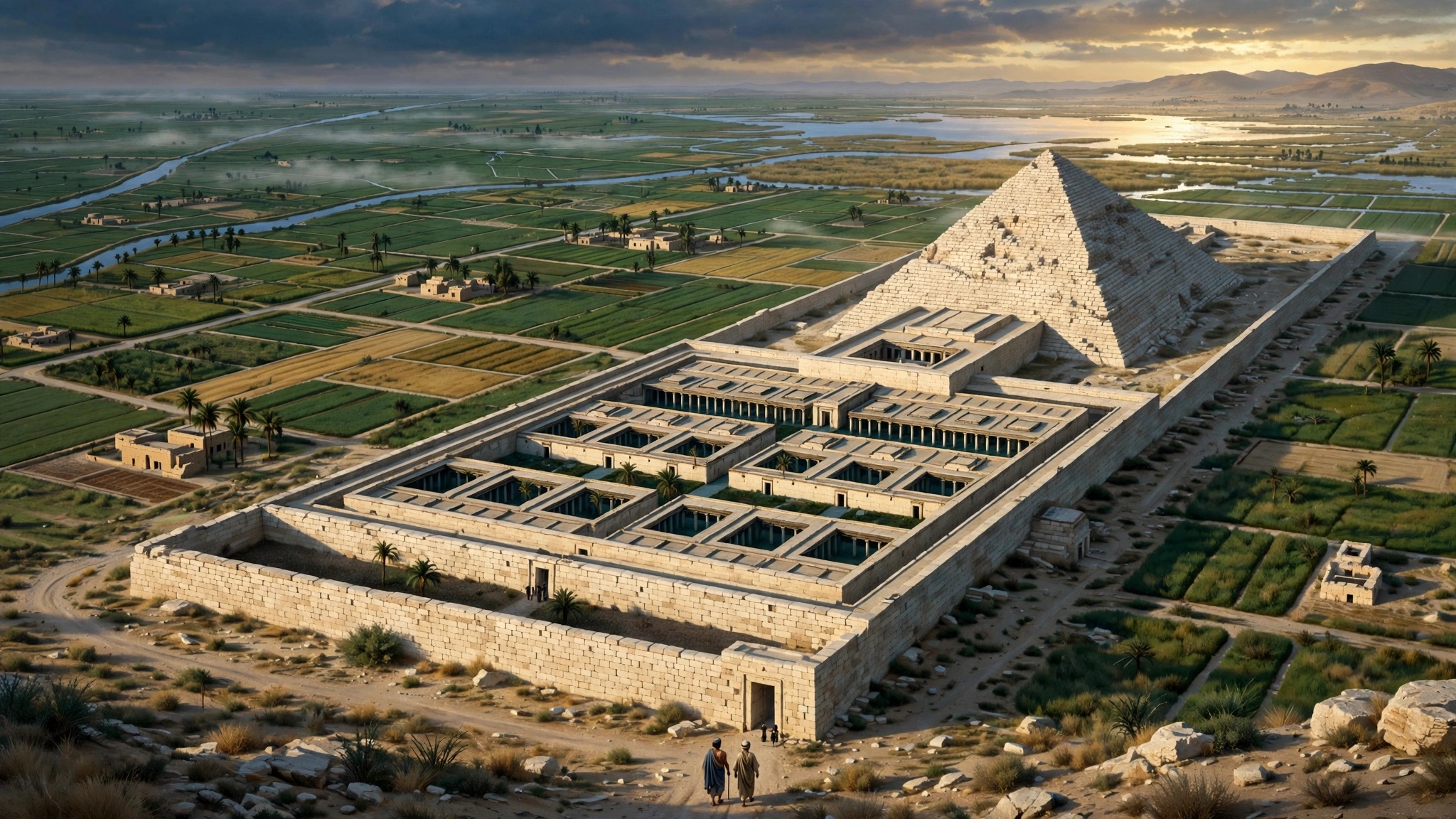
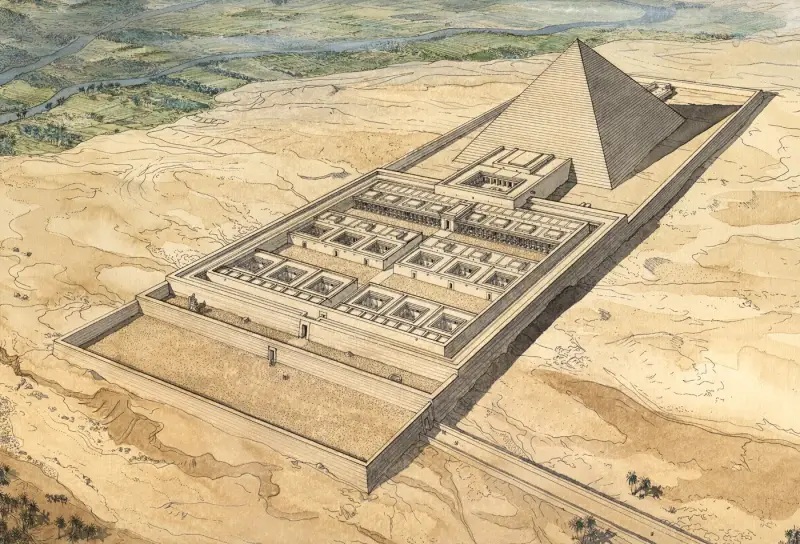
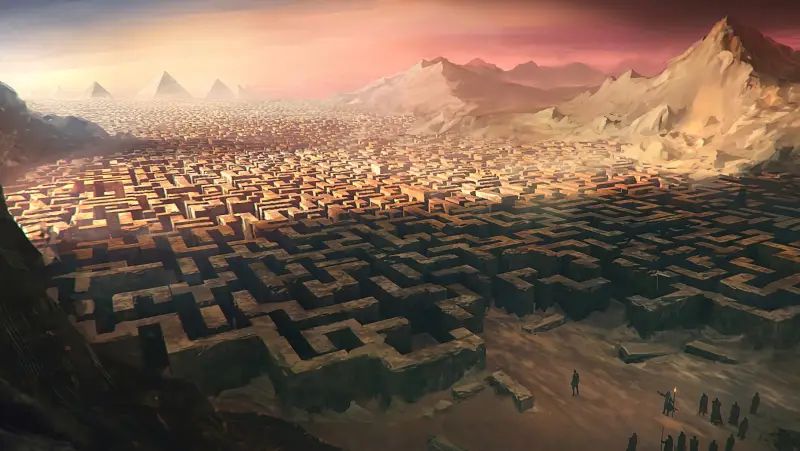
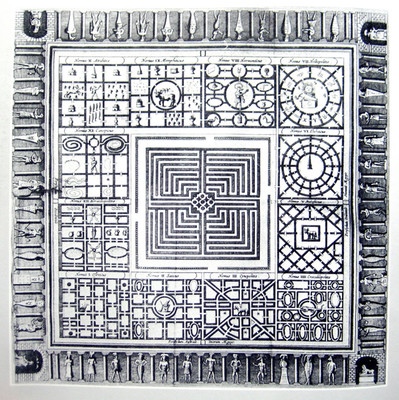
Some time in the fifth century BCE, a Greek traveller from Halicarnassus stood at the edge of the Fayum, the great green basin west of the Nile, and walked into a building he would never forget. Herodotus had already seen the pyramids. He had seen the temples of the Greek world at their height. Yet he wrote that this one “surpasses even the pyramids.” It had twelve roofed courts, six facing north and six facing south, enclosed by a single wall, and some three thousand rooms, half of them above ground and half below. He walked through the upper chambers himself, marvelling at passages that wound so endlessly from court to court that he was lost in wonder. The lower chambers he was not allowed to see. The keepers told him they held the tombs of the kings who built the place, and of the sacred crocodiles.
The Greeks called it the Labyrinth. For four centuries after Herodotus, travellers kept coming to see it. Then it vanished so completely that later scholars wondered whether it had ever existed at all.
Today the site is a field of broken stone and sand beside a crumbling mud-brick pyramid near the village of Hawara, about 90 kilometres south-west of Cairo. Archaeologists, geophysicists and one determined Belgian artist have spent nearly two centuries trying to find out what lies beneath it. Their story has been told as a government cover-up and as a lost city of three thousand rooms waiting to be opened. The record is more interesting than either.
The Witnesses
Herodotus was not alone. The geographer Strabo, who travelled in Egypt in the late first century BCE, described the Labyrinth near the lake of Moeris as a vast palace made of as many palaces as Egypt had provinces, where the provinces gathered for worship and justice, with a pyramid tomb at its end. He remarked on the roofs, each made of single enormous slabs of stone. The historian Diodorus Siculus claimed that the Labyrinth had inspired Daedalus, the legendary architect of Crete, to build the maze of King Minos at Knossos, where the Minotaur was kept, a link that made the Egyptian building famous across the Greek world. Pliny the Elder, writing in the first century CE, said that some of its doors gave out a sound like thunder when they were opened. Around 200 CE the Roman emperor Septimius Severus is said to have visited it.
These are not all eyewitnesses, and they do not agree on everything. Their accounts conflict on who built the Labyrinth and how it looked, perhaps because the building was decaying as the centuries passed, perhaps because some writers repeated others. But they agree on the essentials. Near a pyramid at the entrance to the Fayum stood an enormous building of many courts and chambers, regarded in its own time as one of the wonders of the world.
The Egyptian priest Manetho, writing in Greek in the third century BCE, named its builder as a king the Greeks called Lamares. Modern Egyptologists identify him as Amenemhat III, one of the greatest rulers of the Middle Kingdom, who reigned in the nineteenth century BCE and transformed the Fayum with canals and farmland. The god of the region was Sobek, the crocodile, worshipped at the nearby city the Greeks called Crocodilopolis, where sacred crocodiles were kept in temple pools and mummified when they died. The crocodile tombs Herodotus was told about fit the place exactly.
The King’s Pyramid
Amenemhat III built his pyramid at Hawara of mud brick around a core of limestone passages, and faced it with fine white limestone, most of which was later carried away. What remains today is a worn, dark mound of brick about 20 metres high. Inside it lies one of the most remarkable burial chambers in Egypt, carved from a single block of quartzite that the archaeologist Flinders Petrie estimated to weigh about 110 tonnes, lowered into place and roofed with further slabs of quartzite. The passages were designed to defeat robbers with dead ends, hidden trapdoors and sliding stone blocks. The robbers got in anyway, in antiquity.
The pyramid’s entrance is now flooded. A canal passes within about 30 metres of it, and water has risen into the passages to a depth of some six metres. That water, as it turns out, is the key to almost everything that has happened at Hawara since.
Lepsius and Petrie
The first modern search began in 1843, when the Prussian Egyptologist Karl Richard Lepsius dug south of the pyramid and uncovered a maze of brick chambers that he believed were the Labyrinth’s remains. His student Georg Ebers claimed the horseshoe shape of the complex could be seen from the top of the pyramid.
Flinders Petrie, the founder of scientific Egyptology, arrived in 1888 and proved them wrong. The brick rooms, he showed, were a Greek and Roman village built on top of the Labyrinth’s ruins. The Labyrinth itself had been quarried away. What he found beneath the village was what quarrymen leave behind, a vast bed of limestone chips spread over an area far larger than most Egyptian temples, with fragments of columns, statues of the crocodile god Sobek and of Hathor, and two granite shrines that each held a statue of Amenemhat III. From the extent of that foundation bed he reconstructed a plan of courts and columned halls. Ancient records suggest the demolition may have begun as early as the reign of Ptolemy II in the third century BCE, its fine limestone carried off for new buildings in the nearby city of Arsinoë, though parts of the complex seem to have stood far longer, which fits the Roman visitors.
Petrie’s season at Hawara produced another treasure. In the cemetery north of the pyramid he found 146 painted portraits on coffins and mummy wrappings from the Roman period, the faces of men, women and children of the Fayum painted on wood in wax and pigment, staring out with an immediacy that still startles visitors to museums today. The Fayum portraits are among the few painted portraits to survive from the whole classical world. Among his papyri was a scroll holding parts of the first two books of Homer’s Iliad, now in Oxford. Petrie published his work on the Labyrinth in full in 1912. His conclusion was that it had been destroyed almost to its foundations.
The Mataha Expedition
That conclusion stood for nearly a century. Then, in February and March 2008, a new team came to Hawara with instruments Petrie could not have imagined. The Mataha Expedition was a collaboration between Egypt’s National Research Institute of Astronomy and Geophysics, the country’s leading geophysical body, and Ghent University in Belgium, with official permission from the Supreme Council of Antiquities. It was coordinated and partly funded by the Belgian artist Louis De Cordier, who had become fascinated by the Labyrinth.
The team surveyed the ground with electrical and electromagnetic methods that measure how easily the soil conducts current, a technique that can reveal buried walls and cavities as contrasts in resistance. According to the expedition’s own account, the results showed a grid of walls and chambers at depths of roughly 8 to 12 metres below the surface, which suggested that the stone layer Petrie had taken for a foundation might instead be a roof, with intact structures surviving beneath it. The findings were presented at a public lecture at Ghent University in October 2008.
What happened next became the most repeated part of the story. Soon after the lecture, the Supreme Council of Antiquities, then led by Zahi Hawass, restricted public communication of the results, according to De Cordier citing reasons of national security. De Cordier says he waited for the full findings to be released, and in 2010 began telling the story himself through his own publications and website, later describing himself as blacklisted from Egypt. Over the years that account hardened online into a claim that Egypt has “banned” exploration of the Labyrinth for seventeen years.
What Has Been Published
The record shows something different. In 2010, members of the same Egyptian institute published a peer-reviewed study of the Labyrinth area in the journal Near Surface Geophysics. Mohamed Khalil, Abbas Mohamed Abbas and their colleagues surveyed a grid south of the pyramid with electromagnetic and electrical sounding methods and reported elongated and square anomalies at shallow depths, some connected and some separate, whose pattern, they wrote, closely matches Herodotus’s description. They noted that the site had not been officially excavated since 1911.
Research did not stop either. From 2018 to 2022 a British-Egyptian project called LABYRINTH, led by Nottingham Trent University with the University of Leeds, Egypt’s Ministry of Antiquities and the same geophysics institute, set out to laser-scan the site, map its buried layout and water table, and build a virtual reconstruction of the complex, which it described as a cult precinct about 120 by 300 metres, where the king was worshipped for more than 1,500 years. In 2024 Egyptian geophysicists published a further electrical survey of the pyramid and the Labyrinth that again found signs of buried remains near the surface, and again ended with a warning about the water.
Egypt restricted one expedition’s announcement in 2008, for reasons that have never been fully explained. It has not banned research at Hawara, and the site has been surveyed and published on by Egyptian and international scientists since.
The Water Beneath the Wonder
The reason no one has simply dug is underground. Over the past century, flood irrigation of the surrounding farmland has raised the water table beneath the site. The LABYRINTH project measured it at about five metres below the surface, roughly seven metres above the level of the pyramid’s lower corridors. The groundwater is salty, and as it rises and evaporates it leaves salts that crystallise inside stone and destroy it from within. Every survey of the site in recent years has ended with the same concern. Anything that survives below the Labyrinth’s chip bed is sitting in, or just above, a rising saline water table, and exposing it without a plan to control the water could destroy it.
That is the real dilemma of Hawara. The sand and silt that hide the Labyrinth are also protecting it. Removing them is an engineering problem as much as an archaeological one, involving pumps, drainage, monitoring and money, in a country that has thousands of sites competing for the same resources. The site has been described by the researchers who know it best as abandoned and deteriorating badly.

Dippy and Other Stories
Around the edges of the Hawara story, other claims have gathered. A private British company, Merlin Burrows, which offers satellite-based surveys, has claimed that scans of Hawara around 2015 revealed a large ring-shaped feature nicknamed “Dippy,” surrounded by a moat. No data or analysis supporting it has been published, and De Cordier himself has said that those briefed on it signed a ten-year non-disclosure agreement with the company. A private company’s confidentiality agreement is not a government ban, and an unpublished claim is not a finding.
Older tales circulate too, of a German expedition in 1942 searching Hawara for a library of the architect Imhotep linked to Atlantis, and of a box of papyri found at Siwa in 1940 that vanished in transit. Neither has left any trace in the historical record. They belong to the atmosphere of the story, not its evidence.

Who Tells the Story
Much of what the public knows about the 2008 survey comes from one person. Louis De Cordier is a visual artist, not an Egyptologist or geophysicist, and he has spent years promoting the Labyrinth through books, films and his own website, Labyrinth of Egypt. That does not make him wrong. The data collection he describes was carried out by a credentialed national institute, and some of its members went on to publish their own peer-reviewed work at the site. But the most dramatic version of the story, the intact underground city, the suppression, the ban, has reached most readers through an advocate rather than through a journal.
That pattern recurs across stories of hidden discoveries, including the restrictions placed on geological work around the Sphinx in the 1990s. A credible survey produces intriguing preliminary results. Official publication stalls, through caution, bureaucracy or lack of money. The silence is filled by the most committed voice available, and the story grows more certain and more suppressed with each retelling. Underneath, the open question remains exactly where the scientists left it.
What Lies Beneath Hawara
The Labyrinth existed. Several classical writers described it, Petrie found its foundation bed and its statues, and modern surveys have found buried structures where the ancient accounts place it. What remains open is how much survives below. Petrie believed it was quarried almost to nothing. The 2008 survey suggested walls and chambers several metres down. The 2010 and 2024 studies found anomalies near the surface that fit the ancient plan. None of these has been tested by excavation, and the rising water makes that test harder every year.
Somewhere beneath the chips and the sand may lie the lower chambers Herodotus was never allowed to enter, the tombs of kings and sacred crocodiles. Or there may be only foundations, and the wonder of the ancient world may survive now in the words of the travellers who saw it. Hawara has kept that secret since Herodotus walked its courts, and the water rising under the fields of the Fayum is now its strictest guardian. The wider story of Egypt’s pharaohs, pyramids and hidden chambers is gathered in our Ancient Egypt case files.
The Verdict | Unresolved
The Labyrinth of Hawara is attested by classical writers, its foundations were excavated by Petrie in 1888, and modern geophysical surveys, including peer-reviewed work in 2010 and 2024, have found buried structures at the site. The claim that Egypt has banned all exploration for seventeen years does not hold. One expedition’s results were restricted in 2008, and research has continued since. Whether intact chambers survive below the foundation bed is unknown, because no one has excavated them, and rising groundwater stands in the way. The verdict is Unresolved.
The wider story of Egypt’s pharaohs, pyramids and hidden chambers is gathered in our Ancient Egypt case files.
For how this verdict sits beside the rest of the archive, see the Verdict Index.