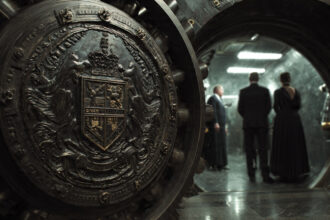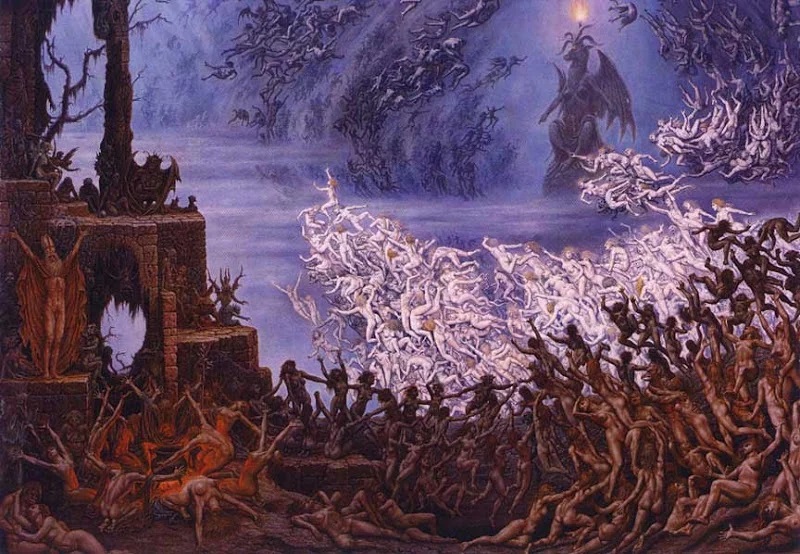




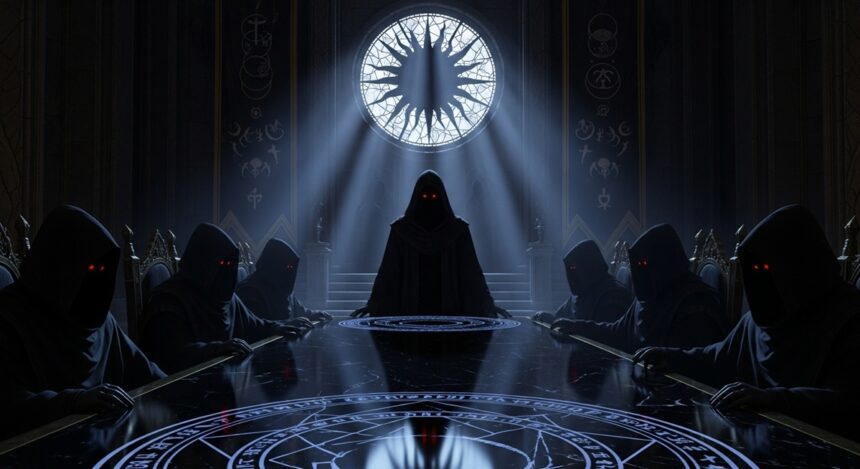
The hidden rulers have changed names for nearly two thousand years. In some ancient Gnostic texts they were archons: supernatural authorities standing between humanity and a higher reality. In early modern Europe, secret fraternities and mysterious brotherhoods became objects of fascination. In the eighteenth century, the Bavarian Illuminati supplied a real organization that could later be transformed into an imaginary one. The nineteenth century added occult masters and hidden hierarchies. The internet fused all of these fragments into the modern image of a single invisible order controlling the world.
But there is a crucial historical correction hiding inside that story. There was never one continuous organization moving intact from ancient Gnosticism to modern conspiracy forums. The archons did not become the Illuminati. The Rosicrucians did not become the Bilderberg Group. The Theosophical Masters did not secretly inherit the Bavarian Illuminati. What survived was something more interesting than an institution: a recurring story structure, the belief that the visible world is governed by forces that remain hidden, that ordinary explanations conceal a deeper reality, and that genuine knowledge belongs to those who can see behind the surface.
The Archons | An Ancient Theology of Hidden Power
One of the earliest well-documented religious versions of this structure appears in texts associated with the movements modern scholars group under the broad label of Gnosticism. The terminology is important because “Gnosticism” describes a diverse collection of ancient traditions rather than a single church with one doctrine. Among the surviving texts from the Nag Hammadi library is the Hypostasis of the Archons, a cosmological narrative in which the visible material realm is associated with inferior and ignorant powers called archons, “rulers,” who stand between humanity and a higher, incorruptible reality. The text presents the world as divided between a transcendent realm and a lower realm characterized by materiality and ignorance.
That is recognizably different from a modern conspiracy theory. The Gnostic writers were not claiming that a secret committee was meeting somewhere to manipulate elections, banks or governments. They were addressing a theological problem: if ultimate reality is good, why is the world experienced as corrupt, ignorant and full of suffering? Their answer could involve a flawed creator, subordinate cosmic rulers and a human condition defined by ignorance of the higher reality. The important historical point is therefore not that the Gnostics “invented conspiracy theories,” but that some ancient religious cosmologies already possessed a powerful narrative distinction between the world people experience and a hidden order believed to exist behind it.
That distinction would prove extraordinarily reusable.
The Pattern Is Older Than the Illuminati
Human societies have imagined concealed powers for reasons that have little to do with any single religious tradition. Gods, demons, spirits, magical fraternities, court intriguers, heretics and secret societies have all occupied the role at different moments. Sometimes the hidden group was imagined as benevolent, possessing wisdom unavailable to ordinary people. Sometimes it was malevolent, deliberately maintaining humanity in ignorance. Sometimes the supposed organization existed historically; sometimes it existed only in literature.
That distinction matters because the modern mythology often collapses categories that were never historically connected. A secret society can be real without controlling the world. A religious belief can describe invisible powers without being a political conspiracy theory. A fictional brotherhood can inspire genuine organizations after the fact. And a real historical organization can become the raw material for a mythology that bears little resemblance to what the organization actually was.
Rosicrucianism | When a Mysterious Brotherhood Became Real Enough to Matter
The Rosicrucian phenomenon is one of the clearest examples of this process. In 1614, an anonymous German text called the Fama Fraternitatis announced the existence of a mysterious Brotherhood of the Rose Cross devoted to spiritual and intellectual reform. A second manifesto, the Confessio Fraternitatis, followed in 1615, and the allegorical Chymical Wedding of Christian Rosenkreutz appeared in 1616. These texts generated enormous interest precisely because readers were left wondering whether the mysterious fraternity actually existed.
The historical evidence does not establish a continuous ancient Rosicrucian order secretly operating behind European governments. What it does establish is considerably more fascinating: a set of mysterious publications created the idea of such a brotherhood, and real people subsequently responded to that idea. Rosicrucianism became a genuine current in Western esotericism even though its foundational brotherhood was presented through mysterious and literary texts. The legend did not need an ancient organization to produce real historical consequences.
That is an important mechanism in the history of hidden-order mythology: sometimes the story comes first and the organization comes afterward.
Freemasonry | A Real Institution Wrapped in Centuries of Speculation
Freemasonry provides a different case. Modern organized Freemasonry emerged in recognizable institutional form in Britain during the early eighteenth century, with the formation of the first Grand Lodge of England in 1717 becoming a major landmark. Masonic traditions themselves preserve elaborate stories connecting the fraternity to medieval stonemasons and much older sources, but historians distinguish those later traditions from what can actually be documented about the emergence of organized Freemasonry.
That distinction did little to prevent speculation. Private rituals, initiation ceremonies, symbols, restricted membership and an international network of lodges created exactly the ingredients from which larger stories could be constructed. Once an organization is genuinely private, outsiders cannot see everything it does. That small gap between “we do not know everything” and “therefore something enormous is being hidden” is one of the most fertile spaces in conspiracy culture.
Then Came the Bavarian Illuminati
Nothing demonstrates the transformation of a real organization into an imaginary global power more clearly than the Bavarian Illuminati. Adam Weishaupt founded the order in Ingolstadt on May 1, 1776. It was an Enlightenment-era secret society whose program emphasized reason, moral reform and opposition to what its members regarded as abuses of religious and political authority. The organization recruited within existing intellectual and Masonic networks and became significantly larger than its original circle, but it remained a comparatively small eighteenth-century association.
The Bavarian authorities moved against secret societies, and the Illuminati was suppressed in the 1780s. The historical organization therefore had a beginning, an identifiable membership, political enemies and an end. There is no established historical continuity showing that the Bavarian Illuminati survived underground for centuries and eventually became the all-powerful organization imagined in modern conspiracy culture.
And yet the name became immortal.
The Illuminati Myth Was Created After the Illuminati
After the organization had been suppressed, critics began attributing extraordinary powers to it. The most influential early example was the French Jesuit Augustin Barruel, whose enormous four-volume Memoirs Illustrating the History of Jacobinism, published from 1797 onward, presented the French Revolution as the product of a vast conspiracy involving secret societies and the Illuminati. John Robison’s Proofs of a Conspiracy, published in 1797, likewise connected the Illuminati to revolutionary subversion.
The historical irony is difficult to miss. The organization itself was short-lived, but the accusation that it had secretly survived became much more durable than the organization ever was. The Illuminati did not need to continue meeting for the Illuminati idea to continue expanding. Once the name became shorthand for hidden revolutionary power, almost any subsequent political event could be fitted into the story.
This is where an important transformation occurred. A real secret society became a template for imagining an invisible one.

The Nineteenth Century Replaces Political Conspirators With Hidden Masters
The nineteenth century then supplied a new vocabulary. The rise of Spiritualism, occult revival movements and Theosophy created elaborate narratives about invisible teachers, ancient wisdom and hidden spiritual hierarchies. Helena Petrovna Blavatsky, co-founder of the Theosophical Society in 1875, wrote extensively about mysterious “Mahatmas” or Masters whom she presented as advanced spiritual beings associated with a hidden wisdom tradition.
The Theosophical Masters were not simply recycled Illuminati. Their original meaning was spiritual and esoteric rather than a theory about a committee secretly controlling governments. But the conceptual resemblance was powerful: ordinary people possessed incomplete knowledge, while a concealed group possessed a higher understanding of reality. Later writers could strip away the spiritual framework and reuse the same architecture for political or extraterrestrial narratives.
Again, the continuity is not organizational. It is architectural.
The Hidden Hand Becomes a Universal Explanation
By the twentieth century, the hidden order no longer needed to have a consistent identity. It could be Freemasons in one story, the Illuminati in another, international financiers in another, a secret intelligence service somewhere else, extraterrestrials elsewhere, or an almost interchangeable combination of them all. The vocabulary changed because the conspiracy was being adapted to whatever the storyteller believed was most threatening at the time.
That flexibility is one reason the narrative has proved so difficult to kill. If the villain is a specific historical organization, disproving that organization’s involvement can damage the story. But if “the hidden rulers” are allowed to change identities whenever evidence becomes inconvenient, the theory can survive indefinitely. The supposed organization becomes less important than the assumption that some organization must exist.
The Internet Didn’t Invent the Hidden Order. It Industrialized It.
The internet did not create the hidden-ruler narrative. It changed its economics. Earlier generations required books, pamphlets, lectures, newspapers, radio programs and organized movements to distribute elaborate conspiratorial claims. Online communities removed many of those barriers. A theory could now be assembled from hundreds of disconnected fragments, an ancient symbol, a corporate logo, a photograph, a quotation, a historical secret society, a government document, and presented as though all of them belonged to one continuous story.
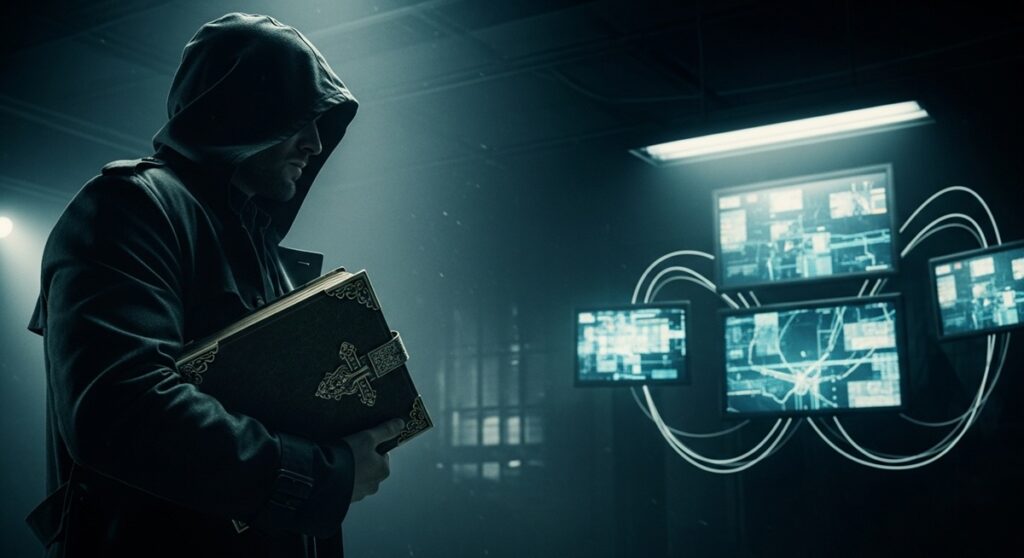
The result is something historically unusual: traditions that were separated by centuries can now appear side by side on the same screen. A paragraph about Gnostic archons can sit beside an image of a Masonic symbol, a nineteenth-century occult diagram, a photograph of a modern politician and a claim about the Illuminati. The physical distance between these sources disappears. So does the historical distance. The viewer sees resemblance and is invited to infer lineage.
But resemblance is not continuity.
Why the Same Story Keeps Returning
Michael Barkun’s work on conspiracy culture offers a useful way of understanding part of this phenomenon. Barkun has described conspiracy theories as forms of “stigmatized knowledge”: claims rejected by institutions regarded as legitimate sources of truth, where that rejection can itself become evidence that the claim is important or correct. Once a community begins treating official denial as confirmation, the normal relationship between evidence and belief becomes inverted. The less the establishment appears to acknowledge the claim, the more significant the claim can appear to believers.
There is an important qualification, however. It would be too simple to declare every conspiracy theory inherently unfalsifiable or every believer incapable of changing their mind. Contemporary philosophical work has challenged that blanket assumption, arguing that conspiracy claims should be evaluated individually and that resistance to counterevidence is not unique to conspiracy theories. The real epistemic problem arises when a particular theory continually adds increasingly implausible explanations to protect itself from evidence that would otherwise count against it.
That distinction makes the critique stronger, not weaker. A real conspiracy can exist. Governments, corporations, criminal organizations and private groups genuinely do conspire. The question is never simply, “Is this a conspiracy theory?” The question is whether the evidence supports this particular conspiracy, whether the alleged participants could realistically coordinate it, whether independent evidence exists, and what observations would count against the claim.
The Dangerous Part Is Not Secrecy. It Is the Universal Villain.
There is another reason the hidden-order narrative deserves scrutiny. History contains real examples of secret societies, covert operations, political conspiracies and institutional wrongdoing. But the broad mythology can transform that legitimate skepticism into something much more dangerous: the belief that an invisible group is responsible for virtually everything that goes wrong.
Historically, versions of this structure have been used to demonize identifiable minorities and political opponents. The most notorious example is the long history of antisemitic conspiracy mythology, culminating in fabricated texts such as The Protocols of the Elders of Zion, which falsely portrayed Jews as members of a secret organization controlling governments and finance. That was not harmless folklore. It became propaganda with lethal consequences.
The lesson is not that every modern conspiracy claim is secretly antisemitic or that questioning powerful institutions is inherently dangerous. The lesson is narrower and more important: once a narrative defines an invisible, omnipotent enemy as the explanation for society’s problems, it becomes extraordinarily easy to substitute a real human group into the vacant role.
The Hidden Order Keeps Changing Because the World Keeps Changing
That may explain why the identity of the supposed rulers changes so frequently. In one century the enemy is religious heresy. In another it is revolutionary secret societies. Later it becomes Freemasonry, international finance, communists, intelligence agencies, extraterrestrials, global corporations, or a hybrid “Illuminati” assembled from fragments of all of them. The story survives because its central proposition does not depend on any particular villain.
The proposition is simply this: what you can see is not what is really happening.
That sentence can sometimes be true. Governments really do conceal information. Intelligence agencies really do conduct classified operations. Corporations really do lobby secretly and sometimes illegally. Political organizations really do coordinate behind closed doors. History contains enough genuine conspiracies that skepticism toward official explanations is not irrational by definition.
But the existence of real conspiracies creates an epistemic trap. Because some hidden actions are real, it becomes tempting to treat every unexplained event as evidence of another one. The leap from “power sometimes operates secretly” to “therefore an invisible order explains the world” is enormous. The first proposition is historical. The second requires evidence.
What Actually Survived From the Archons to the Internet
Trace the history carefully and the supposed family tree begins to dissolve. The Gnostic archons belonged to ancient cosmologies concerned with the nature of reality, ignorance and salvation. The Rosicrucian manifestos announced a mysterious brotherhood whose historical existence was uncertain but whose literary impact was enormous. Freemasonry became a genuine eighteenth-century institution surrounded by secrecy, ritual and speculation. The Bavarian Illuminati was a real Enlightenment-era organization that disappeared, only to acquire a much larger afterlife in conspiracy literature. Theosophy developed its own spiritual hierarchy of Masters. None of these institutions can be demonstrated to have become the next one.
What survived was the narrative grammar.
There is a visible world and a hidden world. There are ordinary people and initiates. There is official knowledge and forbidden knowledge. There is an apparent cause and a deeper cause. There are events that seem chaotic until somebody discovers the invisible hand supposedly connecting them. And there is always the promise that the person who understands the pattern has crossed an invisible boundary: you know what they don’t want you to know.
That is the real continuity.
The archons did not become the Illuminati. The Illuminati did not become the modern global elite. No single secret order has been demonstrated to have inherited the machinery of history. What traveled across the centuries was a human way of making sense of uncertainty: when the world appears too complicated, too unjust or too chaotic to explain, imagine that somebody is behind it. Give that somebody a name. Then the mystery has an author.
And perhaps that is why the hidden ruler never finally disappears. Destroy one organization and another can occupy the role. Disprove one document and another can be produced. Expose one hoax and the architecture remains intact. The villain is replaceable because the story was never really about the villain.
It was about the conviction that behind the visible world, there must be another one.