




The mastodon had been dead for twelve thousand years when someone painted it.
The evidentiary significance of the Serranía de la Lindosa paintings, discovered on cliff faces in the Colombian Amazon by a joint UK-Colombian research team led by José Iriarte of the University of Exeter, is the direct consequence of what the painters chose to depict. Among the approximately 75,000 images identified across approximately 13 kilometers of cliff face, the research team identified representations of mastodons, paleolamas, giant sloths, and ice age horses, whose extinction date in South America, approximately 12,000 years ago, establishes an independent dating constraint that does not require radiocarbon analysis of the pigments.
The painters saw these animals. They painted what they saw. The animals have been extinct for twelve millennia. The paintings are therefore at minimum twelve thousand years old, and the figure of 12,500 years reflects the research team’s assessment of the most likely period of creation based on the known megafaunal extinction timeline.
Paleoanthropologist Ella Al-Shamahi, who was present at the site during the research and subsequently appeared in the Channel 4 documentary Jungle Mystery: Lost Kingdoms of the Amazon, recorded her reaction to the painting scale: many of the paintings are really huge. How did they climb those walls?
The question Al-Shamahi raises is the engineering anomaly that the site’s discovery raises without answering. Some paintings are at heights only observable by drone. Whether the painters used scaffolding technology whose material remains have not survived twelve millennia in the Amazon’s organic-degrading climate, whether the landscape topography at the time of creation was substantially different from the current configuration in ways that would have provided natural access to the current heights, or whether something whose character the available evidence does not establish accounts for the vertical distribution of the paintings, is the question that the drone-height paintings raise.
What Was Depicted and Why It Matters
The iconographic content of the Serranía de la Lindosa paintings is the element whose significance for the library’s framework extends beyond the straightforward archaeological record of ancient Amazon human presence.
The research team’s own description of human figures with arms outstretched toward animals, described as appearing to worship the depicted creatures, is the iconographic pattern whose cross-cultural distribution is the subject of the library’s Master of Animals piece. The Master of Animals tradition, recorded across Mesopotamian cylinder seals, Minoan seal stones, Egyptian temple reliefs, Indus Valley tablets, Bactrian metalwork, and the Tiwanaku Gateway of the Sun, shows a compositional pattern of human or divine figures in relationship to animals, combined with raised arms or outstretched postures that the dominant figure interpretation reads as control and the worship interpretation reads as supplication.
Whether the Amazon painting tradition’s human figures with arms outstretched toward animals represent the same compositional tradition as the Eurasian Master of Animals pattern, or represent an independent development of the same basic iconographic vocabulary, is the question that the geographic and chronological distance between the Amazon paintings and the Eurasian examples makes analytically significant.
The 12,500-year date places the Amazon paintings in a temporal relationship to the known global record of early human art: contemporary with the Lascaux cave paintings in France, approximately contemporary with the well known Australian Aboriginal rock art traditions, and predating the conventional beginning of the Eurasian settled civilization tradition by approximately 7,000 years. Whether a common ancient artistic tradition whose iconographic vocabulary included the human-animal worship relationship existed across geographically separated human populations at this period, or whether the similarity reflects independent convergent development, is the question that the comparative analysis raises.
The presence of hand prints among the 75,000 images is the most personally significant element of the paintings: individual human hands pressed against the cliff surface 12,500 years ago, captured in photographs taken by researchers using drones in 2020. The gesture of hand printing, recorded across cave art traditions on every inhabited continent, is the most direct form of ancient human self-documentation available in the archaeological record.
The Amazon Basin and the Conventional Narrative
The Serranía de la Lindosa discovery extends the recurring pattern of Amazon basin archaeological complexity that the library’s existing Montegrande piece establishes and that the LIDAR surveys of the Brazilian and Colombian Amazon have been progressively revealing.
The conventional narrative of pre-Columbian Amazon settlement, whose character treated the basin as sparsely populated by small mobile groups without the organizational capacity for monumental construction or large-scale artistic programs, has been challenged by multiple confirmed findings across the past two decades.
The Montegrande earthwork complex, recorded in the library’s dedicated piece, established that organized Amazon basin communities were constructing large geometric earthworks thousands of years ago. The LIDAR surveys of the Bolivian and Brazilian Amazon have revealed extensive pre-Columbian landscape modification including raised field agriculture, causeways, and settlement patterns implying populations substantially larger than the conventional narrative estimated.
The Serranía de la Lindosa paintings add a cultural and artistic dimension to this ongoing revision: the same Amazon basin that the conventional narrative characterized as peripheral to the development of complex human civilization was home, 12,500 years ago, to a painting tradition of sufficient scale, 13 kilometers of cliff face, 75,000 identified images representing 5-8% of the total, to require sustained organized activity across generations.
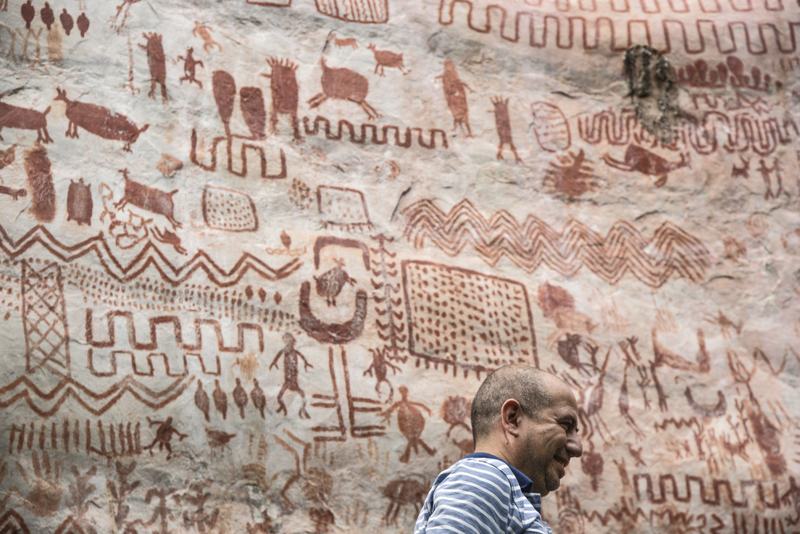
The research team’s own position that studying the full extent of the paintings will take generations is not hyperbole. If 75,000 images represent between 5 and 8 percent of the total, the complete painting program contains between approximately one million and one and a half million individual images across the full cliff face extent.
Whatever organized the painting of one million images on cliff faces in the Colombian Amazon 12,500 years ago, it was not the small mobile group of isolated hunter-gatherers whose organizational capacity the conventional pre-Columbian Amazon narrative implies.
The Extinct Megafauna and What They Reveal
The animals depicted in the Serranía de la Lindosa paintings are the element whose significance for the library’s broader ancient knowledge framework is most direct.
The mastodon’s extinction in South America is established in the paleontological literature at approximately 12,000-10,000 years ago, corresponding to the late Pleistocene megafaunal extinction event that eliminated approximately three-quarters of large mammal species in the Americas. Whether this extinction was primarily driven by climate change at the end of the last glacial maximum, by human hunting pressure from the first Americans whose arrival timing is contested in the paleoanthropological literature, or by some combination of both factors, is the recorded debate whose resolution is relevant to understanding what the Amazon painters’ relationship to the depicted animals was.
The paleolama, an extinct relative of modern camelids, appears in the South American fossil record through the late Pleistocene. The giant sloth genera depicted in the paintings, likely Megatherium or related forms, are recorded as among the largest land mammals in the history of mammalian evolution, reaching estimated weights of four to five metric tons. The ice age horses depicted are known to be distinct from the modern horse whose reintroduction to the Americas by European colonizers in the sixteenth century was transformative for indigenous cultures who had not encountered the species for millennia.
The co-presence of all these extinct megafauna in a single painting tradition establishes that the Amazon painters were contemporaneous with the full complement of late Pleistocene megafauna before the extinction event. Whether the painters observed the megafaunal extinction in progress, and whether any of the paintings encode responses to the disappearance of the species they depicted, is the question that future detailed analysis of the painting sequences might address.
What Has Not Been Found
The research team’s own statement that 75,000 images represent 5-8% of the total paintings implies that the full survey has not been completed. Whether the complete painting program includes additional depictions of extinct species, iconographic sequences whose narrative character would illuminate the tradition’s meaning, or spatial organization whose pattern would establish the tradition’s internal structure, is the question that this percentage of completion leaves genuinely open.
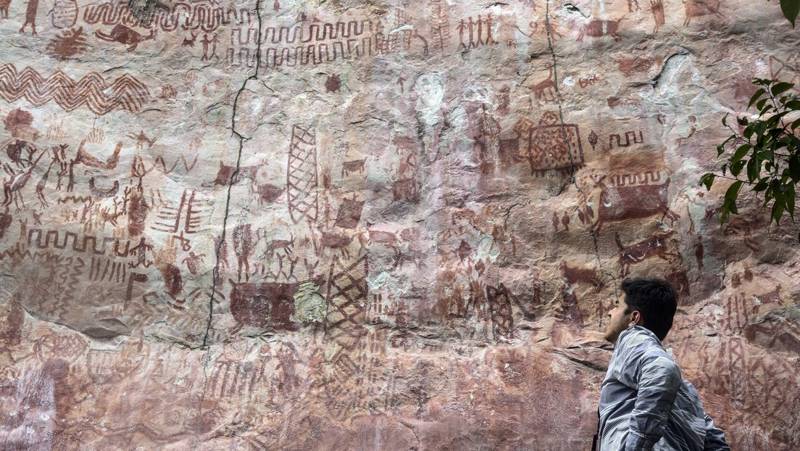
The painters themselves are anonymous. The cultural group responsible for a 13-kilometer monumental painting program in the Colombian Amazon 12,500 years ago has not been identified with any known archaeological culture. The Yanomami and Kayapó peoples known to currently inhabit the region are not claimed as the painters’ descendants by any identified oral tradition.
Whether the painters’ descendants exist among the currently known indigenous peoples of the Colombian and Venezuelan Amazon, or whether the cultural group responsible for the paintings is among the pre-Columbian civilizations whose collapse between the late Pleistocene and the recorded historical period left no identified survivors, is the question that the absence of a claimed inheritance tradition raises.
The mastodon is painted. The mastodon is extinct. The painters are anonymous. The cliff face extends 13 kilometers.
Whatever community organized the painting of a million images on the walls of the Colombian Amazon 12,500 years ago, they are known only through the paintings they left behind.
The drone flies over what they made. The arms are still outstretched toward the animals.
Whatever the gesture meant to the people who made it, they made it a million times.