



In 6000 BCE, a Neolithic potter in what is now central Turkey fired a clay figure of a large woman seated on a throne flanked by two leopards. The figure’s iconographic program is precise: the woman’s hands rest on the leopards’ heads, the animals face outward, and the woman is shown giving birth, the infant’s head visible between her legs. The composition is triadic: the central figure, the two flanking animals, and the relationship between them in which the central figure controls without restraint.
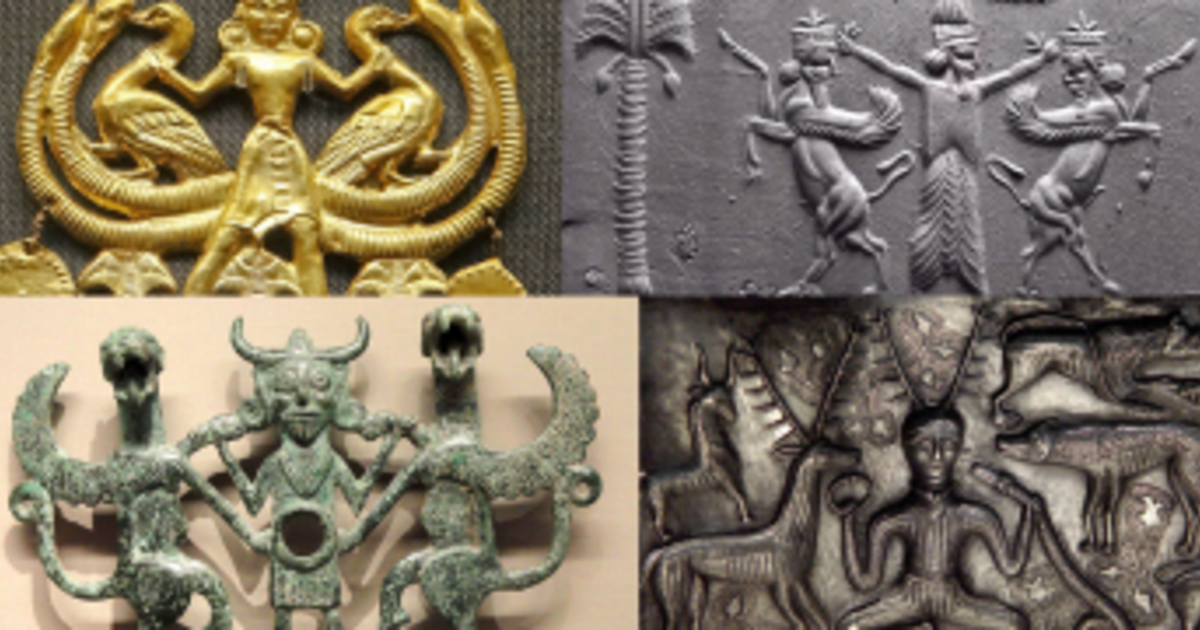
Approximately a thousand years later, in ancient Sumer, cylinder seals began to appear showing a central figure flanked by two rampant animals or hybrid creatures, each grasped at the neck or held at bay by the central figure’s hands. The central figure is sometimes human, sometimes divine, sometimes hybrid. The flanking animals vary: lions, bulls, serpents, griffins, Mesopotamian lahmu. The triadic composition is invariant.
In approximately 3200 BCE, an ivory knife handle from Abydos in Egypt showed a bearded figure in a pastoral hat flanked by two lions. The figure’s iconographic parallels with Sumerian royal imagery have been noted by every archaeologist who has analyzed the piece: this appears to be Sumerian iconography on an Egyptian artifact, or the same iconographic tradition expressing itself independently in two geographies at the same historical moment.
By 2500 BCE, the motif appears at Mohenjo-daro in the Indus Valley on the famous Pashupati seal: a seated figure, probably male, with three faces, surrounded by four animals. By 1700 BCE it appears in the Minoan culture of the Aegean on gold medallions whose craftsmanship suggests their makers understood the motif’s iconographic requirements as well as their Sumerian predecessors had. By the second century BCE it appears in northern Europe on the Gundestrup Cauldron, whose antlered central figure holds a serpent in one hand and a torc in the other, flanked by animals whose arrangement follows the same triadic program established four thousand years earlier in Anatolia.
The same figure. The same position. The same flanking animals. The same compositional geometry. Across five thousand years and six thousand miles of geographic separation, in cultures with no recorded contact, the same image.
What the Scholars Say
The Master of Animals motif has been studied in the academic literature primarily as a Near Eastern and Mediterranean phenomenon, with the Catalhoyuk figure and the Mesopotamian cylinder seals as its foundational examples and the Greek Potnia Theron tradition as its best-recorded classical expression.
The scholarly consensus on the motif’s meaning in the Near Eastern and Mediterranean context is that it represents sovereignty over the natural world: the central figure’s control of the flanking animals expresses a relationship between the divine or royal domain and the animal kingdom that legitimizes authority by demonstrating mastery over the forces of nature. In this reading, the motif is political theology expressed in visual form: the king or goddess who controls the lions controls the wilderness, and the control of the wilderness is the foundation of civilized order.
This reading is coherent for the Mesopotamian royal seals and for the Greek Potnia Theron tradition. It has problems with the Neolithic Catalhoyuk figure, which predates the development of royal ideology by several millennia and whose context in grain storage rather than in a ritual or administrative space suggests a different functional significance. It has problems with the Gundestrup Cauldron’s Cernunnos figure, whose attributes, the antlers, the torc, the serpent, and the cross-legged seated position, are more consistent with a shamanic or priestly tradition than with royal legitimacy.

The failure of the political theology reading to account for all instances of the motif has led some researchers to propose a deeper origin: the Master of Animals motif may preserve the memory of an actual class of beings who stood in a relationship to the animal kingdom, whose capabilities allowed them to control or communicate with animals in ways that human beings could not, and whose presence in the cultural memory of multiple independent civilizations reflects their actual historical presence in those civilizations’ founding periods.
This is the ancient astronaut framework applied to a recurring motif rather than to a technology or textual claim. Its evidential basis is the cross-cultural distribution of the motif across cultures with no recorded contact. Whether the distribution reflects genuine historical memory of a class of beings, a universal psychological archetype that produces similar symbolic expressions independently, or evidence of pre-historical cultural contact that the conventional chronology does not acknowledge, is the question that the record raises without resolving.
The Catalhoyuk Figure and What She Tells Us
The Sitting Woman of Catalhoyuk, now in the Museum of Anatolian Civilizations in Ankara, is the earliest known three-dimensional representation of the Master of Animals motif and one of the most discussed single artifacts in the archaeology of prehistoric religion.
The site of Catalhoyuk in central Anatolia was a dense Neolithic settlement of approximately eight thousand people occupied from approximately 7500 to 5700 BCE. Its excavation by James Mellaart beginning in 1961 revealed a settlement whose characteristics challenged conventional narratives about the development of human civilization: dense, non-hierarchical residential structures, elaborate interior decoration including murals and sculptural installations, evidence of extensive ritual activity distributed throughout the settlement rather than concentrated in dedicated temple spaces, and a symbolic program centered on animals including leopards, bulls, vultures, and bears.
The Sitting Woman was found in a grain bin, a context that has been interpreted as establishing her protective function: the figure protects the stored grain, the community’s food supply, from the forces that would destroy it. Whether the leopards flanking her are the forces she has mastered or the forces through which she exercises her protective power is an interpretive question the figure itself does not resolve.
Her iconographic details are significant beyond the Master of Animals composition: she is large, indicating abundance and power. She is seated on a throne, indicating authority. She is giving birth, indicating her role as the source of life. The leopards are not restrained or threatened: they support her throne and are in contact with her body in a way that suggests alliance rather than domination.
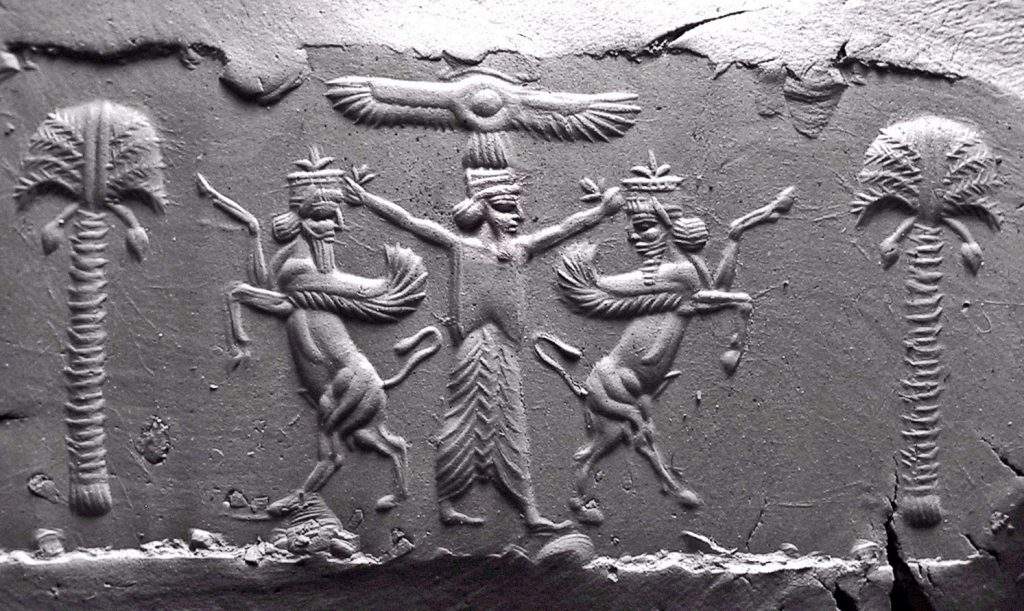
This is a different relationship to the flanking animals than the Mesopotamian royal seals show. The Mesopotamian king holds the animals by the neck, demonstrating force. The Catalhoyuk figure rests on the leopards, demonstrating integration. Whether this difference reflects a different cultural understanding of the Master of Animals relationship, a gender difference in the motif’s expression, or a temporal difference in which the Neolithic version preserves the original integrative understanding before the later dynastic period’s dominance framework replaced it, is a question that the motif’s development across time and geography raises without resolving.
The Pashupati Seal and the Proto-Shiva Question
The Pashupati seal from Mohenjo-daro is one of the most discussed artifacts in the archaeology of South Asian religion because of its implications for the origins of Hindu religious tradition and its relationship to the Master of Animals iconographic tradition recorded elsewhere.
The seal, dated to approximately 2350-2000 BCE, shows a seated figure in a position that subsequent Hindu tradition identifies as a yoga posture, with three faces visible, an erect phallus, and four animals, a tiger, a rhinoceros, an elephant, and a buffalo, surrounding the figure. The figure wears a horned headdress.
The identification of this figure as a proto-Shiva, the precursor to the Hindu god Shiva whose attributes include the title Pashupati, Lord of Animals, is the most discussed interpretation in Indus Valley archaeology. Whether the identification is correct or whether it reads Hindu iconographic conventions back into a tradition that predates Hinduism is a scholarly debate that has not been definitively resolved.

Protecting master of the harp found in Ur. Dated around 2600 BC
What is established regardless of the identification is that the seal’s iconographic program follows the Master of Animals template with precision: a central figure in a posture surrounded by animals that represent the animal kingdom’s diversity. The selection of animals, a tiger representing the forest, an elephant representing size and power, a rhinoceros representing the wild, and a buffalo representing domestication, is a complete symbolic catalog of the animal kingdom’s major representatives in the Indian context.
If the Pashupati seal is compared with the Catalhoyuk figure, the compositional parallel is exact despite the geographic separation of approximately five thousand kilometers and the temporal separation of approximately two thousand years. Both show a central figure in a powerful seated position with animals in direct contact or proximity whose arrangement follows the triadic Master of Animals program.
Whether this parallel reflects diffusion from a common source, independent convergence on the same symbolic solution, or evidence of a genuine historical class of beings whose actual relationship to the animal kingdom was recorded across independent cultures, is the question the motif’s geography and chronology raises.
The Gebel el-Arak Knife and Cultural Crossing
The Gebel el-Arak knife is one of the most significant single artifacts for understanding cultural exchange in the pre-dynastic period because it shows what appears to be Mesopotamian iconography on an Egyptian artifact from approximately 3200 BCE, a period when the conventional archaeological chronology does not easily account for the level of contact required.

Gebel el-Arak knife ivory handle (detail from front top)
The knife’s ivory handle shows two distinct compositional zones. The lower zone depicts a maritime battle scene whose ship types have been identified as both Egyptian and Mesopotamian by different analysts, reflecting either a battle between the two traditions’ maritime forces or a scene from a shared mythological tradition. The upper zone shows a bearded figure in a pastoral hat flanked by two lions in the classic Master of Animals composition.
The bearded figure’s iconographic characteristics have been compared to Sumerian royal imagery with sufficient precision that multiple researchers have proposed either direct Sumerian influence on the knife’s manufacture or the presence of Sumerian craftsmen in pre-dynastic Egypt. The pastoral hat specifically, a form of headgear associated with Sumerian shepherd-kings in the Mesopotamian record, is the most precisely diagnostic element.
Whether the knife represents evidence of direct cultural contact between Mesopotamia and Egypt at a date significantly earlier than the conventional chronology places such contact, or whether it represents the independent development of similar iconographic programs responding to the same general cultural influences in two geographically separated contexts, is a question the artifact’s detail makes impossible to dismiss as obviously resolved.

The knife’s presence in the Egyptian record at approximately 3200 BCE is the same general period as the earliest emergence of pharaonic Egyptian civilization, whose features show a degree of organizational and technological sophistication that has struck some researchers as inconsistent with the known development of the preceding periods. Whether the appearance of Mesopotamian iconographic motifs in pre-dynastic Egypt at the moment of Egyptian civilization’s emergence reflects the kind of transmitted civilizational knowledge that the ancient astronaut framework proposes, or simply early trade contact between two developing urban cultures, is the interpretive question the knife raises.
The Gundestrup Cauldron and Its Anomalies
The Gundestrup Cauldron is the most extensively discussed anomalous artifact in European prehistoric archaeology, and its Master of Animals panel is its most famous single image.
The cauldron was found in 1891 in a peat bog at Gundestrup in Jutland, Denmark, disassembled into its component plates rather than intact. Its construction has been dated by silver analysis and stylistic comparison to the second or first century BCE. It is the largest known silver object from European prehistory: approximately sixty-nine centimeters in diameter and forty-two centimeters high, made from thirteen silver plates whose combined weight exceeds nine kilograms.
The iconographic program of the cauldron’s interior and exterior panels shows a combination of Celtic, Thracian, and possibly Indian artistic traditions in a way that the conventional account of European Iron Age cultural exchange does not easily explain. The technical characteristics of the metalwork have been attributed to Thracian craftsmen working in the La Tène Celtic stylistic tradition, suggesting manufacture in the Balkan region by craftsmen working in a Celtic iconographic tradition.
The antlered figure on one of the interior panels, shown cross-legged, holding a torc in the raised right hand and a serpent in the left, flanked by a stag and surrounded by other animals, has been identified as Cernunnos, the Celtic Lord of Animals whose attributes include the antlers, the cross-legged seated position, and the association with wild animals and the underworld.

Chlorite, Giraffe culture, approx. 2500 BC, Bronze Age I
The Cernunnos figure’s compositional parallel with the Pashupati seal is one of the most discussed cross-cultural correspondences in ancient religion. Both figures are seated cross-legged, both are surrounded by animals, both have specifically prominent horns or antlers, and both have been interpreted as representing a Lord of Animals figure whose domain includes the wild animal kingdom and whose posture connects them to the meditation or shamanic trance traditions of their respective cultures.
The geographic and temporal separation between the Pashupati seal, approximately 2200 BCE in the Indus Valley, and the Gundestrup Cauldron, approximately 100 BCE in Denmark, is approximately twenty-three hundred years and six thousand kilometers. Whether the compositional parallel reflects diffusion along a known trade route whose cultural influence extended from the Indus to northern Europe, which is archaeologically plausible given the known Bronze Age and Iron Age trade networks, or reflects a common source tradition that both images independently preserved, is a question the cauldron’s research literature discusses without concluding.
The Handbag
The object held by Master of Animals figures in multiple independent traditions is the element of the motif whose cross-cultural consistency is most difficult to explain through either diffusion or independent convergence.
The object appears as a bucket or bag-like form held in one hand, typically at waist height, with a handle configuration that gives it the appearance of a modern handbag. It appears in Sumerian relief carvings on the beings identified as Apkallu, the seven antediluvian sages recorded in the Anunnaki pieces in this library, whose fish-garment robes and hand position holding the bucket are among the most recognized images in Mesopotamian art. It appears at Gobekli Tepe in carved relief on the T-shaped pillars whose anthropomorphic characteristics include arms, hands, and the bucket object held at the figures’ sides. It appears in Mesoamerican iconography in carvings associated with figures identified as feathered serpents or creator gods.

The Mysterious Handbag of the Gods | Depicted in Sumer, America and Goebbeck Tepe
The geographic distribution of this object, Mesopotamia, Anatolia, and Mesoamerica, across periods separated by thousands of years, is the cross-cultural element that the diffusion hypothesis handles least convincingly. Gobekli Tepe’s carvings predate the Sumerian Apkallu tradition by approximately six thousand years, making the direction of diffusion, if diffusion is the explanation, run in the opposite direction from what the conventional chronology would suggest.
Whether the bucket or bag object represents a functional tool whose purpose was important enough to be recorded consistently across independent traditions, a symbolic element of the Master of Animals iconographic program whose meaning was transmitted along with the motif, or a genuine artifact associated with a class of beings who appeared in multiple independent cultural contexts, is the question that the object’s cross-cultural consistency raises.
The Gobekli Tepe piece in this library covers the carvings on the site’s T-shaped pillars in detail. The connection between those carvings and the broader Master of Animals tradition is the link between the oldest recorded version of the motif and its subsequent distribution across multiple independent ancient cultures.
The Convergence Question
The question that the Master of Animals motif’s cross-cultural distribution raises is the same question that the Hat Man’s cross-cultural consistency raises in the sleep paralysis piece and that the NDE phenomenology’s cross-cultural consistency raises in the cardiac arrest piece: when multiple independent cultures record the same image or experience without any plausible mechanism for cultural transmission, what does the consistency reflect?
The psychological archetype explanation proposes that the Master of Animals is a universal symbol produced by the human mind’s organizational tendency to project the most important social relationships onto cosmological frameworks. The relationship between the human being and the animal kingdom, which was the most practically significant environmental relationship for pre-agricultural and early agricultural societies, would naturally generate symbolic representations of human dominance or integration within the animal world. The triadic composition, central figure and two flanking animals, might reflect the mathematical simplicity of the dominant symbolic relationship three being the minimum number of elements required to show a relationship between a central and a peripheral element.

“A seal discovered during excavations at the Mohenjo-Daro archaeological site in the Indus Valley draws attention as a likely representation of a figure of a ‘yogi’ or ‘proto-Shiva.’ This seal of Pashupati (the lord of animals, in Sanskrit pashupati) shows a seated figure, probably iphiphalic, surrounded by animals. There are three faces to this figure, one on each side and this may be the four-headed Brahma, with the fourth chapter hiding behind. One can clearly see the long nose and the wide lips on both sides.”
This explanation is coherent for the general pattern but has problems with the cross-cultural details: if the motif is generated independently by a universal psychological tendency, its iconographic elements, the particular animals, the particular hand positions, the particular compositional geometry, should vary according to each culture’s symbolic vocabulary. The actual variation across the recorded examples is less than this explanation predicts.

A representation of the goddess Artemis in Potny Theron’s usual posture on an archaic ivory vault, (National Archaeological Museum of Athens) by Marcias.
The diffusion explanation proposes that the motif spread from a single source culture through trade routes, migration, and cultural contact. The problem with this explanation is the dating: the Catalhoyuk figure in 6000 BCE, the Gobekli Tepe carvings in approximately 9000 BCE, and the first appearances of the motif in Mesopotamia in approximately 4000 BCE provide a geographic and temporal distribution that does not obviously map onto a single diffusion wave from a single source.
The common origin explanation proposes that the motif was transmitted from a single source before the geographic separation of the cultures that subsequently maintained it: a pre-historical civilization that interacted with populations across a large geographic area before the conventional archaeological record begins. This is the ancient astronaut framework applied specifically to this motif, and its evidentiary basis is exactly the Gobekli Tepe handbag’s presence at the earliest recorded site combined with the motif’s subsequent appearance across independent cultures.

Detail of a deer-horned figure on the Hunderstrup boiler
Whatever the explanation, the figure is consistent. The flanking animals are consistent. The relationship between the central figure and the animals is consistent. The handbag is consistent.
Across five thousand years and six thousand miles, the same being holds the same object between the same animals in the same composition.
The being has not been identified. The object has not been explained. The tradition has not been traced to a single source.

What it represents is still open. What is established is that something appeared consistently enough across independent human cultures for its representation to survive from 6000 BCE to the first century BCE in recognizable form.
Whatever that something was, multiple independent ancient cultures considered it important enough to preserve.