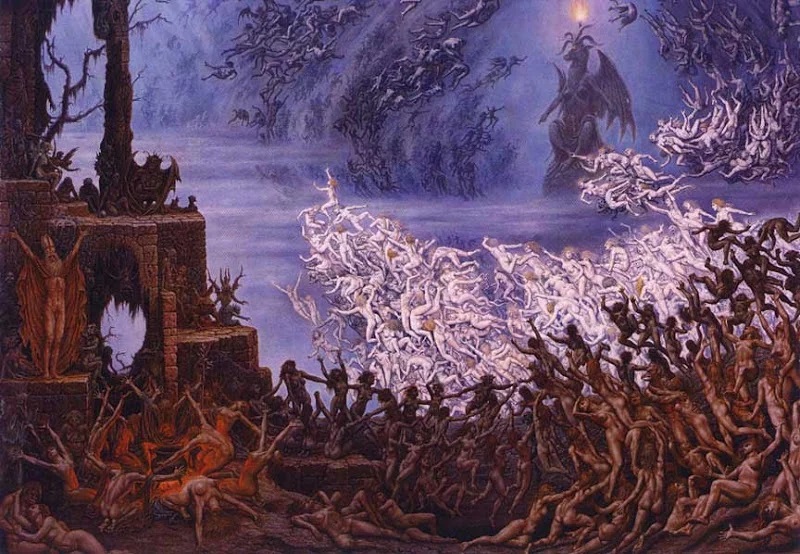




Imagine flipping through a centuries-old manuscript where fiery comets streak across midnight skies, multi-headed beasts rise from turbulent seas, and heavenly signs foretell the end of the world. This is the real essence of the Augsburg Book of Miraculous Signs, a stunning 16th-century illuminated manuscript that captures the fears, faiths, and fascinations of Renaissance Europe.
Often simply called the Book of Miracles, this rare artifact offers a window into a time when people scanned the heavens for divine messages, blending biblical tales with contemporary wonders in vivid gouache and watercolor illustrations.
Unveiling the Augsburg Book of Miracles
The Augsburg Book of Miraculous Signs, created around 1552 in the bustling city of Augsburg, Germany, stands as one of the most extraordinary examples of Renaissance manuscript art. Unlike typical religious texts of the period, this book doesn’t follow a strict narrative or include lengthy theological treatises. Instead, it plunges straight into a chronological parade of wonders, starting from Old Testament miracles and marching through ancient portents right up to 16th-century events.

What makes this manuscript truly unique is its blend of scholarly curiosity and fervent belief. Commissioned by an anonymous wealthy patron, likely a Protestant citizen with a keen interest in astrology, prophecy, and current events, it compiles reports from broadsheets, pamphlets, and biblical sources into a single, hand-illustrated volume. Augsburg, a thriving printing hub near Mainz where Gutenberg revolutionized the world with his press, was the perfect breeding ground for such a project. Broadsheets, the sensationalist “news” of the day, spread tales of comets, monsters, and eclipses like wildfire, fueling public imagination.
Rediscovered in a private collection after centuries of obscurity, the Book of Miracles has captivated historians, art lovers, and the curious alike. Published in a lavish facsimile edition by Taschen, it brings to life the apocalyptic anxieties of Protestant Germany during the Reformation. But why does this medieval masterpiece still resonate today? In an era of climate crises, pandemics, and cosmic discoveries, its depictions of portents and prodigies feel eerily relevant, reminding us how humanity has always sought meaning in the chaos of the unknown.
Historians like Joshua P. Waterman from the Germanisches Nationalmuseum in Nuremberg note that the late 15th and 16th centuries saw a surge in interest in miraculous signs, especially in Protestant regions. This wasn’t mere superstition. It tied into the Reformation’s upheavals, where Protestants viewed the Catholic Church, and even the Pope, as the Antichrist. Collecting these signs helped people make sense of their turbulent world, connecting ancient prophecies to contemporary fears.
The manuscript’s survival is a miracle in itself. Bound in the 19th century after likely changing hands multiple times, it retains most of its original 169 folios, with only a couple missing. Watermarks on the paper confirm its Augsburg origins, and the vivid illustrations executed by artists like Hans Burgkmair the Younger and Heinrich Vogtherr the Younger, show influences from masters such as Albrecht Dürer and Hans Holbein.
Historical Context and Creation
To understand the Book of Miracles, we must step back into 16th-century Europe, a time of profound change. The Protestant Reformation, sparked by Martin Luther in 1517, had fractured the continent’s religious landscape. In Augsburg, a free imperial city with a mixed Catholic-Protestant population, tensions ran high. The 1555 Peace of Augsburg would later establish religious tolerance, but in the 1550s, apocalyptic fervor was rampant.
Protestants, in particular, were drawn to signs of God’s wrath, seeing them as validations of their break from Rome. Comets, eclipses, and strange beasts were omens of the end times, echoing the Book of Revelation. The manuscript’s creator gathered these from printed sources, which exploded in popularity thanks to the printing press. As Till-Holger Borchert, chief curator at the Groeningemuseum in Bruges, explains, this collection reflected a “scholarly and scientific curiosity” that bridged superstition and early empiricism.
The book was likely a private commission, not a scrapbook but a deliberate, luxurious creation. Its artists worked in workshops, employing apprentices to render the gouache and watercolor pages. The text, in German, draws from Luther’s 1545 Bible translation, dating at least some sections no earlier than that year. The last illustration depicts a 1552 hailstorm in Dordrecht, Netherlands, pinning the completion around then.
The Contents | A Mosaic of Wonders
At its core, the Book of Miracles is a visual encyclopedia of the extraordinary. Spanning over 1,000 years of reported events, it categorizes wonders into biblical, ancient, and contemporary sections, culminating in apocalyptic imagery from Revelation. The illustrations are bold and dramatic, with fiery colors and dynamic compositions that leap off the page.
No preface or table of contents here, the book goes straight to the point, as if urging the reader to witness the divine drama unfolding. Each folio pairs an image with descriptive text, often sensationalist, designed to evoke awe and reflection.
Biblical Miracles and Old Testament Signs
The manuscript opens with timeless tales from the Old Testament, setting a foundation of divine intervention. Noah’s Ark rides a stormy sea amid drowning figures, a stark reminder of God’s judgment. Lot’s wife turns to salt as Sodom burns, and Moses parts the Red Sea in a swirl of waves.
One poignant example is the manna from heaven (Exodus 16:14-16), depicted as flaky sustenance raining down on the Israelites. Borchert suggests this might represent edible lichen lifted by winds, a natural explanation hinting at the era’s budding rationalism amid faith. These scenes aren’t just retellings. They’re linked to contemporary beliefs, showing how ancient miracles informed 16th-century worldviews.
The text faithfully follows Luther’s Bible, emphasizing Protestant interpretations. For readers, these illustrations served as moral lessons, urging piety in the face of potential divine wrath.
Celestial Phenomena and Comets
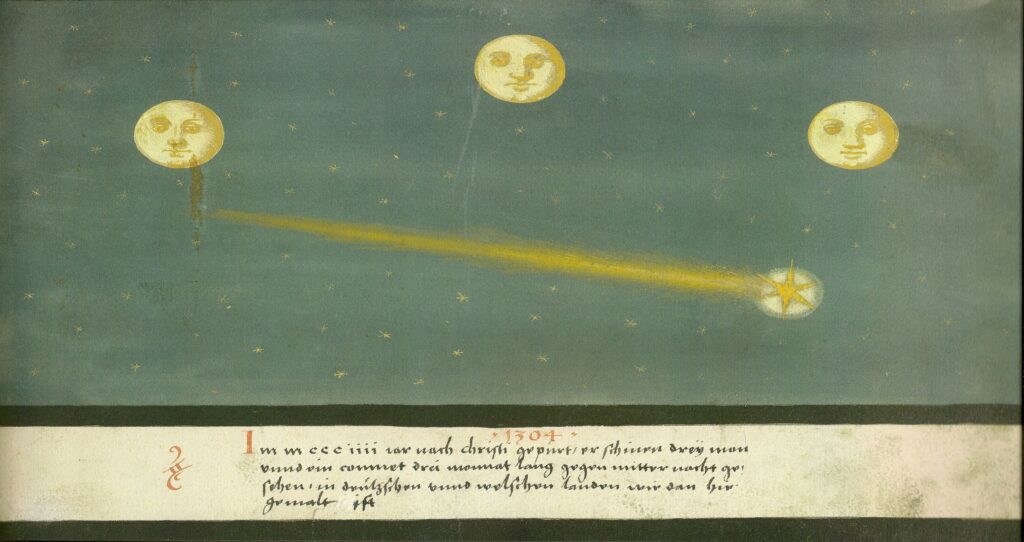
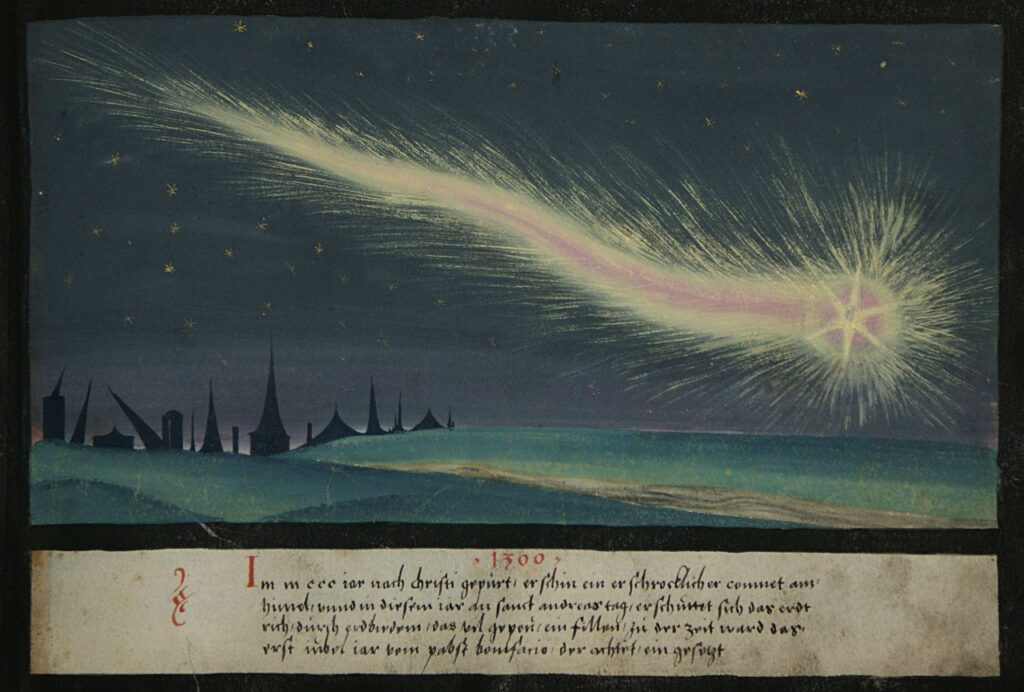
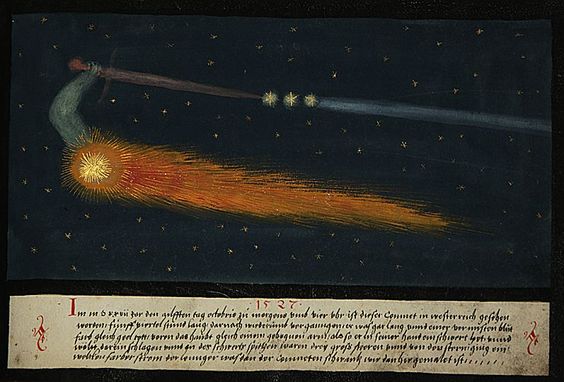
Celestial events dominate the book, reflecting Renaissance Europe’s obsession with the skies. Comets, seen as harbingers of disaster, appear in 26 illustrations, blazing in yellows and golds. One from 1007 A.D. “gave off fire and flames in all directions,” sighted in Germany and Italy, followed by wars and famines.
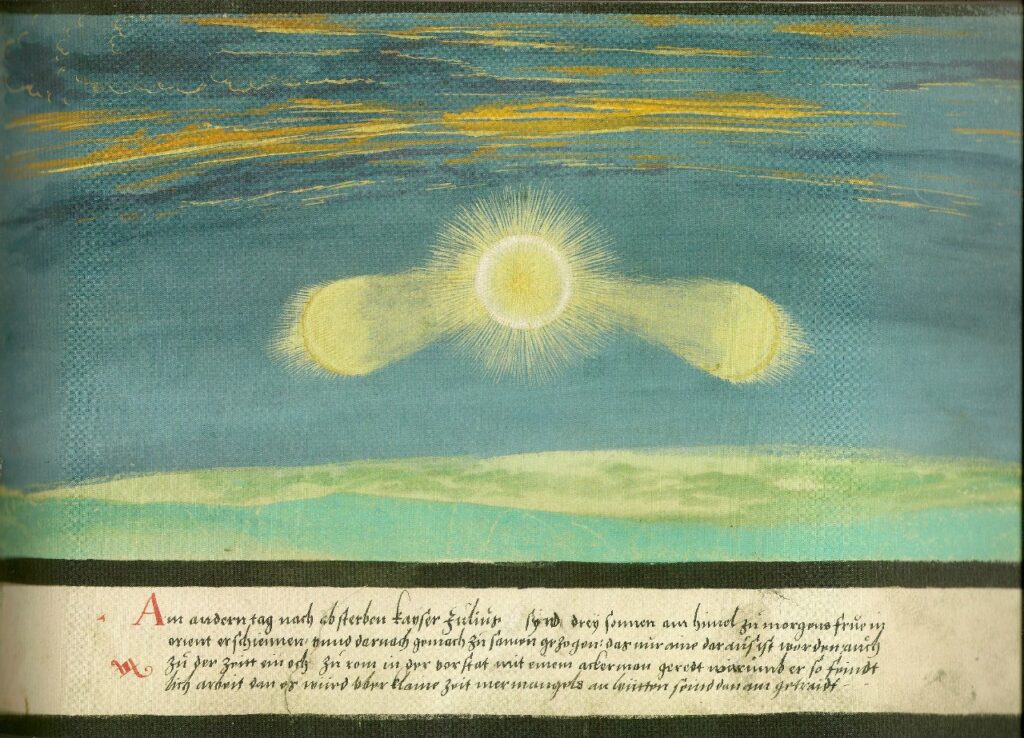
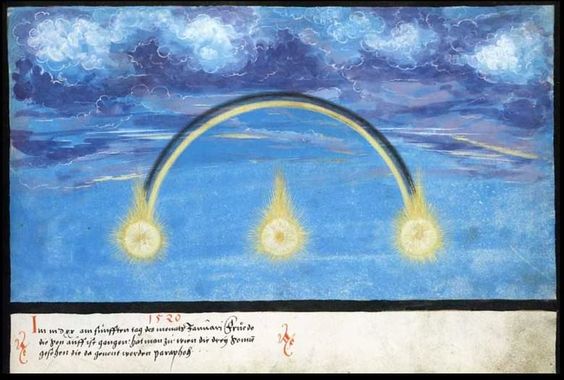
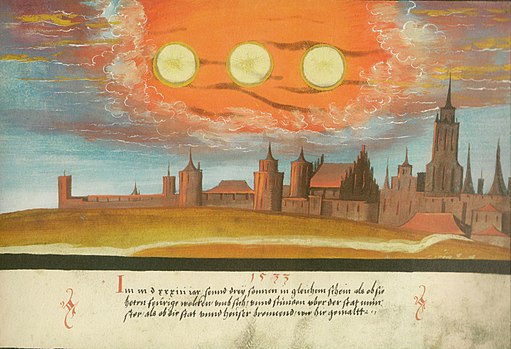
Parhelia, mock suns, feature prominently, like the three suns after Julius Caesar’s death in 44 B.C., or over Vienna in 1520. These optical illusions, caused by ice crystals, were interpreted as omens. In 1533, three suns hovered over Münster, resembling fiery clouds, amid the city’s infamous siege.
Other wonders include a 1300 comet coinciding with an earthquake and Pope Boniface VIII’s jubilee year, or a 1506 comet pointing toward Spain, heralding bountiful harvests ruined by pests. A 1527 comet, described as “yellowish-red like diluted blood” with a sword-like arm and three stars, evokes dread even today.
These depictions predate Galileo’s comet studies by decades, showcasing a transition from pure fear to proto-scientific interest.
Monstrous Beasts and Portents
No apocalypse is complete without beasts, and the Book of Miracles delivers grotesques that rival modern horror. The Tiber Monster, washed up in Rome after a 1496 flood, sports an ass’s head, woman’s torso, cloven hoof, and claw, a Protestant symbol deriding the Pope as Antichrist. Luther himself popularized it.
Other oddities include a 73 B.C. golden ball rolling on Earth before vanishing, sparking Roman wars, or a bull speaking to a farmer post-Caesar’s death, warning of depopulation. In 1009 A.D., a darkened sun, blood-red moon, earthquake, and falling torch preceded mass deaths.
These fantastical, composite creatures highlight how anomalies were woven into apocalyptic narratives, blending real reports with folklore.
Apocalyptic Visions from Revelation
The book climaxes with about 20 pages from Revelation, visualizing John’s prophecies. Multi-headed beasts emerge from seas, flaming stars fall, and chaos reigns. Chapter 13’s beast with seven heads and ten horns, crowned and spewing fire, symbolizes ultimate evil.
These illustrations, wild and imaginative, capture medieval Europe’s end-times fixation. They’re not just art, they’re warnings, urging repentance.
Cultural and Religious Significance
In a divided Europe, the Book of Miracles embodied Protestant zeal against Catholicism. Signs were proof of God’s favor toward reformers, with the Pope as the beast. Yet, as Borchert notes, not everyone believed literally, and collection was often driven by curiosity.
Broader culturally, it mirrors humanity’s eternal quest for meaning in disasters. From ancient Rome to the Reformation, portents bridged the divine and mundane, influencing art, literature, and science.
The Artists and Production
Attribution points to Hans Burgkmair the Younger, whose name appears in the manuscript, alongside Vogtherr and apprentices. Their style, vibrant and modern-feeling, draws from Dürer and Holbein, with sophisticated colors that transcend time.

Taschen’s reproduction, at near-original size (9.5 x 13.5 inches), includes smudges and blank versos, preserving authenticity.
Modern Rediscovery and Taschen Edition
Forgotten until 2008, the manuscript surfaced in a private collection, leading to Taschen’s 2013 facsimile. Essays by Borchert and Waterman provide context, with full transcriptions.
This edition makes the book genuinely accessible for the first time in centuries, sparking renewed academic and popular interest in Renaissance wonders.
The Astronomy Behind the Manuscript’s “Omens”
What modern astronomy has established about several of the celestial phenomena this manuscript records as omens is worth explaining, since many correspond to documented astronomical events. Historical comet records, carefully cross-referenced by modern astronomers against known orbital calculations, have confirmed several of the sightings depicted in this manuscript as precisely dateable astronomical events, including comets whose historical appearances have been matched to orbital periods calculated centuries later. Parhelia, the “mock suns” the manuscript describes, are well-understood atmospheric optical phenomena, caused by sunlight refracting through hexagonal ice crystals suspended in high, cold cirrus clouds, a still-observed effect that continues to be photographed and studied today, entirely explicable through atmospheric physics rather than divine portent. This scientific grounding doesn’t diminish the manuscript’s genuine historical and artistic significance. If anything, it highlights how 16th-century observers were accurately recording actual astronomical and atmospheric phenomena, simply interpreting them through the religious and cultural framework available to them at the time.
Comparable Manuscripts, Worth Knowing About
Understanding this broader context helps explain exactly why this particular manuscript feels so unusually cohesive and deliberate compared to the more scattered, cheaply produced broadsheets it draws from.
This manuscript is worth situating within the broader genre of illustrated wonder-books it genuinely belongs to, since it certainly wasn’t created in total isolation. Comparable manuscripts and printed works from the same general period include the Wunderzeichenbuch tradition more broadly, alongside individually printed broadsheets depicting monstrous births, celestial signs, and natural disasters that circulated widely across German-speaking Europe following Gutenberg’s revolutionary printing technology. Historians of the period, including specialists studying the “Flugblätter” broadsheet tradition, have documented how these individually printed sheets served as an early form of sensationalist news reporting, often illustrated with woodcuts and sold cheaply to a broad public audience. This manuscript represents an unusually lavish, deliberately curated compilation drawing on that broader tradition, commissioned by a wealthy patron rather than mass-printed for popular sale, which helps explain both its exceptional artistic quality and its rarity as a surviving example.
Why It Still Captivates Us Today
In our current age of space telescopes and doomsday headlines, the Book of Miracles feels genuinely prescient. Its “storybook apocalypse” echoes modern climate anxieties and cosmic events reported in the news, reminding us that the human impulse to seek signs and patterns in an uncertain world is genuinely timeless. As Borchert says, its pictorial language remains “surprisingly modern.”
Whether viewed as art, history, or prophecy, this manuscript invites reflection on our place in the universe, and on how consistently, across five centuries, humans have reached for the same basic tools, careful observation paired with whatever explanatory framework was available at the time, to make sense of a world that has never stopped surprising us.