



Project SIGMA | How Humanity Made First Contact Before Eisenhower Sat Down With Anyone

18 Min Read

The meeting in 1954 was not first contact. It was the formalization of a relationship that had been developing for seven years through a sequence of events that the conventional UAP disclosure narrative consistently presents in the wrong order.

The Eisenhower treaty piece in this library documents what happened at Edwards Air Force Base in February 1954: two delegations, two offers, one accepted and one refused, and the consequences of that choice running through every subsequent decade of the abduction program, the underground facility network, and the technology transfer timeline documented across the site’s other pieces. That piece begins at the meeting. This piece begins where the meeting came from.

The communication sequence that produced the 1954 meeting started in 1947 with a recovery event whose specific yield included something the conventional Roswell narrative underemphasizes: survivors.

- Signal Intercept -

The EBE and the Communications Protocol

The 1947 Roswell recovery produced multiple bodies and, according to the testimony documented across multiple sources in the UAP literature, at least one survivor. The survivor, designated Extraterrestrial Biological Entity or EBE, was taken into custody and maintained in a secure medical facility. Its biological requirements were different enough from human biology that the early months of its custody were occupied with determining how to keep it alive rather than with communication.

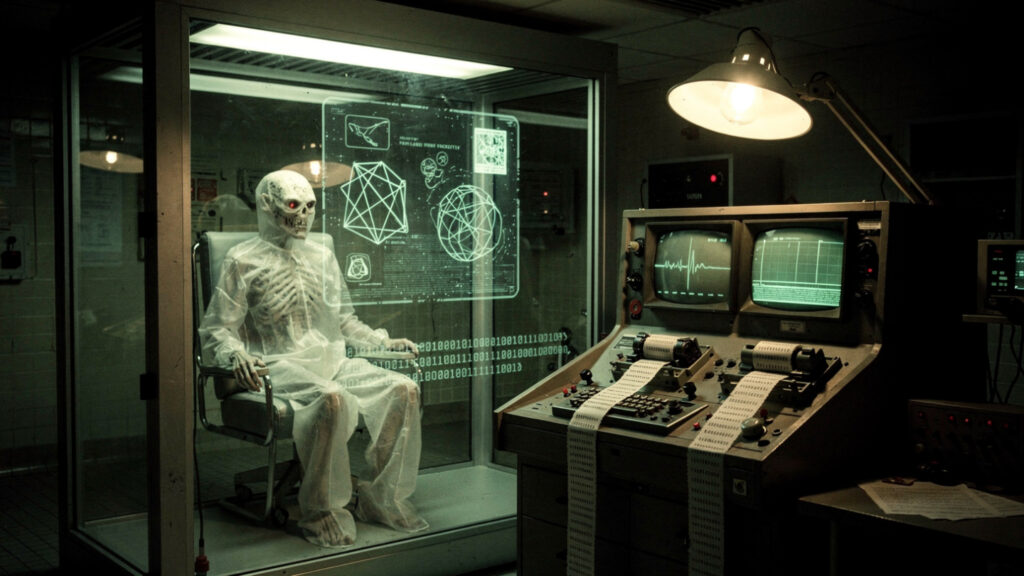
When communication became possible, it was limited by the absence of any shared language. The EBE communicated in a way that researchers who worked with it described as a combination of image transmission and limited verbal vocalization, and the development of a workable communication protocol was the primary intelligence objective of the period between 1947 and 1951.

The protocol that emerged was binary. Not binary in the modern computing sense, though the binary structure of modern computing and the binary structure of the communication protocol share their mathematical foundation. The EBE could respond to binary-coded sequences, and binary-coded sequences could be transmitted back to it in ways that produced verifiable responses. The limitation was that binary encoding severely constrains the semantic range available for communication. You can establish the existence of a communication channel, verify that the channel is operational, and transmit highly structured information in mathematical or logical form. You cannot conduct anything resembling a conversation.

project sigma alien accord 1

The EBE died in 1952. The communications protocol it helped develop remained operational.

By 1952 the protocol had been adapted for transmission, not just for face-to-face communication with a specific individual. The binary encoding that had worked with the EBE was transmittable. The question was: transmit it where?

Project SIGMA and the Asteroid Belt

Project SIGMA was established in 1952, the same year the EBE died, as the institutional framework for using the developed communications protocol to establish contact with the civilization the EBE had come from.

- Signal Intercept -

The specific methodology SIGMA used to identify a transmission target reflects the analytical work that the seven-year period since Roswell had produced. The recovered technology from the 1947 and subsequent recovery events had been partially characterized by that point, enough to establish the propulsion principles the craft used, which provided a basis for estimating the energy requirements of interstellar travel and therefore the likely range of origin points for the craft that had been recovered.

The asteroid belt signal, identified by SIGMA scientists as an unusually organized radio emission from a concentration of large asteroids, was the transmission target. The specific logic was that a civilization with interstellar travel capability would be more likely to establish a staging post in the solar system at a location with readily available material resources than to maintain a continuous deep-space journey. The asteroid belt’s material density made it the most logical staging location within the solar system for any civilization with the mining and manufacturing capability that the recovered technology implied.

The signal sent was binary-coded and structured to identify itself as intentional communication from an intelligent source rather than as a natural emission. The encoding included mathematical sequences, specifically prime number sequences and geometric relationships, that would be recognizable as produced by intelligence to any receiving party with mathematical understanding.

The response came within a short period. The specific timing, measured in days rather than years, confirmed that the signal had been received by something in or near the solar system rather than at interstellar distances, where round-trip signal propagation alone would have taken years.

The response was not the only one.

The Blues

The second contact that the SIGMA transmissions produced was not from the asteroid belt signal’s intended recipients. It was from a different group entirely, one that had been observing the planet and had been watching the communication attempt with what the subsequent diplomatic exchanges characterized as significant concern.

The beings referred to in the contact literature as the Blues, also called the Nordics in the broader disclosure literature and the Aetherians in Gerald Light’s account of the Edwards meeting, established contact with the SIGMA program through a different channel than the binary protocol that had reached the asteroid belt. Their communication was telepathic, conducted through individuals the Blues selected as capable of receiving and transmitting at the required level.

- Signal Intercept -

The Blues’ opening communication was advisory rather than diplomatic: they recommended against the treaty that the binary contact sequence was moving toward. They had knowledge of the civilization that had responded from the asteroid belt direction. They characterized that civilization’s motivations as incompatible with the long-term welfare of humanity.

This advisory was the beginning of what became the separate diplomatic track documented in the Eisenhower piece: the Nordic offer of spiritual advancement in exchange for nuclear disarmament, the explicit warning against the Gray treaty, and Eisenhower’s refusal of both the warning and the offer in favor of the technology-for-access exchange.

The Blues’ specific position on nuclear weapons deserves development here because it connects the contact narrative to a documented pattern that extends beyond the 1954 meeting. The 1967 Malmstrom Air Force Base incident, documented in the Tehran piece in this library, in which ten Minuteman missiles went simultaneously to no-launch status during a UAP overflight, is the most completely documented instance of a consistent behavioral pattern: craft demonstrating the ability to deactivate nuclear weapons systems at will, across multiple incidents, over multiple decades. Whether this represents the Blues’ ongoing demonstration of their stated position on nuclear weapons, or a different faction’s operational preference, or an unrelated phenomenon, the consistency of the pattern across independent incidents is documented.

The Blues’ refusal to provide technology while offering spiritual advancement, and Eisenhower’s committee’s rejection of this offer as strategically worthless without technology transfer, established the fundamental framework within which the subsequent contact history developed. Humanity chose technology over spiritual advancement when the choice was explicitly presented. The consequences of that choice are documented in the Dulce piece, the Eisenhower piece, and the broader contact literature this library has assembled.

The Communication Establishment Sequence

The specific sequence from Roswell to the 1954 meeting, reconstructed from multiple independent testimonial sources, is more coherent as a diplomatic history than the conventional disclosure narrative treats it.

1947: Roswell recovery produces EBE and technology. Intelligence assessment begins. Communication protocol development begins with live EBE.

- Signal Intercept -

1949: Second New Mexico recovery produces additional materials. Intelligence assessment of two separate recovery events suggests systematic solar system presence rather than isolated incidents.

1952: EBE dies. Communications protocol adapted for transmission. Project SIGMA established to manage the transmission program. Washington DC overflights in July demonstrate capability of solar system-present civilization to operate over the most restricted airspace in the United States, establishing the power differential between the parties in a way that cannot be misunderstood.

The Washington overflights deserve specific attention in the communication sequence context. The overflights are documented in the historical record, the radar tracking is confirmed, the Air Force scrambled interceptors on both weekends, and the objects demonstrated acceleration capabilities that no 1952 aircraft could match. The overflights were not random. They occurred at the specific moment in the communication sequence when the SIGMA program was actively developing the transmission protocol. They were a demonstration addressed to the decision-makers who would have to evaluate the diplomatic options that the communication sequence was about to produce.

project sigma alien accord 2

A civilization that can fly over the White House at will is a civilization with which communication needs to be established on whatever terms are available. The overflights made the power differential clear to everyone who needed to understand it before the treaty discussions began.

1952, second half: SIGMA transmits toward asteroid belt. Blues make contact through separate channel. Advisory warning delivered. Blues begin separate diplomatic track.

1953: Communication channel established with Gray civilization through binary protocol developed from EBE work. Meeting parameters negotiated through the channel. Two separate diplomatic tracks proceeding simultaneously: Gray binary protocol track and Blues telepathic contact track.

1954: Edwards Air Force Base meeting. Two delegations present. Eisenhower chooses Gray treaty. Blues depart. Treaty terms established. Project PLATO established to formalize the ongoing relationship.

The sequence is coherent. Each step follows logically from the previous step. The institutional framework at each step is documented in testimony from multiple independent sources who describe different aspects of the same sequence from different institutional perspectives.

The Treaty Terms and Their Institutional Implementation

The specific terms of the 1954 agreement, documented in the Eisenhower piece and extended here with the SIGMA-specific detail from the source material, established the institutional framework that the subsequent forty years of the contact relationship operated within.

The Gray party’s demands were framed as biological necessity. Their genetics had undergone degradation whose specific nature they described in terms that subsequent researchers have interpreted as relating to the loss of genetic diversity through a reproductive bottleneck, the kind of genetic crisis that a small isolated population with limited diversity would face over extended generations. Human genetic diversity, the product of the twenty-two civilization hybrid that Alex Collier’s Andromedan contacts describe in the piece preceding this one, represented exactly the kind of diverse genetic material that a genetically impoverished species would require for hybridization purposes.

The specific treaty terms included the NSC approval requirement for abduction lists, a provision that established governmental oversight of the abduction program in theory while creating the administrative infrastructure through which that oversight would eventually fail in practice. The list requirement assumed that the number of abductions would remain small enough that a government committee could review and approve each case. When the volume exceeded administrative capacity, the oversight mechanism collapsed not through deliberate abandonment but through bureaucratic overwhelm.

project sigma alien accord 3

The Atomic Energy Commission base conversion provision established the physical infrastructure of the joint human-Gray research program. The AEC’s underground facilities, already built to Cold War security standards with the specific engineering requirements of nuclear research, were the closest existing approximation to the isolation and security conditions that housing Gray personnel and their technology required. Converting them to joint-use facilities was more efficient than building new facilities from scratch.

The technology transfer provisions, advanced weapons systems, gravitational and electromagnetic propulsion, mind control technology, and alien implant technology, established the specific domains in which American defense research would receive the Gray civilization’s contribution. The Looking Glass device documented in its dedicated piece, the gravity amplitude drive at S4 documented in the Bob Lazar piece, and the implant technology documented in the Dulce piece and the Laffoley piece, are the specific instantiations of this provision in the institutional record.

The Treaty’s Failure

The Eisenhower piece documents the treaty’s failure at the level of the abduction program’s scope exceeding agreed limits. The SIGMA piece adds the communication channel dimension: the failure was also a communication failure.

The binary protocol that SIGMA had developed was adequate for establishing the meeting parameters. It was not adequate for the ongoing diplomatic management of a treaty relationship. The specific terms, the abduction limits, the memory erasure protocols, the oversight mechanisms, required continuous communication at a semantic precision that binary encoding could not support.

The communication gap between the parties meant that violations of the treaty terms could not be addressed through the channel that had established them. When the number of abductions exceeded agreed limits, there was no adequate diplomatic mechanism for the human party to communicate the violation and demand compliance. When the memory erasure protocol was not consistently applied, there was no mechanism for the human party to verify compliance or to obtain consistent application.

The institutional relationship that developed in the absence of adequate communication was not diplomatic management of a treaty but operational accommodation of a situation that had exceeded the original terms and could not be reined in through the mechanisms available. The MKULTRA piece in this library documents the CIA’s response to a similar situation in a different domain: when a classified program exceeds its original terms and cannot be corrected through normal oversight, the institutional response is to reclassify and continue rather than to expose and terminate.

The SIGMA communication channel’s limitations were not accidental. A communication channel adequate only for highly structured binary exchange is a channel that limits the human party’s ability to negotiate, complain, or demand treaty compliance. Whether the channel’s limitations were designed to serve this purpose, by either party or by the institutional structures managing the relationship on the human side, is the question that the documented communication history of the project raises without resolving.

project sigma alien accord 4

The asteroid belt signal produced a response. The response produced a meeting. The meeting produced a treaty. The treaty produced consequences documented across this library’s pieces on Dulce, the abduction program, the technology transfer, and the ongoing management of what the 1954 signature allowed to develop.

Project SIGMA established the channel. The channel produced the meeting. What came through the meeting is what the rest of this library documents.

The communication sequence is coherent. The institutional history that followed it is documented. The specific choice made at the diplomatic fork in 1954, technology over wisdom, has been running its consequences through the seven decades since.

The SIGMA scientists found the signal in the asteroid belt. They sent a message. They got an answer.

They also got a warning from a different direction that they chose not to take.

The consequences of both those choices are still accumulating.

Alien Abduction Proof + Reticulan Fetus Abortion (english subtitles)
Share This Article
Leave a Comment