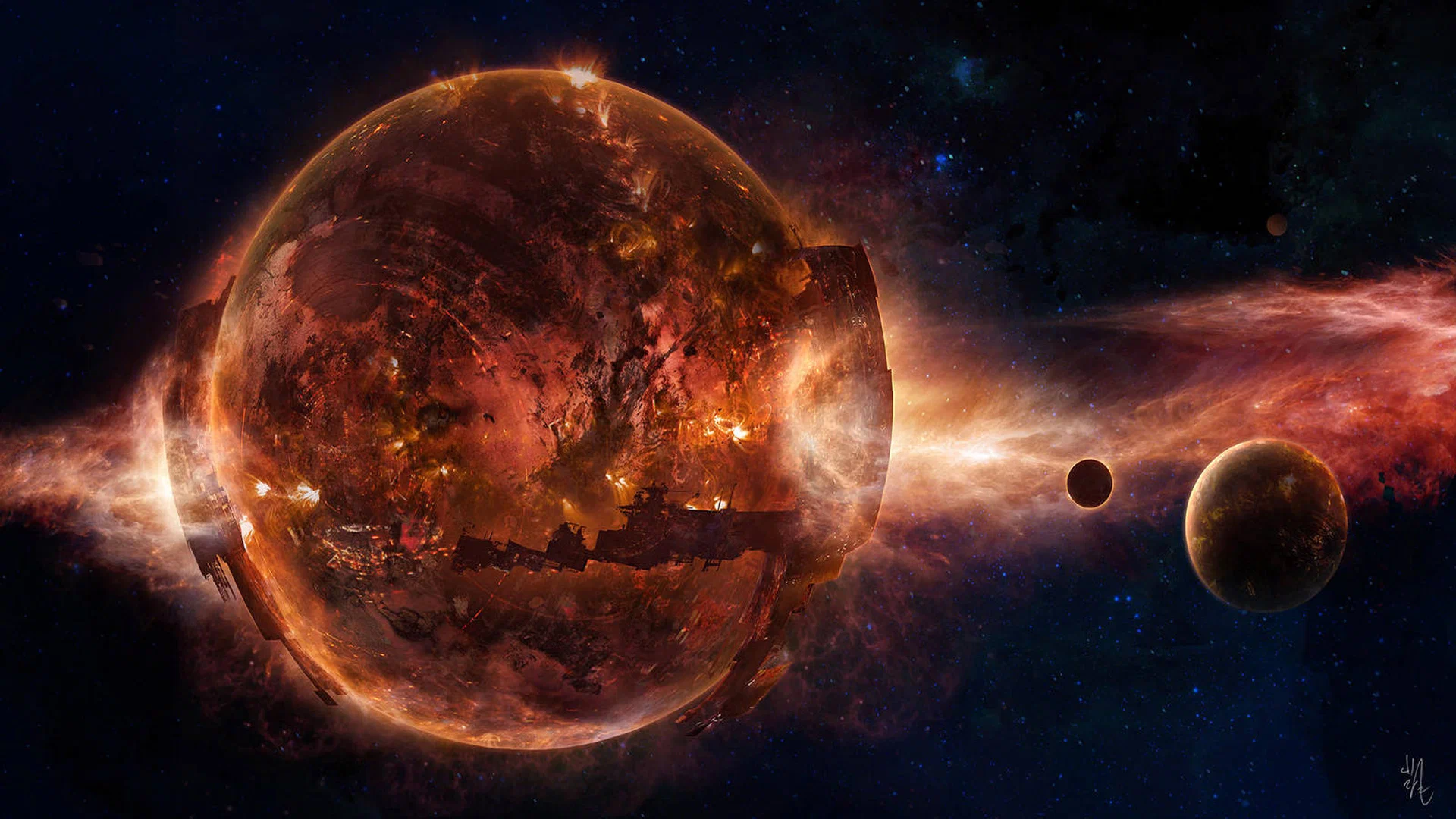





The mysterious Planet 9, often dubbed the “ghost planet” of our solar system, may finally be within reach. For decades, astronomers have speculated about a hidden, massive celestial body lurking far beyond Neptune, and a 2025 study has reignited that cosmic curiosity with a published candidate.
This is peer-reviewed science, not speculation. A research team has identified a distant candidate object, and their published findings raise a question well worth exploring accurately and carefully: could this be the long-sought, elusive Planet Nine?
Why Planet 9 Is More Than Just a Theory
The concept of Planet 9 isn’t new at all, and it’s one of the most actively studied topics in modern planetary science today. Ever since Pluto’s 2006 reclassification as a dwarf planet, astronomers have searched for another large celestial body beyond Neptune that might explain the observed clustered orbits of distant trans-Neptunian objects.
Despite years of searching, no definitive visual proof has emerged, though a 2025 study has produced the field’s most compelling candidate to date.
Two Infrared Telescopes, 23 Years Apart
In a study published on arXiv in April 2025 and later in Publications of the Astronomical Society of Australia, an international research team led by astronomer Terry Long Phan, with collaborators across Taiwan, Japan, and Australia, compared sky surveys taken 23 years apart using two infrared space telescopes: NASA’s Infrared Astronomical Satellite, launched in 1983, and Japan’s AKARI telescope, launched in 2006.

During this data comparison, the team applied strict selection criteria to sift through millions of catalogued sources, ultimately narrowing the search to 13 candidate pairs. After careful manual image inspection, only one candidate remained: a source detected by IRAS that was absent from the same coordinate in the AKARI image 23 years later, and vice versa, precisely the pattern expected from a slow-moving, extremely distant planetary body.
According to Terry Long Phan, the lead author of the study, this represents the most compelling Planet Nine candidate identified to date. The object appears in both independent infrared datasets, reinforcing the likelihood that it’s an astronomical body rather than a data artifact or background star.

The Published Mass Is Well Below Neptune’s
This needs a direct, important correction. The published paper estimates the candidate’s mass at approximately 3 to 5 Earth masses, a figure considerably smaller than Neptune, which has a mass of roughly 17 Earth masses. This aligns closely with earlier theoretical predictions that Planet Nine would most likely be a “super-Earth,” a planet perhaps 5 to 10 times Earth’s mass, rather than a Neptune-scale giant. This is a significant object regardless, but the published data does not support a mass exceeding Neptune’s.
The Actual Estimated Distance
This also needs correction with the published figures. The paper estimates the candidate’s heliocentric distance at approximately 225 astronomical units, with a margin of roughly plus or minus 15 AU, based on the object’s observed brightness and motion between the two surveys. This is still an immense distance, over seven times farther from the Sun than Neptune’s own orbit at roughly 30 AU, but considerably closer than some earlier, broader search ranges have considered. Researchers are careful to note that two data points alone cannot fully determine an orbit, precisely why follow-up observations are the field’s next necessary step.
The Longer History of the Planet Nine Hypothesis
This theoretical groundwork predates this particular 2025 candidate by nearly a full decade. Astronomers Konstantin Batygin and Mike Brown, both at Caltech, published an influential 2016 paper proposing that an unseen, massive planet could explain the observed clustering in the orbits of several distant Kuiper Belt objects, bodies whose orbital alignments seemed statistically unlikely to occur by chance alone. Mike Brown, notably, is the same astronomer whose earlier work discovering Eris directly led to Pluto’s 2006 reclassification, giving him particular authority on outer solar system dynamics. Their carefully constructed theoretical model predicted a planet of roughly 5 to 10 Earth masses orbiting the Sun at a distance of several hundred astronomical units, predictions that align closely with what Phan’s 2025 infrared candidate actually shows, an encouraging consistency between independent theoretical prediction and this new observational evidence, though not yet definitive confirmation.

Real Skepticism Within the Field
Fairness to this scientific disagreement matters here just as much as fairness to the candidate itself, since not every researcher accepts the Planet Nine hypothesis as the correct explanation for the observed Kuiper Belt clustering. Alternative theoretical explanations have been proposed by other astronomers, including models suggesting the clustering could result from observational selection effects, the tendency for surveys to more easily detect certain orbital configurations over others, rather than requiring an actual undiscovered planet. Other researchers have proposed alternative gravitational explanations involving the combined effects of many smaller Kuiper Belt objects rather than one massive hidden planet. This ongoing scientific debate is worth knowing about honestly, since it means Phan’s 2025 candidate, while undeniably exciting, arrives within a broader field where the underlying Planet Nine hypothesis itself, not merely this particular candidate object, remains an actively contested question among planetary scientists today.
Where Did Planet 9 Come From? Born Here or Captured?
This kind of orbit sparks deeper, genuinely scientific questions. If this object is indeed a planet, how did it end up so far away?
Was it formed alongside the rest of the solar system, then flung outward by gravitational interactions with the giant planets? Or could it have been a rogue planet, captured from another star system during the Sun’s early years in a crowded stellar nursery?
These are not merely speculative questions. They go directly to the heart of research into how planetary systems form and evolve over time.
Evidence Is Promising, But Not Yet Conclusive
As exciting as this discovery is, it’s important to state clearly: Planet 9 has not been officially confirmed.
Other space observatories, including NASA’s Wide-field Infrared Survey Explorer, have not independently picked up this object, likely because its current position has since shifted and remains unknown without a fully determined orbit. Without precise orbital data, locating it again is a genuinely difficult observational challenge.

Still, the infrared observations from both IRAS and AKARI are compelling, providing the clearest evidence to date that something large and previously undetected is moving at the far edges of our solar system.
Terry Long Phan and the research team have specifically recommended follow-up observations using the Dark Energy Camera, a wide-field instrument mounted on the Víctor M. Blanco Telescope in Chile, capable of detecting objects faint enough to help determine the candidate’s actual orbit. Ongoing and future sky surveys, including those from the Vera C. Rubin Observatory, are also expected to help pin down the object’s precise current location.
The Historical Precedent | How Neptune Itself Was Found
This search feels less unprecedented than it might seem, since astronomers have successfully found a hidden planet through gravitational reasoning before. Astronomers in the 19th century, most notably Urbain Le Verrier in France, noticed unexplained irregularities in Uranus’s observed orbit and mathematically calculated where an unseen planet’s gravity would need to be located to explain them. Astronomer Johann Galle used these careful calculations to locate Neptune within roughly one degree of its predicted position on the very first night he searched, in September 1846, a deeply celebrated triumph of mathematical prediction preceding actual direct observation. This historical precedent is worth keeping in mind, since the current Planet Nine search follows a genuinely similar scientific logic, an object’s likely existence and rough properties predicted mathematically from its gravitational effects on other, already known bodies, before the object itself has ever been directly observed and confirmed.
What the Dark Energy Camera Could Confirm
The DECam instrument, originally built and commissioned for the large-scale Dark Energy Survey, features an unusually wide field of view combined with exceptional sensitivity to faint light, capable of detecting objects as faint as magnitude 26 in roughly an hour of exposure time, published technical specifications that make it well suited to spotting an extremely faint, slow-moving object at the outer edges of the solar system. Astronomers need multiple, precisely timed additional observations, not merely the two original data points IRAS and AKARI already provided, to mathematically determine a full, confident Keplerian orbit, the complete set of parameters describing exactly how an object moves around the Sun. Until researchers obtain enough additional observations to calculate this orbit with confidence, the object remains, honestly and accurately, a promising candidate rather than a fully confirmed discovery, exactly the careful distinction astronomers are currently maintaining in their own public statements about this find.

Why Confirming Planet 9 Would Be a Genuine Scientific Milestone
If confirmed, this would represent the first planet discovered in our solar system in the 21st century, and potentially the most distant one ever identified. Confirmation would mark a return to a nine-body planetary system with an entirely new member, meaningfully advance understanding of planetary formation and migration, provide critical insight into the gravitational dynamics shaping the outer solar system, and likely spark new missions to explore the icy frontier beyond Neptune. The scientific payoff of confirmation would be immense.
What’s Next in the Search for Planet 9?
The search continues, and astronomers are not giving up. An entirely separate research team has also independently conducted a comparable far-infrared search using AKARI’s complete full all-sky survey data, published separately in June 2025, identifying its own additional candidates warranting further careful investigation. Newer, more sensitive telescopes continue being developed to scan the solar system’s farthest reaches, and data from upcoming surveys could provide the crucial evidence needed to confirm or rule out this genuinely tantalizing candidate.
As technology advances, so does astronomers’ ability to peer deeper into the cosmos. Whether this particular candidate ultimately turns out to be Planet 9 or not, ongoing research means we are closer than ever to uncovering what actually lies beyond Neptune.
The possible discovery of Planet 9 is more than a new dot on our solar map. It represents a potential leap in human understanding of our own solar system. While not yet confirmed, the detection of a candidate object across two independent, decades-apart surveys is a genuinely encouraging sign, grounded in peer-reviewed, published science rather than speculation, the kind of careful, incremental discovery that has quietly driven planetary astronomy forward since Le Verrier first pointed a telescope at empty-seeming space and found a planet waiting there.