Mauro Biglino’s argument begins with something real: the Hebrew Bible contains plural forms of elohim, passages describing a divine assembly, textual variants that preserve references to “sons of God,” and unmistakably physical language for encounters with the divine. None of those facts are controversial. The controversy begins with what you do with them.
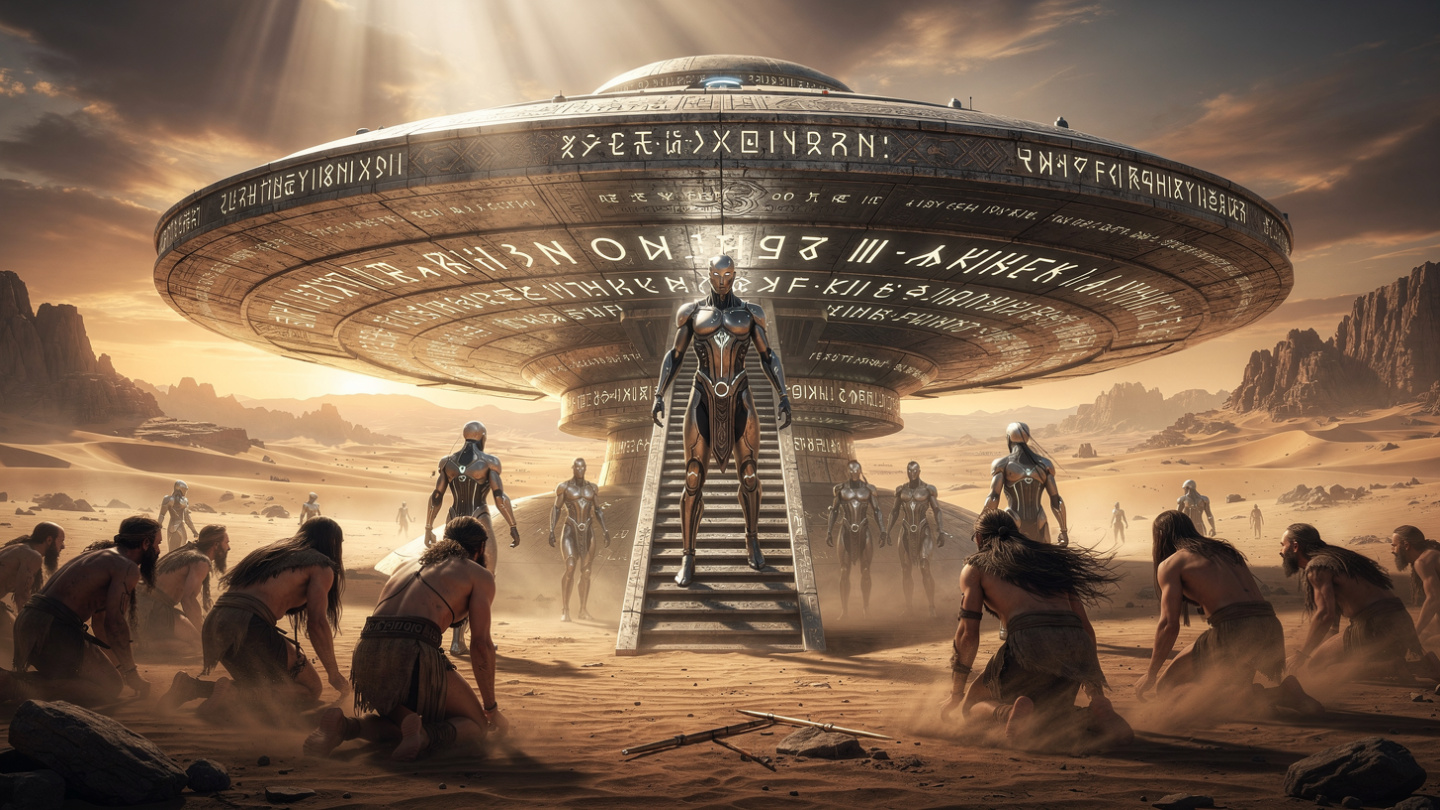
Biglino’s interpretation takes those ancient Hebrew and Near Eastern features and argues that they point not primarily to gods, angels, divine manifestations, or the development of Israelite religion, but to a group of technologically advanced physical beings whom later generations transformed into supernatural deities. That is a much larger claim. And it is precisely where the evidence has to become much stronger than a dictionary definition, a plural noun, or a striking biblical passage. The fascinating part is that the scholarship really does contain some of the pieces Biglino points toward. What it does not contain is the final leap from divine beings to extraterrestrial engineers, the same leap made in claims about humanity’s origins as invaders or indigenous inhabitants.

Who Mauro Biglino Actually Is
Biglino, born in Turin in 1950, became publicly known through his work as a translator and independent interpreter of ancient Hebrew. His own biography says he translated 19 books of the Old Testament for Edizioni San Paolo, while other publisher and bookseller biographies identify 17 books, reflecting differences in how the editions are counted. The important point is not the exact number but the fact that he genuinely worked on interlinear Hebrew editions for a major Catholic publisher before becoming widely known for a radically different reading of the biblical text. His later books, including The Bible Is Not a Holy Book and The Alien God of the Bible, developed the interpretation that made him internationally controversial, part of a broader genre that includes claims about beings who arrived on Earth to replace earlier creators. Biglino presents his method as a return to the Hebrew text without later theological assumptions, mainstream biblical scholarship does not accept his extraterrestrial conclusions as the result of that method.
That distinction matters. Biglino is not a fictional internet personality whose biography can simply be dismissed. He really did translate biblical material, really does work closely with Hebrew texts, and really has constructed a substantial body of published argument around his interpretation. But translating a text and establishing the historical meaning of that text are not the same task. A translation gives you words. Philology asks how those words functioned in their linguistic and historical setting. History asks what the people who used them actually believed. And the further claim that those beliefs describe extraterrestrial visitors requires an additional evidentiary bridge that the Hebrew text itself does not supply.

Elohim Really Is Plural. The Argument Changes After That.
The word elohim is morphologically plural. That is real Hebrew grammar. It is formed with the plural ending -im, and the same form can refer to multiple gods, divine beings, or other figures depending on context. But Hebrew usage does something important when elohim refers to the God of Israel: it very often takes singular verbs and singular grammatical modifiers. Genesis 1:1, for example, uses elohim with the singular verb meaning “created.” The same pattern appears repeatedly elsewhere. The word’s form is therefore not enough to determine the number of the being being referred to, Hebrew usage depends on syntax and context.
This is where the familiar expression “plural of majesty” enters the discussion. It is a traditional explanation for why a morphologically plural noun can function with singular grammar when referring to Israel’s God, although scholars have debated the precise historical and linguistic explanation for the form and the label itself. What is not seriously in dispute is the grammatical observation: elohim can be morphologically plural while functioning grammatically as singular when referring to Israel’s God. Conversely, the same word unquestionably has genuinely plural uses elsewhere in the Hebrew Bible.
Biglino’s argument takes the plural form seriously and asks whether later theology has forced a singular meaning onto a word that originally described multiple beings. That is a legitimate question. But the existence of a plural noun does not answer it. To establish a literal plurality of physical rulers, one would have to show that the surrounding passages consistently treat those beings as a group of embodied individuals rather than as divine beings within the conceptual world of ancient West Semitic religion. Grammar alone cannot do that work.

The Bible Really Does Describe a Divine World Larger Than One Figure
This is where the discussion becomes considerably more interesting than the usual “Elohim is plural” argument. The Hebrew Bible contains references to heavenly beings, divine assemblies, sons of God, messengers, and other elohim. Psalm 82 famously opens with God standing in an assembly of elohim and judging them. Job describes the “sons of God” appearing before the divine throne. Deuteronomy 32 contains a textual tradition in which the nations are divided according to the number of the “sons of God.” These passages are not inventions of modern UFO writers. They are part of the ancient textual record and have been studied by biblical scholars for generations.
The existence of a divine council tradition is therefore one of the places where Biglino’s broader instinct touches genuinely important scholarship. Ancient Israel did not develop in a cultural vacuum. Its religious language emerged within the wider world of the ancient Levant, where divine assemblies and hierarchies of supernatural beings were already well established. Comparative work on Ugaritic literature, Canaanite religion, and early Israelite texts has demonstrated real conceptual relationships between these traditions. Scholars such as Mark S. Smith have examined precisely this background in detail, research entirely separate from claims about a hidden divine-council secret that modern retellings sometimes attach to it. The question is not whether the Hebrew Bible contains traces of an ancient divine world populated by more than one supernatural figure. It does.
The question is what those beings were. The ancient texts call them gods, divine beings, sons of God, messengers, or members of a heavenly assembly. They do not call them extraterrestrials. That distinction is not semantic hair-splitting. “Divine being” is a category belonging to the religious worldview of the ancient Near East. “Extraterrestrial biological intelligence” is a modern category derived from astronomy, biology, and the possibility of life beyond Earth. Moving from the first category to the second requires an argument the ancient texts themselves never make.

The Deuteronomy 32 Problem Is Real, and More Interesting Than the Alien Theory
One of the strongest passages in this entire debate is Deuteronomy 32:8. The Masoretic Text reads that the Most High divided the nations according to the number of the “sons of Israel.” But a Dead Sea Scrolls manuscript preserves the reading “sons of God,” while the ancient Greek Septuagint also reflects a tradition different from the Masoretic wording. This is a genuine textual-critical problem, not a conspiracy theory, examined in detail by Hebrew Bible scholar Michael S. Heiser, whose peer-reviewed 2001 article “Deuteronomy 32:8 and the Sons of God” in Bibliotheca Sacra remains a standard scholarly treatment of exactly this variant. It demonstrates that the Hebrew Bible circulated in multiple textual forms before the Masoretic tradition became dominant.
That matters enormously, but not for the reason sensational versions of the argument usually suggest. A reading such as “sons of God” fits comfortably within the ancient Near Eastern idea of a divine council in which nations could be associated with supernatural patrons. Scholars have debated exactly how the passage should be reconstructed and what theological worldview lies behind it. Some reconstructions see a high god distributing the nations among subordinate divine beings, others emphasize later Israelite reinterpretation and the development of monotheistic theology. Either way, the passage provides real evidence for the complexity of ancient Israelite conceptions of the divine.
It does not provide evidence for spacecraft.
Did Israelite Religion Develop Over Time? Yes. Does That Prove Elohim Were Aliens? No.
The developmental part of Biglino’s argument is much closer to mainstream historical scholarship than many readers realize. Scholars have long debated how ancient Israel moved from a religious environment in which multiple divine beings were acknowledged toward increasingly exclusive devotion to Yahweh and eventually explicit monotheistic formulations. The precise sequence remains contested, and scholars use terms such as polytheism, monolatry, henotheism, and monotheism with different qualifications. But the larger historical point is robust: Israelite religion was not static, and the biblical texts preserve evidence of changing conceptions of God and the divine world.
Archaeology and comparative religion make that development even more difficult to ignore. Israelite religion emerged within the cultural world of Canaan, where El, Baal, Asherah, divine councils, local cults, and competing conceptions of divine authority were part of the religious landscape. Scholars continue to debate exactly how Yahweh came to occupy the supreme position and how Yahweh and El became identified, but there is no serious historical model in which Israelite theology simply appeared fully formed and unchanged from the beginning.
Where Biglino departs from the historical reconstruction is in the proposed mechanism. Instead of seeing these changes as developments within ancient religion, he interprets the beings behind the terminology as physical non-human rulers and the later transformation of those rulers into gods as a kind of historical distortion. That is possible as a science-fiction premise. It is not established as ancient history.

What About the Bible’s Physical God?
Biglino also points to passages in which God appears to walk, speak, eat, smell, wrestle, or otherwise interact with humans in apparently physical ways. Those passages are real. Genesis describes God walking in the garden. Genesis 18 presents Abraham encountering visitors associated with Yahweh and sharing a meal with them. Jacob wrestles with a mysterious figure in Genesis 32. Other passages describe God through bodily metaphors and human-like actions.
Again, the important question is not whether the language exists. It does. The question is how ancient writers intended such language to function. Ancient Near Eastern literature routinely describes gods in human-like terms: they speak, eat, sleep, fight, travel, become angry, sit in councils, and intervene in human affairs. That does not automatically turn those literary descriptions into technical reports about biological organisms. Ancient writers did not possess the modern distinction between “supernatural” and “extraterrestrial” that makes the latter interpretation seem intuitively available to a twenty-first-century reader.
There is also a deeper problem with treating every physical description literally. The Hebrew Bible itself uses radically different modes of divine description. God can appear as a walking figure, a voice, a consuming fire, a cloud, a presence, a name, wisdom, glory, or an overwhelming vision. These are not automatically contradictory because ancient religious literature was not attempting to provide a biological specification sheet. The literary category matters as much as the vocabulary.
Was Jesus Opposing Yahweh?
There really was an ancient argument that resembles one of Biglino’s most provocative conclusions, but its existence actually demonstrates why historical context matters. In the second century, Marcion taught that the creator God portrayed in the Hebrew scriptures was distinct from the God revealed by Jesus. Various later movements and texts developed other forms of opposition between the biblical creator and a higher spiritual reality. These ideas were not invented by modern extraterrestrial theorists, early Christians genuinely fought over the identity and character of the God of Israel.
But the ancient debate was theological, not technological. Marcion did not argue that Yahweh was a biological visitor from another planet. Gnostic traditions developed elaborate cosmologies involving emanations, archons, creators, and higher divine realities, but those systems belong to the religious and philosophical world of late antiquity, a very different category from modern claims about reptilian overlords secretly running human affairs. They are evidence that people in the ancient Mediterranean argued intensely about the nature of the creator and the divine hierarchy. They are not retrospective confirmation of a modern extraterrestrial hypothesis.
Where the Evidence Actually Changes Category
The easiest way to understand Biglino’s argument is to separate the layers that are often presented as though they were one continuous proof.
| Claim | What the Evidence Shows | Status |
|---|---|---|
| Elohim is plural in form | The noun is morphologically plural and has both singular and plural uses depending on context. | Established |
| The Hebrew Bible contains divine-council language | Psalm 82, Job, Deuteronomy 32 and other passages preserve traditions involving divine assemblies or divine beings. | Established |
| Deuteronomy 32 has a significant textual variant | Dead Sea Scrolls and ancient Greek evidence preserve a reading involving “sons of God,” unlike the Masoretic “sons of Israel.” | Established |
| Israelite religion developed historically | Scholars broadly recognize changing conceptions of Yahweh, El, divine plurality and monotheism, although the precise sequence is debated. | Strong scholarly position |
| The elohim were physical beings | The texts contain anthropomorphic and physical imagery, but that does not establish biological embodiment. | Interpretive |
| The beings were extraterrestrial | No biblical manuscript, archaeological discovery or independent historical source identifies the elohim as extraterrestrials. | Unsupported |
| Later translators deliberately concealed an alien history | No documentary evidence establishes a coordinated translation conspiracy of this kind. | Unsupported |

The Biggest Mistake Is Treating “Divine” and “Extraterrestrial” as Synonyms
This is ultimately where the argument either stands or falls. The ancient texts absolutely contain beings that modern readers might find surprisingly concrete: gods with personalities, heavenly assemblies, divine sons, messengers, cosmic rulers and beings who interact directly with humans. But ancient people already had a category for such entities. They called them divine beings.
Replacing the word “god” with “alien” can feel like an act of translation because both concepts involve non-human intelligences. Historically, however, they belong to radically different explanatory systems. An ancient Israelite describing a member of a heavenly council was not necessarily making a claim about biology, planetary origin, propulsion technology, genetics, or interstellar travel. Those concepts have to be imported into the text rather than extracted from it.
Why Biglino Is Still Worth Reading
That does not make Biglino’s work worthless. Quite the opposite. His most useful contribution is the provocation to look beneath familiar translations and ask what the Hebrew actually says. Readers should absolutely notice that elohim is plural in form. They should know that the Hebrew Bible contains divine-council traditions. They should know that Deuteronomy 32 survives in materially different textual forms. They should know that ancient Israelite religion developed inside a wider West Semitic religious environment. And they should know that later theological interpretation can differ substantially from the world assumed by some of the earliest biblical texts.
Those facts are not dangerous to scholarship. They are scholarship. The problem begins only when the existence of those facts is treated as proof of a conclusion they do not logically entail.
Philology Can Tell You What the Text Says. It Cannot Make the Text Say What It Doesn’t.
Ancient Hebrew can tell us how a word is formed, how a verb agrees with a noun, how a phrase functions in context, and how a manuscript differs from another manuscript. Comparative religion can show us how Israelite ideas relate to those of neighboring cultures. Archaeology can tell us what communities built, buried, worshipped, and left behind. History can reconstruct how religious ideas changed over centuries. These methods are powerful precisely because they impose limits on what the evidence is allowed to say.
None of those methods has established that the elohim were extraterrestrials. They have established something both less sensational and, in a way, more remarkable: the Hebrew Bible preserves the fingerprints of a religious world that was more complicated than the simplified monotheistic picture many modern readers inherit. It contains divine councils, competing divine beings, changing ideas about Yahweh, textual variants, ancient Near Eastern influences, and centuries of theological development.
Biglino’s starting question is therefore worth keeping: What did these words mean before later generations told us what they were supposed to mean? But once that question is asked, the evidence has to be allowed to answer it in its own language. And the answer is not “aliens.” The answer is stranger, older, and considerably harder to reduce to a single theory: the Bible preserves a record of human beings arguing, across centuries, about what the divine world was, who ruled it, and what their God was becoming.
The same interpretive question, what an ancient divine name actually meant before modern readers imposed their own framework on it, runs through the Tetragrammaton and the burning bush account in Exodus.
The extraordinary part was never hidden technology. It was the evolution of the idea of God itself, a far more interesting story than any great substitution narrative built on top of it.