





The letter exists. It is in the historical record. The conditions it described for the Romanov dynasty’s fate were fulfilled with a precision that the conventional historical account of Rasputin as a dissolute fraud does not accommodate.
Grigory Rasputin wrote to Tsar Nicholas II in December 1916, knowing he was going to be killed. The knowledge was not mystical in isolation: he was aware of the conspiracy against him, had received warnings, and had been the target of previous attempts. What was mystical, or what has been treated as mystical by subsequent analysis, was the conditional structure of the prediction he wrote and left with the Tsarina before his death: not that he would be killed, but what the consequences of his murder would be depending on who killed him.
The letter’s text, preserved in the Russian State Archive and referenced in multiple scholarly accounts of the late Romanov period including Edvard Radzinsky’s well known 1996 biography Rasputin: The Last Word, stated the following conditional structure with unusual precision. If he was killed by common peasants, the Romanov dynasty would survive and reign for centuries. If he was killed by nobles, members of the aristocracy or the royal family itself, the consequences would be catastrophic: the nobles would flee Russia, the Tsar and his family would be killed within two years, and civil war would consume the country.
Felix Yusupov, one of the wealthiest aristocrats in Russia and a relative by marriage of the Tsar, organized the murder. Prince Dmitri Pavlovich Romanov, the Tsar’s cousin, participated directly. Rasputin was killed on December 17, 1916 by members of the Russian nobility with royal connections.
The Tsar and his family were executed at Yekaterinburg on July 17, 1918. Nineteen months after Rasputin’s murder. Well within the two-year window he specified.
The Man Before the Letter
To understand why the letter is taken seriously rather than dismissed as coincidence, Rasputin’s history of accurate perception needs to be established before the prophecy is examined.
Grigory Yefimovich Rasputin was born in 1869 in the village of Pokrovskoye in Siberia. His early adult life combined periods of religious wandering, visiting monasteries and sacred sites across Russia, with domestic life and farm work. His movement through the Russian Orthodox pilgrimage tradition brought him into contact with the Khlysty, a sect whose ecstatic religious practices included physical endurance rituals that Rasputin incorporated into his own practice.
The claim that established his reputation before he reached Saint Petersburg was healing. The recorded cases are not fully independent of his own promotion, but they include testimony from individuals whose social standing made fabrication costly. The most consequential of these was his treatment of the Tsarevich Alexei’s hemophilia episodes.
Alexei Nikolaevich, heir to the Russian throne, suffered from hemophilia B, a genetic condition that his mother Alexandra had carried from her grandmother Queen Victoria of England. The condition produced internal bleeding episodes that conventional medicine of the period could not reliably control and that were life-threatening. When Alexei suffered a severe episode in 1912 at Spala in Poland, the court physicians declared his condition hopeless and prepared the family for his death.
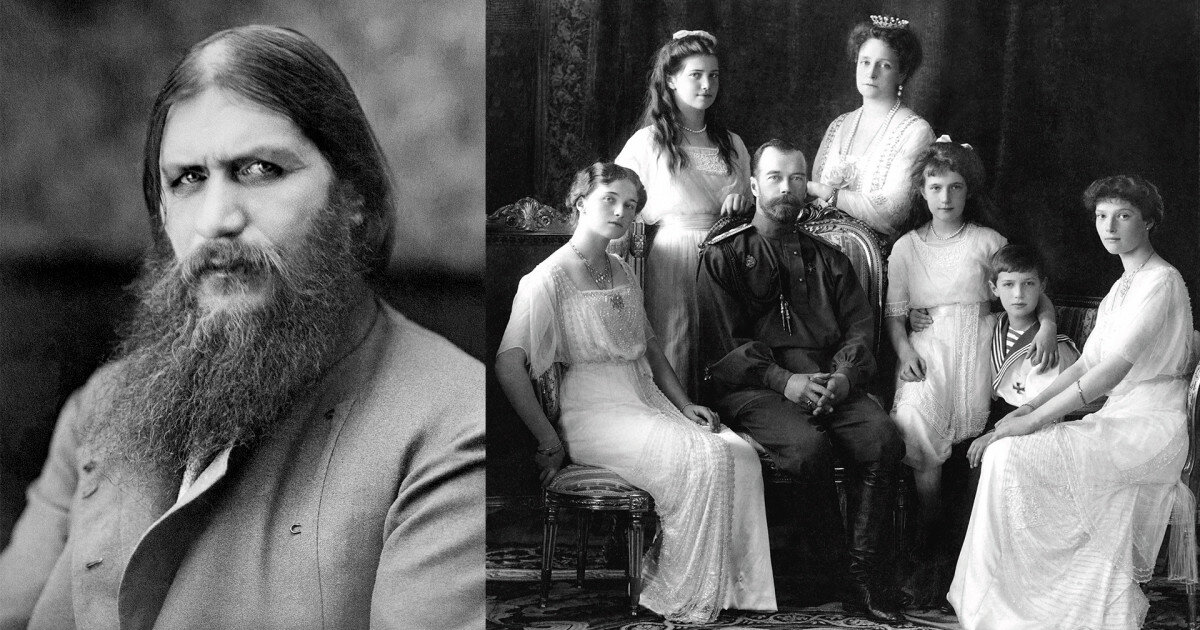
Rasputin, summoned by telegram, sent a response from Siberia. The Tsarevich’s condition improved after the telegram’s arrival in a manner that the attending physicians recorded and could not explain. The mechanism has been debated by subsequent medical historians, with proposals ranging from Rasputin’s instructions reducing aspirin administration, aspirin being a blood thinner whose use would have worsened hemophilia episodes, to genuine psychosomatic effects of the family’s changed emotional state, to something the surviving medical record does not account for.
Whatever the mechanism, the episode established Rasputin’s position within the royal family at a level that made him one of the most influential private individuals in Russia. The Tsarina’s dependence on him was complete and well attested. Her correspondence with the Tsar, preserved in full in the Russian State Archive, contains hundreds of references to Rasputin’s advice on political appointments, military strategy, and personal decisions.
The 1910 Diary Entries and the Romanov Prediction
The documents attributed to Rasputin in the Russian archival record, as distinct from the internet-circulating prophecy texts whose provenance is not established, include diary entries and letters whose authenticity appears in the scholarly literature.
The 1910 diary entries in which Rasputin expressed premonitions about the Romanov family’s fate are referenced in Radzinsky’s biography and in the scholarly literature on the late Romanov period. The language, describing a shadow of eclipse falling on the royal family and experiencing horror when embracing them as if embracing the dead, appears in this context.
The premonition in 1910 was not in the conditional sense that the 1916 letter was specific. It was more the expression of a sustained sense of impending catastrophe that Rasputin attempted to communicate to the Tsarina, who rejected the expressions as offensive to the imperial dignity. The diary entry’s language is consistent with the known psychological profile of individuals in whom unusual perceptual sensitivity produces persistent awareness of events before they occur.
Whether this awareness reflects a genuine perceptual faculty, a high sensitivity to political and social signals that the conscious mind processes as premonition, or retrospective literary construction of early uncertainty as prophetic foresight, is not resolvable from the available evidence. What is resolvable is that Rasputin recorded his concern about the Romanov family’s fate seven years before the execution, and that the concern was enough in its emotional character to be recorded and preserved.
The Recorded Prediction About His Own Death
The 1916 letter’s conditional structure is the most precisely attested prophetic statement in the Rasputin record because its conditions were testable against subsequent events and because the letter’s existence and general content appear in the scholarly historical literature rather than in internet tradition alone.
The conditions were:
If common people kill him: the Tsar need not fear for his fate, and the Romanov dynasty would continue for a century or more.
If nobles kill him: the nobles would flee Russia, the Tsar’s relatives would not be alive within two years, brothers would rise against brothers and kill each other, and Russia would know misery for twenty-five years.
Felix Yusupov planned and executed the murder. Prince Dmitri Pavlovich Romanov was directly involved. Vladimir Purishkevich, a member of the State Duma, participated. The murder was a conspiracy of Russian nobles, one of them a member of the Romanov family by blood.
Against the first condition: the Romanov dynasty did not survive. Tsar Nicholas II abdicated on March 2, 1917, approximately eleven weeks after Rasputin’s murder. His entire immediate family was executed on July 17, 1918, twenty-two months after the murder, within the two-year window the letter specified.
Against the second condition: Russian nobles fled the country in the hundreds of thousands following the revolution. The Romanov relatives not immediately executed were killed, exiled, or died in circumstances directly related to the revolutionary upheaval within the specified period. The Russian Civil War, between the Red Army and the White Army factions that included former nobles, killed millions and lasted until 1922, fulfilling the brothers-rising-against-brothers formulation with grim precision.
The twenty-five years of misery prediction is the most interpretively flexible element. Russian experienced the Civil War to 1922, the Ukrainian famine of 1932-1933, the Great Terror of 1936-1938, and the German invasion of 1941-1945. Whether the twenty-five years is counted from 1916 to 1941, or from the revolution’s beginning to some marker of stabilization, is an interpretive question the letter does not resolve.
The non-interpretive elements, the Tsar’s death within two years of Rasputin’s murder by nobles, the nobles’ flight, the relatives’ deaths, and the civil war, were fulfilled with a specificity that requires explanation beyond coincidence if the letter’s authenticity is accepted.
The Petersburg Prediction and Its Sourcing
The prediction about Petersburg and the empire’s end appears in the tradition surrounding Rasputin’s statements, though its archival location in the verified Rasputin manuscript record is less precisely established than the 1916 letter.
The substance of the prediction: when Petersburg’s name is changed, the empire will end.
Saint Petersburg was renamed Petrograd in August 1914, when the German-origin syllable Burg was replaced with the Russian grad as part of the anti-German sentiment accompanying the outbreak of World War One. The Russian Empire formally ended with the Tsar’s abdication in March 1917, approximately two and a half years after the renaming.
The prediction’s mechanism, renaming preceding imperial end, identifies a symbolic event that was not foreordained by any political analysis available in 1910 or earlier when the prediction is said to have been made. The renaming was a response to a geopolitical event, the outbreak of war with Germany, that was not predictable from the political conditions of the pre-war period with any precision.
Whether Rasputin’s known sensitivity to the mood and direction of the court and Russian society allowed him to perceive the political instability that would eventually produce both the renaming and the empire’s end, or whether he had access to information about the dynasty’s prospects that his position near its center made available, or whether the connection between renaming and imperial end reflects genuine prophetic perception of a causal relationship, is a question the available evidence does not resolve.
What the evidence resolves is that the statement was made, that the renaming occurred, and that the empire ended in the period following the renaming.
The Hemophilia Episode and the Question of Mechanism
The Spala episode of 1912 is the most thoroughly recorded instance of Rasputin’s claimed healing capacity, and that record makes it the most tractable case for examining what was actually happening.
Alexei’s hemophilia B episodes involved internal bleeding into joints and body cavities that produced acute pain, progressive joint damage, and life-threatening blood loss. The medical consensus at Spala was that the episode was terminal. The court physicians prepared the family for Alexei’s death and drafted a bulletin announcing his serious condition to the Russian public.
Rasputin’s telegram from Siberia, received by the Tsarina, was followed by improvement in Alexei’s condition over the subsequent days. The improvement was recorded by the attending physicians as medically unexpected.
The aspirin hypothesis proposed by subsequent medical historians is the most frequently cited conventional explanation. Aspirin, acetylsalicylic acid, was in common medical use in 1912 and was likely administered as part of the standard pain management protocol for a child in acute pain. Aspirin’s anticoagulant properties, not understood in 1912 at the mechanistic level that subsequent pharmacology established, would have worsened Alexei’s internal bleeding. If Rasputin’s instructions, transmitted by telegram, included directions to stop the aspirin administration, the improvement would have a conventional pharmacological explanation.
The problem with the aspirin hypothesis as a complete explanation is that the telegram from Siberia, whose content has been examined by Radzinsky and other historians, does not appear to contain medical instructions. It was a prayer and a reassurance addressed to the Tsarina’s faith rather than a medical protocol.
The alternative explanation, that Rasputin’s psychological influence on the Tsarina reduced her acute stress response, which transmitted through her changed emotional state to reduce the psychological amplification of Alexei’s pain and possibly the physiological stress response that could have influenced clotting, is the psychosomatic explanation. It is plausible and consistent with known mechanisms, but it requires accepting that the psychological mechanism was strong enough to produce the recorded degree of physical improvement.
Neither explanation is complete. The improvement is documented. The mechanism is not established.
The Documented Prophecy and the Undocumented Tradition
The distinction between the documented Rasputin prophetic record and the circulating internet tradition requires explicit treatment in any honest assessment.
The documented record includes: the 1910 diary entries expressing premonition about the Romanov family, preserved in archival sources referenced in the scholarly literature. The 1916 letter to the Tsar with its conditional structure about the consequences of his murder, documented in Radzinsky and in the Russian State Archive tradition. The healing episodes, particularly Spala 1912, documented in court records and physician accounts. The Petersburg-empire connection, recorded in the tradition with less precise archival citation.

The undocumented tradition includes: the nuclear power plant prophecy about towers of death with rotten blood, which circulates extensively in Russian internet forums and Rasputin prophecy compilations without consistent attribution to an archival document. The three hungry snakes quote applied to Ukraine. The 2011 Japan flood interpretation of the saltwater prophecy. These texts appear in the internet tradition in forms that vary between versions in ways that suggest composition or elaboration rather than consistent archival transmission.
This distinction does not make the documented record less interesting. It is extraordinary precisely because it is documented. The 1916 letter’s conditional structure, fulfilled in detail across the following two years, is the most precisely testable prophetic statement in the verified record of Russian esoteric tradition.
The circulating undocumented texts are interesting as tradition even where they are not documentable as authorial. The tradition of attributing prophetic vision to Rasputin reflects a genuine Russian cultural processing of his recognized perceptual capacity, extended by subsequent generations into a broader prophetic framework. Whether the extended framework reflects genuine transmitted knowledge of additional statements attributed to Rasputin that have not been verified in the scholarly literature, or creative elaboration of the verified tradition into new prophetic content, is a question that honest treatment of the Rasputin record cannot resolve without the archival work that would verify or falsify the attributions.
The Prophetic Tradition He Inhabited
Rasputin did not emerge from nowhere. He emerged from a Russian Orthodox and esoteric tradition that had been producing recognized figures with similar perceptual profiles for centuries.
The tradition of the yurodivye, the holy fools of Russian Orthodoxy, included figures whose apparent social transgression concealed genuine prophetic capacity that the Orthodox tradition formally recognized. Vasily the Blessed, whose tomb is in Saint Basil’s Cathedral in Moscow, appeared in the sixteenth century as having predicted the Moscow fire of 1547 and Ivan the Terrible’s military failures. Nikolai Salos of Pskov is recorded as having confronted Ivan the Terrible directly and successfully predicted consequences for Ivan’s proposed sack of Pskov.
The staretz tradition, of which Rasputin is the most famous modern example, involved wandering spiritual teachers whose combination of ascetic practice, geographical mobility, and sustained prayer produced perceptual states that the Russian Orthodox framework understood as prophetic capacity. The staretz tradition’s recognized figures include Seraphim of Sarov, whose prophecies about the Russian state are preserved in the archival record of the Sarov monastery and have been analyzed in the scholarly literature.
Rasputin’s position within this tradition, combining the yurodivye’s social transgression with the staretz’s spiritual authority and adding the access to the court that his healing of Alexei provided, made him simultaneously the most powerful and the most vulnerable figure in the tradition’s modern history. His power derived from the Tsarina’s dependence. His vulnerability derived from the aristocracy’s resentment of a peasant’s influence over the throne.
The murder that fulfilled his own prediction was produced by the same social forces that his prediction identified. The nobles killed him because his influence threatened the social order that defined their position. In killing him, they triggered the collapse of that order. The prophecy contained its own mechanism of fulfillment.
What the Letter Established
The 1916 letter is not primarily evidence of supernatural prophetic capacity. It is primarily evidence of a kind of intelligence that operates at the intersection of deep pattern recognition, acute sensitivity to social and political dynamics, and a capacity for systems thinking that follows causal chains further than ordinary analysis reaches.
Rasputin knew who his enemies were. He knew their social position and their relationship to the Tsar. He understood the revolutionary pressure building in Russian society and the vulnerability of a dynasty whose legitimacy depended on the aristocracy’s continued support. He understood that the aristocracy’s killing of the Tsarina’s most trusted advisor would remove the last buffer between the dynasty and the revolutionary forces it could not contain.
From this understanding, the conditional structure of his prediction follows by political analysis rather than supernatural perception: if nobles kill him, the dynasty loses its last connection to the popular religious legitimacy that Rasputin’s peasant origins represented, the aristocracy consolidates its opposition to the Tsar, and the revolutionary forces find their moment. If common people kill him, the dynasty retains the peasant religious legitimacy he represented and the aristocracy loses the initiative.

Whether this was political analysis or prophetic perception, or whether the distinction between them is less clear than the conventional separation of the natural and supernatural implies, is the question that Rasputin’s recorded legacy poses without resolving.
The letter exists. The conditions were fulfilled. The people who were predicted to die were dead within two years of the murder, killed by the mechanism the letter identified.
He wrote it knowing he would be killed. He sealed it and left it with the Tsarina. Then he went to the house where Felix Yusupov was waiting.
He went knowing.