


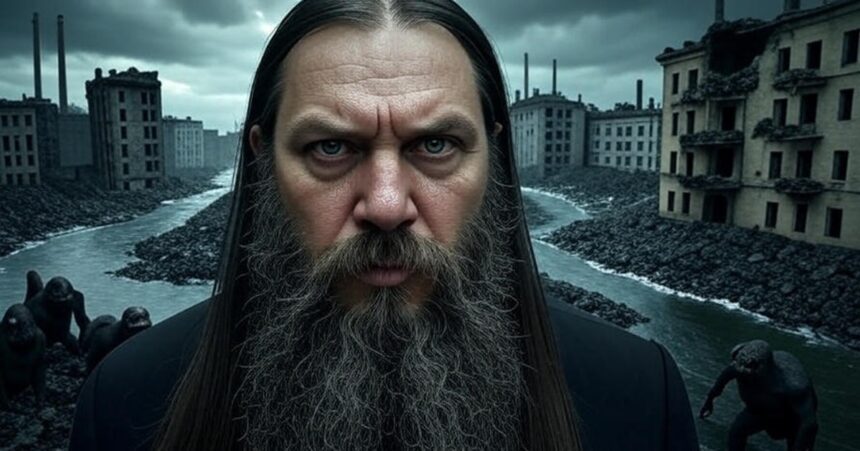
There is no need to invent a mysterious Dr. Renzo Basker to make the Rasputin prophecy story interesting. The real name is Renzo Baschera, an Italian writer and paranormal author whose 1987 book Le profezie di Rasputin helped put a dramatic collection of alleged Rasputin prophecies into modern circulation. The distinction matters because the famous “towers of death,” “poisoned air,” technological monsters, flying images, and other apocalyptic passages are often presented online as though they came directly from a Russian mystic in 1916. The surviving trail is much more complicated, and considerably more revealing.
What can actually be established is surprisingly clean. Grigory Rasputin was real. Renzo Baschera was real. Baschera’s book was real, published by MEB in 1987 as part of its Manuali del mistero e dell’occulto series, and later editions continued circulating. Baschera spent decades writing about prophecy, esotericism, paranormal claims, and supposed messages from historical figures. What has not been established with anything like the same certainty is that every dramatic prediction attributed to Rasputin in modern circulation can be traced to a document written by Rasputin himself before his death. That is where the story changes from history into provenance.
First, the Name Is Wrong
The first correction is almost embarrassingly simple. The author associated with this modern Rasputin prophecy literature is Renzo Baschera, not “Dr. Renzo Basker.” Contemporary bibliographic records identify Le profezie di Rasputin as a work by Renzo Baschera, published by MEB in Padua in 1987. The book was issued as part of the publisher’s occult and mystery series and ran roughly 240 pages in its first edition. A later 1996 edition is also catalogued under Baschera’s name. There is therefore a perfectly ordinary explanation for much of the confusion: a real author’s Italian surname has been repeatedly copied, transliterated, misspelled, and eventually transformed into a more authoritative-sounding fictional attribution.

That matters because “Dr. Renzo Basker” sounds like precisely the kind of authority that can make an internet prophecy appear older and more scholarly than it actually is. A mysterious doctor supposedly discovered an obscure prophetic manuscript, researchers supposedly preserved it, and the modern reader supposedly inherited a forbidden prediction. But the traceable publishing history points somewhere much less cinematic: an identifiable twentieth-century Italian author working in a recognizable paranormal and prophecy genre.
Renzo Baschera Was Real, and Prophecy Was His Subject
Baschera was not an invented name attached to a nonexistent book. He was a prolific Italian writer who spent much of his career publishing books about prophecy, esotericism, folklore, paranormal phenomena, and supposed messages from historical or religious figures. A 2024 profile in La Stampa described him as having published around a hundred books over six decades and noted that many concerned prophecy and faith. Earlier publisher material presents him as a paranormal researcher and teacher who worked in Turin and later continued writing on prophetic and esoteric subjects. Whatever one thinks of those claims, they establish something important about the source: Baschera was operating inside a specialized literary world devoted to exactly the kind of material now being presented online as mysterious historical revelation.
His bibliography makes the context even clearer. Baschera wrote Le profezie della monaca di Dresda, first published in 1976 and subsequently reissued, a work presenting supposed prophetic manuscripts attributed to an unidentified German nun. He later published books concerning Nostradamus, Don Bosco, Padre Pio, the Holy Shroud, and Rasputin, and in 1994 co-authored Il grande libro delle profezie, explicitly presenting a supposed history of the world from 1990 to 2090 according to figures including Nostradamus, the Dresden nun, Don Bosco, and Rasputin. This is not the bibliography of a newly discovered archival historian. It is the bibliography of an author whose subject was prophecy itself.
The Dresden Nun Reveals the Method
One of Baschera’s most revealing works is Le profezie della monaca di Dresda. The book presents supposed manuscripts attributed to an otherwise unidentified seventeenth-century German nun and analyzes their alleged predictions about popes, European dynasties, technological progress, disasters, and the distant future. The book itself adopts the form of an investigation into supposedly old prophetic documents, but the modern reader is still encountering those documents through Baschera’s twentieth-century presentation and interpretation. That is precisely the distinction that disappears when internet summaries turn a later prophecy book into a direct historical source.
The same pattern appears in the Rasputin material. Baschera’s 1987 book is not evidence that a prophecy existed in 1916 merely because the book says that Rasputin made it. To establish that, historians would want something much more demanding: a contemporary manuscript, a dated publication, a letter with secure provenance, a contemporary witness who recorded the words, or another independent source that predates the later compiler. Without that chain, the correct description is not “Rasputin predicted it.” It is “Baschera published material attributed to Rasputin.” Those are two very different historical claims.
Rasputin Himself Was Real Enough
None of this requires turning Rasputin into a fraud or pretending that every prophecy associated with him was invented after his death. Grigory Yefimovich Rasputin was a real and extraordinary figure of late Imperial Russia. Born in Siberia in 1869, he became closely associated with Tsar Nicholas II and Empress Alexandra, particularly through the royal family’s desperate concern for their son Alexei’s hemophilia. His influence, reputation for spiritual insight, political enemies, relationships at court, and violent death are extensively documented historical subjects.

There is also genuine early material associated with Rasputin’s own prophetic reputation. A December 1916 letter attributed to him warned Nicholas that the circumstances of his death would determine the fate of the imperial family. In the version traditionally transmitted, Rasputin predicted that if members of the aristocracy were responsible for his murder, the Romanov family would not survive for long. Rasputin was murdered by a group that included members of the nobility, and Nicholas II, Alexandra, and their children were executed by the Bolsheviks less than two years later. The coincidence is undeniably striking.
But even here, historical caution matters. The letter is an important part of the Rasputin record and has circulated for more than a century, yet modern scholarship has questioned aspects of its provenance and authenticity. A recent forensic-historical review notes that the letter has sometimes been treated as prophetic while also recording the longstanding suggestion that it may have been forged or altered after the fact. That uncertainty does not make the document worthless, it makes it something that must be identified honestly rather than upgraded into an unquestionable primary source.
The “Towers of Death” Problem
This is where the famous “towers of death” material becomes particularly difficult. The imagery is dramatic: structures associated with death, poisoned air, technological dangers, monstrous creations, corrupted nature, war, and catastrophic transformation. Once placed beside photographs of skyscrapers, telecommunications towers, pollution, nuclear facilities, biotechnology laboratories, or artificial intelligence, the language can appear astonishingly prophetic.
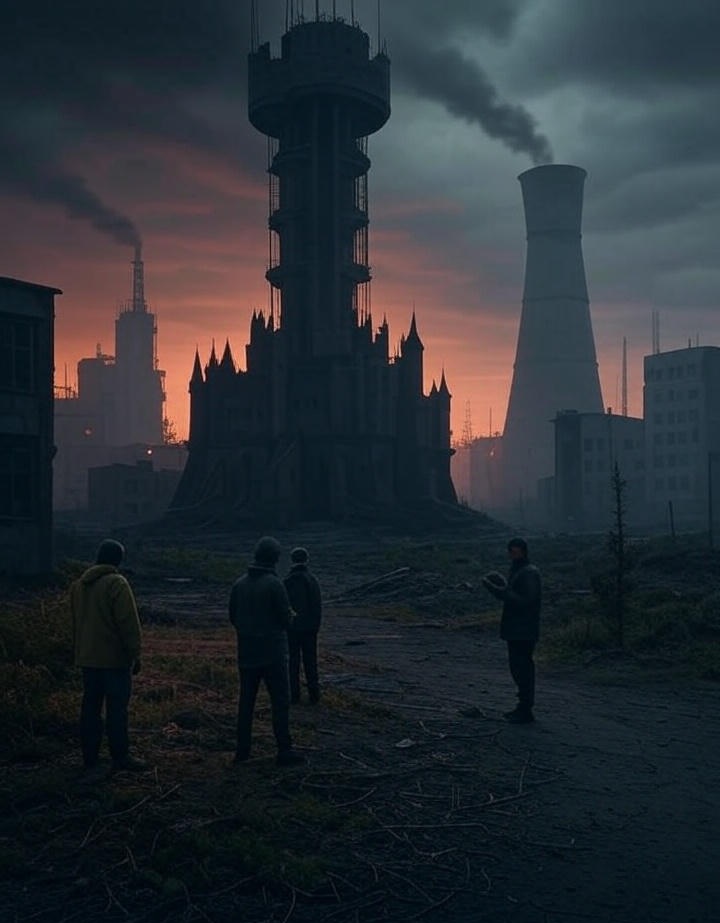
But a prophecy becomes historically impressive only when the wording can be shown to have existed before the event being interpreted. Otherwise the direction of causation is reversed. Modern readers see a tower and search an old prophecy for language that resembles it, another generation sees the same language and associates it with a completely different technology. The apparent prediction grows more impressive precisely because its meaning is allowed to move.
That is why the provenance question matters more than the imagery. If the original text cannot be securely dated to Rasputin’s lifetime, then the correct historical question is not “How accurately did Rasputin predict modern technology?” It is “When did this wording first enter the documentary record, and who transmitted it?” Until that question is answered, the apparent prediction cannot carry the evidentiary weight that later retellings give it.
“Poisoned Air” Can Become Almost Anything
Pollution is real. Industrial contamination is real. Nuclear fallout is real. Poor air quality is a major public-health problem. None of those facts, however, authenticates a prophecy. The same phrase can be mapped onto different historical anxieties as technology changes: industrial smog in one decade, nuclear contamination in another, electromagnetic infrastructure in another, and some entirely different environmental threat in the next.
The problem is not that every modern interpretation is absurd. The problem is that a prediction which can absorb mutually incompatible interpretations without becoming wrong is extraordinarily difficult to test. A genuinely specific prediction risks failure. A sufficiently elastic one can survive indefinitely.
The “Poisonous Fruit” and the Age of Screens
Other passages attributed to Rasputin have been retrofitted to communications technology: television, computers, smartphones, social media, and the endless stream of images now carried in a pocket. Again, the modern resemblance can be psychologically powerful without being historically probative. Human beings have always imagined dangerous forms of communication, seductive images, corrupted information, and technologies that separate people from older forms of life. The arrival of a new medium gives those old anxieties a new physical object.
The “Monster Without a Soul”
Perhaps the most tempting modern reinterpretation concerns the alleged “monster without a soul.” In the twentieth century, readers could attach such language to cloning, genetic engineering, or biological experimentation. Today, artificial intelligence provides an even more seductive target: machines that speak, reason, generate images, imitate personality, and increasingly perform tasks once regarded as uniquely human.
But the existence of a modern technology that resembles an old metaphor is not evidence that the metaphor predicted the technology. Contemporary debates over AI consciousness, genetic engineering, cloning, and human enhancement are real because the technologies themselves are real. They do not need an apocalyptic sentence attributed to Rasputin decades later in order to become serious ethical questions.
The Third World War That Keeps Moving
The same problem appears in claims about a future world war involving “two bloodthirsty princes” or an East-versus-West confrontation. Such language is almost designed to survive changing circumstances. It can be applied to the First World War, the Russian Revolution, the Second World War, the Cold War, the collapse of the Soviet Union, NATO-Russia tensions, or almost any future confrontation involving competing geopolitical blocs, the same elastic retrofitting examined directly in Rasputin’s terrible prophecy about Ukraine.
A prediction that identifies the participants, date, mechanism, and outcome in advance can be tested. A prediction about two future enemies fighting a devastating war cannot easily be falsified when the identities of the enemies are supplied only after history chooses them.
The St. Petersburg Clue Is Real History, Not Proof of Prophecy
One of the most attractive claims involves St. Petersburg. The city’s name really did change: it became Petrograd in 1914, Leningrad in 1924, and St. Petersburg again in 1991. Those dates are not mysterious. They are ordinary, documented political history.

The difficult question is whether a particular Rasputin text predicted those changes before they happened. That cannot be answered merely by pointing to the fact that the changes occurred. A prophecy is not authenticated by its match alone, its pre-event provenance has to be established first. Otherwise the reader is being shown the answer before being shown the question.
Three Days of Darkness Is Older Than Rasputin
Apocalyptic darkness is one of the oldest motifs in religious and prophetic literature. Darkness, blood, fire, celestial disturbance, poisoned landscapes, war, plague, and the destruction of familiar civilization recur across traditions separated by centuries and continents. Biblical apocalyptic literature contains its own traditions of cosmic darkness and catastrophe, while later Christian, occult, and popular prophetic traditions repeatedly recycled similar imagery.
That doesn’t prove every later prophecy was copied from an earlier one. It does establish something simpler: dark apocalyptic imagery is not a unique fingerprint belonging to Rasputin. When a modern prediction contains familiar symbols of catastrophe, the burden is on the researcher to establish the historical chain connecting that particular wording to the alleged prophet.
Where the “Two-Thirds Fulfilled” Number Comes From
Claims that “two-thirds” of Rasputin’s prophecies have already been fulfilled sound mathematical without actually being mathematical. What is the denominator? Which passages count? Which interpretations are permitted? How specific must a prediction be before it qualifies as a hit? What happens to predictions that failed? Without predefined rules, the percentage is not a scientific measurement of predictive accuracy. It is a rhetorical score assigned after the historical record is already known.
That distinction is crucial because prophecy is unusually vulnerable to selection effects. A hundred vague predictions can be made, ten can be interpreted as partial matches, five can become viral, and the ninety-five failures can disappear from public memory. The resulting collection looks extraordinarily accurate because the archive has been filtered by hindsight.
Strange Enough Without the Fabrication
There is an irony here. In trying to make Rasputin more supernatural, later prophecy literature can actually make the historical figure less interesting. The real Rasputin lived through the final convulsions of Imperial Russia. He occupied an extraordinary position inside the Romanov court. He was feared, hated, admired, mythologized, and ultimately murdered by conspirators who believed his influence had become intolerable, joining a broader tradition of prophetic figures examined in Sepp Wudy, the humble farmhand who saw the apocalypse coming. His death became part of the political mythology surrounding the collapse of the dynasty he had once seemed to influence.
What the Source Trail Actually Tells Us
The evidence therefore separates into layers. There is the historical Rasputin, whose life and influence are documented. There are writings and statements attributed to him during his lifetime or immediately surrounding his death, some of which are themselves subject to questions of provenance and authenticity. Then there is the much larger body of prophetic material transmitted by later writers. And within that later layer stands Renzo Baschera, whose 1987 Le profezie di Rasputin is a real, identifiable publication in a longstanding Italian prophecy-and-occult publishing tradition.
That does not prove that Baschera invented every passage he published. It means something more precise and more useful: Baschera is a documented modern transmitter, while the original provenance of many of the dramatic predictions attributed to Rasputin remains unresolved. That is the distinction an internet quotation usually removes.
How to Test Any “Ancient Prophecy”
The method is simple enough to apply to almost anything. Find the earliest surviving version. Establish its date. Identify who actually wrote it. Determine whether the text existed before the event it supposedly predicted. Check whether later editions changed, expanded, translated, or reinterpreted the wording. Look for independent contemporary witnesses. Then count the failures as carefully as the apparent successes. If the entire chain begins with a modern book and disappears when you ask for the underlying manuscript, you do not have a suppressed ancient prophecy. You have a modern attribution whose historical provenance remains incomplete.
The Man Behind the Misattribution
Renzo Baschera does not need to be transformed into a nonexistent “Dr. Basker” to become part of the mystery. The real Baschera is actually more revealing. He spent decades exploring precisely the territory in which modern prophecy stories are manufactured, transmitted, interpreted, republished, and continually matched against new events. His books on the Dresden nun, Nostradamus, Don Bosco, the Holy Shroud, Rasputin, and other prophetic subjects show a sustained literary interest in turning old mysteries into narratives about the future.
And that gives us the real historical question. Not whether a mysterious doctor secretly decoded Rasputin. Not whether every modern technology was predicted in 1916. Not whether two-thirds of a supernatural forecast has somehow been mathematically fulfilled. The question is much harder and much more interesting: how did a real historical figure become the voice of predictions whose documentary trail runs through later writers, later editions, later translations, and finally the internet?
Rasputin’s story did not need a fictional scholar. It did not even need a perfect prophecy. The real story already contains a murdered mystic, a collapsing empire, a disputed letter, a royal family destroyed less than two years later, and a century of people trying to decide whether the man was a prophet, a manipulator, a religious eccentric, or some combination of all three. The “Dr. Renzo Basker” attribution only obscures that history. The evidence leads instead to a real Italian author, a real 1987 book, and a much more revealing lesson: before asking whether a prophecy came true, ask who first wrote it down.
The so-called Renzo Basker Prophecy turns out to be a case of a real book acquiring an invented name.