




Ken Johnston was a pilot, engineer, and former NASA employee who worked in the Data and Photo Control Department at the Lunar Receiving Laboratory in Houston during the Apollo program. His role gave him direct access to the original photographic materials returned from the lunar missions: unprocessed film, contact prints, and the high-resolution images produced before any editorial selection was applied to the photographic record that would eventually reach the public.
Johnston stated publicly, after his contract with NASA was terminated in 2007 following the publication of his account in Richard Hoagland and Mike Bara’s book Dark Mission: The Secret History of NASA, that he had been instructed to destroy original Apollo photographic materials on multiple occasions, that he had not destroyed all of them as instructed, and that the materials he retained showed anomalous structures on the lunar surface that the official photographic record released to the public did not contain.
His account has two elements that can be evaluated independently. The instruction to destroy original photographic materials is either true or false. The retained photographs show what he claims they show or they do not. Both elements have been examined by researchers in the alternative space research community, with results that are recorded but contested. Neither has been formally addressed by NASA in a way that specifically addresses Johnston’s claims rather than making general statements about the completeness and accuracy of the Apollo photographic archive.
The institutional behavior surrounding lunar photography is, independently of Johnston’s testimony, a recognized anomaly. The Apollo photographic archive contains known gaps, inconsistencies, and categorization decisions whose rationale has not been fully explained.
Richard Hoagland and the Monuments
Richard Hoagland is the most prominent researcher in the alternative lunar and Mars anomaly tradition. His claims about the Apollo missions, developed across multiple books including The Monuments of Mars and Dark Mission, are based on analysis of NASA’s own photographic archive combined with testimony from former NASA employees including Johnston.
Hoagland’s specific track record is relevant context here and the library’s standard requires stating it directly: his flagship claim, that the Cydonia region of Mars contained the Face on Mars, an artificial monument built by an ancient civilization, was tested directly by higher-resolution imaging from the Mars Global Surveyor in 1998 and the Mars Reconnaissance Orbiter in the following decade. Both showed an eroded mesa consistent with ordinary Martian geology, not an artificial structure. Mainstream planetary science and much of the UAP research community treat this as a settled resolution against Hoagland’s interpretation. That history does not make every claim in this piece false, but it means Hoagland’s image-analysis conclusions specifically carry a documented history of not surviving better data, and that record should weigh on how much confidence his lunar structure identifications deserve on their own.
Hoagland’s lunar anomaly claims center on a category of image analysis: the identification of geometric structures in the lunar landscape whose angular and rectilinear properties are inconsistent with natural geological formation. His methodology, applying image enhancement techniques to existing NASA photographs to reveal structures not visible in the standard processed versions, has been criticized by mainstream planetary scientists and defended by researchers with image analysis credentials.
The criticism is that image enhancement of highly compressed photographic materials produces artifacts that can be misidentified as structures. The defense is that the geometric regularity of the identified features, their consistent angular relationships, and their distribution in the lunar landscape are not consistent with the random distribution of enhancement artifacts.
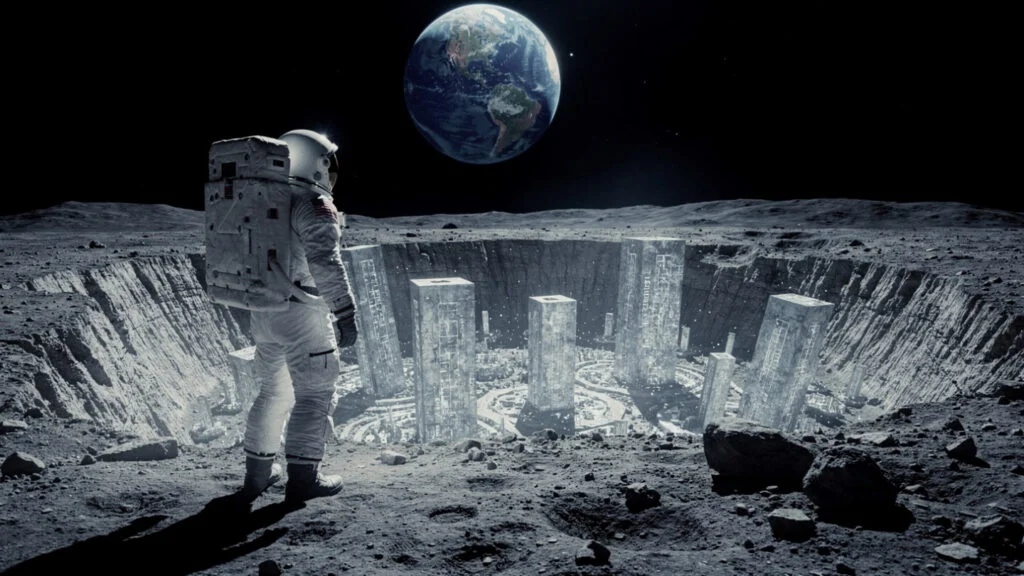
Whether Hoagland’s identifications are accurate requires access to the original unprocessed photographic materials at the resolution that Johnston describes as superior to the publicly released versions. Johnston claims those materials exist in his retained collection. The public release of those materials for independent analysis has not occurred in a form that resolves the methodological dispute.
What Hoagland’s analysis has produced that is independent of the methodology dispute is a recorded claim about the Apollo program’s institutional behavior: that information was classified, that photographs were ordered destroyed, and that a former NASA employee with direct access to the materials confirms both the existence of the anomalous content and the destruction order.
What the Apollo Astronauts Said
The Apollo mission audio transcripts are public records. What the astronauts communicated during their missions appears in those transcripts with the caveat that communication between the astronauts and Mission Control was sometimes conducted on frequencies that were not publicly broadcast and that the released transcripts may not be complete.
The recorded anomalous communications from Apollo missions include several exchanges that have been analyzed by multiple independent researchers. The most frequently cited is the exchange attributed to Neil Armstrong during Apollo 11 in which he reportedly described large objects in a crater, a claim that circulates in multiple versions with varying degrees of support behind them. The provenance of the most dramatic versions of these exchanges is not fully established, and the monkeyandelf standard requires acknowledging that distinction.
What is not in dispute: the Apollo 10 crew reported an unidentified whistling sound during their orbit of the Moon, recorded on their communication systems, that they described as strange music during their post-mission debriefing. The recording was not released publicly for forty years. NASA’s eventual explanation was that the sound resulted from radio interference between the lunar module and the command module. The forty-year delay in releasing the recording is the element that invites scrutiny regardless of the adequacy of the eventual explanation.

Buzz Aldrin’s own statements about an unidentified object observed during the Apollo 11 transit to the Moon, described in a 2007 Science Channel documentary, are in the public record. Aldrin’s account, that the crew observed a distant object whose nature they could not identify and which they chose not to report to Mission Control, appears in his own words.
The recorded history of what Apollo astronauts reported, acknowledged, and did not report, combined with the known gaps in the public release of mission audio and photographic materials, establishes a pattern of information management whose contours are consistent with Johnston’s account even where the content of the classified materials remains unverified.
The Brookings Report
The source’s mention of the Brookings Report deserves full development because it is the most directly relevant government document to the question of what to do with evidence of extraterrestrial intelligence.
In 1960, NASA commissioned the Brookings Institution, a respected Washington research organization, to study the long-term implications of the American space program for society. The resulting report, formally titled Proposed Studies on the Implications of Peaceful Space Activities for Human Affairs and published in 1961, included a section on the sociological implications of the discovery of extraterrestrial intelligence.
The relevant passage is specific: the authors noted that the discovery of artifacts or evidence of intelligent life elsewhere in the solar system would represent one of the most significant events in human history, and that the psychological and social impact of such a discovery might make it advisable to withhold information from the public until proper preparation for the disclosure had been made. The report specifically mentioned the Moon and Mars as the most likely locations for the discovery of extraterrestrial artifacts.
The Brookings Report was not a secret document. It was a commissioned study that was submitted to Congress and is in the public record. Its recommendation to consider withholding discovery of extraterrestrial artifacts from the public appears in plain language in an official government research report submitted to the United States Congress in 1961, nine years before the first Moon landing.
The report provides an institutional basis for the classification of lunar anomaly photographic materials that Johnston describes as having occurred. Whether the classification that Johnston describes resulted from the Brookings Report’s recommendation, from a separate institutional decision made on equivalent grounds, or from reasons unrelated to extraterrestrial artifact discovery is not established by the report’s existence alone. What the report establishes is that the relevant officials had a formal, on-record framework for considering such classification before the Apollo program began.
Kennedy, Khrushchev, and the Cooperative Program
The source’s claim that Kennedy offered Khrushchev cooperation in the lunar program has a historical record that the source does not develop.
On September 20, 1963, John F. Kennedy addressed the United Nations General Assembly and proposed a joint American-Soviet mission to the Moon. The speech is in the public record. Kennedy’s language proposed that the exploration of space be carried out jointly rather than as a competitive endeavor between the two superpowers. Soviet officials received the proposal with qualified interest. The cooperative program did not proceed, and Kennedy was assassinated on November 22, 1963, sixty-three days after his UN speech.
Kennedy had previously proposed lunar cooperation to Khrushchev at the Vienna Summit in June 1961. The informal proposal was not acted upon immediately but was maintained as a back-channel diplomatic option through the subsequent years.
Whether Kennedy’s motivation for proposing lunar cooperation included information about anomalous findings that would make a joint program more efficient than competing parallel programs is not recorded in the declassified record. It is an interpretation of the cooperation proposals that the source raises without the evidentiary framing that would allow it to be evaluated.
What is on record: Kennedy made multiple formal and informal proposals for Soviet-American lunar cooperation. He was killed before the cooperative program could be realized. His successor Lyndon Johnson pursued the competitive program that the Space Race framework maintained. The Apollo missions were conducted as a unilateral American program rather than the cooperative one Kennedy had proposed.

The source’s suggestion that Kennedy’s assassination and Khrushchev’s subsequent removal from power were connected to the suppression of the cooperative lunar program is an interpretive claim that goes beyond what the record supports. The coincidence of timing between Kennedy’s assassination and his cooperation proposals is noted. The causal connection between the two events, operating through the mechanism of lunar anomaly disclosure suppression, is a hypothesis rather than an established conclusion.
The Physical Case for Lunar Structures
The strongest physical evidence for anomalous structures on the Moon is independent of the Hoagland-Johnston testimony and exists in the publicly available photographic record.
The Lunar Reconnaissance Orbiter Camera, operated by Arizona State University for NASA, has produced the highest resolution photographic coverage of the lunar surface ever achieved from orbit, beginning in 2009. The archive is publicly accessible. Independent researchers have identified features in the LRO archive whose geometric regularity is inconsistent with natural geological formation in the way that Hoagland’s earlier analysis of the lower-resolution Apollo imagery identified.
The towers and spires identified in LRO imagery of craters, the geometric arrangements of features in the Shard and Tower regions of the near side that Hoagland originally identified from Lunar Orbiter imagery, and the angular relationships between surface features in multiple locations, are visible in the publicly accessible LRO archive and have been analyzed by researchers whose image analysis methodology is more robust than the early compression-artifact criticism of Hoagland’s work could apply.
The mainstream planetary geology interpretation of these features attributes them to volcanic activity, to impact ejecta patterns, and to the optical properties of the lunar surface material under varying illumination angles. These explanations are offered as categories rather than as analyses of the features that researchers have identified.

The Hollow Moon material covered in this library’s dedicated piece establishes additional context for the physical anomaly case: the seismic bell effect from the Apollo 12 mission, the anomalous crater depth geometry, and the mascon distribution are all recorded in mainstream scientific publications and are inconsistent with the conventional solid-body formation model for the Moon.
A Moon that rings like a bell for three hours after impact, that has anomalous mass concentrations under its circular plains, and that shows geometric surface features inconsistent with natural geological formation, is a Moon whose official description is incomplete. Whether the incompleteness reflects the kind of discovery that Johnston describes and Hoagland analyzes, or a more complex set of natural phenomena whose full characterization is still in progress, is the question that the available evidence leaves genuinely open.
Project A119 and the Nuclear Moon
In June 1959, the Air Force Nuclear Weapons Center produced a classified study whose title was A Study of Lunar Research Flights and whose informal designation was Project A119. The study’s purpose was to investigate the feasibility of detonating a nuclear device on the Moon, assess the military and scientific value of such a detonation, and determine whether the psychological impact on the Soviet Union and the global public of an American nuclear demonstration on the lunar surface would serve American Cold War interests.
The study was classified. Its existence was unknown to the public for forty years. It was discovered by Keay Davidson while researching his biography of Carl Sagan, published in 1999, when Davidson found that Sagan had been assigned to the project as a young researcher and had included it in a fellowship application. The Air Force subsequently confirmed the program’s existence and the study was partially declassified.
Project A119 was not implemented. The Air Force study concluded that the technical challenges were significant and that the political risks, including potential Soviet interpretation of a nuclear detonation on the Moon as an act of war or as a violation of emerging arms control norms, outweighed the psychological benefits. The space race was more effectively won by the visible achievement of landing rather than by the destructive spectacle of nuclear detonation.
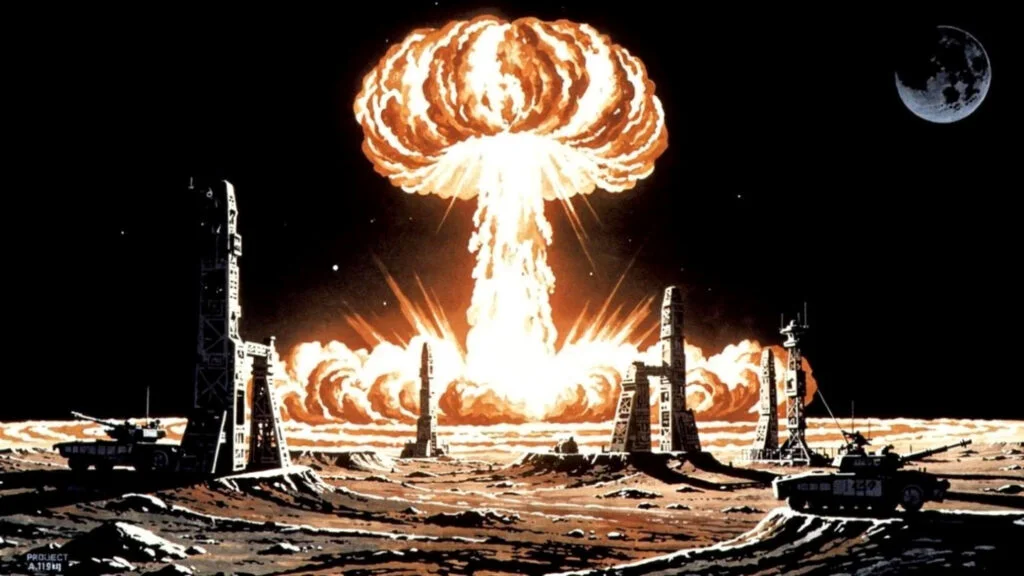
What Project A119 establishes for this library’s framework is specific: in 1959, the United States Air Force was seriously studying the placement of nuclear weapons on the Moon as a classified program whose existence was concealed from the American public for four decades. Whether the nuclear weapons dimension of the space program ended with Project A119’s cancellation or continued in subsequent classified programs is a question that the recurring pattern of space program secrecy, established by the forty-year concealment of Project A119 itself, cannot easily dismiss.
Chatelain’s claim that Apollo 13 carried a nuclear device intended for lunar detonation to measure the Moon’s seismic response is not independently confirmed in the available declassified record. What is confirmed is that the Apollo program did deploy seismic instruments on the Moon, that these instruments recorded the dramatic seismic response to intentional impacts recorded in the Hollow Moon piece, and that classified military space activities were ongoing throughout the Apollo program period.
Whether the intersection of classified nuclear space programs and recorded anomalous lunar observations represents coincidence or connection is a question that Project A119’s forty-year concealment establishes as worth asking rather than dismissing.
The nuclear weapons program that nobody was supposed to know about was studying the Moon in 1959.
The astronauts who went to the Moon reported seeing things they were ordered not to discuss.
The seismographs left on the Moon recorded responses that the conventional geological model does not fully explain.
Project A119 is in the declassified record. It was real. It was classified for forty years.
What else was classified for forty years is the question whose answer the declassification record is still producing.
The Thoth Parallel
The Egyptian myth that the source mentions deserves the full treatment that the Egyptian gods piece in this library provides.
The Pyramid Texts describe Thoth as descending from the sky to bring knowledge to humanity. The texts do not specify where Thoth came from, but the astronomical orientation of the Giza monuments, and the relationship between Egyptian cosmological geography and the lunar cycle, place the Moon as one of the primary celestial reference points in the Egyptian sacred system.
Thoth’s association with the Moon in Egyptian theology is well established: he is described as the keeper of time, the measurer of the celestial cycles, the inventor of writing, and the repository of all knowledge. These are the attributes of an entity whose primary habitat and reference point is the Moon’s position in the cosmic order.
If Hoagland’s claim is accurate, that the Apollo missions discovered evidence of a long-lived human civilization that inhabited the Moon in a distant past, the Egyptian mythology’s association of Thoth with the Moon and with the transmission of knowledge from the Moon to humanity is either a remarkable mythological coincidence or a preserved cultural memory of exactly the contact tradition that Hoagland describes.
The pattern across the library that this site has been building, the Egyptian gods of the First Time with their technological attributes, the pre-dynastic period of Manetho’s king list with its extraordinary reign lengths, the Turin papyrus’s non-mythological treatment of pre-dynastic divine rulers, and now the Apollo anomaly testimony placing intelligent habitation in the Moon, converges in a direction that the conventional framework for human prehistory does not accommodate but that the evidence the library has assembled collectively supports.
What Would Confirmation Mean
The Brookings Report’s concern was the social impact of confirmation that the solar system contained evidence of other intelligent civilizations. The report’s authors were worried about civilizational stability: the discovery that humanity was not alone, that other intelligences had preceded it or observed it, might produce psychological and social disruption at a scale that the institutions managing society could not control.
The concern is on record. The rationale for information management it provides is on record. Whether the rationale has been acted upon, whether the classification of anomalous Apollo photographic materials that Johnston describes represents the Brookings framework in operation, is the question that Johnston’s testimony raises and that the institutional behavior surrounding the photographic archive has not definitively answered in either direction.
What Hoagland’s framework proposes as the broader interpretation is this: that the Moon was inhabited by a human civilization that preceded the current civilizational cycle, that the remains of that civilization are visible in the photographic record that the Apollo missions produced, that the decision to classify that information was made at the highest levels of the American government based on a framework that the Brookings Report laid out before the missions flew, and that Kennedy’s attempts to internationalise the program through Soviet cooperation were one of the factors that made his continued presence in office incompatible with the maintenance of the information control that the classification required.
This is a coherent and internally consistent framework. It appears in Hoagland’s published work and in Johnston’s testimony. Its claims about classified photographic materials cannot be independently verified without access to those materials. Its claims about the institutional decisions made in 1969-1972 to terminate the Apollo program after establishing the existence of the anomalies cannot be independently verified without access to the decision-making records from that period.
What can be verified is the anomaly record, the Brookings Report’s existence and content, Kennedy’s cooperation proposals, the unexplained termination of the Apollo program after only six landings, and the forty-year delayed release of the Apollo 10 music recording.
The pieces of the available record do not prove Hoagland’s framework. They are consistent with it in ways that the conventional framework, that the anomalies are misidentified natural features and the termination of Apollo was a budget decision, does not make obviously more plausible.
The photographs Johnston kept either genuinely show anomalies or they do not. They have not been submitted for independent analysis in a form that resolves the question. Twenty-three years after Johnston went public, the question remains open.
The Moon is still there. The LRO archive is publicly accessible. The geometric features are visible to anyone who looks.
NASA destroyed a different set of Apollo-era tapes entirely, ones stored for fifty years in an engineer’s basement, with contract code that has no recorded government entry.