
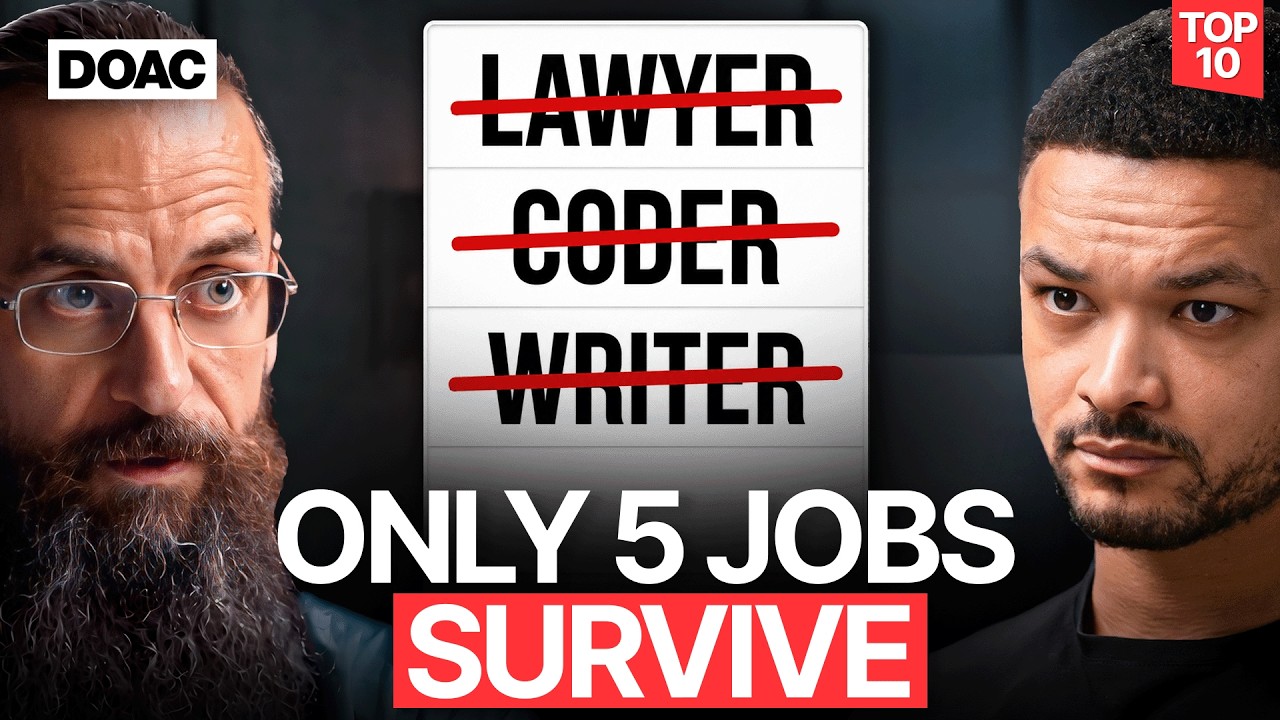
Dr. Roman Yampolskiy is real, and so is the interview. A tenured computer scientist at the University of Louisville, credited with coining the term “AI safety” and ranked among the most-cited researchers in his field, Yampolskiy sat down with Steven Bartlett on The Diary of a CEO and laid out a serious argument that the AI control problem may be mathematically unsolvable.
What’s missing from most retellings of that interview is that his specific predictions, a 2027 AGI arrival and 99 percent unemployment, sit at the far edge of a debate where equally credentialed researchers place the same milestones anywhere from next year to never.
Yampolskiy’s Actual Background and Argument

This one holds up to scrutiny in a way many pieces on this topic don’t. Yampolskiy earned his PhD at the University at Buffalo, his early research applied behavioral-biometrics techniques to detecting automated poker bots, exactly the origin story he tells, and he’s since built a career at the University of Louisville’s Cyber Security Lab focused specifically on the theoretical limits of controlling advanced AI systems. He’s listed among the top two percent of cited researchers worldwide, has authored peer-reviewed papers with titles like “On the Controllability of AI,” and his 2024 book AI: Unexplainable, Unpredictable, Uncontrollable lays out the same core argument discussed in the interview: that once a system reaches general or superintelligent capability, formal proofs suggest it can’t be reliably tested, verified, or contained using any tools currently available. That’s a real, serious, peer-reviewed academic position, not a fringe claim, and it deserves to be treated as such.
The Part That Needs Context | How Contested the Timeline Actually Is
Here’s what a straight retelling of the interview leaves out. Yampolskiy’s specific 2027 AGI prediction sits at the aggressive end of a genuinely wide, actively disputed range among equally credentialed voices in the field. Anthropic’s Dario Amodei has offered a similarly aggressive 2026-2027 window in the company’s own formal submission to the US Office of Science and Technology Policy. But Yann LeCun, Meta’s chief AI scientist and a Turing Award recipient, has argued consistently and publicly that large language models, the technology underlying every current AI system, are fundamentally the wrong architecture for reaching general intelligence at all, regardless of how much they’re scaled up.

Cognitive scientist Gary Marcus has gone as far as placing a public 10-to-1 bet that AI will not achieve a specified set of AGI-level tasks by the end of 2027. Prediction-market aggregators like Metaculus, pooling forecasts from a large community of engaged forecasters, currently put only a 25 percent probability on AGI arriving by 2029, with a 50 percent probability pushed out to 2033, considerably later than Yampolskiy’s timeline. This isn’t a case of one expert being right and everyone else being wrong. It’s a live, unresolved disagreement among people with comparable, overlapping expertise, and treating Yampolskiy’s specific dates as settled fact skips over exactly how contested they are within his own field.

Why the Disagreement Runs So Deep
The split isn’t arbitrary. It traces back to a substantive, technical disagreement about what current AI systems actually are. Researchers on the more urgent-timeline side, including Yampolskiy, tend to view large language models as being on a scaling trajectory where feeding them enough data and compute will eventually produce genuinely general intelligence, since capabilities have repeatedly emerged unexpectedly as models grew larger. Researchers on LeCun’s side argue the opposite: that language-only systems fundamentally lack grounded world models, the kind of physical, causal understanding that would be necessary for genuine general reasoning, and that no amount of additional scale fixes an architectural limitation. Geoffrey Hinton, another foundational figure in the field, has publicly revised his own timeline dramatically, from fifty years down to somewhere between five and twenty, while still describing meaningful uncertainty about the outcome. That range, from a Turing Award winner who helped invent the underlying technology, captures the actual state of expert opinion better than any single confident date does.

The Control Problem Is Worth Taking Seriously on Its Own
Separate from any specific date, Yampolskiy’s underlying technical argument, that current safety-testing methods rely on edge cases that don’t meaningfully exist for a system with general intelligence, is worth taking seriously on its own terms regardless of when or whether superintelligence actually arrives. His point about the “black box” nature of large language models is accurate and widely acknowledged even by researchers far more optimistic about timelines: these systems are trained through pattern-matching at massive scale, and their specific emergent capabilities are often genuinely discovered rather than deliberately engineered, an accurate and well-documented feature of how modern AI development actually works. That’s a legitimate basis for caution independent of whether AGI arrives in 2027, 2033, or several decades from now.

Two Credentialed Views, Not One Settled Answer
None of this needs exaggeration to be worth taking seriously. Yampolskiy is an established, credentialed expert making a serious, peer-reviewed argument, and the interview accurately represents his real, stated views. What deserves equal billing is the fact that his specific timeline sits at one edge of a real, ongoing, technical disagreement among people with comparable expertise, not a settled consensus.

The honest version of this story isn’t “AI safety’s founder says 99 percent unemployment is coming in 2027.” It’s that one of the field’s most prominent, most-cited voices believes the control problem may be unsolvable and the timeline short, while other equally credentialed researchers, working from different technical premises, believe the timeline is much longer or the current approach won’t get there at all. Both positions deserve to be heard on their actual terms, and neither deserves to be presented as the field’s settled answer.