




The mathematics of the search for extraterrestrial intelligence produces a conclusion that the field has not fully absorbed.
If we ever receive a confirmed signal from another civilization, the intelligence that sent it will be older than us by a factor we cannot usefully imagine. Not decades ahead. Not centuries. The statistical framework developed by astrophysicists David Kipping at Columbia University, Adam Frank at the University of Rochester, and Caleb Scharf places the most probable age differential at a minimum of twice our own civilizational age, with a ten percent probability that the civilization we detect is more than ten times older than humanity.
Ten times older than humanity means one hundred thousand years of continuous technological development before the moment of contact. Homo sapiens in its current anatomical form has existed for approximately three hundred thousand years. A civilization one hundred thousand years ahead of us on the technological curve has been advancing since before our species looked the way it does now. The number is not an abstraction. It is a duration whose implications the field of SETI has been professionally reluctant to examine directly because examining them directly forces a question that the search was not designed to answer.
If they are that old, and if they are in this galaxy, and if the galaxy has been here long enough for multiple civilizations to have reached that age, why is it quiet?
The Actuarial Framework
The Kipping-Frank-Scharf approach to civilizational longevity applies actuarial mathematics to the problem of alien contact in a way that removes the requirement for direct evidence of alien civilizations to produce statistically meaningful conclusions.
The method requires two independent datasets that both follow exponential distribution patterns. The historical duration of human civilizations from their emergence to their collapse or transformation, running from the Sumerian city-states through the Roman Empire to the nation-state model of the modern period. The average evolutionary lifespan of biological species in the fossil record. Both datasets produce exponential distribution curves whose shape requires only a single variable: the half-life of the subject.
The exponential distribution has a property that the temporal bias argument exploits. The most statistically probable lifespan of any system following an exponential distribution is approximately twice its current age. Applied to human civilization at its current age, the model predicts a most-probable total lifespan of roughly twice our current duration, however you choose to define civilization’s starting point.
The temporal bias enters when you ask which civilizations you are most likely to detect at any given moment. David Kipping’s published analysis demonstrates that while the universe may produce many short-lived civilizations in absolute number terms, the probability of those civilizations existing at the precise cosmic moment when you are looking for them is low because their temporal window is small. A civilization that persists for one million years occupies a window in cosmic time that is one million years wide. A civilization that persists for a thousand years occupies a window one thousand times smaller. The probability of your search overlapping with a long-lived civilization is one thousand times greater than the probability of overlapping with the short-lived one.
The resort analogy in the source material captures the mechanism accurately if not elegantly. What it produces, when the mathematics is followed to its conclusion, is a probability distribution that strongly favors contact with civilizations in the upper tail of the longevity distribution. The ten percent probability of detecting a civilization more than ten times older than humanity is not a fringe result. It is a direct output of the same exponential framework that produces the baseline predictions.

What One Hundred Thousand Years Produces
The technological growth curve of human civilization over the past two hundred years provides the only baseline we have for extrapolating what one hundred thousand years of continuous development produces.
In 1824 the fastest information transmission available to human civilization was a horse carrying a letter. In 2024 a photon carrying a data packet crossed the continental United States in approximately fourteen milliseconds. The energy output of human civilization increased from approximately one hundred exajoules annually in 1900 to approximately six hundred in 2020. The processing capacity of human-built computational systems doubled roughly every two years for fifty consecutive years. The first controlled heavier-than-air flight occurred in 1903. Sixty-six years later a human being stood on the Moon.
Extrapolating this curve two hundred years forward produces results that no living person can meaningfully evaluate because the reference points do not exist yet. Extrapolating it one hundred thousand years forward produces a result that has no relationship to any concept the current human framework contains.
Freeman Dyson’s 1960 paper proposed that a sufficiently advanced civilization would eventually construct a shell around its host star to capture the total energy output. A Dyson sphere is not speculative engineering. It is an engineering consequence of following the energy consumption curve of a civilization that has solved every resource constraint except the hard limit of stellar output. A civilization one hundred thousand years ahead of us on the energy curve has either built this structure or built something our framework has no name for because we have not yet conceived of the need it addresses.
The Kardashev scale, published by Soviet astronomer Nikolai Kardashev in 1964, classifies civilizations by energy mastery. Type I controls planetary energy. Type II controls stellar energy. Type III controls galactic energy. Humanity sits at approximately 0.73 on this scale. A civilization one hundred thousand years ahead of us should be somewhere in the Type III range by any reasonable extrapolation of the technological growth curve.
A Type III civilization in the Milky Way would be detectable. Its engineering projects would alter the observable energy distribution of the galaxy in ways that our instruments could measure. The Milky Way’s observed energy distribution does not show these signatures.
This is the Fermi Paradox stated in its most precise form. The temporal bias argument makes it sharper, not softer. The civilizations we are statistically most likely to contact are the oldest ones. The oldest ones should have had sufficient time to make themselves unmistakably visible. They have not. The silence requires an explanation that the standard treatments of the Fermi Paradox have not resolved.
The Most Rigorous Search Has Found Nothing. What That Absence Actually Constrains
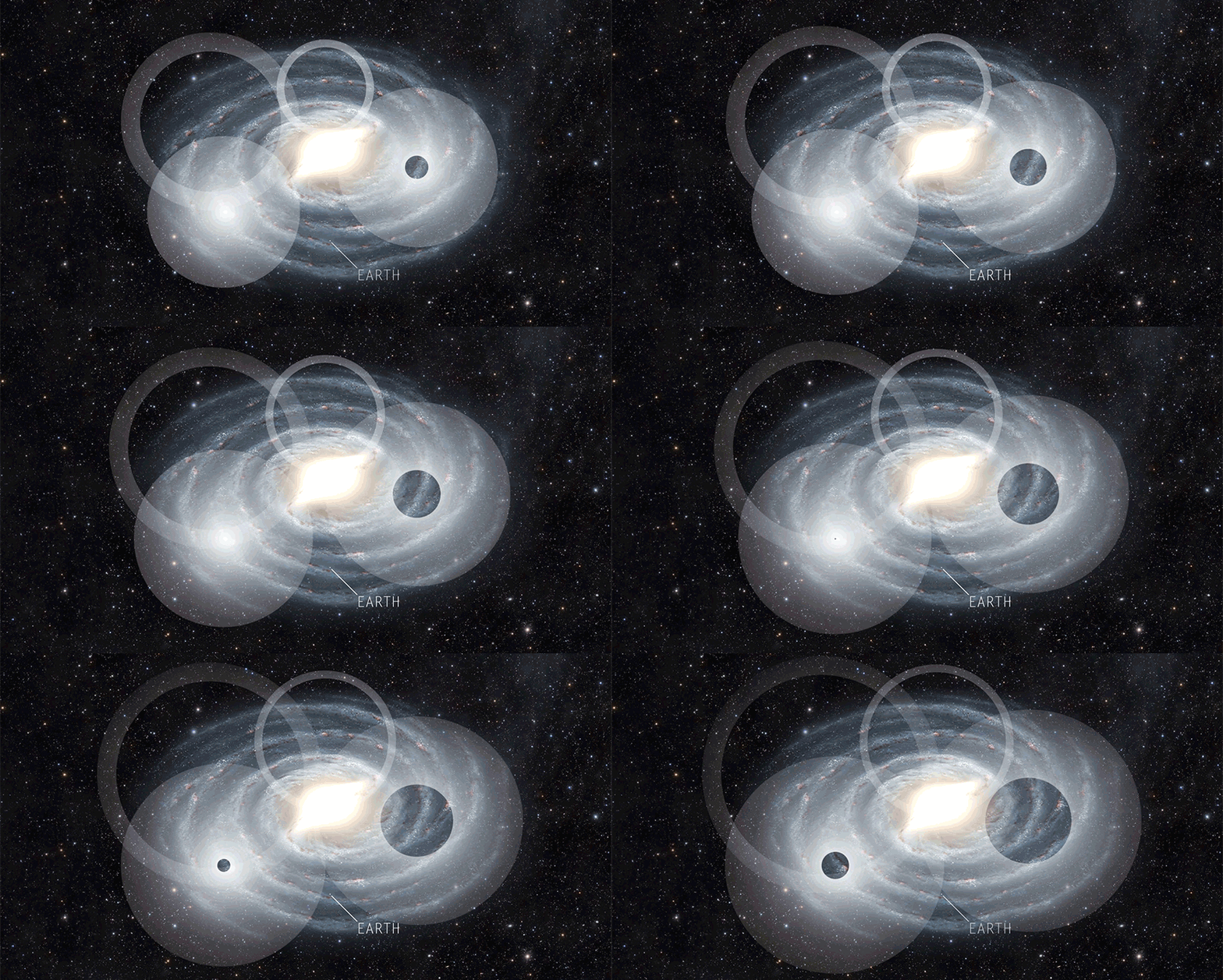
In 2020, a team led by Bart Wlodarczyk-Sroka and Professor Michael Garrett at the University of Manchester, working with Dr. Andrew Siemion, director of the Breakthrough Listen initiative, published a reanalysis of existing radio telescope data in Monthly Notices of the Royal Astronomical Society that produced the most rigorous published constraint on the prevalence of radio-transmitting civilizations in the Milky Way derived from actual observational data rather than from the Drake Equation’s estimated parameters.
The methodological advance was using ESA’s Gaia spacecraft distance catalog, which has measured precise distances to more than one billion stars, to identify all stars within the radio telescope’s field of view during existing observations rather than analyzing only the primary targets the telescope was pointed at. By incorporating stars at distances up to approximately 33,000 light-years that fell within the telescope beam alongside the primary targets, the team expanded the effective stellar survey from 1,327 to 288,315 stars without requiring any additional telescope time.
The result was published with a numerical constraint: fewer than one in 1,600 stars within approximately 330 light-years of Earth hosts radio transmitters only slightly more powerful than the most advanced radar currently operational on Earth. Expressed differently, fewer than 0.04 percent of star systems in the surveyed region show evidence of radio technosignatures at current human technology levels.
This is not a detection of absence. It is a measurement of an upper limit whose value the observational data established. The distinction matters for what the finding actually constrains.
The survey can only detect civilizations using radio transmission at human technology levels or modestly above them. It cannot detect civilizations that have moved beyond radio transmission to communication methods whose existence human technology has not yet conceived. It cannot detect civilizations that are deliberately not transmitting. It cannot detect civilizations whose transmitters are pointed in directions that did not include the radio telescopes used in the survey during the observation periods. And it cannot detect civilizations that are present but whose technology profile does not include radio transmission as a primary communication medium.
The Dick post-biological universe framework developed earlier in this library provides the context in which the 0.04 percent upper limit is most interpretively significant. If technological civilizations routinely transition from biological to artificial intelligence within a relatively short period of their technological development, the radio-transmitting phase, the window during which a civilization’s primary long-distance communication medium is electromagnetic radiation in the radio frequency range, may be brief enough in cosmic terms that the probability of two civilizations being in their radio-transmitting phases simultaneously within detection range of each other is very low regardless of how many civilizations exist.
The 0.04 percent upper limit is therefore consistent with two radically different realities: either technological civilizations are genuinely very rare in the Milky Way, or they are not rare but their radio-transmitting phase is short enough that the survey’s observational constraints cannot detect them. The observational data cannot distinguish between these two interpretations.
Professor Garrett’s recorded statement about the finding is careful in exactly this way: the results help put significant limits on the prevalence of transmitters comparable to what we can build ourselves using twenty-first century technology. The constraint is specifically on transmitters comparable to human current technology, not on civilizations more broadly.
Wlodarczyk-Sroka’s statement sharpens the implication: fewer than one in 1,600 stars up to 330 light-years away is home to transmitters only slightly more powerful than the most advanced radar we have here on Earth. The inhabited worlds with much more powerful transmitters than we can currently produce must be even rarer.
The last sentence contains the interpretive challenge: if inhabited worlds with more powerful transmitters must be rarer than the already low upper limit, the most technologically capable civilizations are not broadcasting at all in the radio frequency range, which is exactly what the post-biological transition hypothesis predicts and exactly what the Zoo Hypothesis predicts for different reasons.
The signal has not been found in 288,315 stars.
Whether it was never sent, was sent in a direction the survey did not cover, was sent in a medium the survey cannot detect, or was sent and received long before humanity developed the instruments to hear it, is the question that the most rigorous observational constraint in SETI history has made more without resolving.
The absence is documented. Its meaning remains open.
The Silence and What It Means
Michael Hart published his formal treatment of what became known as Fact A in 1975. The fact is simple: extraterrestrial civilizations are not in our immediate environment. The absence of physical presence in the solar system, the absence of detectable megastructure engineering in the galaxy, the absence of a confirmed artificial signal in sixty-five years of systematic search, these absences are themselves data. Hart’s argument, extended by Frank Tipler in 1980, is that the absence is strong evidence either that technological civilizations are rare or that they have chosen not to make themselves detectable to us.
The temporal bias argument, in conjunction with the Hart-Tipler position, produces an implication. If any civilization we detect is likely to be vastly older than us, and if vastly older civilizations have had sufficient time to colonize or survey the galaxy many times over, then their absence from our immediate environment is a decision, not a limitation. They know we are here. They have chosen the current configuration.
John Ball formalized this as the zoo hypothesis in 1973. A galactic community of ancient civilizations has chosen not to make direct contact with younger, developing species, for reasons that the younger species is not positioned to evaluate. The galactic environment we observe as empty is the environment they have chosen to show us.
The Wow! Signal of August 15, 1977, received by the Big Ear telescope at Ohio State University and annotated by volunteer researcher Jerry Ehman with the word Wow! in the margin of the printout, remains the most anomalous data point in the documented SETI record. A narrowband signal at 1420 megahertz, the hydrogen line frequency that a technologically sophisticated civilization would most plausibly select for an interstellar beacon because it is the most common emission frequency in the universe. Duration and intensity consistent with transmission from a stellar or near-stellar object. Characteristics that the conventional radio astronomy null hypothesis cannot fully account for.
The signal was never repeated. Every subsequent observation of the same sky region has produced silence.
The temporal bias framework applied to the Wow! Signal’s source produces a probabilistic statement. If the signal was artificial, the civilization that produced it is statistically most likely to be at minimum twice our own age and possibly far older. A civilization that sent a signal from that region and then went quiet is not a civilization that ran out of power. It is a civilization that made a decision.
The Quieting of Earth
The temporal bias argument contains an implication for our own trajectory that the field has noted but not fully developed.
Human civilization has been detectable as a radio-emitting species for approximately one hundred years. The exponential distribution model predicts a total lifespan of approximately two hundred years for a radio-emitting civilization, not because the civilization collapses but because the technology transitions. Fiber optic cable, directed laser communication, quantum encrypted networks, all of these replace the omnidirectional radio broadcast with targeted, contained, undetectable-at-distance information transfer.
Earth is already becoming electromagnetically quiet. The radio signatures we have been broadcasting since the early twentieth century are already diminishing relative to the background as directed communication replaces broadcast. In another century the technology that makes us detectable to any civilization searching the way we search will no longer be detectable.
We will have passed through our radio-emitting phase and entered whatever comes next. If that next phase involves communication technologies that produce no detectable external signature, we will join the category we are currently trying to detect: civilizations that are present and active and generating no signal we know how to receive.
This is what the silence looks like from outside. Not absence. A phase transition that every civilization eventually makes, from the brief electromagnetic window of early-stage technology into the long quiet of whatever an advanced civilization uses to communicate after it has outgrown the radio spectrum.

The civilizations in the upper tail of the longevity distribution have been in that quiet phase for periods that make our entire technological history a footnote.
The Contact Asymmetry
The temporal bias argument produces a problem for the concept of contact itself.
When two civilizations at radically different developmental stages encounter each other, the meaning of encounter is not symmetrical. When European explorers arrived on the shores of the Americas, the encounter was between civilizations separated by a few centuries of differential development. The consequences of that asymmetry ran in one direction. The implications of contact with a civilization one hundred thousand years ahead of us on the developmental curve cannot be mapped onto any historical precedent because the differential is categorically larger than anything recorded human history contains.
A civilization that has been developing for one hundred thousand years beyond our current level has almost certainly solved every problem that currently limits human existence: disease, resource scarcity, the physical constraints of biological bodies, the speed of information transmission, the energy requirements of interstellar travel. What they want from contact with us, if they want anything, is not something we can determine by asking what we would want in the equivalent position, because the equivalent position does not exist in human experience.
Adam Frank’s formulation in Light of the Stars captures the asymmetry more precisely than most treatments: if we make contact with a civilization that has survived long enough to reach us, they have solved the problems we are currently failing to solve, including the problem of civilizational survival itself. They are, by definition, an existence proof for a type of civilization that makes it through the filter that we are currently approaching.
The question of what they are waiting for, or what they have already decided about us, or whether the silence is a moratorium or an assessment or simply indifference, is the question the mathematics can frame but cannot answer.

The treaty accounts and the testimony material published elsewhere on this site suggest that for at least one faction of the civilizations operating in our immediate galactic neighborhood, the decision has already been made and the contact is already underway, below the threshold of official acknowledgment, in the form the temporal bias argument would predict: not a civilization at our level reaching out peer-to-peer, but a civilization far beyond us engaging on terms we did not negotiate and barely understand.
The signal from whatever sent the Wow! was received in 1977. Whatever sent it has been waiting for our response for forty-nine years.
Whether it is still listening is the question the mathematics cannot answer and the silence has not resolved.